
Is Air Frying Faster Than Baking? Air Fryer vs. Oven Times
Quick Answer
Yes, air frying is usually faster than baking in a conventional oven, especially for small batches. An air fryer has a compact cooking chamber, powerful circulating air, and a short preheat, so food often cooks sooner; air fryer baking guidance from King Arthur Baking suggests lowering conventional-oven temperature by about 25°F and beginning with a cooking time roughly 20% to 25% shorter.
Why Air Frying Can Be Faster
- Smaller chamber: There is much less empty oven space to heat.
- Fast airflow: A strong fan continually moves hot air around the food.
- Short preheat: Many air fryers need only a few minutes of preheating, if any.
- Small batches: Compact portions receive concentrated heat more efficiently.
- Faster browning: Moving hot air removes surface moisture quickly, helping food crisp sooner.
Best Starting Rule
- Reduce an oven recipe by about 25°F, then start checking for doneness 20% to 25% earlier.
If you are deciding between an air fryer and a regular oven, speed is one of the biggest practical differences. The answer is not simply that an air fryer always wins, though.
Food type, portion size, air fryer design, and the amount of preheating all matter. In this guide, I will show you when air frying saves meaningful time and when baking still makes more sense.
In This Guide
Is Air Frying Faster Than Baking?
For most small and medium portions, yes. Air frying often takes less total time than conventional-oven baking because both preheating and active cooking can be shorter.
An air fryer is essentially a compact convection cooker. It uses a heating element and a powerful fan to move hot air rapidly around food.
Definition: Convection cooking means cooking with hot air that is actively circulated by a fan. The moving air improves heat transfer and can speed browning compared with still air inside a conventional oven.
A full-size oven has much more metal and air to heat before cooking begins. Even after reaching the set temperature, its larger cavity spreads heat across far more space.
The air fryer’s small chamber puts the heating element, fan, and food much closer together. That is particularly useful for fries, vegetables, chicken pieces, pastries, cookies, and reheated foods.
- Frozen snacks: Air fryers can heat and crisp small portions quickly.
- Roasted vegetables: Fast airflow helps remove surface moisture and encourage browning.
- Cookies and pastries: Small batches often finish sooner than in a conventional oven.
- Reheating: Pizza, pastries, and breaded foods usually regain crispness without a long oven preheat.
Speed becomes less clear when you need several batches. A large sheet pan may hold much more food than one compact air fryer basket.
Section Takeaway: Air frying is generally faster for modest portions, but capacity matters. A large oven can become more time-efficient when it cooks everything in one batch.
Why Does an Air Fryer Cook Faster Than an Oven?
The main reasons are air movement, compact size, and reduced preheating. Together, these change how quickly heat reaches the surface of your food.
Stronger airflow around the food
A conventional oven mostly relies on radiant heat and natural movement of hot air unless you switch on convection. An air fryer constantly pushes hot air around a much smaller space.
America’s Test Kitchen describes convection as moving heated air continuously with a fan, which can shorten cooking time. You can read its broader convection oven guidance for the underlying principle.
Less space to preheat
A standard oven may need substantial preheating before you add food. An air fryer reaches cooking temperature much faster because its chamber is compact.
This difference matters when you only want a few cookies or one serving of vegetables. Heating a full oven for a small amount of food adds time before cooking even begins.
Food sits close to the heat source
Basket-style air fryers place food close to the heating element and fan. Perforated baskets and crisper trays also let moving air contact more of the food’s surface.
- More exposed surface: Hot air reaches the top, sides, and often the bottom.
- Less trapped steam: Moist surface air gets moved away more quickly.
- Rapid browning: A drier surface can brown and crisp sooner.
This is why an air fryer may make roasted or breaded foods look finished surprisingly quickly. The center still needs enough time to cook safely, so browning should never be your only test for raw meat.
Pro tip: For meat and poultry, verify doneness with a food thermometer and follow FoodSafety.gov’s minimum internal temperature guidance rather than relying only on cooking time or exterior color.
Section Takeaway: Air fryers gain speed by concentrating moving heat in a small chamber. Faster surface browning does not replace checking internal doneness where food safety matters.
How Much Faster Is Air Frying Than Baking?
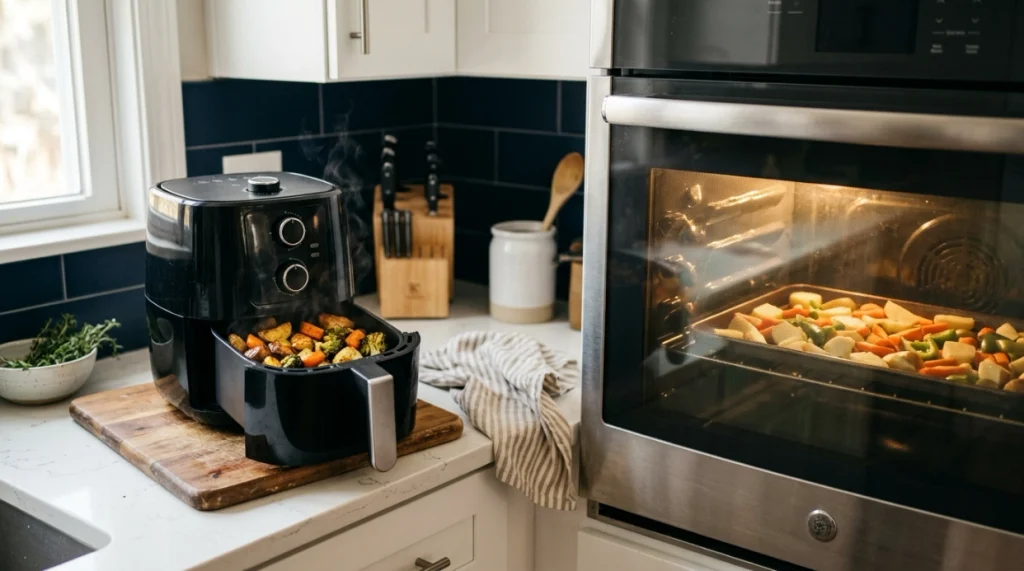
There is no single percentage that applies to every recipe. A useful starting point is to expect roughly 20% to 30% less cooking time after adjusting the temperature, then check the food early.
Some foods can show a larger difference. King Arthur Baking has reported that small air fryers may bake certain cookies substantially faster than the conventional recipe time.
| Factor | Air Fryer | Conventional Oven |
|---|---|---|
| Preheating | Usually short because the cavity is small | Usually longer because the cavity and oven structure are larger |
| Recipe temperature | Often about 25°F lower when adapting a conventional recipe | Use original conventional-oven temperature |
| Time adjustment | Begin checking about 20% to 25% earlier | Use recipe’s standard time range |
| Best capacity | Small and medium batches | Large trays and multiple dishes |
| Browning | Fast because of concentrated airflow | Usually more gradual without convection |
Think about total kitchen time rather than cooking time alone. Saving ten minutes of preheating can matter more than shaving two minutes from the recipe itself.
Consumer Reports also notes that air-fry cooking uses rapidly circulating hot air and can shorten cooking compared with regular baking. Its air fryer buying guide explains how this convection-style cooking works.
Your own appliance may behave differently. Basket size, wattage, food thickness, starting temperature, and how full you load the basket all change the result.
Section Takeaway: Treat percentage reductions as starting points, not guarantees. Check early, note what works in your machine, and use doneness cues appropriate for the food.
How Do You Convert Oven Time to Air Fryer Time?
A practical conversion is to reduce the temperature by about 25°F and shorten the stated cooking time by roughly 20% to 25%. Start checking before the calculated finish time.
For example, if a conventional recipe calls for 400°F, I would usually begin an air fryer adaptation near 375°F. If the oven time is 20 minutes, I would start checking several minutes early rather than automatically cooking the full 20 minutes.
- Lower the temperature: Start about 25°F below the conventional-oven setting.
- Shorten the first test: Reduce the original time by around one-fifth.
- Check early: Look for browning, texture, and proper internal doneness.
- Avoid overcrowding: Leave enough room for circulating air to contact the food.
- Record the result: Note the final temperature and time for your specific air fryer.
Air fryer models differ more than many cooks expect. A shallow basket can cook differently from a large oven-style air fryer even at the same display temperature.
For baking, the adjustment also depends on what you are making. Cookies, rolls, brownies, muffins, and cakes respond differently to strong top heat and rapid air movement.
Be cautious with delicate baked goods
A cake may brown on top before its center finishes. Lowering the temperature can help the interior catch up without over-darkening the surface.
Small cookies and rolls are often easier because heat can reach their centers quickly. King Arthur’s air fryer baking guidance also recommends learning how your individual appliance behaves rather than assuming every preset performs identically.
Section Takeaway: The 25°F and 20% to 25% rule is a starting point. Your first batch should be treated as a calibration run for the specific recipe and air fryer.
When Is a Regular Oven Better Than an Air Fryer?
A conventional oven is often better when capacity matters more than raw speed. One large oven batch can beat several consecutive air fryer batches.
This becomes obvious when cooking for a family or preparing a full tray of baked goods. A small basket may force you to repeat the same cooking cycle two or three times.
- Large batches: Sheet-pan meals, dozens of cookies, and party food favor an oven.
- Large bakeware: Full-size cakes, casseroles, and bread loaves may not fit an air fryer.
- Gentle baking: Some cakes and custards benefit from less aggressive airflow.
- Multiple dishes: A full oven can hold several pans at once.
A conventional oven can also provide more predictable results when a recipe was developed specifically for conventional baking. You do not need to convert temperature or timing.
Convection ovens narrow the speed gap even further. They also circulate hot air, although the cooking chamber is still much larger than a countertop air fryer.
As of 2026, many full-size ranges and toaster ovens include convection or dedicated air-fry settings. That gives home cooks more options than the old choice between a basic oven and a separate basket appliance.
Section Takeaway: Choose an air fryer for speed with smaller portions. Choose the oven when its larger usable cooking area lets you finish the entire meal in one cycle.
How Can You Make Air Frying Faster and More Consistent?
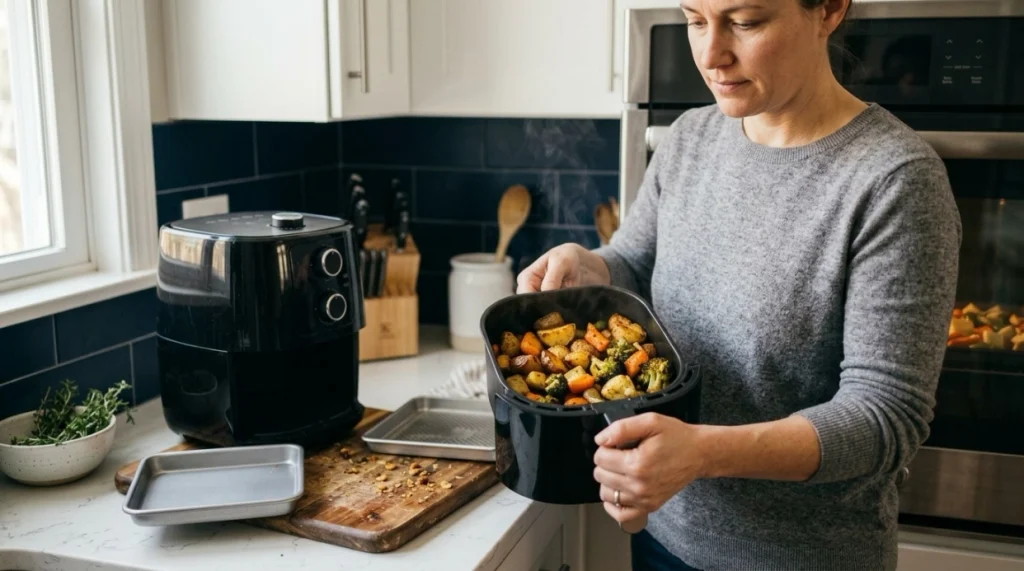
Fast cooking depends on airflow. If you block the hot air with overcrowded food, the air fryer loses one of its biggest advantages.
I recommend treating basket space as part of the recipe. A slightly smaller batch can finish sooner and brown more evenly than a tightly packed basket.
- Leave airflow space: Avoid tightly stacking breaded foods, pastries, or foods that need crisp surfaces.
- Preheat when consistency matters: Starting at a known chamber temperature makes timing easier to repeat.
- Turn or shake food: Redistribute pieces when one side blocks airflow.
- Use suitable pans: Choose bakeware that fits without blocking most circulation around it.
- Check sooner: Strong airflow can take food from pale to browned quickly near the end.
- Keep the appliance clean: Grease and crumbs around the basket or heating area can interfere with normal operation.
Do not chase speed by increasing temperature far above the recipe. That often produces an over-browned exterior before the center is ready.
A controlled temperature reduction usually works better when adapting conventional baking. This is especially important with thick foods and baked goods.
For repeat recipes, write down the exact setting and time that worked. After a few batches, your own notes become more useful than a generic conversion chart.
Section Takeaway: Good airflow and early checking matter more than maximum temperature. A well-spaced basket usually cooks faster and more evenly than an overloaded one.
Frequently Asked Questions
Does an air fryer cook twice as fast as an oven?
Usually not. Air fryers often reduce total cooking time, but the difference varies widely with the recipe, portion, appliance, and preheating requirements.
Should I reduce cooking time when using an air fryer?
Yes, when converting a conventional-oven recipe. A sensible starting point is to check the food roughly 20% to 25% earlier while also lowering the recipe temperature by about 25°F.
Does an air fryer need to preheat?
Not every recipe requires preheating. However, a short preheat can improve consistency when baking because each batch begins at a more predictable chamber temperature.
Is an air fryer faster than a convection oven?
It can be for small portions because the air fryer chamber is smaller and the food sits close to the fan and heating element. A full-size convection oven may be more efficient for large batches.
Is air frying faster for baking cookies?
It often is. Small batches of cookies can bake noticeably faster because air fryers heat a compact space and circulate hot air aggressively, so you should begin checking them well before the conventional recipe’s maximum time.
Can I use the same temperature for an air fryer and oven?
You can, but it may brown food too quickly. When adapting a conventional-oven recipe, starting about 25°F lower is a commonly used convection-style conversion.
Does a fuller air fryer basket take longer?
Usually, yes. Crowding reduces airflow around individual pieces, which can slow browning and create uneven cooking, particularly with foods that need a crisp surface.
The Bottom Line
Air frying is usually faster than conventional baking when you are cooking a small or medium batch. The biggest advantages come from the compact chamber, strong convection airflow, and shorter preheating time.
Start by lowering a conventional recipe about 25°F and checking 20% to 25% sooner. Then adjust based on your appliance and the food in front of you.
For large trays, multiple dishes, or recipes that need gentle, even baking, the regular oven may still be the more practical choice. Speed is useful, but capacity and cooking quality matter just as much.
