
Is Silicone Safe in an Air Fryer? What Home Cooks Should Know
Quick Answer: Is Silicone Safe in an Air Fryer?
Yes—silicone is generally safe in an air fryer when it is food-grade, clearly labeled for high heat, and used within the product’s temperature rating. That last part matters. A silicone liner, mold, or cup that is meant for cooking can usually handle typical air fryer temperatures, but an unverified or low-quality product may warp, smell, or perform poorly.
Silicone is most useful in an air fryer when you want easier cleanup, a nonstick surface, or a container shape for foods like egg bites, small cakes, or portioned sides. It is less useful when you want maximum crisping, because bulky silicone accessories can slow airflow.
If you want the short version: food-grade, heat-rated silicone is usually fine; cheap, unknown, or damaged silicone is not worth the risk.
How Silicone Handles Air Fryer Heat
Silicone is popular in kitchen tools because it is flexible and designed to tolerate heat better than many plastics. In practice, that makes it a reasonable material for air fryer accessories if the manufacturer gives a clear temperature limit.
A practical rule of thumb is to choose silicone rated at least at or above your air fryer’s maximum temperature, and preferably with some margin. Since many air fryers max out around 400°F, a silicone accessory rated for 400°F or higher is the minimum benchmark I would look for. If your appliance runs hotter, use that higher number as the baseline instead.
The air fryer itself is the key variable. Some basket models top out around 400°F, while others run lower or higher depending on the design. That means the silicone product needs to be rated above the hottest temperature you plan to use, not just “probably okay.”
A useful way to think about it:
- Low-heat tasks like reheating or gentle baking are easier on silicone.
- High-heat crisping puts more stress on the accessory and can expose weak products faster.
- Preheating matters too, because an empty basket can get hotter than expected before food goes in.
One practical note: silicone can feel completely fine in one air fryer and still be a bad fit in another if the basket is small, the heating element sits close to the top, or the accessory blocks too much airflow. Heat resistance is only part of the decision.
What Makes Silicone Safe or Unsafe
Not all silicone kitchenware is equal. The label matters.
Food-grade silicone vs. unknown silicone
Food-grade silicone is the version you want for direct contact with food. It is made and marketed for kitchen use, which gives you a better starting point than a generic silicone product from an unknown source.
Trustworthy products usually give you more than a vague “silicone” claim. Look for packaging or product pages that clearly state one or more of the following:
- food-grade silicone
- a specific heat rating
- intended use for baking, cooking, or food contact
- a recognizable food-safety claim tied to the product, not just marketing language
By contrast, cheap or unverified silicone may have:
- weak heat tolerance
- a strong odor when heated
- inconsistent thickness
- poor durability after repeated use
- mixed-material construction that is not clearly explained
Those problems do not automatically mean the product is dangerous, but they do make it less trustworthy in a high-heat appliance.
Certifications and labels that matter
For consumers, the most useful signs are clear food-contact labeling and specific temperature information. If a product mentions a standard or certification, that is more reassuring than a generic “safe” claim, but the label should still be easy to verify on the packaging or product page.
What I would treat as more trustworthy:
- a clearly stated food-grade claim
- a temperature range printed by the manufacturer
- clear indication that the item is designed for food contact
- product details that match the item’s actual use, such as a silicone air fryer liner, mold, or cup
What I would treat as warning signs:
- no heat rating
- no food-contact information
- only vague phrases like “premium silicone”
- thin, flimsy material that feels cheap
- mixed materials with no explanation of which part touches the food
- strong chemical odor that lingers after washing
BPA-free is helpful, but not enough
A lot of packaging says BPA-free, and that is fine to see. But BPA-free does not automatically mean the item is suitable for air fryer temperatures. It is a useful label for some plastic concerns, but it does not replace a real heat rating or food-contact claim.
Which Silicone Accessories Are Safe to Use
Different silicone accessories behave differently in an air fryer. Here is the practical breakdown.
| Accessory type | Usually suitable? | What to check | Main trade-off |
|---|---|---|---|
| Silicone liners | Sometimes, if well-made and correctly sized | Heat rating, basket fit, airflow holes | Easy cleanup, but can reduce crisping |
| Silicone molds | Often suitable for egg bites, muffins, small cakes | Depth, temperature rating, stability | Good for shaping food, but may slow browning |
| Silicone cups | Usually suitable for portioned foods | Food-grade label, size, heat rating | Handy for small portions, but can tip if overloaded |
| Silicone utensils | Usually suitable for brief handling | Heat rating and stiffness | Gentle on nonstick surfaces, but not for long contact with heating zones |
Silicone liners
Silicone liners are the most debated accessory because they sit directly in the basket. They are convenient for sticky foods and fast cleanup, but they can also block airflow if they cover too much of the basket base or have solid sides with few openings.
A silicone liner can make sense for foods that release a lot of grease or batter, but it is not my first choice for foods where crisping matters most. In basket-style air fryers, a perforated or vented silicone liner is usually a better choice than a solid one because it lets more air move around the food.
Silicone molds and cups
These are often a better fit for air frying than full basket liners. Think egg bites, mini frittatas, custards, or small baked items. Because they hold food in a defined shape, they are useful when you want even portions and easy removal.
Just keep in mind that deeper molds can slow browning on the sides. If you want a browned top, you may need to choose a recipe and fill level that works with the mold’s shape.
Silicone utensils
Silicone spatulas, tongs, and brushes are usually fine for moving food in and out of the basket. They are a different category from liners and molds because they are not sitting in the hot airflow the whole time.
Still, check the heat rating. A utensil that is fine for stirring a pan may not be ideal if you leave it near the heating zone.
How to Use Silicone in an Air Fryer Correctly
Safe silicone use is mostly about fit, placement, and airflow.
Keep airflow open
Air fryers work by circulating hot air around the food. If a silicone accessory blocks too much of that movement, the food may cook more slowly and come out softer than expected.
That is why a silicone liner with solid sides can be a mixed bag. It may be convenient, but convenience can come at the cost of less browning.
Match the accessory to the basket
The accessory should sit flat and leave space for air to move around it. If it bulges, curls, or presses tightly against the basket walls, it is more likely to interfere with cooking.
A good test before cooking:
- place the accessory in the empty basket
- close the drawer fully
- make sure it does not touch the heating element
- check that air can still move around the sides
Use silicone for the right job
Silicone is best when you want:
- easier cleanup
- a reusable container
- a nonstick surface for sticky foods
- individual portions
It is less ideal when you want:
- extra crisp skin on chicken
- browned edges on fries
- the fastest possible cook time
That trade-off is normal. Silicone is a tool, not a universal upgrade.
When Silicone Can Warp, Melt, or Affect Cooking
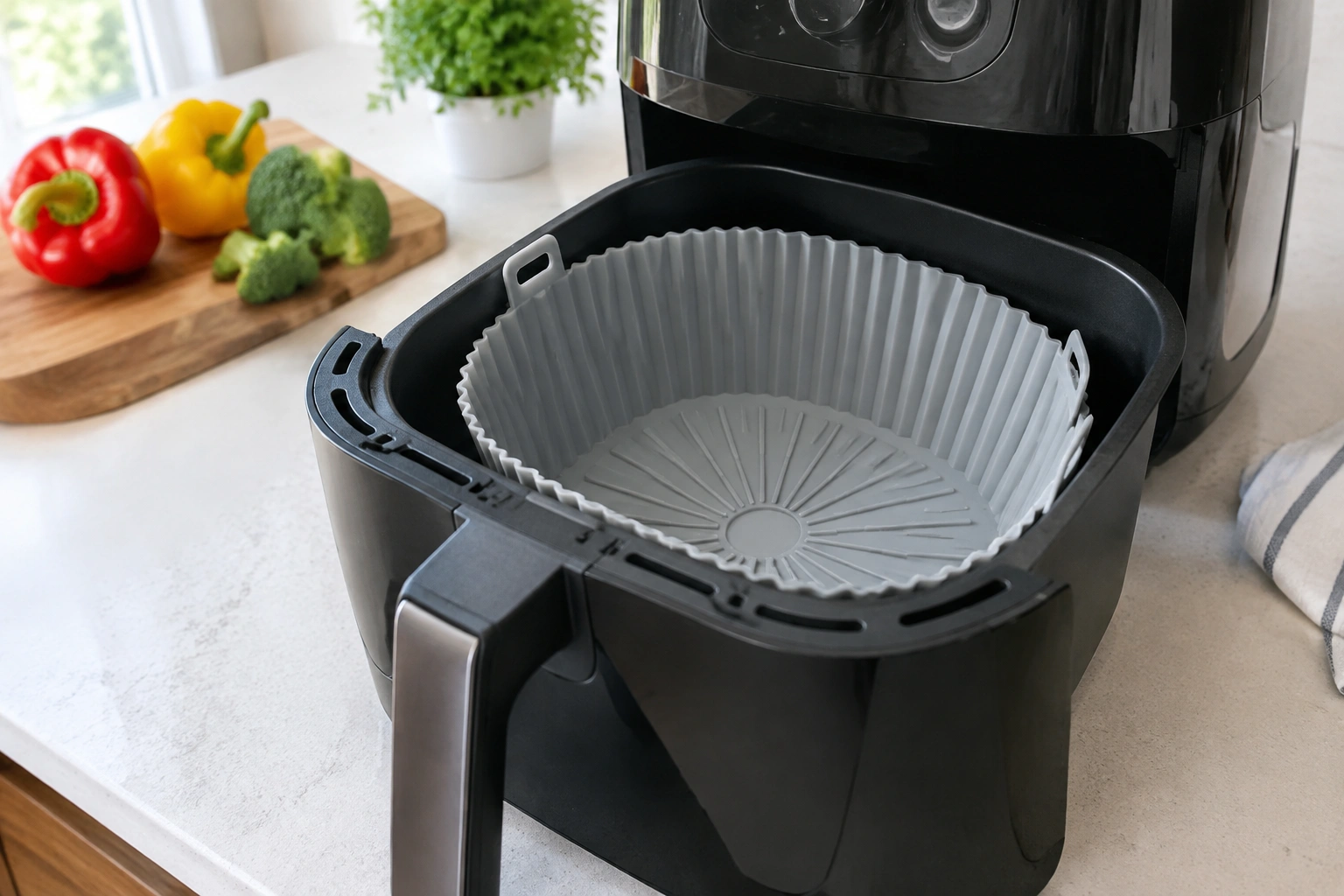
Silicone is heat-resistant, but that does not mean it is indestructible.
At normal air fryer temperatures and with a properly rated food-grade product, silicone should not release fumes or harmful chemicals in normal use. The main risks show up when the accessory is overheated, poorly made, damaged, or used outside its stated temperature range. That is when you are more likely to see odor, softening, warping, or material breakdown.
Realistic failure scenarios
The most common issues are not dramatic melting events. More often, you see:
- warping after repeated high heat
- softening if the product is thin or low quality
- odor from cheap materials or residue
- reduced crisping because airflow is blocked
- staining from oily or strongly colored foods
If a silicone item smells strongly the first time it heats up, I would be cautious about using it again until you know whether the odor is just manufacturing residue or a sign of poor material quality.
When to stop using it
Replace the accessory if it becomes:
- sticky
- cracked
- badly discolored
- misshapen
- thin in spots
- warped enough to stop sitting flat
Once silicone starts breaking down, it is no longer a good candidate for high-heat cooking.
Silicone vs Parchment Paper vs Metal Accessories
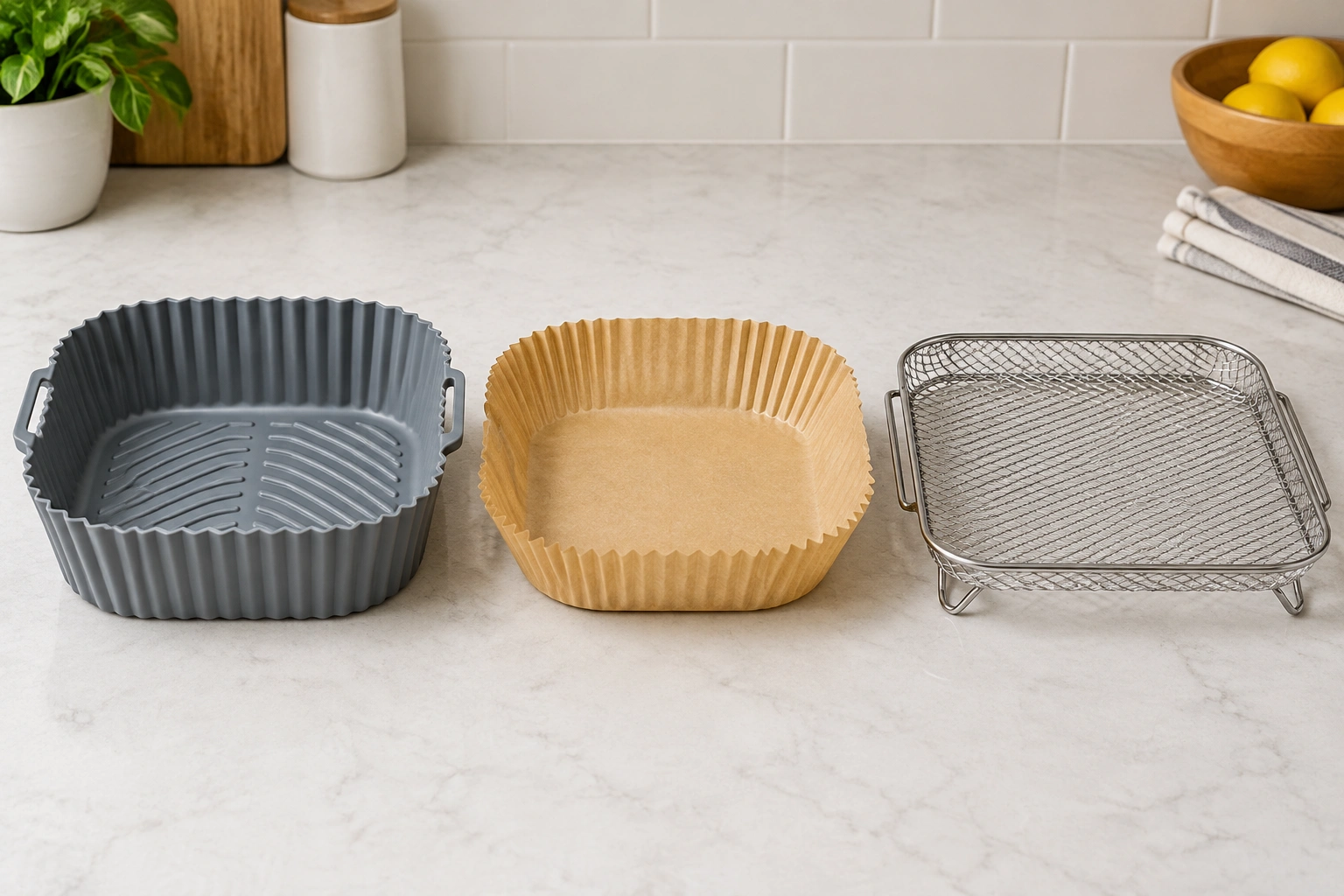
Here is the practical comparison most home cooks need.
Silicone vs parchment paper
Silicone
– reusable
– sturdier
– easier to wash
– can interfere more with airflow if bulky
Parchment paper
– thinner
– often better for airflow
– disposable
– less durable for repeated use
If your main goal is cleanup and reuse, silicone has the edge. If your main goal is crisping, parchment paper can be the better fit in some setups.
Silicone vs metal accessories
Silicone
– nonstick
– flexible
– gentler on food and coatings
– usually not as good for browning
Metal
– better heat transfer
– often better for crisping
– usually more rigid and durable
– can be less forgiving with delicate foods
For things like roasted vegetables or fries, metal accessories often perform better. For egg bites or sticky batters, silicone is more convenient.
Silicone liners vs reusable fabric or paper liners
Reusable fabric or paper-style liners can be thinner and may disturb airflow less, but they are not always as sturdy or easy to clean. Silicone is more durable, but that durability comes with the risk of a thicker barrier in the basket.
How to Check a Silicone Product Before You Buy or Use It
Before I buy a silicone air fryer accessory, I look for a short checklist.
Buy only if you can confirm these points
- The product is labeled food-grade
- It has a clear temperature rating
- The rating is at or above your air fryer’s maximum temperature
- The shape fits your basket without crowding it
- The product is intended for cooking or baking, not just storage
- The seller provides clear product details, not vague marketing language
Signs I would skip a product
- no heat rating
- no food-contact information
- unusually low price with vague labeling
- strong chemical odor in reviews
- photos that show a liner packed tightly into a basket
- claims that sound too broad, like “safe for everything”
- mixed-material items where the food-contact surface is not clearly identified
If you already own the item, inspect it before use. A damaged accessory is not worth testing in a hot appliance.
For a quick reference on air fryer models and basket styles, see our Chefman TurboFry Touch 8 Qt Air Fryer Review and Cuisinart AIR-160 Air Fryer Review: Worth It?. Basket size and shape affect how well any accessory fits.
Cleaning and Maintaining Silicone Air Fryer Accessories
Silicone is usually easy to clean, which is one of the main reasons people buy it. Many products are dishwasher safe, but I still prefer to wash new accessories by hand the first time so I can inspect them closely.
Good cleaning habits
- wash off grease soon after use
- avoid abrasive scrubbers that can damage the surface
- dry fully before storing
- check for trapped oil in folds or corners
- keep it away from sharp tools that can nick the material
When residue becomes a problem
If silicone starts holding onto odor or grease, that is often a sign it needs a deeper clean. Sometimes a hot wash with dish soap is enough. If the smell stays after cleaning, I would not keep using it for high-heat air frying.
Storage matters too
Do not store silicone items folded, crushed, or bent under heavy cookware. That can create permanent shape issues that affect how they sit in the basket later.
Common Mistakes to Avoid
These are the mistakes that cause most silicone problems in air fryers:
-
Assuming all silicone is the same
A food-grade mold and a random silicone tray are not equivalent. -
Ignoring the temperature rating
If the product does not clearly state a safe heat range, do not guess. -
Using a liner that blocks too much airflow
Thick walls and solid bases can reduce crisping and slow cooking. -
Placing silicone too close to the heating element
Clearance matters, especially in compact air fryers. -
Using damaged or sticky silicone
Wear and heat damage are reasons to replace it. -
Expecting silicone to perform like metal
It is better for cleanup and flexibility, not for maximum browning.
When to Stop Using the Accessory
You do not need to “consult a professional” for most silicone accessory problems. A better rule is to stop using the item and replace or return it if you see clear warning signs.
Stop using it if:
- it warps and no longer sits flat
- it develops cracks, splits, or sticky spots
- it keeps a strong odor after washing
- it leaves residue on food or in the basket
- the packaging or listing was misleading about heat rating or food-contact use
- the item touches the heating element or crowds the basket too much to use safely
If the problem shows up right away, return it if possible. If it degrades after repeated use, replace it rather than trying to push it further.
Bottom Line
Silicone can be a safe, practical choice in an air fryer, but only when the item is food-grade, heat-rated, and sized correctly for the basket. The biggest risks are not usually melting disasters; they are poor fit, blocked airflow, weak labeling, and low-quality materials that do not hold up under repeated heat.
The simplest decision framework is this: use silicone if it is clearly food-grade, rated for at least your air fryer’s max temperature, and shaped to preserve airflow; skip it if the labeling is vague, the material seems flimsy, or crisping matters more than cleanup. For many home cooks, that means silicone liners, molds, and cups can be useful—but only in the right setup.

