
Why Butter Temperature Changes Pie Crust Texture
Quick answer: the butter temperature sets the texture
Butter temperature has a direct effect on whether pie crust turns out flaky, tender, cohesive, or dense. Very cold butter tends to stay in distinct pieces longer, which can help create layers that bake into a flakier crust. Softer butter blends more fully into the flour, which usually gives a more uniform, tender texture. Melted butter changes the dough even more, because the fat no longer stays in discrete pieces during mixing.
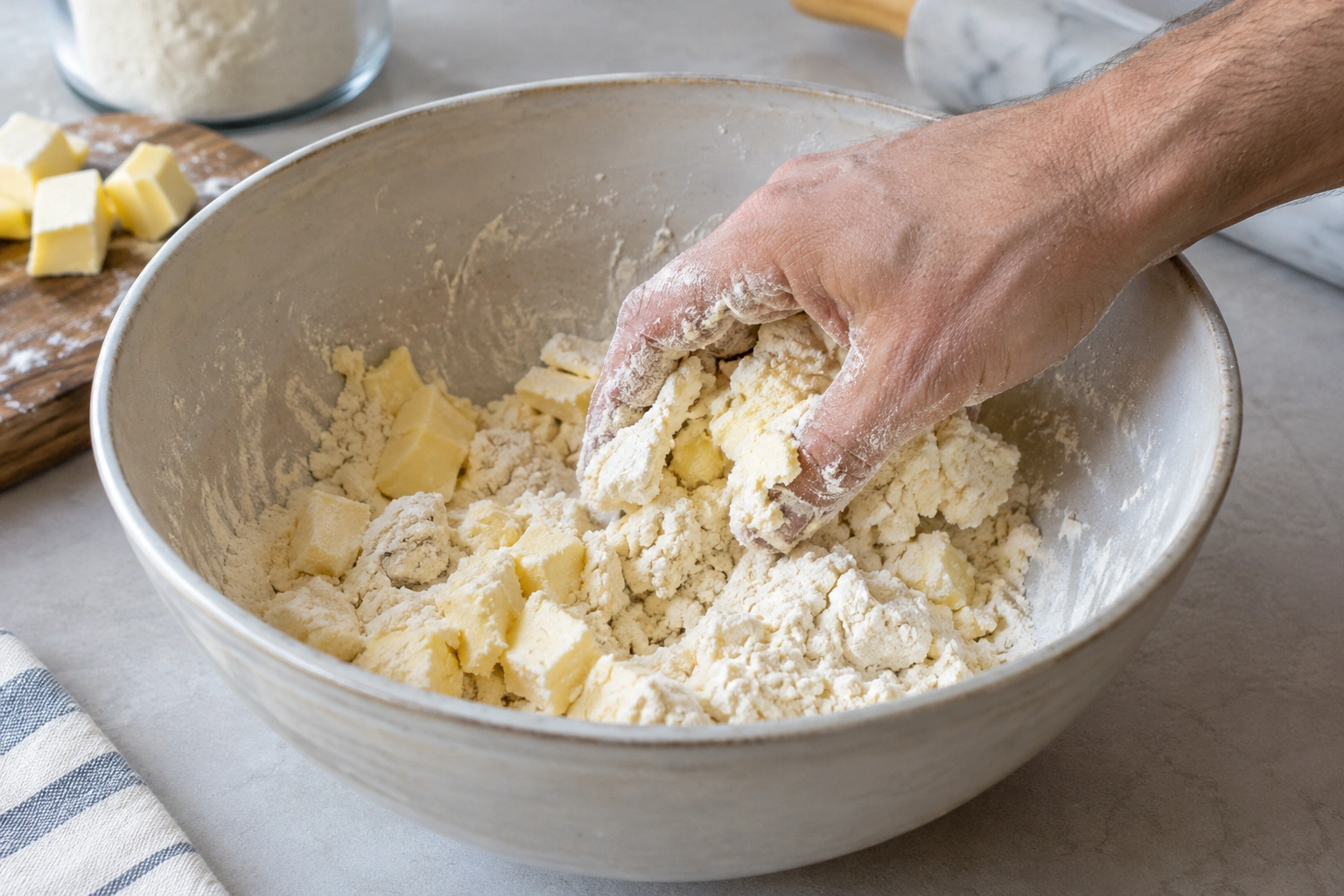
If your goal is a classic flaky pie crust, cold butter is usually the safest starting point. If you want a crust that rolls more easily and feels a little more cohesive, slightly cooler-than-room-temperature butter can be easier to work with. Melted butter is generally a poor choice for a flaky pie crust, though it can create a different style of crust with less layering and more uniformity.
The key idea is simple: butter temperature affects how fat is distributed in the dough, and that distribution shapes the final bite.
Why butter temperature matters in pie dough
Pie crust is a balance of flour, water, fat, and handling. Butter is not just there for flavor. It also influences how much gluten develops, how the dough holds together, and how much separation you get after baking.
When butter stays in small pieces, it coats some of the flour and limits how much water reaches those particles right away. That helps keep the dough from becoming fully uniform. During baking, those butter pieces melt and leave behind pockets and gaps. Steam from the water in the dough helps expand those gaps, which is one reason a crust can turn flaky.
When butter is warmer and softer, it blends more completely into the flour. That usually means fewer visible pockets of fat and less dramatic layering. The crust may bake up more tender and even, but it can lose some of the crisp texture associated with a flaky pie crust.
For all-butter crusts, temperature has a bigger effect on flakiness because butter melts relatively quickly. In butter-shortening blends, the shortening can stay more stable during mixing and baking, so the dough may be a little more forgiving if the butter softens slightly.
Cold butter vs. softened butter vs. melted butter
The easiest way to choose the right butter state is to match it to the texture you want.
| Butter state | What it does in the dough | Best texture outcome | Main trade-off |
|---|---|---|---|
| Cold butter | Stays in pieces longer and resists blending | More flakiness and visible layers | Harder to mix and roll if it is very firm |
| Softened butter | Blends more easily into flour | More tenderness and cohesion | Less distinct layering |
| Melted butter | Mixes fully and evenly through the dough | Uniform texture, less flake | Weak structure for a classic pie crust |
Cold butter is the classic choice for flaky pie crust because it helps preserve separate fat pockets. Softened butter can be useful when you want a dough that comes together more easily, but it usually gives up some flakiness. Melted butter is the least forgiving option if your goal is a traditional pie crust with layers.
A useful comparison is this: if you want a crust that breaks into crisp shards, colder butter is usually the better choice. If you want a crust that feels smoother and more cohesive, slightly warmer butter may help. If you want a classic layered pie crust, melted butter is usually too far in the wrong direction.
What happens when butter is too warm
Warm butter tends to smear into the flour instead of staying in distinct pieces. That changes the dough in several ways.
First, the fat spreads more evenly, which reduces the number of separate pockets that can later become layers. Second, the dough often feels sticky sooner, which tempts bakers to add more flour or knead longer. Both of those responses can make the crust tougher. Third, the dough may look smooth and easy at mixing time, but bake into something flatter and less crisp than expected.
A common example is the baker who starts with chilled butter, then works the dough in a warm kitchen for too long. By the time the crust is rolled, the butter has softened enough to disappear into the flour. The dough may still hold together, but the finished crust often loses definition.
Warm butter is not automatically a disaster. Some pie styles benefit from a more even, tender crumb. But if flakiness is the goal, too much softness usually works against you.
What happens when butter is too cold
Butter that is very cold can be hard to incorporate evenly. Instead of creating small, distinct pieces, it may stay in large chunks. That can leave the dough patchy: some areas are dry and crumbly, while others are dense or overworked because you had to force the dough together.
Very cold butter also makes mixing harder by hand. If you keep pressing and smearing just to break it down, you may warm the dough unevenly and overwork parts of it. That can create a crust with poor hydration and inconsistent texture.
There is a practical sweet spot. Butter should be cool enough to hold its shape in the dough, but not so firm that it refuses to blend at all. If you have to fight the dough for too long, the butter may be too cold for the method you are using.
How to match butter temperature to your crust goal
Your texture goal should guide your butter choice.
For a flaky crust
Use cold, firm butter and keep the pieces visible in the flour. You want enough distribution to hold the dough together, but not so much mixing that the butter disappears. For many home bakers, this means butter that is straight from the refrigerator or only slightly softened at the edges. This is the best approach when you want a crust with layers and crisp edges.
A good example is a double-crust fruit pie where the top and bottom crust should bake up with clear separation and a delicate bite.
For a tender, cohesive crust
Use butter that is still cool but slightly easier to blend. This creates a dough that rolls more smoothly and holds together with less cracking. In practical terms, the butter should give a little under pressure but still feel firm, not greasy. It is useful when you want a crust that feels less brittle and more even.
This can help with decorative work, such as a lattice, where a more cooperative dough is easier to shape without breaking.
For a more crumbly, uniform crust
A warmer butter state can push the dough toward a more uniform texture, but this is usually not the same as a classic pie crust. If that is the style you want, the dough may be less flaky and more short or sandy in feel.
That difference matters. Tender is not the same as flaky. Tender means the crust breaks easily without feeling tough. Flaky means it separates into layers. Butter temperature influences both, but not in the same direction.
How mixing method changes the ideal butter temperature
The method you use changes how quickly butter warms up and how much control you have over its size.
Hand mixing
Hand mixing gives you the most control. You can stop the moment the butter pieces look right, and you can feel when the dough is warming too much. This method works especially well for flaky crusts because you are less likely to overprocess the butter.
For hand mixing, butter that is well chilled from the refrigerator is usually the safest starting point. If it is so hard that it barely breaks apart, let it sit for a few minutes before cutting it in. The drawback is speed. If your hands are warm or your kitchen is hot, the butter can soften faster than you expect.
Pastry cutter
A pastry cutter is a reliable middle ground. It helps break butter into flour without the speed of a machine, which reduces the risk of warming the dough too quickly. It is a good tool for home bakers who want a flaky result but still need a manageable workflow.
For this method, chilled butter that is firm but not rock-hard usually works best. You should be able to press it down without it smearing immediately. The main caution is to stop before the butter gets too small. If you keep cutting until the mixture looks sandy and uniform, you may lose the texture that helps create layers.
Food processor
A food processor is fast, which is both its advantage and its risk. It can cut butter into flour efficiently, but the speed and friction can warm the dough quickly if you overdo it. For pie crust, short pulses are usually safer than long runs.
With a processor, the butter should still start out very cold so it does not soften too quickly during mixing. If possible, chill the flour and bowl as well. Keep a close eye on the mixture. The goal is not a paste. The goal is a dough with visible butter pieces that still look distinct enough to create structure in the oven.
How to tell when butter is the right temperature
You do not need a thermometer for every batch. Visual and tactile cues are often enough.
Butter is usually in a useful range for pie dough when it is cool, firm, and slightly resistant to pressure, but not rock-hard. In the flour, the pieces should still be visible. You should be able to press some of them flatter without completely smearing them.
The dough itself should look uneven rather than perfectly smooth. A few dry spots are normal early on. If the mixture looks glossy, greasy, or paste-like, the butter has likely warmed too much. If it looks like dry flour with no sign of clumping, the butter may be too cold or not yet worked in enough.
A practical test: pinch a bit of the mixture between your fingers. If it holds together without feeling oily, you are usually close. If it feels greasy or slippery, pause and chill it. If it crumbles into powder, continue mixing carefully or let the butter soften slightly before trying again.
How kitchen temperature and handling time affect results
A warm kitchen can change pie dough faster than many bakers realize. Butter softens while it sits on the counter, while it is cut, and while the dough is being mixed. Warm hands speed that process up.
That is why two bakers using the same recipe can get different results. One works quickly in a cool kitchen and keeps the butter in distinct pieces. Another spends more time mixing in a warm room and ends up with dough that smears before it is rolled.
If your kitchen runs warm, keep the butter chilled until the moment you need it. Work in shorter sessions. If the dough starts to feel sticky or overly soft, chill it briefly before continuing. That pause can save the texture.
This is especially useful when the dough is beginning to resist. Many bakers try to fix warm dough by adding flour, but that often creates a drier, tougher crust instead of restoring flakiness.
Common butter-temperature mistakes and how to fix them
The butter smears into the flour
This usually means the butter got too warm. The fix is to stop mixing, chill the bowl or dough briefly, and continue with shorter, gentler mixing. Avoid adding a lot of extra flour just to make the dough feel less sticky.
The dough won’t come together
This can happen when the butter is too cold or the pieces are too large. Let the mixture rest for a few minutes, then mix again just enough to bring it together. The goal is cohesion, not a perfectly smooth mass.
The crust bakes up dense instead of flaky
This often points to butter that blended too fully into the flour. Next time, keep the butter colder and shorten the mixing time. Leave more visible butter pieces in the dough.
The dough cracks badly when rolling
This can happen when the butter is too firm or unevenly distributed. Let the dough rest briefly so it becomes more workable, then roll with steady pressure instead of forcing it all at once.
A simple rule to remember
If you want flakiness, keep the butter cold enough to stay in pieces. If you want more tenderness and cohesion, allow it to soften slightly, but not so much that it turns greasy or blends away. The more the butter disappears into the flour, the less layered the crust usually becomes.
For home bakers, that is the heart of the technique: control the butter, and you control the texture.
FAQs
Why does cold butter make pie crust flaky?
Cold butter stays in separate pieces longer. When those pieces melt in the oven, they leave spaces and help create layers, which is what gives pie crust a flaky texture.
Can I use room-temperature butter for pie crust?
You can, but it usually changes the result. Room-temperature butter blends more fully into the flour, which tends to reduce flakiness and create a more uniform crust.
Does melted butter ruin pie crust?
For a classic flaky pie crust, melted butter is usually not the best choice. It removes the fat pieces that help form layers, so the crust is less likely to bake up flaky.
How do I know if my butter is too warm?
If the dough looks greasy, sticky, or paste-like, the butter has likely warmed too much. If the butter is still visible in small pieces and the dough is not oily, you are usually in a better range.
What is the best butter temperature for pie crust?
The best temperature depends on your goal. Cold butter is usually best for flakiness, while slightly softer butter can help with tenderness and easier mixing.
Why is my pie dough hard to roll?
Very cold butter can make dough stiff and crack-prone. Let it rest briefly so it becomes more workable, but keep it cool enough that the butter does not fully soften.
Can a food processor make pie crust flaky?
It can, if you use short pulses and stop before the butter disappears into the flour. Overprocessing can warm the dough and reduce flakiness.
Should I chill the dough before rolling?
If the dough feels soft or sticky, chilling helps firm the butter and makes the crust easier to handle. That pause can improve texture and reduce tearing during rolling.
If you want, I can also turn this into a tighter SEO version with a featured-snippet style intro and a comparison table near the top for easier scanning.

