
B0D1845NYY Review: What Winb’s Reusable Fruit and Veggie Savers Offer Busy Kitchens

If you found B0D1845NYY in an Amazon search and are trying to figure out whether it is worth buying, here is the short version: this ASIN refers to the Winb Set of 4 Reusable Fruit and Veggie Savers. The listing positions it as a reusable food storage container set with an airtight design, and the product appears aimed at helping households store cut produce more neatly and with less waste.
For busy home cooks, the real question is not whether the idea is clever. It is whether the size, seal, material, and price make sense in everyday use. That is where this review focuses.
Quick Pros and Cons
Pros
– Set of 4 gives you multiple containers for different produce
– Compact 1-cup size is useful for small cut portions
– Color coding makes it easy to organize in the fridge
– Better fit for produce storage than generic meal-prep boxes
Cons
– Too small for most leftovers or meal prep
– Leakproof, dishwasher-safe, freezer-safe, and microwave-safe details are not clearly verified from the available listing information
– Airtight claim should not be treated as transport-grade leakproof performance
– At the stated price, it only makes sense if you will use it often for produce
What Is B0D1845NYY?
B0D1845NYY is an Amazon product listing for a set of four reusable fruit and vegetable savers from Winb. The listing identifies the set with red, yellow, orange, and green containers and describes it as a reusable food storage container with airtightness. A separate product listing also shows a 1-cup usable capacity and 4.9-inch by 4.9-inch dimensions.
That matters because produce savers are only useful when they fit the actual foods you buy most often. A container that sounds convenient on paper can still be awkward if it is too small for a halved onion, too shallow for a cut tomato, or too bulky for a crowded fridge.
Based on the available listings, the product is most plausibly suited to small produce portions such as halved avocados, citrus halves, small tomatoes, onion pieces, garlic, or a few grapes. That is an inference from the size and category, not a confirmed official use list.
Key Specifications and Features
Here is the decision-making snapshot based on the available listing information:
| Factor | Verified or listed detail | Why it matters |
|---|---|---|
| Product type | Set of 4 reusable fruit and veggie savers | Useful if you frequently store cut produce |
| Capacity | 1 cup usable capacity | Best for smaller portions and halves, not large leftovers |
| Approx. dimensions | 4.9 in x 4.9 in | Helps judge fridge space and cabinet storage |
| Colors | Red, yellow, orange, green | Makes it easier to keep sets organized |
| Intended use | Produce-focused storage | Suggests a specialized design rather than general meal storage |
| Seal claim | Airtight / tight-fitting / oxidation-blocking language appears in listings | Helpful for freshness, but not the same as leakproof transport performance |
| Reusable | Yes | Better value than disposable wraps or bags if it holds up |
Direct answers to common buyer questions
- Microwave-safe? Not clearly verified from the available listing information.
- Dishwasher-safe? Not clearly verified from the available listing information.
- Freezer-safe? Not clearly verified from the available listing information.
- Leakproof? Not clearly verified. Airtight marketing does not automatically mean leakproof for transport.
- Exact capacity? One listing shows 1 cup usable capacity.
- Use limit? Best suited to small produce portions, not large leftovers, liquids, or full meal prep.
The most important number here is the 1-cup capacity. That is not a large container. It suggests the product is better for halves, small pieces, and compact produce than for full meal portions. If you regularly store large chopped salads, bulk cooked grains, or family-size leftovers, this is not the right size category.
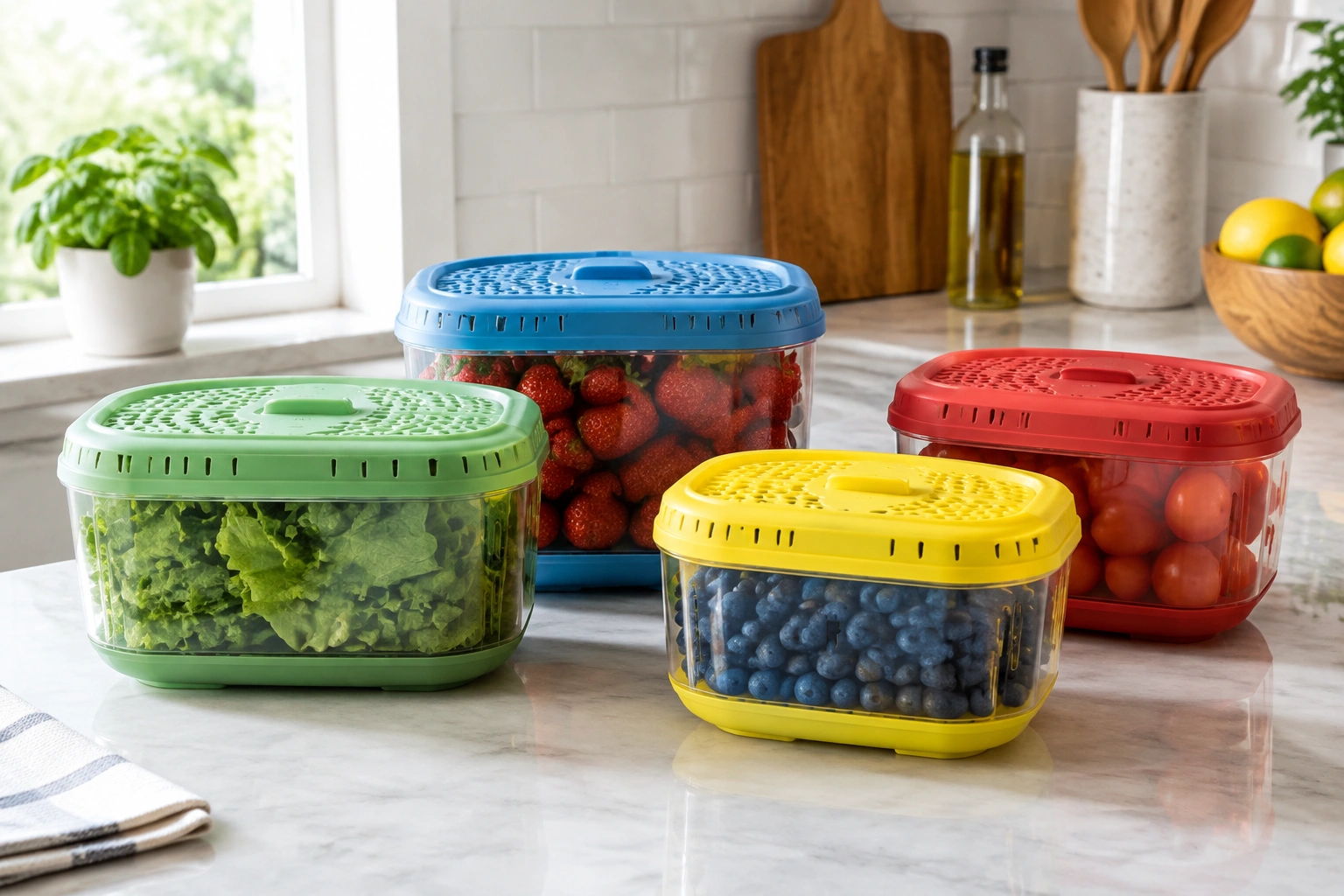
The other critical detail is the shape. A round, compact design can be helpful for fridge organization, but it also means you should expect a more specialized storage tool than a general-purpose container.
How It Performs in Everyday Use
In real kitchens, produce savers live or die by convenience. If the lid is fiddly, the container takes too much space, or the seal is annoying to align, people stop using it.
For this product, the likely appeal is simple: it gives you a dedicated place for half-used produce instead of wrapping it in plastic film or leaving it in a loose bag. That can reduce mess and make the fridge easier to scan.
The trade-off is capacity. A 1-cup saver is practical when you are dealing with:
- half an avocado
- a cut lemon or lime
- a small tomato
- a partial onion
- a few grapes or a small apple portion
It is less practical when you need to store:
- a large onion half
- a big avocado half with the pit removed
- multiple cut vegetables from meal prep
- saucy leftovers
That means this is more of a produce preservation accessory than a full meal-prep container system. If your household wastes produce because small leftovers get forgotten, this type of container can be genuinely useful. If your main need is packing lunches or storing cooked dinners, you will probably want a different product family.
For a quick real-world comparison: compared with common produce saver pods or general plastic containers, this set looks more specialized and compact. It should be easier to assign to one fruit or vegetable at a time, but it is less versatile than a standard rectangular storage box.
Portability and leak risk
The listings emphasize airtightness, but airtight is not the same thing as truly leakproof for transport. For dry or lightly moist produce, the design may be perfectly adequate. For juicy cut fruit or anything with liquid, you should be cautious until you have confirmed how the lid performs in your own kitchen.
A useful rule: if you would not trust a container to sit on its side in a lunch bag, do not assume it is safe for soup, dressing, or marinated foods. Produce savers are usually best used for fridge storage, not as all-purpose transport containers.
Material Quality, Safety, and Durability
The available listing information does not clearly verify the exact material composition in a way that supports strong claims about BPA-free construction, silicone thickness, or long-term durability. That means the safest approach is to treat material claims conservatively unless you can confirm them on the official listing or packaging.
What to expect in practice: this is best approached as a light-duty produce storage accessory, not a heavy-duty container built for rough handling. If the seal feels loose, the plastic flexes too much, or the lid no longer closes evenly after a few uses, those are warning signs that the product may not last well.
What matters most in use is whether the material:
- seals consistently
- holds its shape after repeated use
- resists cracking or warping
- does not pick up odors quickly
- cleans easily after contact with onion, garlic, citrus, or avocado
Produce containers often fail in small but annoying ways. A lid that stretches too loosely after a few uses. A surface that stains from tomato. A container that warps when washed too hot. These are not dramatic failures, but they are the reasons people abandon reusable storage items.
If you are choosing between this and a sturdier glass storage system, the trade-off is clear:
- Plastic or flexible produce savers are lighter, cheaper, and easier to toss into crowded fridges.
- Glass containers are usually better for durability and odor resistance, but they are heavier and less specialized for oddly shaped produce.
For this product, the value comes from convenience and specialization, not from being the toughest option in the kitchen.
Cleaning and Maintenance
Cleaning convenience is where many reusable storage products either earn their keep or become drawer clutter.
A compact produce saver is easiest to live with when it can be rinsed quickly after use and dries without holding onto moisture in seams or corners. That matters because produce residue can build up fast, especially with onion, garlic, avocado, and tomato.
In practical terms, a good routine would be:
- Rinse soon after emptying.
- Wash with warm water and mild dish soap.
- Dry fully before nesting or stacking.
- Check the lid or rim for residue before the next use.
The key question shoppers usually ask is whether it is dishwasher-safe. Based on the available listing information here, that is not clearly verified, so it is better not to assume it. Until confirmed, hand washing is the safer default.
The same caution applies to freezer use and microwave use. If you need either of those functions, verify them on the official product page or packaging before buying. For a produce saver, those features are nice to have, but they are not the main reason to purchase it.
For families, the maintenance question is simple: if a container takes longer to clean than to use, it will not stay in rotation. This product seems most likely to succeed if you use it for a small set of repeat produce items rather than as a catch-all storage system.
Strengths and Limitations
Strengths
- Comes as a set of 4, which gives you some flexibility for different produce items.
- The 1-cup size is useful for common half-used produce.
- The compact 4.9-inch by 4.9-inch footprint should fit many fridges without much fuss.
- The color-coded set can make kitchen organization easier.
- The produce-focused design may reduce waste if you regularly save cut fruits and vegetables.
Limitations
- The size is small, so it will not replace general meal-prep containers.
- Airtight and oxidation-blocking claims are helpful, but still need real-world confirmation in your kitchen.
- The product appears best for produce, not for liquids or full leftovers.
- Material and dishwasher/freezer details are not fully verified from the available sources.
- If you need one container system for everything, this is too specialized.
The biggest limitation is not quality alone; it is fit. If your household mostly needs lunch containers, this is the wrong purchase. If your household repeatedly tosses half-used produce, it may be a smart one.
Who This Product Is Best For
B0D1845NYY is best for people who:
- buy produce in small-to-medium amounts
- want a neater way to store cut fruits and vegetables
- are trying to reduce waste from half-used avocados, onions, tomatoes, and citrus
- prefer lightweight, compact storage over heavy glass
- want a low-effort tool for fridge organization
It is less suitable for:
- meal preppers who portion full lunches or dinners
- families who need larger containers for leftovers
- buyers who want a single storage solution for both produce and cooked food
- anyone expecting a fully verified premium build from a budget-friendly listing
A good way to think about it: this is a specialized produce keeper, not a universal kitchen container set.
How B0D1845NYY Compares to Similar Options
Compared with plastic meal prep containers, this product is more specialized. Meal prep boxes usually win on versatility because they handle cooked food, sauces, and larger portions. B0D1845NYY wins if your main problem is half-used produce that gets forgotten in the fridge.
Compared with glass storage containers, this set is likely lighter and easier to tuck into small fridge spaces. Glass usually wins on sturdiness, odor resistance, and long-term confidence, but it is heavier and less tailored to odd-shaped produce.
Compared with disposable wraps or bags, the reusable design is the better long-term choice if it actually gets used. The decision rule is simple: if you are repeatedly throwing away half an avocado or wrapped onion pieces, a reusable saver can pay for itself in convenience even before you account for reduced waste.
Compared with premium produce savers, this product appears more budget-oriented. That can be a good thing if the fit and seal are adequate. The risk is that lower-cost items sometimes save money by using thinner materials or simpler seals. In other words, the price advantage only matters if the product still feels dependable after repeated use.
Is It Worth the Price?
One listing shows a price of $20.98 USD for the set. That is not a trivial impulse buy, especially for a specialized storage item.
My view: it is worth considering only if you will use it regularly for small produce portions. At this price, it is not a must-buy for the average kitchen, but it can be a sensible niche purchase for households that frequently save cut fruits and vegetables and want a neater, reusable system.
A practical value test:
- Worth buying if you will use at least a few pieces every week.
- Probably not worth it if you mostly store cooked leftovers or buy produce infrequently.
- Better value than disposable storage if it helps you reduce repeated waste.
- Poor value if you need large-capacity containers or verified dishwasher-and-freezer performance.
The product is easiest to justify when it replaces a habit that wastes food. It is harder to justify when it becomes another niche gadget that lives in a drawer.
When to Ask a Food Safety Expert
If you plan to use any produce container for longer-term storage, or if you are unsure whether a container is appropriate for a specific food and temperature range, check the manufacturer’s instructions carefully. For general guidance on safe food handling and refrigeration practices, the USDA’s food storage resources are a helpful starting point, and the FDA’s advice on food contact materials is worth reviewing when material safety matters: USDA food safety and storage guidance and FDA food contact information.
Final Verdict
B0D1845NYY looks like a practical niche buy for households that frequently save cut fruits and vegetables and want a reusable, compact, color-coded storage option. Its strongest case is convenience for produce, not versatility for all food storage.
If your fridge often contains half an avocado, a cut onion, or a leftover tomato that gets lost before you use it, this set may help. If you need one container system for meal prep, leftovers, freezing, and transport, look elsewhere.
My recommendation: buy it only if you specifically want a small produce-saving set and you are comfortable with the size and the fact that key features like dishwasher-safe, freezer-safe, microwave-safe, and leakproof performance are not clearly verified in the available listing information. If you want broader kitchen utility, a more general-purpose container set will likely serve you better.