
How to Store Food in the Refrigerator for Safer, Fresher Meals

If you want a fridge that actually helps you save money and waste less food, the rules are simple: keep it cold, keep raw foods separate from ready-to-eat foods, and give each item a place that matches its risk level. A refrigerator held at 40°F / 4°C or below helps slow bacterial growth and gives you a safer window for storing groceries, leftovers, and meal-prep food. USDA refrigeration guidance is the standard many home cooks rely on, and it’s the right place to begin.
The practical goal is not just safety. It is also visibility. Food that is easy to see gets eaten sooner, which means fewer mystery containers and fewer last-minute throwaways. That is why a good fridge system uses shelf placement, covered containers, and date labels together.
The Fast Answer: The Core Refrigerator Rules
Use these four rules every time you put food away:
- Keep the fridge at 40°F / 4°C or below.
- Store raw meat, poultry, and seafood below ready-to-eat foods.
- Cover food unless it is actively cooling.
- Do not overpack the refrigerator; cold air needs room to move.
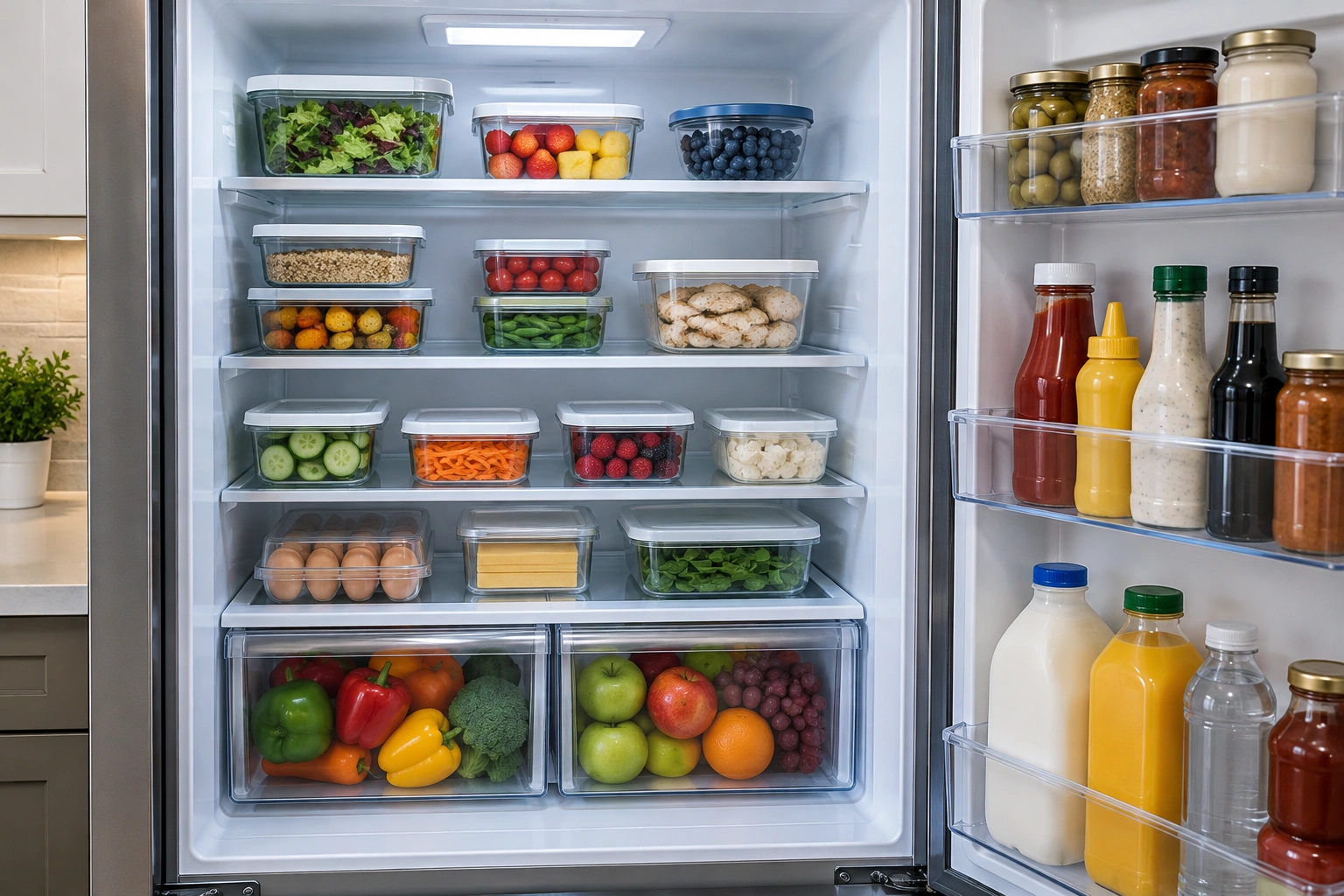
That last point matters more than many people realize. If the fridge is stuffed edge to edge, the cold air cannot circulate well, and some items may stay warmer than you think. Wisconsin’s Department of Agriculture notes that refrigerators should not be stocked with more food than they are designed to hold because air circulation around food is important. Their refrigerator storage chart also recommends keeping refrigerated foods at 41°F (5°C) or below.
Refrigerator Temperature and Food Safety Basics
A refrigerator is not a magic box that stops food from changing. It only slows down spoilage. That is why temperature control matters so much. If the fridge runs too warm, bacteria can multiply faster, and foods that seem fine may no longer be safe.
A separate appliance thermometer is worth using, especially if your fridge does not have a reliable display. Put it in the middle of the unit and check it regularly. If the temperature keeps drifting upward, food storage becomes a guessing game. A fridge thermometer is one of the cheapest food-safety tools a household can own.
A few habits make temperature control easier:
- Open the door less often during busy meal times.
- Let hot food cool briefly before refrigerating, but do not leave it out for long stretches.
- Avoid cramming the shelves so tightly that cold air cannot move.
- Keep the door for stable items, not delicate ones.
A useful decision rule: if a food is highly perishable or already opened, give it the coldest, most stable spot you have. If it is used often and can tolerate small temperature swings, the door is usually fine.
What Goes on Each Shelf, Drawer, and Door
Think of the refrigerator in zones. The safest arrangement is one that keeps raw foods low, ready-to-eat foods high, and frequently used items easy to reach.
| Fridge area | Best foods to store there | Why this spot works |
|---|---|---|
| Top shelf | Ready-to-eat foods, leftovers, cooked meals, yogurt, prepared salads | Keeps cooked food above raw food, reducing cross-contamination risk |
| Middle shelves | Dairy products, eggs in original carton, deli items, opened packaged foods | Cold enough for perishables and easy to see at eye level |
| Bottom shelf | Raw meat, poultry, seafood in sealed containers or wrapped securely | Lowest position helps catch drips and keeps raw juices away from other foods |
| Crisper drawers | Produce, separated by moisture needs when possible | Helps manage humidity and reduce wilting or excess moisture |
| Door | Condiments, juices, less perishable items | Warmest and least stable part of the fridge |
The top shelf is a good home for leftovers because they are already cooked and should not be exposed to raw drips. It is also a good spot for foods you want to grab quickly, like yogurt cups, hummus, and prepped fruit cups, as long as they are sealed.
The middle shelves are usually the best place for dairy and other items that need steady cold but are used often. Think milk, cream, sour cream, cottage cheese, shredded cheese, opened cream cheese, opened deli meats, and eggs in their original carton. If your household reaches for these items multiple times a day, the middle shelf is often a better choice than the door because it stays colder and more stable.
The bottom shelf should hold raw meat, poultry, and seafood in a sealed container or securely wrapped package. USDA guidance is clear on this point: raw meat, poultry, and seafood should be stored in a way that prevents juices from contaminating other foods.
The door is best for items that can tolerate the warmest, most changeable zone in the fridge. That usually means condiments, pickles, jams, mustard, ketchup, salad dressings, juice, and other shelf-stable or less sensitive items. If you keep milk in the door because it is convenient, it may spoil faster than if it were stored on a middle shelf. The same goes for soft cheeses and opened deli meats, which are better kept inside the main compartment.
If you are deciding between two spots, choose the one with less contamination risk. That usually means:
– cooked food above raw food,
– fragile produce away from dripping items,
– dairy away from the door if you use it slowly,
– and high-risk foods on the coldest stable shelf you have room for.
Best Containers, Wraps, and Labels for Fridge Storage
The container matters almost as much as the food. The best choice depends on whether you need moisture protection, odor control, stackability, or quick visibility.
Airtight containers
These are the best all-around option for leftovers, cut fruit, cooked grains, chopped vegetables, and meal-prep portions. They reduce drying out and help keep odors from spreading. UConn Extension recommends wrapping foods tightly or using covered plastic or glass containers so they do not dry out and are protected from bacteria found in raw foods.
Plastic wrap, foil, and bags
These are useful for temporary storage, sandwiches, herbs, cheese, and foods that will be used soon. They are convenient, but they usually protect less well than a rigid container. If food is soft, saucy, or strongly scented, a hard container is usually better.
Original packaging
Original packaging is fine for many unopened foods, but once a package is opened, it often stops being the best storage method. If a package cannot be resealed tightly, move the contents into a clean container or wrap them securely. In some cases, transferring opened canned goods or non-resealable packages into another container before refrigeration can be helpful.
Labels and date markers
Labeling is not busywork. It keeps leftovers from turning into forgotten science projects. Write:
– what the food is,
– the date it was stored,
– and, if helpful, the planned use date.
This is especially useful for meal prep. A container labeled “Chicken rice bowl — Mon” is far more likely to be eaten on time than an unlabeled container at the back of the shelf.
How to Store Leftovers and Meal-Prep Food Safely
Leftovers are one of the easiest places to lose food safety control, mainly because they are often stored in a rush. A better routine is simple:
- Refrigerate leftovers within 2 hours of cooking.
- If the room is very warm, get them into the fridge sooner.
- Cool large batches in shallow containers or smaller portions so they chill faster.
- Cover or seal the food once it is no longer steaming heavily.
- Label it with the date.
- Place it where it will be seen and used soon.
Shallow portions cool more evenly than one large deep container. That is practical guidance, not a guarantee, but it helps food chill faster and more consistently. For very large pots of soup, chili, rice, or sauce, divide the food into smaller containers before refrigerating if you can. If you need to keep it in one container at first, use a shallow pan or smaller batches so the heat can escape more quickly.
For meal prep, individual containers are useful because they make lunches grab-and-go. The trade-off is that they take more space. If your fridge is small, stackable square containers usually work better than round ones because they waste less room.
A practical example: if you cook rice, chicken, and vegetables for lunches, divide them into 3 or 4 shallow containers instead of leaving the food in one large bowl. Put them on the top or middle shelf, not in the door. That keeps them colder and easier to track.
How Long Common Foods Last in the Refrigerator
Storage time is one of the most useful decision tools you have. USDA guidance gives a general rule of 4 days for cooked leftovers and 1 to 2 days for raw poultry and ground meats. Those are not suggestions to stretch as far as possible; they are practical safety limits to help you decide when food should be used or discarded.
Here is a more specific guide for common foods people actually store:
| Food | Practical refrigerated storage guidance |
|---|---|
| Cooked leftovers | About 4 days |
| Cooked rice | About 4 days if refrigerated promptly |
| Cooked pasta | About 3 to 5 days, depending on ingredients and storage conditions |
| Raw poultry | 1 to 2 days |
| Ground meats | 1 to 2 days |
| Raw seafood | Use promptly; keep cold and follow package guidance |
| Opened deli meats | Use within a few days; follow the package date if sooner |
| Soft cheeses | Keep refrigerated and use soon after opening; follow package guidance |
| Eggs | Store in original carton and follow package date |
| Cut fruit and vegetables | Use within a few days, depending on type and freshness |
| Prepared salads | Best used soon after opening or assembling |
| Leftover pizza | About 3 to 4 days |
| Soups, stews, and chili | About 3 to 4 days |
| Cooked vegetables | About 3 to 4 days |
| Meal-prep bowls | Usually about 3 to 4 days, depending on ingredients |
For foods without a clear universal timeline, use the package date, the smell and texture, and your own storage conditions together. If the food was left out too long, stored in a crowded warm fridge, or handled with dirty utensils, shorten the window.
One important habit: once a week, scan the fridge and remove anything that is clearly past its safe life. That prevents older food from quietly contaminating or spoiling nearby items.
Which Foods Should and Shouldn’t Be Refrigerated
Not every fruit or vegetable belongs in the fridge immediately. Some foods keep better cold, while others lose flavor or texture.
Usually better refrigerated
- Leafy greens
- Berries
- Cut fruit
- Most cooked vegetables
- Herbs that wilt quickly
- Dairy
- Eggs
- Opened deli meats
- Leftovers
- Cut melon
- Sliced apples or pears
- Cut cucumbers and peppers
- Opened hummus and dips
Often better at room temperature until ripe
- Bananas
- Tomatoes
- Avocados
- Some stone fruit
- Peaches and nectarines before they are ripe
- Pears before they are ripe
- Potatoes and onions, depending on the food and your kitchen conditions
- Whole tomatoes and avocados if you want them to soften first
The decision often comes down to ripeness and texture. For example, a ripe tomato in the fridge may last longer, but its flavor and texture can suffer. A very ripe berry, on the other hand, usually benefits from refrigeration because it is highly perishable. Bananas are another good example: keep them out until they are as ripe as you want, then refrigerate if you want to slow further softening.
If you are unsure about a fruit or vegetable, ask two questions:
1. Is it already ripe and ready to eat?
2. Do I want to slow spoilage more than I care about peak texture?
That trade-off helps you decide whether the fridge is the right place.
How to Prevent Odors, Moisture Problems, and Cross-Contamination
The most common storage problems are not dramatic. They are small habits that add up.
To prevent odors
- Keep foods covered.
- Remove spoiled items quickly.
- Clean the fridge regularly.
University of Delaware Extension specifically recommends cleaning refrigerators regularly to reduce food odors and removing spoiled foods immediately so decay does not pass to other foods. That is practical advice, not just housekeeping.
To prevent moisture problems
- Use containers that fit the food well.
- Do not leave cut produce loose in a drawer.
- Keep very wet foods sealed so they do not make nearby items soggy.
To prevent cross-contamination
- Store raw meat, poultry, fish, and eggs away from ready-to-eat foods.
- Use a tray or sealed container under raw meat packages if there is any chance of leaking.
- Wash hands and utensils after handling raw foods.
A good household rule is simple: raw foods go low and sealed; ready-to-eat foods go high and covered.
Signs Refrigerated Food Has Gone Bad
Do not rely on appearance alone. Some spoiled foods look almost normal until you smell or touch them. Watch for:
– sour or off odors,
– slime,
– mold where it should not be,
– unusual softness or mushiness,
– leaking containers,
– or a package that is badly swollen.
If a food seems questionable and you cannot confidently explain why it is still safe, discard it. That is especially true for leftovers, cooked rice dishes, dairy that smells off, and any raw meat package with damaged wrapping.
The safest habit is to pair time with condition. If the date is old and the texture looks wrong, that is enough reason to throw it out.
Fridge Organization Tips for Small or Crowded Households
A crowded fridge is not just annoying; it can be unsafe. Air needs space to move, and food needs to be visible enough to be used.
Try these strategies:
- Put the oldest items in front.
- Keep one shelf for leftovers and meal prep.
- Use clear containers so you can identify food quickly.
- Group similar items together: dairy, produce, condiments, cooked foods.
- Do not stack food so tightly that you have to remove three things to reach one item.
If you have a small fridge, prioritize the foods that spoil fastest. That usually means leftovers, opened dairy, cut produce, and raw proteins. Less perishable condiments can handle the door better than milk or raw meat. If space is tight, keep the highest-risk foods on the main shelves and use the door for sauces, jams, pickles, dressings, and other items that can handle small temperature swings.
A simple rotation system helps too: new groceries go behind older items, and older items stay visible. That is the fridge version of first-in, first-out, and it works.
Common Refrigerator Storage Mistakes to Avoid
These are the mistakes I see most often:
- Putting raw meat on a high shelf.
- Using the refrigerator door for milk, eggs, or other sensitive foods.
- Leaving food uncovered.
- Overcrowding shelves until air cannot move.
- Skipping labels on leftovers.
- Storing spoiled food “just a little longer.”
- Using deep containers for hot leftovers instead of shallow ones.
Each mistake has a cost. Some shorten shelf life. Others raise the risk of contamination. Most are easy to fix once you know what to look for.
A Simple System You Can Use Tonight
If you want a quick reset, do this:
- Put ready-to-eat foods on the top shelf.
- Move raw meat and seafood to the bottom shelf in sealed containers.
- Place dairy and eggs on a middle shelf, not the door.
- Use the crisper drawers for produce.
- Store condiments in the door.
- Label leftovers with the date.
- Throw out anything spoiled or unidentified.
- Check the fridge temperature.
That is enough to make a real difference in safety, waste, and daily convenience.
When to Ask a Food Safety Expert
If your refrigerator cannot hold 40°F / 4°C or below, if food has been left out for an extended time, or if you are unsure whether a food is still safe after a power outage or temperature problem, ask a food safety expert or your local extension office before serving it. When safety is unclear, the cost of replacing food is usually much lower than the cost of getting it wrong.
For a related visual guide, see our internal resource on how to store food in the fridge with a simple diagram, and if you need a deeper look at raw protein placement, our guide on where to store raw meat in a refrigerator goes into that part in more detail.
FAQ
Should eggs go in the refrigerator door?
Usually no. Eggs are better kept on a middle shelf in their original carton, where the temperature is more stable.
Where should milk go in the fridge?
Milk is usually best on a middle shelf, not in the door, because the middle shelf stays colder and more consistent.
Can you refrigerate cooked rice and pasta?
Yes. Refrigerate both promptly after cooking. Cooked rice is usually best used within about 4 days, and cooked pasta is often best within about 3 to 5 days.
What foods should not go in the refrigerator right away?
Bananas, tomatoes, avocados, and some stone fruit are often better kept out until they are ripe. Whole potatoes and onions are also usually stored outside the fridge, depending on conditions.
What is the safest place for raw meat in the fridge?
The bottom shelf, in a sealed container or securely wrapped, so juices cannot drip onto other foods.
What should I do if my fridge is crowded?
Prioritize leftovers, cut produce, opened dairy, and raw proteins. Use the door for condiments and other less sensitive items, and keep air space between items when possible.