
Are Air Fryers Harmful to Health? Risks, Benefits & Safer Use

Quick Answer
Air fryers are not considered inherently harmful to health when they are used correctly. They can reduce the amount of oil needed compared with deep frying, but high-temperature cooking can still create compounds such as acrylamide in certain foods, so the FDA’s acrylamide guidance is worth keeping in mind.
What matters most?
- Food choice: Air-fried vegetables, fish, potatoes, and lean proteins are different nutritionally from heavily processed frozen snacks.
- Browning level: Very dark browning can increase acrylamide formation in starchy foods such as potatoes and bread.
- Cooking temperature: Excessively high temperatures and long cooking times can increase unwanted high-heat reaction products.
- Oil amount: Air frying can lower oil absorption when it replaces traditional deep-fat frying.
- Food safety: Meat and poultry still need to reach safe internal temperatures, regardless of how crispy the outside looks.
If you’re wondering, “Are air fryers harmful to health?”, the short answer is usually no. Air frying can be a practical cooking method, especially when it replaces deep frying.
That doesn’t make every air-fried meal automatically healthy. What you cook, how dark you brown it, and how often you rely on processed foods still matter more than the appliance name.
In This Guide
- Are air fryers harmful to health?
- What health risks can air frying create?
- Does air frying create acrylamide or cancer-causing compounds?
- Is air frying healthier than deep frying or oven baking?
- How can you use an air fryer more safely?
- Frequently asked questions about air fryer health
- Should you worry about using an air fryer?
Are Air Fryers Harmful to Health?
For most people, normal air fryer use isn’t known to make the appliance inherently harmful. An air fryer is essentially a compact convection cooker that moves hot air rapidly around food.
Definition: Convection cooking uses a fan to move heated air around food. In an air fryer, the small chamber and concentrated airflow can brown and crisp food quickly.
- It does not deep-fry food: Food isn’t submerged in a large volume of hot oil.
- It can cook with little added oil: Some foods need only a light coating for browning.
- It still uses high heat: Frying, roasting, baking, and air frying can all trigger browning reactions.
- It doesn’t transform processed food: Frozen fries, nuggets, and other packaged foods keep their original sodium, refined carbohydrate, and fat content.
That last point is easy to overlook. Cooking a heavily processed food in an air fryer may use less added oil, but it doesn’t suddenly turn that food into a vegetable-rich meal.
As of 2026, the more useful question isn’t whether the appliance itself is “healthy.” It’s whether air frying helps you prepare the foods you want with reasonable heat, oil, salt, and browning.
Section Takeaway: Air fryers aren’t automatically harmful or automatically healthy. The food and cooking technique matter most.
What Health Risks Can Air Frying Create?
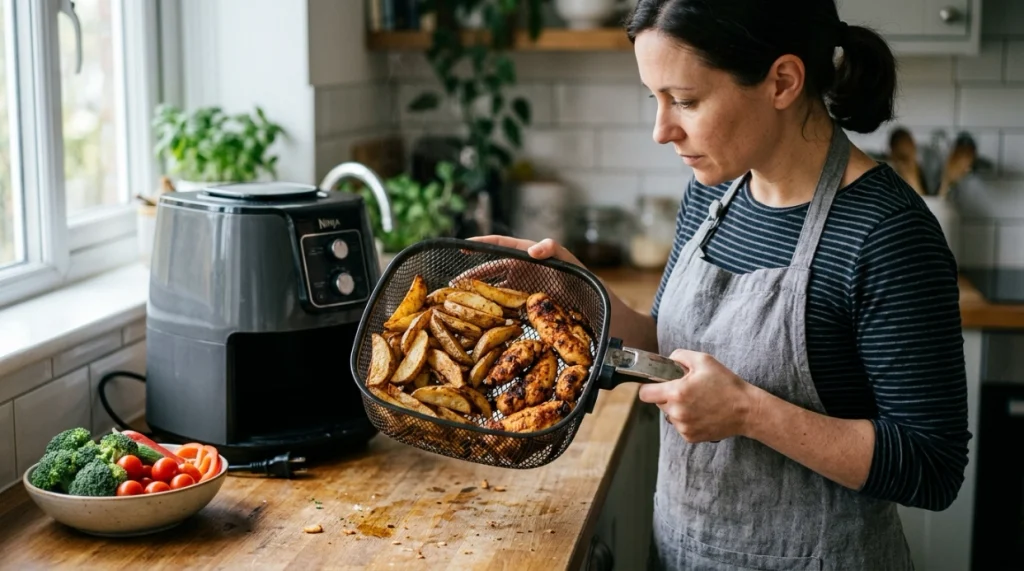
The main concerns come from high-temperature cooking, over-browning, food safety mistakes, and—in some appliances—the materials used for nonstick surfaces. These aren’t unique to air fryers.
High heat can change food chemistry
Cooking creates hundreds of chemical reactions that produce aroma, flavor, color, and texture. Many are completely normal parts of roasting, frying, and baking.
Problems become more relevant when food is repeatedly cooked very dark, charred, or exposed to excessive temperatures. Starchy foods and meats have different high-heat concerns.
- Potatoes and grains: These can form acrylamide during high-temperature cooking.
- Meat and poultry: High-temperature cooking can form heterocyclic amines, usually called HCAs.
- Very dark surfaces: Heavy browning generally deserves more attention than lightly golden cooking.
Air frying doesn’t remove sodium or saturated fat
A frozen snack can absorb less added oil in an air fryer while still containing considerable sodium or saturated fat. Read the nutrition label rather than judging healthfulness from the cooking method alone.
I find a simple rule more useful: use the air fryer mainly as a fast roasting and crisping tool. Vegetables, potatoes, fish, chicken, and reheated homemade foods give you much more control over ingredients.
Damaged cooking surfaces deserve attention
Air fryer basket materials vary by manufacturer. Some nonstick cookware and kitchen appliances use coatings associated with the broad PFAS family, while other products use stainless steel, glass, ceramic-style coatings, or other surfaces.
If coating materials concern you, check the manufacturer’s specifications rather than relying only on a “PFOA-free” label. Consumer Reports’ cookware guidance explains why PFAS terminology can be confusing.
- Don’t scrape a coated basket with sharp metal tools.
- Replace severely peeling or damaged cooking surfaces.
- Follow the appliance’s stated temperature limits.
- Choose an alternative basket material if that better matches your preferences.
Section Takeaway: Most air-fryer health concerns involve what happens to food at high heat or how the appliance is used, not simply the presence of an air fryer on your counter.
Does Air Frying Create Acrylamide or Cancer-Causing Compounds?
Yes, air frying can produce acrylamide in certain plant-based foods. That doesn’t mean eating air-fried food has been proven to cause cancer in people.
Acrylamide forms when naturally occurring sugars and the amino acid asparagine react during high-temperature cooking. Potatoes and grain-based foods are important examples.
What does the evidence say about acrylamide?
The FDA reports that high acrylamide doses caused cancer in laboratory animals. However, it also says human epidemiological evidence from dietary exposure has not shown a consistent cancer association.
One useful lesson is that cooking conditions matter enormously. Two studies comparing air-fried potatoes with other methods reached notably different results.
| Research example | Air frying result | What it means |
|---|---|---|
| 2024 potato study | 12.19 ± 7.03 µg/kg acrylamide in air-fried potatoes, versus 8.94 ± 9.21 µg/kg for deep frying and 7.43 ± 3.75 µg/kg for oven frying | Air frying was highest numerically, but differences between cooking methods were not statistically significant. |
| 2015 potato study | Air frying produced about 90% less acrylamide than conventional deep-oil frying under that study’s conditions. | Different temperatures, times, food preparation, and experimental conditions can change the result substantially. |
The 2024 results are available through PubMed’s air-fried potato study record. I wouldn’t use either experiment alone to claim that air frying always creates more or less acrylamide.
What about meat cooked in an air fryer?
Muscle meats cooked at high temperatures can form heterocyclic amines. The National Cancer Institute’s high-temperature meat guidance notes that hotter and longer cooking can increase HCA formation.
Air frying isn’t identical to flame grilling, and you shouldn’t assume every cooking method creates the same compounds at the same level. Avoiding heavily charred meat is still a sensible approach.
How can I reduce acrylamide in air-fried potatoes?
- Aim for golden: Stop cooking before potatoes become dark brown.
- Soak cut potatoes: FDA guidance suggests soaking raw potato slices for 15 to 30 minutes before frying or roasting can reduce acrylamide formation.
- Don’t cook longer than needed: More time and heat can increase browning.
- Remove very dark areas: Heavily browned sections tend to contain more acrylamide.
Section Takeaway: Acrylamide is a real high-heat cooking issue, but it isn’t unique to air fryers. Browning level, temperature, cooking time, and food preparation all influence formation.
Is Air Frying Healthier Than Deep Frying or Oven Baking?
Air frying often has a clear advantage over deep frying when your goal is to reduce the amount of oil absorbed by food. Compared with oven baking, the difference is much smaller because both methods can use little added fat.
| Factor | Air frying | Deep frying | Oven baking |
|---|---|---|---|
| Cooking medium | Fast-moving hot air | Food submerged in hot oil | Still or fan-assisted hot air |
| Added oil | Often little or none | Large quantity required for cooking | Can also be little or none |
| Acrylamide possible? | Yes, in susceptible foods | Yes | Yes |
| Main nutritional advantage | Crisp texture with less oil than deep frying | No clear oil-reduction advantage | Low-oil cooking is also easy |
Research comparing French fries has found substantially lower fat content after air frying than after conventional deep-fat frying. That advantage is most meaningful when the air fryer directly replaces deep frying.
Air frying versus baking is different. Both rely primarily on hot air, so the healthier method often comes down to the recipe, added oil, temperature, and final browning level.
For baking and pastry, the compact chamber can brown surfaces quickly. I prefer to watch color closely instead of assuming the original full-size oven time will transfer perfectly.
Section Takeaway: Air frying’s strongest health advantage is over deep frying, not necessarily over ordinary oven baking.
How Can You Use an Air Fryer More Safely?
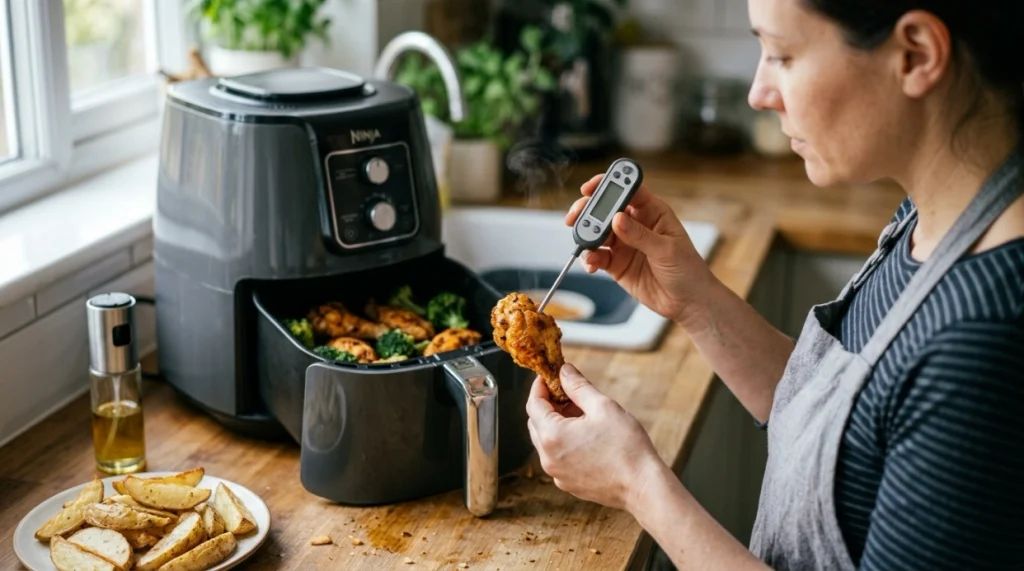
You don’t need complicated rules. A few habits address most of the practical health and safety concerns associated with air frying.
- Cook food until golden, not burnt. This is especially useful for fries, potatoes, toast, and other starchy foods.
- Use oil deliberately. Start with a light coating rather than automatically pouring in several tablespoons.
- Leave space for airflow. Overcrowding can cause uneven cooking and may tempt you to extend cooking unnecessarily.
- Clean grease regularly. Old oil and food residue can smoke during later cooking sessions.
- Inspect the basket. Follow manufacturer instructions if the surface becomes badly scratched, chipped, or peeled.
- Use a food thermometer. Exterior browning doesn’t prove that raw meat or poultry is safely cooked inside.
What temperatures should meat reach?
The FoodSafety.gov minimum-temperature chart gives specific targets. These temperatures matter whether food is cooked in an air fryer, oven, skillet, or grill.
- Poultry: 165°F (74°C).
- Ground meat: 160°F (71°C).
- Whole cuts of beef, pork, veal, lamb, and goat: 145°F (63°C), followed by a 3-minute rest.
- Fish: 145°F (63°C), or cook according to the agency’s visual doneness guidance.
- Leftovers: 165°F (74°C).
Pro tip: Don’t use air-fryer cooking time alone to judge raw meat or poultry. Check the thickest part with a food thermometer and follow verified government temperature guidance.
What foods make the most sense for regular air frying?
I like to think of the air fryer as a compact roasting tool rather than a machine designed only for frozen fries. That mindset makes healthier everyday choices much easier.
- Broccoli, cauliflower, Brussels sprouts, peppers, and green beans
- Potato wedges cooked to a light golden color
- Salmon and other fish
- Chicken breast, thighs, or wings
- Chickpeas and other foods suited to dry roasting
- Small batches of homemade baked goods
Section Takeaway: Control browning, clean the appliance, use modest oil, and verify the internal temperature of meat. Those habits matter more than chasing a special “healthy” preset.
Frequently Asked Questions About Air Fryer Health
Is it unhealthy to use an air fryer every day?
Using an air fryer every day isn’t automatically unhealthy. Your overall diet matters more, so daily vegetables, fish, lean proteins, potatoes, and homemade meals are quite different from eating heavily processed air-fried snacks every day.
Do air fryers cause cancer?
There is no good evidence that simply owning or normally using an air fryer causes cancer. High-temperature cooking can create compounds such as acrylamide or HCAs, but their formation depends on the food and cooking conditions.
Is air-fried food healthier than deep-fried food?
It can be, particularly when air frying replaces deep frying and substantially reduces the oil absorbed by the food. The benefit becomes smaller when comparing air frying with other low-oil methods such as oven roasting.
Does an air fryer destroy nutrients?
All cooking can change nutrient levels to some degree. Air frying is not uniquely destructive, and shorter cooking times may help preserve some heat-sensitive nutrients, although the result varies by food and cooking conditions.
Should I worry about acrylamide in air-fried potatoes?
Acrylamide deserves sensible attention rather than panic. Cook potatoes to golden yellow instead of dark brown, avoid unnecessarily long cooking, and consider soaking freshly cut potatoes for 15 to 30 minutes before cooking.
Are nonstick air fryer baskets dangerous?
The answer depends on the coating and its condition. Check the manufacturer’s materials information, avoid damaging coated surfaces, and replace a basket if its coating is badly peeling or deteriorating.
Can I make an air fryer meal healthier without changing recipes completely?
Yes. Reduce added oil, pair crispy foods with vegetables, use less salty seasoning, avoid heavy charring, and keep portions reasonable.
Should You Worry About Using an Air Fryer?
For most home cooks, there’s no strong reason to fear normal air fryer use. The appliance can be especially useful when it replaces deep frying with a much smaller amount of oil.
The sensible concerns are the same ones that apply to many high-temperature cooking methods. Avoid excessive browning, don’t rely on processed foods for every meal, and cook meat to verified safe internal temperatures.
For potatoes and grain foods, aim for a golden finish instead of a deeply browned one. For meat, use a thermometer rather than judging doneness by color alone.
- Use the air fryer as a tool: It doesn’t determine the quality of your diet.
- Keep heat reasonable: More browning isn’t always better.
- Choose varied foods: Vegetables, fish, lean proteins, and minimally processed ingredients work well.
- Maintain the appliance: Keep the basket clean and follow its material-care instructions.
Used that way, an air fryer can fit comfortably into a balanced kitchen. You get the convenience and crisp texture without treating the appliance as either a health miracle or a health hazard.