
Are Air Fryers Healthy to Use? Benefits, Risks & Healthy Cooking Tips
Quick Answer
Yes, air fryers can be a healthy way to cook, especially when they replace deep frying. They can crisp foods with little or no added oil, but the healthiness of your meal still depends mainly on what you cook, how much salt or oil you add, and how heavily you brown it. Consumer Reports’ healthy air-fryer guidance also highlights reduced oil use as a major advantage over traditional frying.
What matters most for healthy air frying?
- Use less oil: A light coating is often enough for browning and crispness.
- Choose whole foods: Vegetables, fish, chicken, beans, and potatoes can all work well.
- Watch the salt: Air frying does not reduce sodium already present in processed foods.
- Avoid over-browning: Starchy foods cooked too dark can contain more acrylamide.
- Check doneness: Use a food thermometer for meat and poultry rather than relying only on cooking time.
Simple rule
- Treat the air fryer as a cooking tool, not a health machine. Healthy ingredients and sensible portions still matter most.
Air fryers have a reputation for making fried-style food healthier, and there is some truth behind that idea. The biggest advantage is simple: you can get browned, crisp food without submerging it in oil.
That does not make every air-fried meal nutritious. As of 2026, I think the most useful approach is to judge the food, oil, sodium, browning, and portion size together.
In This Guide
Are Air Fryers Healthy Compared With Deep Frying?
For foods that would otherwise be deep-fried, an air fryer can be the healthier cooking method. The main reason is that it requires far less added cooking oil.
Definition: An air fryer is a compact convection appliance that uses a heating element and powerful fan to circulate hot air rapidly around food.
Deep frying works differently. Food is submerged in hot oil, which transfers heat quickly while also exposing the surface to much more cooking fat.
Does an air fryer remove fat from food?
No. An air fryer does not remove fat that is naturally present in meat, cheese, pastry, or packaged foods.
Its advantage is reducing the amount of extra fat added during cooking. If I air-fry vegetables with a small coating of olive oil instead of immersing them in oil, the cooking method adds considerably less oil.
- Fresh vegetables: Often need only a light oil coating for browning.
- Frozen fries: May already contain oil from manufacturing.
- Chicken wings: Naturally contain fat and may need little additional oil.
- Breaded snacks: Their nutrition still depends heavily on the coating and ingredients.
Does air frying automatically make junk food healthy?
No. A highly processed frozen snack remains highly processed after it goes through an air fryer.
The appliance cannot remove sodium, refined flour, added sugar, or saturated fat already present in the food. It simply changes how the food is heated.
This distinction matters. Air-fried broccoli, salmon, potatoes, and frozen mozzarella sticks can all come from the same appliance but have very different nutritional profiles.
Section Takeaway: Compared with deep frying, air frying can substantially reduce the oil required for cooking. The ingredients themselves still determine most of the meal’s nutritional value.
What Makes Air-Fried Food Healthier?
Air frying can support healthier meals because it makes browning and crispness possible without a deep bath of oil. It can also make vegetables and lean proteins convenient enough to cook more often.
1. You can cook with less added oil
A small amount of oil can cover a surprising amount of food when it is tossed or lightly brushed over the surface. You do not need to fill a pot with oil.
That difference is particularly useful for potatoes, breaded foods, and vegetables. A teaspoon or light spray may be enough for some small batches, although recipes and appliance designs vary.
2. Vegetables work exceptionally well
Strong circulating heat creates browned edges on foods such as broccoli, Brussels sprouts, cauliflower, peppers, carrots, and green beans. That texture can make vegetables more appealing without requiring heavy sauces.
- Broccoli can develop crisp tips.
- Brussels sprouts brown around the outer leaves.
- Cauliflower takes spices and a light oil coating well.
- Carrots develop sweetness as their surfaces brown.
- Green beans can stay tender while gaining lightly blistered edges.
3. Lean proteins can cook quickly
Chicken breast, fish, shrimp, and some lean cuts of meat suit the compact cooking chamber. Fast cooking can be especially convenient when you are preparing one or two servings.
Convenience matters more than it sometimes gets credit for. A healthy cooking method is more useful when it is easy enough to use on an ordinary weeknight.
4. You can reheat without adding more frying oil
An air fryer is also useful for reheating foods that should stay crisp. Rapid dry heat can restore texture without another trip through a pan of oil.
That does not change the nutritional makeup of the original food. It simply gives you another reheating option that does not require additional deep frying.
Section Takeaway: The health advantage comes mainly from what air frying lets you avoid—especially large quantities of added frying oil. Its convenience can also make vegetables and lean proteins easier to prepare.
Are There Health Risks With Air Fryers?
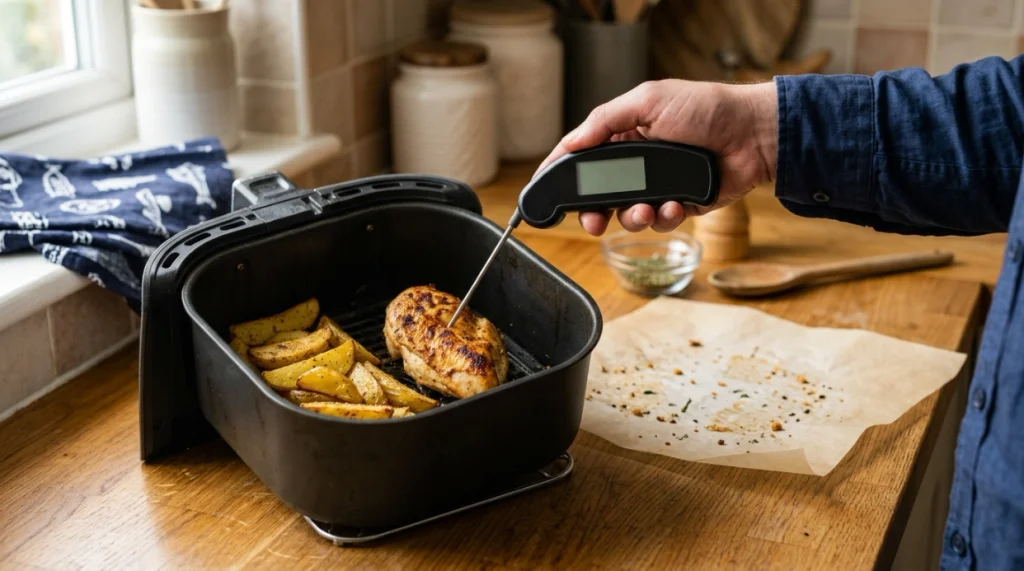
Air fryers are not risk-free, but most concerns relate to high-temperature cooking and food choice rather than the basic idea of circulating hot air. Two issues deserve particular attention: excessive browning and food safety.
Can air frying create acrylamide?
Yes. Acrylamide can form naturally in certain carbohydrate-rich plant foods when they are cooked at high temperatures.
The FDA’s guidance on acrylamide and food preparation explains that the compound can form during frying, roasting, and baking. Potatoes and grain-based foods are among the main foods involved.
Air frying is also a high-temperature dry-heat technique. That means potatoes, breaded foods, and similar starches should not be intentionally cooked until extremely dark.
How can you reduce excessive browning?
- Aim for golden: Stop potatoes when they are golden yellow rather than dark brown.
- Watch the final minutes: Browning can accelerate quickly near the end.
- Use moderate settings: Higher heat is not always necessary for better food.
- Soak fresh potato slices: The FDA notes that soaking raw potato slices for 15–30 minutes before frying or roasting can help reduce acrylamide formation.
- Do not deliberately char starches: Darker is not automatically crispier or better.
Can meat look done before it is safe?
Yes. Air fryers brown surfaces quickly, so visual appearance alone can be misleading with thick meat and poultry.
The outside may look crisp while the center still needs more cooking. This is why I would never use crust color as the only doneness test.
Pro tip: For raw meat and poultry, use a food thermometer and follow FoodSafety.gov’s safe minimum internal temperature chart. Poultry should reach 165°F (74°C), while whole cuts of beef, pork, veal, lamb, and similar meats have different requirements.
What about smoke and burnt food?
Grease, crumbs, sugary marinades, and old food residue can burn against hot surfaces. Keeping the basket and cooking chamber clean helps reduce smoke and unpleasant burnt flavors.
- Clean removable parts after greasy meals.
- Remove accumulated crumbs.
- Avoid allowing loose parchment to contact the heating element.
- Follow your appliance manual for liners and accessories.
Section Takeaway: The main health precautions are familiar cooking precautions—avoid excessive browning, keep the appliance clean, and verify safe internal temperatures when cooking meat or poultry.
What Are the Healthiest Foods to Cook in an Air Fryer?
The healthiest choices are generally minimally processed foods that already fit into a balanced diet. The air fryer is particularly good at foods that benefit from roasted edges and a crisp surface.
Vegetables
Vegetables are one of my first choices because the air fryer can make them satisfying with modest amounts of oil. Cut similar pieces to similar sizes so they finish together.
- Broccoli
- Cauliflower
- Brussels sprouts
- Carrots
- Bell peppers
- Zucchini
- Green beans
- Sweet potatoes
Fish and lean proteins
Salmon, white fish, shrimp, chicken breast, and chicken tenderloins can all work well. You can season them with herbs, spices, citrus, garlic, or a small amount of oil.
Keep food safety separate from cooking time. Thickness varies, and different air fryers transfer heat differently.
Beans and chickpeas
Cooked chickpeas can become a crisp snack with seasoning and a modest amount of oil. They also provide fiber and plant-based protein.
Dry the surface first if crispness is your goal. Moisture slows browning.
Potatoes and sweet potatoes
Potatoes can absolutely fit into a balanced diet. The biggest difference often comes from preparation and toppings.
Air-fried wedges with a light coating of oil are different from deep-fried fries covered in salty seasoning and rich sauces. Cooking them only until golden also avoids unnecessary over-browning.
Can you make healthier baked foods in an air fryer?
Yes, although the air fryer does not change the sugar, butter, flour, or other ingredients in a recipe. It mainly changes the baking environment.
King Arthur Baking’s air-fryer baking guidance explains that these appliances work particularly well for small batches and foods that benefit from crisp exteriors.
For conventional recipes, King Arthur suggests that a useful starting point can be lowering the temperature by about 25°F and checking roughly 20% to 25% earlier. Your specific appliance may still require adjustments.
Section Takeaway: Use the air fryer mainly for vegetables, minimally processed proteins, beans, potatoes, and sensible portions. The appliance becomes healthier when the ingredients going into it are healthier.
How Can You Use an Air Fryer in a Healthier Way?
Healthy air frying is mostly about ingredient choice and cooking technique. You do not need complicated rules.
- Start with whole ingredients. Build meals around vegetables, fish, lean meats, beans, potatoes, and whole-food sides rather than only frozen snacks.
- Measure oil when needed. A drizzle can quietly become several tablespoons if you pour directly from the bottle.
- Choose unsaturated oils. Olive, avocado, or canola oil can work for many air-fryer recipes when used within appropriate cooking temperatures.
- Control sodium yourself. Herbs, pepper, paprika, garlic, lemon, cumin, and other seasonings can add flavor without relying entirely on salt.
- Do not crowd the basket. Open space improves airflow and can help food brown without excessive cooking time.
- Shake or turn when needed. Moving food exposes different surfaces to hot air and reduces the temptation to overcook one side.
- Stop at golden brown. Extra-dark potatoes or breading are not necessary for crispness.
- Use a thermometer for proteins. Time and color are less reliable than internal temperature.
- Clean grease and crumbs regularly. Old residue can smoke during later cooking.
Do you need oil at all?
Not always. Some frozen foods already contain enough fat to brown without additional oil.
Fresh vegetables, potatoes, and breaded foods may benefit from a small coating. The goal is not necessarily zero oil; it is using enough for good results without automatically pouring in more than you need.
Does portion size still matter?
Yes. Air frying changes the cooking method, not the fundamental energy content of the food.
A large serving of calorie-dense frozen snacks does not become a low-calorie meal simply because no extra oil was added. Portion size still matters alongside food quality.
Section Takeaway: The healthiest air-fryer habit is simple—cook mostly nutritious foods, use oil deliberately, control sodium, avoid excessive browning, and cook proteins to verified safe temperatures.
Air Fryer vs. Deep Fryer vs. Oven: Which Is Healthier?
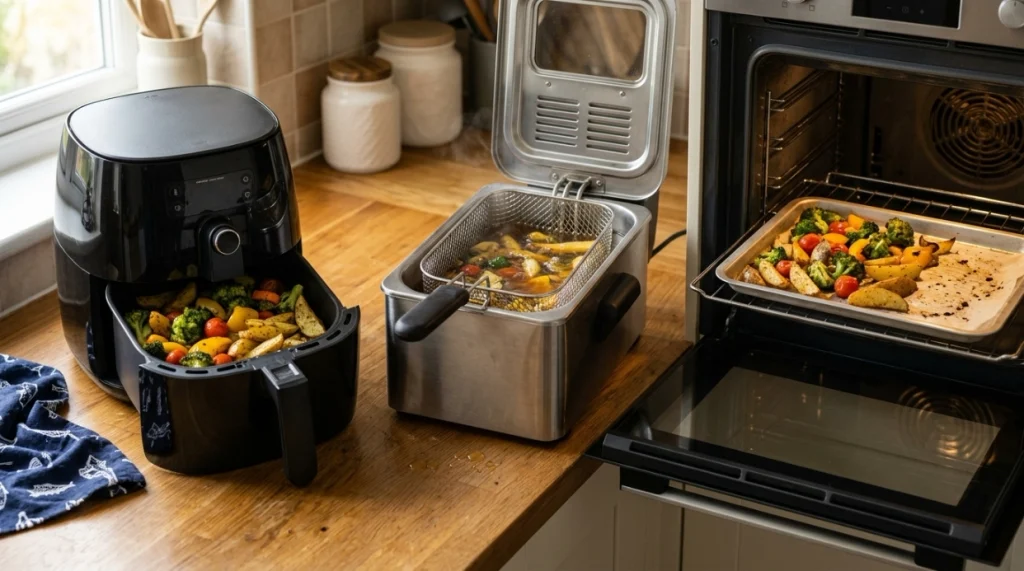
An air fryer has the clearest nutritional advantage when it replaces deep frying. Compared with an oven, the health difference is usually much smaller because both can cook with little added oil.
| Feature | Air Fryer | Deep Fryer | Conventional Oven |
|---|---|---|---|
| Cooking method | Rapid circulating hot air | Food submerged in hot oil | Radiant and surrounding hot air |
| Added oil needed | None to a light coating for many foods | Enough oil to immerse the food | None to a light coating, depending on recipe |
| Common cooking range | About 325–400°F (163–204°C) for many recipes | Often around 325–375°F (163–191°C) | Often around 325–425°F (163–218°C) |
| Best health advantage | Crisp texture with much less added oil than deep frying | No specific low-oil advantage | Also supports low-oil roasting and baking |
| Best use case | Small crispy or roasted portions | Traditional deep-fried texture | Larger batches and full-size baking |
The oven-versus-air-fryer question is therefore mostly about convenience, speed, capacity, and texture. Either one can be part of a healthy kitchen.
For a small batch of Brussels sprouts or salmon, I would choose the air-fryer approach because strong airflow suits the job. For a large tray of vegetables, a full-size oven may be more practical.
The comparison changes dramatically with deep frying. If the same food can be cooked with a light oil coating instead of oil immersion, air frying gives you a clear way to reduce added cooking fat.
Section Takeaway: Air frying has its strongest health advantage over deep frying, not ordinary oven cooking. Both an air fryer and oven can prepare nutritious foods with modest amounts of added fat.
Frequently Asked Questions About Air Fryer Health
Is it healthy to use an air fryer every day?
It can be. Daily use is less important than what you cook in it. Regularly air-frying vegetables, fish, lean proteins, and minimally processed foods is different from eating frozen fried snacks every day.
Is air frying healthier than deep frying?
Generally, yes when you compare the same food. Air fryers can create a browned, crisp exterior with much less added oil because the food does not need to be submerged in cooking fat.
Is air-fried food good for weight loss?
An air fryer can help reduce added cooking oil, but weight management depends on the overall diet and energy intake. Portions, beverages, sauces, snacks, and the ingredients themselves still matter.
Does air frying cause cancer?
There is no basis for saying that normal air-fryer use itself causes cancer. However, high-temperature cooking of certain starchy foods can produce acrylamide, so the FDA recommends avoiding excessive browning and following an overall healthy eating pattern.
Does an air fryer destroy nutrients?
Any cooking method can alter some nutrients, especially heat-sensitive vitamins. The effect varies with the food, temperature, cooking time, and nutrient involved, so it is not accurate to say air frying simply destroys nutrients.
Are frozen foods healthier in an air fryer?
Air frying may avoid adding more oil, but it does not remove sodium, saturated fat, refined carbohydrates, or other ingredients already present. Check the nutrition label if you eat packaged frozen foods frequently.
What is the healthiest oil for an air fryer?
Unsaturated oils such as olive, avocado, and canola oil can be practical choices. Use only as much as the food needs, and follow the temperature guidance for the oil and your air-fryer manufacturer.
Final Takeaway
Air fryers can absolutely be part of a healthy kitchen. Their biggest benefit is giving you crisp, browned food while using much less added oil than traditional deep frying.
The appliance cannot turn an unbalanced food into a nutritious one. Focus on vegetables, lean proteins, beans, sensible portions, moderate oil, and reasonable sodium.
Cook starchy foods until golden rather than heavily browned, and use a thermometer for meat and poultry. Those habits matter more than any health claim printed on the appliance box.
If you use an air fryer as a fast countertop convection cooker rather than an excuse to eat fried-style snacks at every meal, it can be a genuinely useful tool for everyday healthy cooking.

