
Are Air Fryers Toxic? What Health-Conscious Buyers Should Know
Quick Answer: Are Air Fryers Toxic?
Air fryers are not automatically toxic. In normal use, the bigger question is not whether the appliance itself is poisonous, but whether its materials, coatings, and cooking habits create avoidable risk.
The main concerns fall into three buckets:
- What the basket, tray, or liner is made of
- Whether high heat, wear, or damage can release unwanted substances
- Whether the food is being cooked so hot or so long that it creates more byproducts than necessary
That means a well-made air fryer used correctly is generally a low-risk kitchen appliance. But a scratched nonstick basket, overheating, heavy smoke, or burnt food changes the picture.
If you want the short version: air fryers are not inherently toxic, but some models and some cooking habits are safer than others.
What People Mean by “Toxic” When Talking About Air Fryers
The word “toxic” gets used loosely online, which makes this topic more confusing than it needs to be. In the air fryer conversation, people usually mean one of four things:
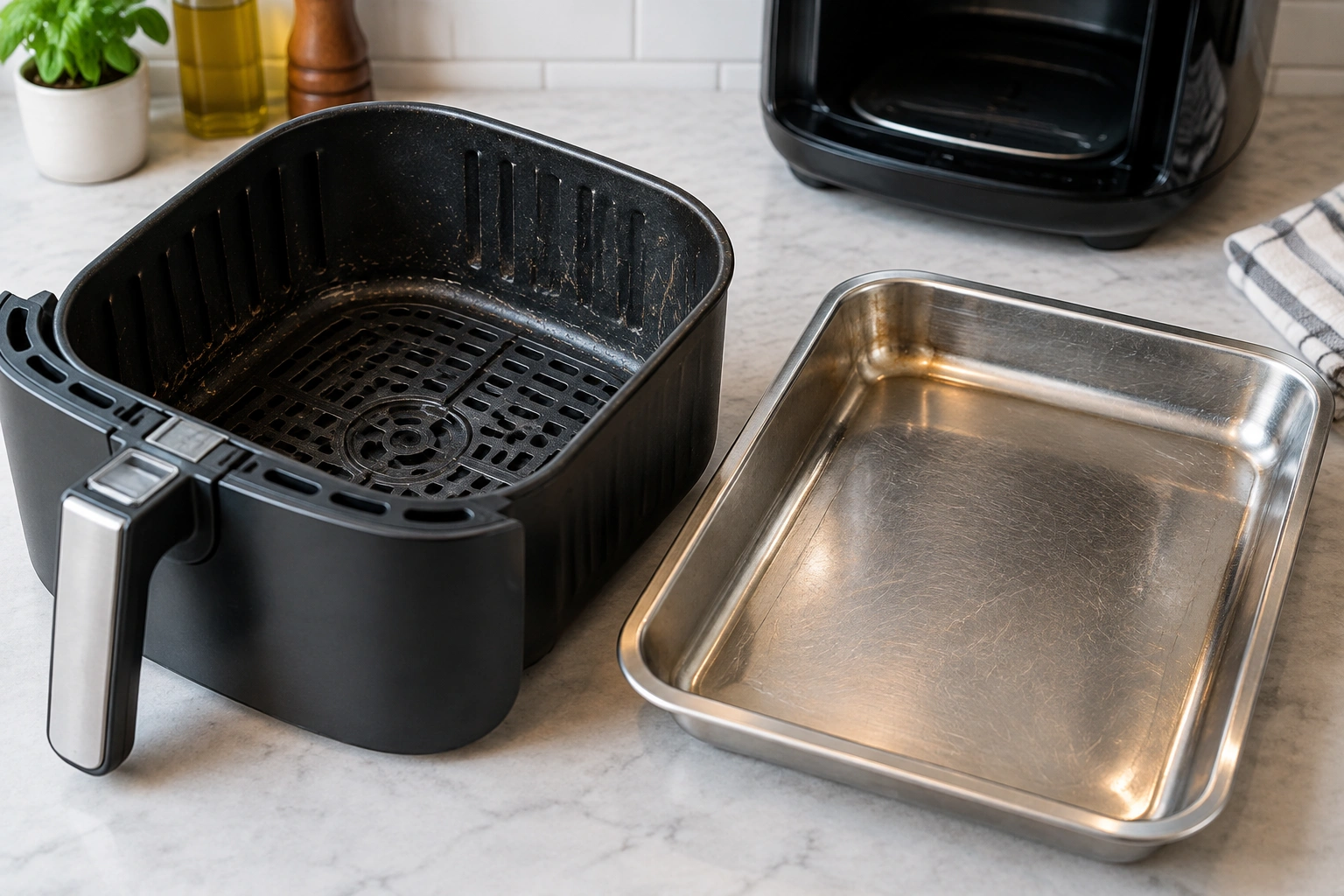
- Chemical exposure from nonstick coatings
- Plastics or other materials near heat
- Smoke or fumes from grease and overheating
- Harmful compounds formed in food during high-heat cooking
Those are different issues, and they should be judged separately.
For example, a parent worried about a basket coating is asking a different question than someone who notices smoke when cooking bacon. And both are different from a health-conscious cook who wants to avoid overbrowned potatoes because of acrylamide.
That distinction matters because an air fryer can be safe in one sense and still be misused in another. A machine with a sturdy, well-documented cooking surface is one thing; a damaged basket running too hot for too long is another.
Can Air Fryer Materials Release Harmful Chemicals?
This is where most of the concern comes from. The appliance itself is not the issue so much as the food-contact surfaces and nearby materials.
The most common questions involve:
- PTFE coatings, often associated with Teflon
- PFAS-related concerns
- Ceramic-coated baskets
- Plastic parts close to the cooking chamber
A cautious buyer should pay attention to what the manufacturer actually discloses. “PFOA-free” is not the same as “no fluoropolymer coating.” Likewise, a vague “nonstick” label tells you very little unless the brand explains the material.
A practical rule: if the product page does not clearly say what touches the food, that is a yellow flag.
A brief BPA note
BPA is not usually the main concern in the cooking basket itself. In most air fryers, the food-contact surface is a basket or tray made from metal with a coating, not BPA-containing plastic. BPA matters more if a model has plastic components near the heating area or if accessories, lids, or containers are made from plastic that may contact hot food or steam. For cautious buyers, BPA-free wording is most relevant for plastic parts and accessories, not the metal basket or tray.
The material itself is only part of the story. Heat, wear, and damage matter too. A coating that is intact and used within the manufacturer’s limits is not the same as one that is scratched, peeling, or repeatedly overheated.
What to watch for
- Scratched or flaking nonstick baskets
- Plastic parts inside or very near the hottest zone
- Accessories used above their listed temperature limit
- Poorly documented coating claims
If you are comparing models, a stainless steel basket may feel more reassuring than a coated one, but it can also be less convenient to clean. That is a trade-off, not a universal upgrade.
Is the Nonstick Coating Dangerous?
This is the concern most buyers ask about first.
A nonstick basket is not automatically dangerous. The real issue is condition and composition. A well-maintained basket used as directed is different from one that is visibly worn.
Here is the practical test I use:
- If the coating is smooth and intact, risk is lower.
- If the coating is scratched, chipped, or peeling, replacement becomes much more reasonable.
- If the basket has been heavily used and the surface looks degraded, I would not ignore it.
Why? Because wear can change how the surface performs and may increase concern about what is contacting food during high heat.
Some shoppers prefer a PFAS-free air fryer or a stainless steel basket for peace of mind. That can be a sensible choice, especially for parents or anyone trying to reduce uncertainty around coatings. But it is worth remembering that “PFAS-free” is not a magic label. You still want to know what the food-contact surface is made of and whether the product documentation is specific.
If you already own a nonstick basket, don’t panic. Just inspect it under bright light. If you see peeling, deep scratches, or areas where the coating looks compromised, that is a good time to stop using it and consider replacing the basket or the unit.
For a broader look at appliance-related risk, see our guide on are air fryers harmful to health.
Do Air Fryers Create Toxic Compounds in Food?
This is a separate issue from coatings. Even if the appliance materials are fine, the cooking process itself can create compounds in food when temperatures are high enough.
The main one people ask about is acrylamide. Acrylamide can form when certain foods are cooked at high heat, especially starchy foods. That does not mean every air-fried meal is dangerous. It means high-heat cooking of certain foods can increase the amount formed, so it is smart to avoid pushing food into very dark browning or burning.
The foods most likely to be affected are usually:
- Potatoes
- Breaded foods
- Other starchy foods that brown heavily
The key is not to avoid browning entirely. A pale, undercooked potato is not the goal either. The practical target is golden, not dark brown or burnt.
A simple example: air-fried potato wedges cooked until lightly golden are a different situation from fries left in long enough to become deeply browned and brittle. The latter is where you start pushing harder into the zone where unwanted compounds can rise.
This is also where air frying can be a reasonable option compared with some other methods, mainly because it often uses less oil. But less oil does not mean zero risk, and the cooking time and color still matter.
If you want a related breakdown of cooking-method risk, our article on can air fryers cause health problems goes deeper into the food side of the issue.
Can Air Fryers Produce Smoke, Fumes, or Burning Smells?
Yes, and this is one of the most common real-world problems.
A little cooking smell is normal. Smoke, sharp burning odors, or visible fumes are not something to shrug off. They usually point to one of three things:
- Too much grease or residue
- Food that is too fatty or too heavily coated
- Temperature or time set too aggressively
I see this most often with bacon, sausage, breaded frozen foods, and anything with dripping fat. If old grease has built up in the basket or drawer, it can smoke even when the food itself is not especially oily.
A few practical checks help:
- Clean the basket and tray regularly
- Don’t run the fryer empty longer than needed
- Keep fatty foods from sitting in pooled grease
- Use ventilation if the food tends to smoke
If smoke appears only when cooking a specific food, that is usually a cooking issue. If smoke or a hot plastic smell happens during ordinary use, that is more concerning and worth investigating. Ordinary cooking smoke is usually tied to food, grease, or residue. Potentially harmful fumes are more of a concern if a coating is overheating, plastic is too close to the heat source, or a part is damaged and starting to degrade.
A persistent burning smell is not “just how air fryers work.” It may signal residue, overheating, or a damaged part.
Air Fryer vs Deep Fryer, Oven, and Toaster Oven: Which Is Safer?
There is no single winner for every household. Each method has different trade-offs.

| Cooking method | Main safety upside | Main concern | Best fit |
|---|---|---|---|
| Air fryer | Uses less oil than deep frying | Coating concerns, smoke, high-heat browning | Fast crisping with less oil |
| Deep fryer | Consistent frying performance | Much more oil and hotter grease | Occasional indulgent frying |
| Oven | Familiar, broad use, usually no basket coating issue | Slower, may still brown food heavily | Batch cooking and roasting |
| Toaster oven | Flexible and often simple | Can still create smoke or burnt food | Small-batch cooking |
For cautious buyers, the comparison usually comes down to this:
- Air fryer vs deep fryer: Air fryer usually wins on oil use and cleanup.
- Air fryer vs oven: The oven may feel simpler from a materials standpoint, but air fryers often cook faster and with less oil.
- Air fryer vs toaster oven: Similar category in some ways, but air fryers are usually more focused on crisping.
If your main concern is chemical exposure from coatings, a toaster oven or stainless steel oven tray may feel safer. If your main concern is excess oil, air frying may be the better option. If your main concern is burning or smoke, either appliance can misbehave if food is overcooked.
What to Look for in a Safer Air Fryer
If you are buying one now, look beyond marketing language.
Prefer clear material disclosure
You want to know what touches food. Clear details are better than vague claims like “premium nonstick” without specifics.
Look for exact wording on the product page
Useful phrases include:
– “PTFE-free” if you want to avoid PTFE-based nonstick
– “PFAS-free food-contact surface” if the brand clearly defines what that means
– “Stainless steel basket” or “stainless steel tray” when you want a coating-free option
– “Ceramic-coated” only if the product page explains what that coating is and where it is used
– “BPA-free” for plastic parts and accessories that may contact heat or food
Check for meaningful compliance statements
Look for specific references such as:
– UL Listed
– ETL Listed
– cETLus
– FCC compliance for electronics, when relevant
– A clear statement that the product meets applicable safety standards
Vague claims like “safe,” “eco-friendly,” or “toxin-free” are not very useful on their own. They are marketing language, not material disclosure.
Be cautious with plastic-heavy designs
Plastic in the outer body is common and not automatically a problem. Plastic close to the cooking chamber is where I would ask more questions.
Think about how you actually cook
If you mostly make potatoes, breaded food, or fatty meats, a model that handles cleaning well and can tolerate regular use matters more than flashy presets.
I would personally prioritize clear documentation, sturdy construction, and a surface I’m comfortable using daily over extra features I may never touch.
How to Use an Air Fryer More Safely
A lot of the risk people worry about is reduced by basic habits.
Keep the temperature reasonable
Very high heat increases the chance of overbrowning and smoke. If food is cooking too fast on the outside, lower the temperature and give it more time.
Avoid heavy charring
Golden brown is one thing. Dark brown or blackened edges are another. If food looks burnt, it is worth trimming away the worst parts rather than serving it as-is.
Clean grease and crumbs regularly
Old residue is a smoke machine. Even a safe appliance can start acting unpleasant if the basket and drawer are coated with buildup.
Don’t use damaged baskets
If the coating is peeling or the basket is badly scratched, replace it. That is one of the clearest decision points in this whole topic.
Follow food safety rules for meat
An air fryer is not a shortcut around proper cooking temperatures. For meat and poultry, follow official food-safety guidance rather than relying on color alone. The USDA and FoodSafety.gov are good places to check current recommendations.
Ventilate when needed
If you are cooking fatty or breaded foods, use the hood fan or open a window. That is especially helpful in smaller kitchens where smoke lingers.
When to Replace an Air Fryer or Stop Using It
Some air fryers are fine for years. Others become questionable sooner.
I would seriously consider replacement if you notice:
- Peeling or flaking on the basket coating
- Persistent odd smells that do not go away after cleaning
- Visible damage to plastic or internal parts
- Repeated overheating or smoke during normal cooking
- A basket or tray that no longer feels stable or safe to handle
If the issue is only a dirty basket, cleaning may solve it. If the issue is damaged coating or recurring overheating, that is different.
For parents and cautious buyers, this is the simplest rule: when the appliance stops looking well-maintained and predictable, it stops being a low-risk choice.
Bottom Line
Air fryers are not inherently toxic, but they are not all equal either. The main concerns are usually about materials, coating wear, overheating, smoke, and how the food is cooked.
If you want the safest practical approach:
- Choose a model with clear material disclosure
- Avoid damaged nonstick coatings
- Don’t overbrown food
- Keep the appliance clean
- Replace worn parts when needed
Used thoughtfully, an air fryer can be a reasonable, low-risk kitchen tool. The real goal is not finding a mythical “perfectly non-toxic” appliance. It is choosing one you understand, maintaining it well, and cooking in a way that avoids the obvious problems.

