
B0D6BCQRCB Food Storage Containers Review: What This 52-Piece Set Offers and Whether It’s Worth Buying

If you found B0D6BCQRCB on Amazon, you are probably trying to answer a simple question: is this a practical, good-value container set for real household use, or just another bulk pack that looks useful until you start living with it?
The short answer is that B0D6BCQRCB appears to be a 52-piece plastic food storage container set with 26 lids and 26 containers, positioned for meal prep, leftovers, and general kitchen organization. Some retailer pages also describe it as airtight, leak resistant, microwave safe, dishwasher safe, freezer safe, and BPA-free. Those are listing claims, not independently verified performance results, so it is best to treat them as manufacturer or retailer assertions unless you can confirm them from the packaging or a trusted source.
For a home cook, the value of a container set is not just the piece count. It is whether the sizes match your portions, whether the lids seal well enough for transport, and whether the containers stay usable after repeated washing and reheating.
Quick Verdict
B0D6BCQRCB looks best suited to buyers who want a large, budget-friendly plastic container set for leftovers, lunch prep, and pantry organization. The set size gives you flexibility, and the product listings suggest it is designed for everyday convenience.
Where it is less convincing is long-term durability and premium sealing performance. Plastic sets in this price-and-quantity category often do a good job for dry foods, leftovers, and portioning, but they usually do not match the sturdiness or stain resistance of glass. If you regularly carry soups, oily sauces, or thin liquids, you should be cautious and treat “leak resistant” as a listing claim rather than a guarantee of spill-proof transport.
At-a-Glance Specs
| Feature | What the listing says | What is verified vs. unverified |
|---|---|---|
| Set count | 52 pieces total | Listing claim |
| Included pieces | 26 lids and 26 containers | Listing claim |
| Material | Plastic; some listings say BPA-free and food-grade | Material is listed; BPA-free is a listing claim unless independently confirmed |
| Safety claims | Microwave safe, dishwasher safe, freezer safe | Listing claims |
| Seal claim | Airtight / leak resistant | Listing claims; not the same as verified leakproof performance |
| Dimensions | Amazon Canada listing shows 24.6 L x 17.8 W x 22.9 H cm | Verified outer package/listing dimension, not individual container size |
| Individual container sizes | Not disclosed in the available listing information | Capacity breakdown unavailable |
| Rating | 4.3 out of 5 stars from 2,043 reviews on Amazon listing | Listing claim / retailer-reported rating |
[Image: Stack of mixed-size plastic food containers with labeled lids]
What B0D6BCQRCB Is and What Comes in the Set
The product tied to ASIN B0D6BCQRCB is listed as a 52-piece food storage container set. The Amazon listing describes it as 26 lids and 26 containers, and one version also mentions labels included. Retailer pages describe it as a reusable plastic leakproof meal-prep container set for kitchen storage organization.
That count matters more than it may seem. In a busy household, a large set is only useful if it gives you enough matching containers to cover several jobs at once: packing lunches, storing leftovers, freezing soup portions, and holding chopped produce. A 52-piece set can do that better than a small mixed set, especially if you are replacing a drawer full of mismatched lids and containers.
The trade-off is that bulk sets often include more small containers than some families actually need. If your routine is mostly storing casseroles, family-size leftovers, or large batch cooking, a set like this may feel fragmented unless the sizes are well distributed. That is why the dimensions and capacity details matter.
Dimensions, Capacity, and Material: What We Can Verify
The clearest size information available in the research notes comes from an Amazon Canada listing for the same ASIN, which gives the overall product dimensions as 24.6 L x 17.8 W x 22.9 H cm. That is the outer footprint for the packaged set, not the size of each container, so it helps with storage planning more than portion planning.
The individual container capacity breakdown is not disclosed in the available listing information. That is a real limitation for buyers because it means you cannot tell from the listing whether the set includes a practical mix of small, medium, and large containers or whether it skews heavily toward one size range. If you need containers for soups, family leftovers, or meal-prep portions, that missing detail makes it harder to judge whether the set will actually fit your routine.
The material is described on retailer pages as plastic, with one page calling it upgraded food-grade plastic and BPA-free. That is a useful baseline, but it does not tell you everything. “BPA-free” is a positive listing claim for buyers who want to avoid that specific chemical in food-contact plastics, yet it does not automatically mean the plastic is thick, rigid, or resistant to long-term wear.
What I would watch for in a set like this:
- Wall thickness: thinner plastic is lighter and cheaper but more likely to flex, warp, or crack.
- Lid rigidity: a floppy lid usually signals weaker closure and faster wear.
- Container shape: square and rectangular containers generally stack better than round ones in fridge and cabinet spaces.
- Capacity spread: a useful set should include small portions for snacks and sauces, not just medium containers.
If you need containers for one-person lunches, a large assortment can be excellent. If you need mostly family-size storage, the missing capacity breakdown is a drawback because it forces you to buy without knowing the exact size mix.
Build Quality and Durability: The Practical View
Because I do not have lab measurements for this set, the best approach is to judge durability from product category and listing details. In this price range, a 52-piece plastic set typically aims for convenience first and premium toughness second.
The upside of plastic is obvious: it is light, easy to handle, and less likely than glass to shatter if dropped. That makes it a sensible choice for households with children, crowded refrigerators, and frequent meal prep. It is also easier to carry in a lunch bag.
The downside is that plastic containers can show wear faster. The most common long-term issues are:
- Warping after repeated high-heat dishwasher cycles or microwave use
- Staining from tomato sauce, curry, and oily foods
- Odor retention after storing strong-smelling foods
- Cracking around edges or hinge points if the plastic is thin
A budget plastic set is best treated as a workhorse, not heirloom cookware. If you want a set to last for years under heavy use, you should expect to replace lids or containers eventually. That is normal in this category.
Seal Performance: Airtight vs. Leakproof
The listing uses words like airtight and leak resistant. Those are helpful, but they are not identical to a fully sealed, transport-safe leakproof system in the strictest sense.
Here is the practical distinction:
- Airtight means the lid is designed to reduce air exchange, which helps with freshness and freezer burn resistance.
- Leak resistant means it should handle normal storage better than a loose lid.
- Leakproof for mealtime transport means I would trust it with soup, sauce, or dressing in a backpack without testing first.
That last standard is much harder to meet. Even good plastic sets can seep if the lid flexes, the seal is not fully aligned, or the container is overfilled. For thick foods like rice, pasta, chopped vegetables, or leftovers with minimal liquid, this set should be much more comfortable to use. For broth, chili, curry, or vinaigrette, I would still prefer a container known for stronger sealing or a glass option with a more robust lid system.
If you are considering it for soup or liquid storage, assume the seal claim is unverified until you test it yourself.
Microwave, Freezer, and Dishwasher Safety
The product is listed as microwave safe, freezer safe, and dishwasher safe on retailer pages and Amazon listings. That is a strong convenience package for a busy household, because it means one container can move through multiple steps of meal prep.
Still, there are a few practical cautions.
Microwave use
Microwave-safe usually means the container can tolerate reheating, but that does not always mean the lid should stay sealed during heating. Most plastic lids need venting or partial removal to avoid pressure buildup. If you microwave with the lid on, make sure steam can escape.
Freezer use
Freezer-safe is useful for batch cooking and leftovers, but frozen food expands. Leave headspace, especially for soups and sauces. Overfilled containers are more likely to bulge or crack when frozen.
Dishwasher use
Dishwasher-safe is convenient, but repeated high heat can shorten the life of lower-cost plastic. If the lids feel thin or flexible, the top rack is usually the safer choice. That helps reduce warping and preserves the seal longer.
For food-contact safety basics, the FDA’s guidance on food contact substances is a useful reference point for understanding why material claims matter in everyday kitchen use: FDA food contact basics.
Usability for Meal Prep, Leftovers, and Pantry Storage
This is where a large set like B0D6BCQRCB can earn its place. The one-to-one lid count is especially helpful because lid mismatches are one of the fastest ways to make a storage system annoying.
For meal prep, the likely strengths are:
- easy portioning for lunches
- a consistent container system instead of random leftovers jars
- stackable storage that can simplify fridge organization
- enough pieces to keep several days of food sorted at once
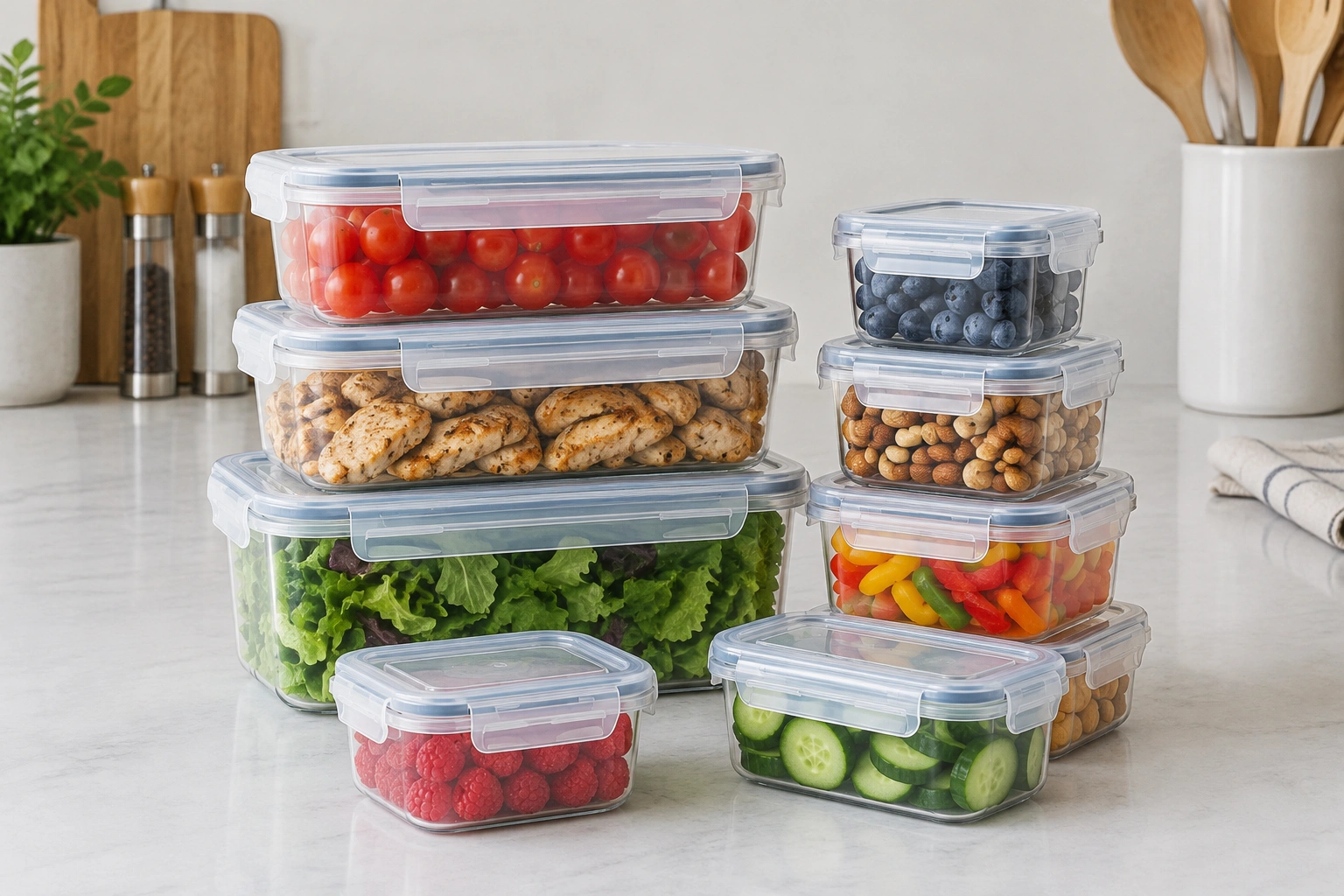
For leftovers, the set is useful if your household regularly stores half-served meals, chopped produce, or side dishes. It is also practical for pantry items like candy, dried snacks, or cut fruit, based on the Amazon Canada listing’s recommended uses for candy, fruit, and vegetable storage.
The main limitation is that plastic sets rarely feel as premium or stable as glass when stacked high. If your fridge shelves are crowded, lighter plastic helps. If you care about a rigid, heavy-bottomed feel, glass usually wins.
For general food storage guidance on freezing and safe handling, USDA resources are a solid starting point: USDA food safety and storage guidance.
What Buyers Like and Dislike
The Amazon listing shows a 4.3 out of 5 star rating from 2,043 reviews, which suggests generally favorable sentiment. That is not perfect, but it is strong enough to indicate the product is meeting expectations for many buyers.
Without pulling in unsupported assumptions, the review themes most consistent with this type of set are:
Common buyer positives
- Large piece count for the price
- Helpful for meal prep and leftovers
- Lightweight and easy to store
- Convenient for fridge, freezer, and microwave use
- Better organization than a random container mix
Common buyer complaints
- Lids may not feel as sturdy as premium brands
- Seals may be fine for storage but less reassuring for very liquid foods
- Plastic may stain or retain odor over time
- Some sizes may be smaller than expected
- Repeated dishwasher use may shorten lifespan
That mix is common in budget-friendly plastic container sets. The important question is not whether there are any complaints. It is whether the complaints match your own use case. A family storing dry leftovers and lunch portions may be very happy. A commuter carrying soup every day may not be.
Value for Money: Is B0D6BCQRCB Worth Buying?
If you want a coordinated, low-friction storage system without paying for glass, B0D6BCQRCB looks like a reasonable contender. The value comes from quantity, convenience, and versatility.
This set makes sense when:
- you need many containers at once
- you want to replace a mismatched drawer of lids
- you prep lunches or leftovers several times per week
- you prefer lightweight plastic over heavier glass
- you want something that can move from fridge to microwave to dishwasher
It is less compelling if you want maximum durability, the most reliable liquid sealing, or the best stain resistance. In those cases, paying more for a premium plastic line or switching to glass may be the smarter long-term buy.
A budget set only becomes a bad value when it forces you to replace it quickly. If this set survives your routine for a year or two of normal family use, the cost-per-use can be very attractive. If the lids loosen early or the plastic stains badly, the savings disappear.
Best Alternatives and When to Choose Them
If you are comparing this set with other container types, the closest competitors are other budget plastic food storage container sets in the same price tier, especially multi-piece meal-prep packs from mass-market brands. Against those sets, B0D6BCQRCB appears to compete on quantity and convenience rather than premium construction.
Compared with similar budget plastic sets
- Price: likely in the same low-cost, high-piece-count category
- Seal quality: probably similar to other basic snap-lid sets, where “airtight” and “leak resistant” are more about everyday storage than true spill-proof transport
- Durability: likely average for the category, with the usual trade-offs of lighter plastic, possible staining, and eventual lid wear
Compared with glass container sets
- Price: usually cheaper upfront than glass
- Seal quality: often adequate for leftovers, but not necessarily better than a quality glass-lid system
- Durability: more shatter-prone than glass, but lighter and easier to carry
Compared with stainless steel or premium sealed systems
- Price: usually much lower
- Seal quality: less convincing for soups and liquids
- Durability: typically less robust over the long term, though easier on the budget
A Black+Blum meal prep set, for example, emphasizes leak proof, stackable, microwave-safe stainless steel construction, which is a different value proposition entirely. That kind of product is better for buyers who care more about longevity than bulk quantity.
Who Should Buy This Set—and Who Should Skip It
Buy it if you are:
- a busy home cook who needs a lot of matching containers
- a meal prepper packing lunches for the week
- a budget-conscious family replacing old containers
- someone who wants lightweight fridge and freezer storage
Skip it if you are:
- carrying soups or sauces every day
- especially sensitive to stains or food odors
- looking for a premium, long-life container system
- expecting glass-like rigidity and durability from plastic
My practical recommendation is simple: buy B0D6BCQRCB if your priority is convenience, quantity, and everyday storage flexibility. Skip it if your priority is rugged sealing performance or long-term premium durability.
Final Take
B0D6BCQRCB looks like a sensible bulk food storage set for households that value practicality over luxury. The 52-piece count, the airtight and leak-resistant listing claims, and the microwave/freezer/dishwasher claims make it appealing for meal prep and leftovers. The 4.3-star rating from a large number of reviews also suggests it is doing enough things right to stay popular.
My concrete recommendation is this: buy it if you want a low-cost, high-piece-count plastic set for families, meal prep, and general leftovers. It is a reasonable fit for dry foods, portioned meals, and fridge/freezer organization. Do not buy it if your main need is soup, broth, or other liquid storage for transport, because the seal quality is only a listing claim here, not a verified leakproof system. If you want the strongest seal, the most durable build, or the best resistance to stains and odors, compare it against better-built plastic or glass alternatives before buying.