
Baker’s Percentage Made Simple: How to Read, Scale, and Adjust Bread Formulas

If you’ve ever looked at a professional bread formula and wondered why the flour is always 100%, you’re in the right place. Baker’s percentage is one of the most useful tools in bread making because it turns a recipe into a system. Once you understand it, you can read formulas, compare doughs, scale batches, and make smarter adjustments without guessing.
I’m Ethan Baker, and I like baker’s math because it takes the mystery out of bread. A formula written in percentages may look more technical at first, but it actually makes the process simpler. Instead of asking, “How much of everything do I need?” you ask, “How much flour am I using, and what ratio do I want for the rest?”
That shift changes everything.
What Baker’s Percentage Means in Bread Formulas
Baker’s percentage is a way of expressing every ingredient in relation to the flour weight in the dough. In this system, flour is always set at 100%, and every other ingredient is measured as a percentage of that flour weight.
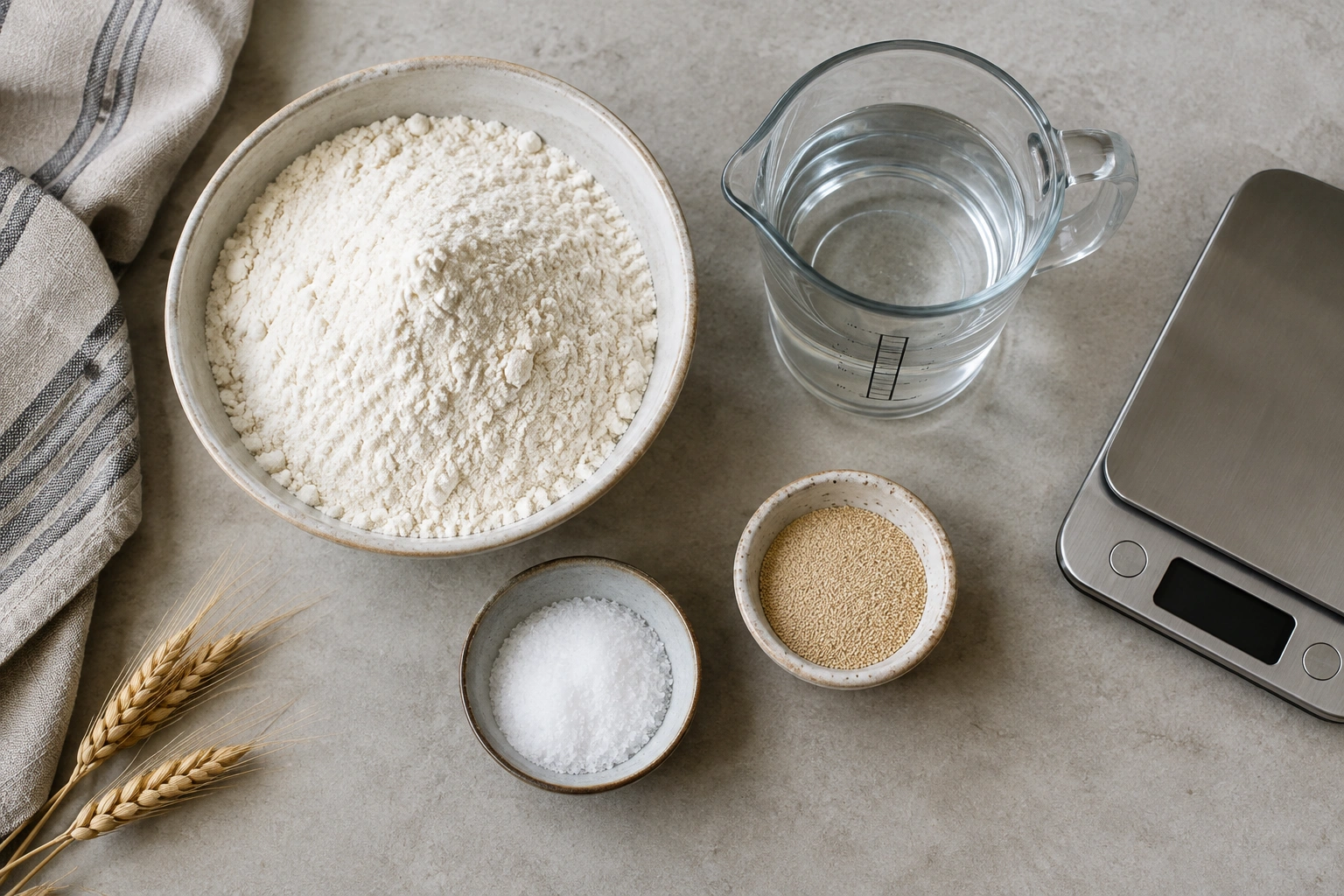
So if a dough has 1,000 grams of flour and 700 grams of water, the water is 70%. If it has 20 grams of salt, the salt is 2%.
That’s the core idea: flour is the anchor, and everything else is measured from there.
This is why baker’s percentage is so practical. It gives you a common language for bread formulas, whether you’re making one loaf or fifty. King Arthur Baking’s reference on baker’s percentage explains the same basic rule: flour is always 100%, and the other ingredients are expressed as percentages of flour weight.
Why flour is the baseline
Flour is the main structural ingredient in bread, so it makes sense to use it as the reference point. If you changed the base to total dough weight, the percentages would shift every time you added or removed an ingredient. Using flour keeps the formula stable.
That stability is the real advantage. You can compare two breads instantly:
- A lean sandwich loaf at 65% hydration
- A ciabatta-style dough at 80% hydration
Even if the batch sizes are different, the formula still tells you how wet, salty, rich, or enriched the dough is.
Why Bakers Use Percentages Instead of Regular Recipe Percentages
Regular percentages in everyday cooking are usually based on the total amount of all ingredients added together. Baker’s percentage works differently. It uses one fixed reference point: flour.
Here’s the simplest way to see the difference:
| Calculation type | Reference point | Example |
|---|---|---|
| Standard percentage | Total amount of all ingredients | 20 g salt in a 1,035 g dough = about 1.9% |
| Baker’s percentage | Flour weight only | 20 g salt in 1,000 g flour = 2% |
That difference matters because baker’s percentage keeps the flour at 100% no matter how much water, salt, yeast, or enrichment you add. Standard percentage changes the base every time the recipe changes.
That makes baker’s math much easier to scale.
Imagine a recipe written as:
- 500 g flour
- 325 g water
- 10 g salt
- 5 g yeast
If you want to make a larger batch, you don’t need to recalculate the whole recipe from scratch. You just keep the ratios the same and multiply the flour weight by the batch size you want.
What You Need Before You Start
You can calculate baker’s percentage with very little equipment, but a few basics make the process much easier.
Use a digital scale
If you want accurate baker’s math, weigh ingredients in grams. Volume measurements like cups and spoons are too inconsistent for precise formula work, especially with flour.
Convert cups to grams first
If your recipe is written in cups, convert it to grams before you calculate percentages. Here’s a simple example:
Cup-based recipe
– 4 cups bread flour
– 2 3/4 cups water
– 1 1/2 teaspoons salt
– 1 teaspoon instant yeast
Step 1: Convert each ingredient to grams
– Bread flour: 4 cups = 480 g
– Water: 2 3/4 cups = 660 g
– Salt: 1 1/2 teaspoons = 9 g
– Instant yeast: 1 teaspoon = 3 g
Step 2: Use flour as the base
– Flour = 480 g = 100%
Step 3: Calculate the percentages
– Water: 660 ÷ 480 × 100 = 137.5%
– Salt: 9 ÷ 480 × 100 = 1.9%
– Yeast: 3 ÷ 480 × 100 = 0.6%
Once the recipe is in weights, the baker’s percentages are easy to read.
Know which ingredient is the flour base
Flour is your 100% reference. If a recipe includes multiple flours, add them together before calculating percentages. That total flour weight becomes the base.
The Baker’s Percentage Formula
The formula is simple:
Ingredient percentage = (ingredient weight ÷ total flour weight) × 100
That’s it.
If your flour weight is 1,000 g and your water is 700 g:
700 ÷ 1,000 × 100 = 70%
So the water percentage is 70%.
Why total formula percentages can exceed 100%
This surprises beginners, but it’s completely normal. Since flour is already counted as 100%, adding the rest of the ingredients pushes the total above 100%.
For example:
- Flour: 100%
- Water: 70%
- Salt: 2%
- Yeast: 0.5%
Total formula percentage = 172.5%
That number is not a mistake. It simply reflects the full dough composition relative to the flour base.
How to Convert a Bread Recipe Into Baker’s Percentages
Let’s walk through a simple white bread formula.
Example recipe in grams
- Bread flour: 1,000 g
- Water: 680 g
- Salt: 20 g
- Instant yeast: 10 g
Step 1: Set flour to 100%
Bread flour = 1,000 g = 100%
Step 2: Calculate each ingredient as a percentage of flour
- Water: 680 ÷ 1,000 × 100 = 68%
- Salt: 20 ÷ 1,000 × 100 = 2%
- Yeast: 10 ÷ 1,000 × 100 = 1%
Step 3: Write the formula
| Ingredient | Weight | Baker’s % |
|---|---|---|
| Bread flour | 1,000 g | 100% |
| Water | 680 g | 68% |
| Salt | 20 g | 2% |
| Instant yeast | 10 g | 1% |
Step 4: Read the formula as a dough profile
This is a fairly standard lean dough. The hydration is 68%, which suggests a dough that is moderately soft but still manageable by hand or machine. Salt is at 2%, which is a common bread level. Yeast at 1% is enough for a straightforward same-day dough, though fermentation time will still depend on temperature and dough strength.
How to Read Hydration, Salt, Yeast, Sugar, and Fat Percentages
Once you know the math, the percentages start telling you how the dough will behave.
Hydration: the water percentage
Hydration is the percentage of water relative to flour. It’s one of the most important numbers in bread making.
- Lower hydration doughs are usually firmer and easier to shape
- Higher hydration doughs are more extensible and often produce a more open crumb, but they can be stickier and harder to handle
Salt
Salt usually sits around 1.8% to 2.2% in many bread formulas, though recipes vary.
What salt does:
- strengthens flavor
- tightens gluten slightly
- slows fermentation a bit
If salt is too low, bread can taste flat and ferment too quickly. If it’s too high, yeast activity may slow too much and the dough can taste overly salty.
Yeast
Yeast percentage affects fermentation speed.
- More yeast usually means faster rise
- Less yeast usually means slower fermentation and more timing flexibility
A small change in yeast percentage can make a noticeable difference, especially in warm kitchens. That’s why baker’s percentage is so useful for scheduling.
Sugar
Sugar is often used in enriched doughs, sandwich breads, and sweet breads. It can:
- add sweetness
- contribute to browning
- soften the crumb
But sugar also changes fermentation and dough feel. More sugar can make dough softer and stickier, and in higher amounts it can slow yeast activity.
Fat
Butter, oil, or other fats tenderize dough and enrich flavor.
Fat can:
- soften the crumb
- reduce chew
- make dough feel smoother
The trade-off is structure. A richer dough often feels more luxurious, but it may not develop the same open crumb or strong chew you’d expect from a lean artisan loaf.
How to Scale a Bread Formula Up or Down
This is where baker’s percentage really earns its keep.
Once you know the percentages, scaling is just a matter of choosing your flour weight.
Scaling up
Suppose you want to make a batch with 1,500 g of flour using the same formula:
- Water: 68% of 1,500 = 1,020 g
- Salt: 2% of 1,500 = 30 g
- Yeast: 1% of 1,500 = 15 g
New formula:
- Flour: 1,500 g
- Water: 1,020 g
- Salt: 30 g
- Yeast: 15 g
Scaling down
If you want a half batch using 500 g flour:
- Water: 68% of 500 = 340 g
- Salt: 2% of 500 = 10 g
- Yeast: 1% of 500 = 5 g
A simple rule
Pick the flour weight first, then multiply it by each percentage.
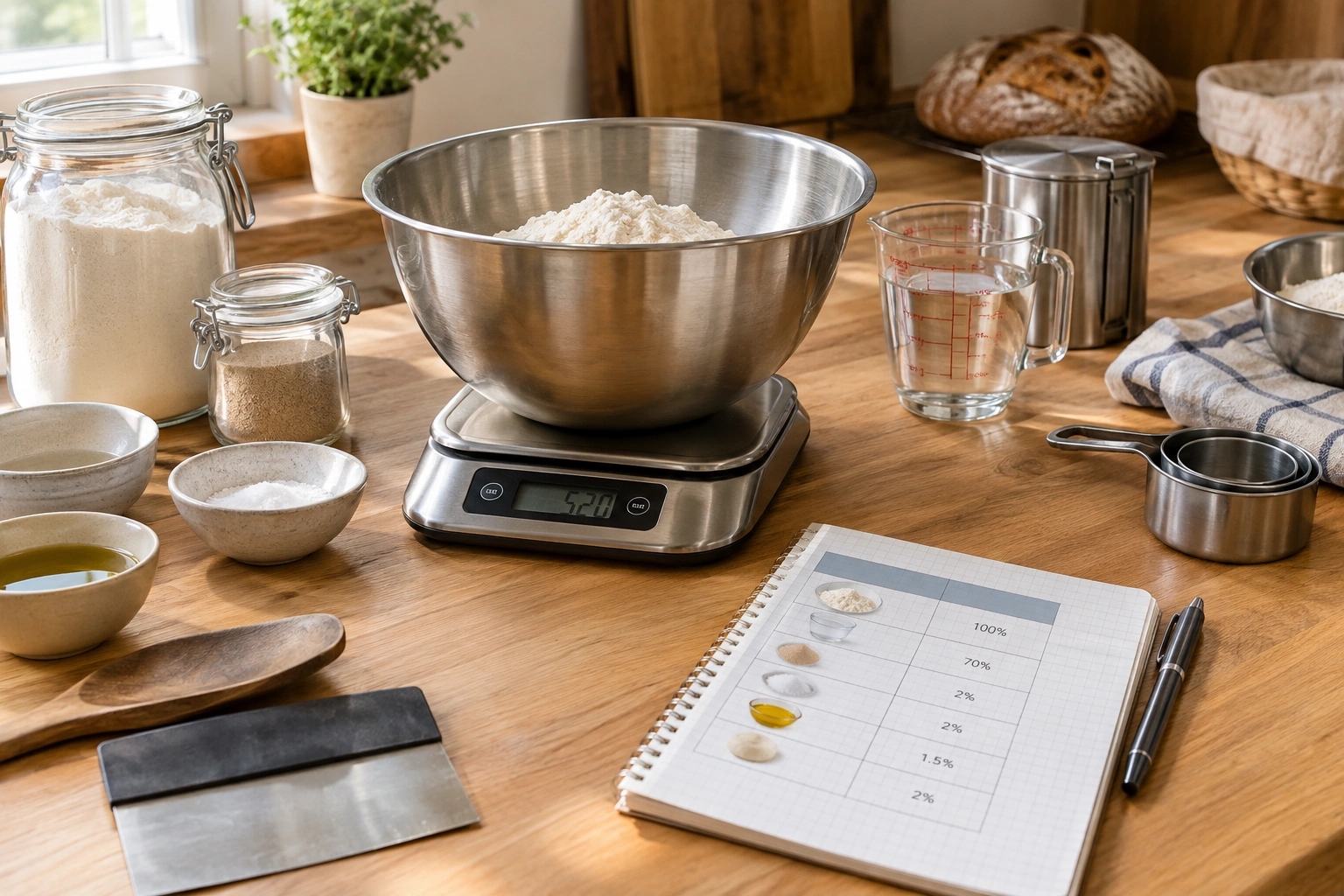
That keeps the ratios intact. If you change only the flour amount and recalculate the rest, the dough stays balanced.
How to Compare Two Bread Formulas With Baker’s Percentage
This is one of the best uses of baker’s math. Two recipes may look very different on paper, but their percentages reveal what’s actually going on.
Example comparison
Formula A
– Flour: 100%
– Water: 65%
– Salt: 2%
– Yeast: 1%
Formula B
– Flour: 100%
– Water: 80%
– Salt: 2%
– Yeast: 1%
Even before baking, you can tell Formula B will be wetter and more open-textured, while Formula A will be firmer and easier to shape.
Why this matters
If a dough feels too stiff, the problem may not be the flour brand alone. It may simply be that the hydration is too low for the style you want. If a dough spreads too much, the hydration may be too high, or the flour may not be strong enough to support it.
Baker’s percentage gives you a way to diagnose the formula instead of guessing from the finished loaf.
How to Handle Preferments and Sourdough Starter
Preferments and sourdough starter add another layer, because they already contain flour and water.
That means you need to decide whether you’re writing:
- the final dough formula only, or
- the full formula including the preferment or starter
Why this matters
If you ignore the flour and water inside the starter, your hydration and flour totals will be off. That can make the dough wetter or drier than you intended.
Full worked example: 100% hydration starter
Suppose your recipe uses 200 g of sourdough starter at 100% hydration. That starter contains:
- 100 g flour
- 100 g water
Now suppose the rest of the formula is:
- 900 g flour
- 600 g water
- 20 g salt
Step 1: Break the starter into flour and water
| Component | Flour | Water |
|---|---|---|
| Starter, 200 g at 100% hydration | 100 g | 100 g |
Step 2: Add the starter to the final dough ingredients
| Ingredient | Weight |
|---|---|
| Flour from starter | 100 g |
| Flour added to final dough | 900 g |
| Water from starter | 100 g |
| Water added to final dough | 600 g |
| Salt | 20 g |
Step 3: Calculate the total formula
| Ingredient | Total weight | Baker’s % |
|---|---|---|
| Total flour | 1,000 g | 100% |
| Total water | 700 g | 70% |
| Salt | 20 g | 2% |
So the true hydration is 70%, not 66.7%.
Decision rule
If you want an accurate full dough formula, count starter flour and water in the totals. If you’re only tracking the final mix, label the starter clearly so you don’t confuse the numbers later.
Common Mistakes When Using Baker’s Percentage
Here are the errors I see most often.
Using total dough weight as the base
This is the biggest one. Baker’s percentage is based on flour weight, not total dough weight. If you use the wrong base, every number becomes misleading.
Mixing cups with grams
Once you start calculating percentages, stick with weight. Cups are fine for casual home baking, but they are not reliable enough for accurate formula math.
Forgetting that flour is 100%
This sounds obvious, but it’s easy to lose track when converting recipes. If the flour changes, the whole formula changes.
Ignoring starter flour and water
With sourdough or preferments, the flour and water in the preferment still count. Leaving them out gives you an incomplete formula.
Not deciding how to treat add-ins
Ingredients like milk, eggs, seeds, nuts, and dried fruit don’t fit as neatly as flour, water, salt, or yeast. In baker’s math, you usually have two choices:
- Count them in the formula as percentages of flour if you want the full recipe balance on paper
- Track them separately as add-ins if they mainly affect texture, flavor, or mix-ins rather than dough structure
For example:
– Milk is usually counted as part of the liquid side of the formula, though some bakers separate it from water if they want to see the dairy contribution clearly.
– Eggs are often listed by weight and included in the total formula, but they are not treated exactly like water because they also bring fat and solids.
– Seeds and nuts are usually shown as add-ins by percentage of flour, especially when they are folded into the dough.
– Dried fruit, chocolate, and similar mix-ins are also commonly tracked as a separate percentage of flour.
The key is consistency: decide whether you’re building a full formula or just tracking the core dough, then label the ingredient clearly.
Rounding too aggressively
In small batches, rounding can distort the dough. If you’re making a tiny loaf, even a few grams matter.
Troubleshooting Dough With Baker’s Percentage
Baker’s math is not just for scaling. It also helps you troubleshoot.
Dough feels too stiff
Check hydration first. If the dough is much lower than the style calls for, it may feel tight and hard to extend.
A small increase in water can make a noticeable difference, but don’t jump too far at once. Move in modest steps so you can see the effect.
Dough feels too slack or sticky
The hydration may be too high for the flour strength, or the formula may include too much fat or sugar for the style.
If the dough is supposed to be a lean bread, compare it to a known benchmark.
Dough rises too fast
Look at yeast percentage and temperature. A high yeast percentage in a warm kitchen can shorten fermentation more than expected.
Bread tastes flat
Salt may be low, or the fermentation may have been rushed. In many bread formulas, salt around 2% helps keep flavor balanced.
Practical Examples: From Home Recipe to Bread Formula
Here’s a simple home-style formula you can use as a model.
Basic sandwich loaf
- Flour: 500 g
- Water: 325 g
- Salt: 10 g
- Instant yeast: 5 g
- Sugar: 20 g
- Butter: 25 g
Baker’s percentage table
| Ingredient | Weight | Baker’s % |
|---|---|---|
| Flour | 500 g | 100% |
| Water | 325 g | 65% |
| Salt | 10 g | 2% |
| Instant yeast | 5 g | 1% |
| Sugar | 20 g | 4% |
| Butter | 25 g | 5% |
What this tells you:
- 65% hydration suggests a fairly manageable dough
- 4% sugar adds mild sweetness and browning
- 5% butter makes the crumb softer than a lean hearth loaf
If you wanted to make two loaves of the same size, you wouldn’t rewrite the formula. You’d simply double the flour to 1,000 g and multiply the rest by the same factor.
Worked scaling example: target loaf count and dough yield
Suppose you want 3 loaves, and each loaf should have about 750 g of dough.
Step 1: Find the total dough weight
3 loaves × 750 g = 2,250 g total dough
Step 2: Use the total formula percentage to find the flour base
From the sandwich loaf formula above:
- Flour = 100%
- Water = 65%
- Salt = 2%
- Yeast = 1%
- Sugar = 4%
- Butter = 5%
Total formula percentage = 177%
That means:
Total dough weight = flour weight × 1.77
So:
Flour weight = 2,250 ÷ 1.77 = about 1,271 g
Step 3: Calculate the rest from the flour base
- Water: 65% of 1,271 = about 826 g
- Salt: 2% of 1,271 = about 25 g
- Yeast: 1% of 1,271 = about 13 g
- Sugar: 4% of 1,271 = about 51 g
- Butter: 5% of 1,271 = about 64 g
Step 4: Write the scaled formula
| Ingredient | Weight |
|---|---|
| Flour | 1,271 g |
| Water | 826 g |
| Salt | 25 g |
| Instant yeast | 13 g |
| Sugar | 51 g |
| Butter | 64 g |
That gives you a batch sized for roughly three 750 g loaves, with the formula kept in balance.
Quick Reference: Baker’s Percentage Cheat Sheet
Use this as a fast reminder while you bake.
Core formula
Ingredient % = (ingredient weight ÷ flour weight) × 100
Key rules
- Flour is always 100%
- All other ingredients are measured against flour
- Total formula percentage can exceed 100%
- Hydration is the water percentage relative to flour
- For accurate scaling, work in grams
Common bread benchmarks
These are general reference points, not hard rules:
- Hydration: about 60% to 80% depending on bread style
- Salt: often around 2%
- Yeast: often around 0.5% to 2% depending on fermentation speed and method
- Sugar and fat: more common in enriched doughs than lean artisan bread
Best use cases
Baker’s percentage is especially helpful when you want to:
- compare two formulas
- scale a recipe
- adjust hydration
- work with preferments or sourdough starter
- keep results consistent from batch to batch
FAQ
Is baker’s percentage the same as regular percentage math?
No. Regular percentage math usually compares an ingredient to the total of everything in the recipe. Baker’s percentage compares each ingredient to flour only, and flour is always 100%.
Do I need to count starter flour and water?
Yes, if you want the full formula to be accurate. A sourdough starter or preferment contains flour and water, so both should be included in the totals.
How do I handle milk, eggs, seeds, or nuts?
Usually by deciding whether they are part of the core dough or add-ins. Milk and eggs are often included in the formula by weight, while seeds, nuts, and mix-ins are commonly listed as a percentage of flour.
Can I use cups instead of grams?
You can start with cups, but convert to grams before calculating baker’s percentages. The math is much more reliable in weight.
What if my dough includes more than one flour?
Add all the flours together first. That combined flour weight becomes the 100% base.
When to Consult a Master Baker
If a dough keeps behaving differently from what the percentages suggest, the formula may be fine but the process may need attention. That can happen with flour changes, kitchen temperature swings, overmixing, underfermentation, or starter strength.
If you’re working on a professional bread formula, trying to adapt a sourdough to a production schedule, or troubleshooting a dough that refuses to behave predictably, a master baker can help you separate formula issues from process issues. That distinction saves a lot of time.
Final Thoughts
Baker’s percentage is one of the clearest ways to understand bread. Once you stop thinking in loose ingredient amounts and start thinking in ratios, formulas become easier to read, scale, and adjust. You’ll see hydration more clearly, compare doughs more confidently, and make changes with purpose instead of guesswork.
That’s the real strength of baker’s math: it turns bread from a recipe you follow into a formula you understand.