
Bread in a Slow Cooker: A Practical Guide to Soft, Reliable Homemade Loaves

If you’ve ever wanted homemade bread without turning on the oven, baking bread in a slow cooker is a clever method worth knowing. It won’t give you a crackly artisan crust, but it can produce a tender, sliceable loaf with very little fuss. Think of it as a cross between baking and steaming: the loaf cooks gently, holds moisture well, and is especially useful when you want a low-effort bread or you don’t want to heat up the kitchen.
If you’re new to this method, start by baking in a loaf pan that fits inside the slow cooker rather than directly in the insert. It’s usually easier to remove, helps the loaf keep a neater shape, and gives beginners a little more control. Direct-in-insert baking can work too, but the pan is the simpler first choice.
The key is to set your expectations correctly. Slow cooker bread is usually softer and paler than oven-baked bread, and the texture leans more toward a steamed loaf than a crusty hearth loaf. That’s not a flaw; it’s the nature of the method. Once you understand that trade-off, you can use the slow cooker to make a surprisingly useful everyday loaf.
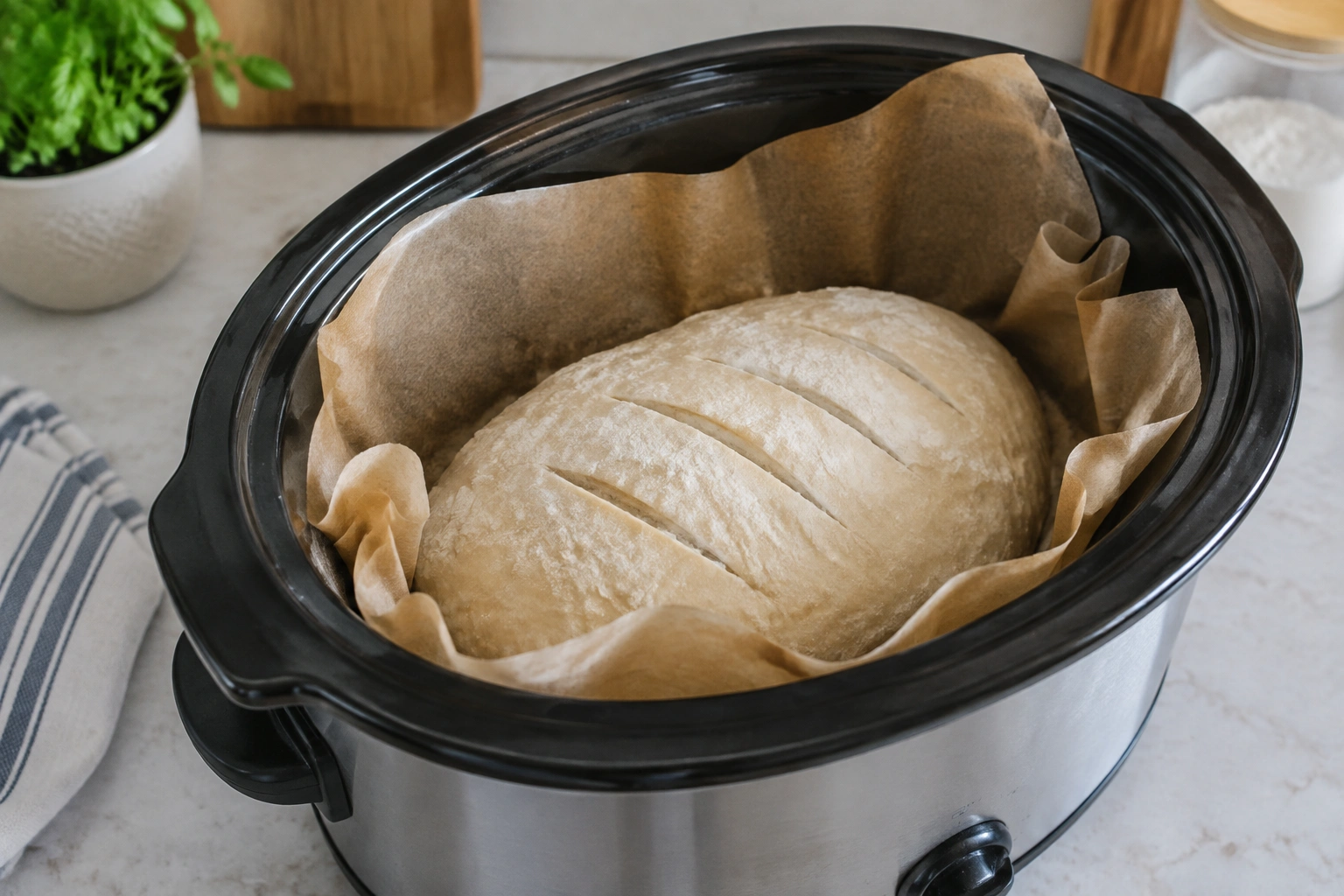
Can You Really Bake Bread in a Slow Cooker?
Yes — with the right dough and a little patience, you can bake bread in a slow cooker. The appliance creates a warm, enclosed environment that cooks the dough through without the intense dry heat of an oven. That’s why the finished loaf tends to be moist and tender rather than deeply browned.
This method works best when you want:
- a simple loaf for sandwiches or toast
- a low-heat baking option in warm weather
- a beginner-friendly bread project with fewer variables than oven baking
The trade-off is crust quality. A slow cooker does not brown bread the way an oven does, so the top will usually stay soft and the loaf may look pale until you flip it or finish it under a broiler. If you want a rustic, crackly crust, the oven is still the better tool. If you want convenience and a soft loaf, the slow cooker earns its place.
What You’ll Need
Before you begin, gather the basics so you’re not improvising mid-recipe.
Essential ingredients
For a simple yeast loaf, you’ll usually need:
- bread flour or all-purpose flour
- instant or active dry yeast
- warm water
- salt
- a little sugar or honey, depending on the recipe
- fat such as olive oil or butter, if the dough calls for it
Helpful tools
A few items make this method much easier:
- slow cooker or crockpot
- loaf pan that fits inside the slow cooker, or parchment if baking directly in the insert
- parchment paper
- clean kitchen towel or paper towels for condensation control
- instant-read thermometer
- cooling rack
Quick setup rule
If you want the easiest path, use a loaf pan inside the slow cooker. Baking directly in the insert is optional, not required, and it’s usually a better fit once you’re comfortable with the method.
Why the thermometer matters
An instant-read thermometer removes guesswork. One tested slow cooker bread method uses an internal temperature of 190°F as a practical doneness cue for that style of loaf. That’s a useful target for this kind of bread, but it isn’t a universal rule for every slow cooker bread recipe. Color alone is less reliable, because the top often stays pale even when the bread is fully baked. Baked by an Introvert
Best Types of Bread Dough for a Slow Cooker
Not every dough behaves well in this setup. The best candidates are doughs that are sturdy enough to hold shape but not so heavy that they stay gummy in the center.
Best choices
- Basic white sandwich dough: This is the safest starting point. It bakes evenly, stays soft, and slices neatly.
- Lean doughs: Doughs with modest fat and sugar are easier to judge for doneness.
- Small no-knead loaves: These can work well if the dough isn’t overly wet.
Doughs that need more caution
- Whole wheat dough: Tends to bake denser and may need a slightly longer cook time. It can still work, but the crumb will usually be heavier.
- Enriched doughs: Doughs with milk, eggs, butter, or a lot of sugar can brown less and may feel soft even when done. They’re usable, but they’re less forgiving.
- Very wet doughs: High-hydration doughs can collapse or turn gummy if the center doesn’t set in time.
A simple decision rule
If this is your first attempt, choose a moderately soft white dough rather than a heavy whole grain or enriched dough. Once you understand how your slow cooker behaves, then you can experiment.
Before You Start: Prep and Prerequisites
A few setup choices make a big difference in the final loaf.
Decide how you’ll bake it
You have two main options:
- Bake directly in the slow cooker insert
- simpler setup
- more likely to stick
-
loaf shape can be less even
-
Bake in a loaf pan placed inside the slow cooker
- easier removal
- more consistent shape
- slightly more setup, but often worth it
If your goal is a neat sandwich loaf, the pan-insert method is usually the cleaner choice.
Shape matters
Slow cooker bread is often shaped into a round loaf or compact oval rather than a long, narrow pan loaf. That shape fits the insert more naturally and helps the center cook through more evenly. A loaf that is too large or too tall is more likely to stay underdone in the middle.
Proofing still matters
Don’t rush the dough. If you underproof it, the loaf may spring unevenly and end up dense. If you overproof it, the structure can weaken and collapse as it cooks. Aim for dough that has risen noticeably and feels airy but still holds shape.
Control moisture before you cook
Condensation is one of the biggest slow cooker bread problems. The lid traps moisture, and that moisture can drip back onto the loaf. A simple towel or paper towel layer under the lid is a common practical trick to help catch droplets before they land on the bread, but it’s not a guaranteed fix.
Step-by-Step: How to Make Bread in a Slow Cooker
Here’s the practical method I’d use for a straightforward yeast loaf.
1) Mix the dough
Prepare your bread dough as directed by your recipe. A basic loaf usually involves mixing flour, yeast, salt, water, and any fat or sweetener until a shaggy dough forms, then kneading until smooth and elastic.
If you’re adapting a standard bread recipe, avoid making the dough wetter just because it’s going into a slow cooker. A dough that is already soft enough for oven baking will usually work better than one that’s extra slack.
2) Let it rise
Proof the dough until it has expanded and feels lighter. The exact timing depends on room temperature and yeast activity, so use the dough itself as your guide rather than the clock alone.
3) Shape the loaf
Turn the dough out onto a lightly floured surface and shape it into a compact round or oval. If the recipe calls for it, fold the dough onto itself a few times to tighten the surface. That helps it hold shape during cooking.
4) Prepare the slow cooker
Line the insert with parchment if needed, or set in a loaf pan that fits comfortably. You want enough room for the loaf to expand slightly without touching the lid.
5) Add moisture control
Place a clean kitchen towel or a double layer of paper towels under the lid if your setup allows it. This is a common way to absorb condensation so the top of the bread doesn’t turn wet and gummy.
6) Cook on HIGH
Most tested methods use the HIGH setting, not LOW. One source recommends cooking for 2 hours on high, while another says bread may take 1 to 2 1/2 hours, and another notes a range of 1 to 3 hours depending on the slow cooker and loaf size. In other words, high heat is the usual starting point, but timing varies by appliance. The Kitchn, TASTE
7) Check early and often near the end
Begin checking before the recipe’s upper time estimate. Some slow cooker models run hotter than others, and loaf size changes everything.
8) Remove and cool
When the bread is done, lift it out carefully and cool it on a rack before slicing. Cutting too soon can make the crumb seem gummy even when the loaf is fully baked.
How Long to Cook Bread in a Slow Cooker
There isn’t one universal time, because slow cookers vary in wattage, insert shape, and heat distribution. A higher-wattage cooker may run hotter and finish sooner, while a deeper or narrower insert can change how quickly the center sets. Still, the practical range is narrow enough to be useful.
Typical timing on HIGH
Expect roughly 1 to 3 hours, depending on the loaf and the cooker. A few tested recipes land around 2 hours, with some suggesting a check at 1 to 1 1/2 hours and others allowing up to 2 1/2 hours. Hamilton Beach, Baked by an Introvert
What changes the timing
- Loaf thickness: thicker loaves take longer to set in the center
- Slow cooker size and shape: a smaller or narrower insert can cook differently than a wider, shallower one
- Dough type: whole wheat and enriched doughs often need more time
- Lid fit and moisture: excess condensation can make the bread seem “not done” even when the center is close
High vs. low
For bread, HIGH is usually the more practical setting. LOW can take too long to set the structure, which increases the chance of a dense or gummy center. Unless a recipe specifically proves otherwise, HIGH is the safer choice.
How to Tell When Slow Cooker Bread Is Done
This is the part that saves you from disappointment.
Use the thermometer first
An instant-read thermometer is your best tool. For one tested slow cooker bread recipe, the bread should register 190°F in the center. That’s a strong doneness cue for that recipe and a useful practical benchmark for this style of loaf. Baked by an Introvert
Watch for these visual and tactile signs
- the loaf feels set, not squishy in the middle
- the edges pull slightly from the insert or pan
- the top looks dry rather than wet
- the loaf sounds hollow-ish when tapped, though this is less reliable than temperature
Why the center matters more than the top
Slow cooker bread can look finished on the outside while the interior is still underbaked. Because the lid traps moisture, the top often stays pale, so color is not a dependable indicator.

How to Prevent Soggy Bottoms and Condensation
This is the most common texture complaint, and it’s fixable.
Use a towel or paper towel barrier
A double layer of paper towel under the lid can absorb condensation before it drips back onto the bread. That small step can make a real difference in the top crust and overall texture.
Don’t overload the cooker
A loaf that is too large for the insert is more likely to cook unevenly and trap moisture. Leave breathing room around the dough.
Consider a loaf pan
A pan can help the bread keep its shape and make removal easier, which reduces the chance of tearing a soft bottom crust. It’s not mandatory, but it often improves the result.
Let it cool on a rack
If you leave the loaf sitting in the hot insert after cooking, steam keeps collecting underneath it. Moving it to a rack helps the bottom stay drier.
Optional: How to Brown the Top After Cooking
If you want more color, you can finish the loaf briefly under a broiler or in a hot oven. This is a finishing move, not a substitute for proper cooking.
Best practice
- remove the loaf from the slow cooker first
- brush the top lightly with butter if you want extra color and flavor
- broil briefly, watching constantly
Because the bread is already cooked, this step is only for appearance and a little extra crust texture. It can turn a pale loaf into something more appetizing, but it won’t make it into a true crusty artisan bread.
Common Mistakes and How to Fix Them
The loaf is dense
Likely causes:
– underproofed dough
– dough too heavy or whole-grain-heavy for the setup
– loaf shaped too large for the cooker
Fix:
Use a smaller, lighter dough next time and let it rise fully before cooking.
The center is gummy
Likely causes:
– undercooking
– too much moisture trapped inside
– slicing too soon
Fix:
Check with a thermometer, manage condensation with a towel layer, and cool the loaf before cutting.
The bread sticks to the insert
Likely causes:
– no parchment or lining
– direct baking in an unprepared insert
Fix:
Line the cooker or use a pan next time. A little prep prevents a lot of frustration.
The top stays too pale
Likely cause:
– this is normal for slow cooker bread
Fix:
Accept the soft top, or brown it briefly after baking if you want a more finished look.
Troubleshooting Guide
If your loaf is still wet after the suggested time
Give it more time in short increments and check the center temperature again. Slow cookers vary enough that one model may finish much sooner than another.
If the loaf is done but looks flat
The dough may have been overproofed or shaped too loosely. Next time, shape it tighter and reduce the rise slightly.
If the bottom is over-soft
Use parchment, a loaf pan, or a towel barrier to reduce direct moisture contact. Also cool the bread on a rack instead of leaving it in the cooker.
Practical Example: A Beginner-Friendly Slow Cooker Sandwich Loaf
Imagine a home baker using a basic white sandwich dough in a 6-quart slow cooker. The dough is mixed, kneaded until smooth, and left to rise until puffy. It’s then shaped into a compact round, set in a parchment-lined loaf pan, and placed in the slow cooker on HIGH.
After about an hour and a half, the baker checks the loaf. The top is pale, but the edges look set. An instant-read thermometer shows the center is still below target, so the loaf goes back in. A later check shows the center at about 190°F, and the bread comes out fully baked, soft, and sliceable.
That example shows the real rhythm of the method: shape carefully, cook on HIGH, and use doneness cues rather than trusting the clock alone.
Storage, Reheating, and Serving Ideas
Slow cooker bread is usually at its best the day it’s baked, but it stores well enough for everyday use.
Storage
- cool completely before storing
- keep at room temperature in a sealed bag or container for short-term use
- freeze sliced bread if you want to preserve it longer
Reheating
A quick toast or short warm-up in the oven restores some texture. Because the loaf is soft by nature, reheating can make it feel fresher without drying it out too much.
Good uses for this loaf
- sandwiches
- toast
- grilled cheese
- bread pudding or savory strata if the loaf starts to go stale
FAQ
Do I have to use a loaf pan in a slow cooker?
No. You can bake bread directly in the insert, but a loaf pan is often easier for beginners because it helps with shape and removal.
Why is my slow cooker bread pale on top?
That’s normal. Slow cooker bread usually doesn’t brown like oven-baked bread, so the top often stays soft and light in color even when the loaf is done.
Can I use a towel or paper towels under the lid?
Yes, that’s a common practical way to catch condensation. It can help reduce sogginess, but it isn’t a perfect fix in every slow cooker.
How do I know when the bread is done?
The most reliable method is an instant-read thermometer. One tested recipe uses 190°F as a practical doneness cue, but you should still follow the specific recipe when possible and use visual cues as backup.
Final Thoughts
Baking bread in a slow cooker is less about chasing a bakery-style crust and more about making a reliable, soft loaf with minimal effort. If you choose a sensible dough, manage condensation, and check doneness with a thermometer, the method can absolutely earn a place in your bread-making routine. For a home baker or culinary student, it’s a useful reminder that bread is not one technique but many — and each tool gives you a different result.