
Bulk Fermentation Explained: How to Judge Dough, Timing, and Readiness

Bulk fermentation is the stage where bread dough does its quiet, transformative work. After mixing, the dough rests as one mass while yeast or sourdough culture produces gas, acids, and flavor compounds. This is also the period when the dough begins to organize itself into something strong enough to shape and bake.
If you’ve ever wondered why one loaf tastes bland and tight while another has better flavor and a lighter crumb, bulk fermentation is usually part of the answer. As King Arthur Baking notes, bulk fermentation begins when mixing ends and continues until the dough is divided and preshaped. In other words, it is the dough’s first major fermentation stage, and it matters more than many new bakers realize. Read more from King Arthur Baking
What Bulk Fermentation Is and Why It Matters
Think of bulk fermentation as the dough’s “build phase.” The flour is hydrated, the leavening begins working, and the dough slowly gains strength, volume, and flavor. During this time, carbon dioxide inflates the dough, while acids and other compounds deepen the taste and improve keeping quality.
That is why shortening bulk often leads to a loaf that tastes underdeveloped and feels tight in the crumb. The dough may still bake, but it usually won’t bake well. The gas network is less organized, the flavor is flatter, and the oven spring is often weaker.
There is also a practical reason bulk matters: it is the stage where you can influence dough strength before shaping. If the dough feels slack early on, folds can help. If it already feels elastic and aerated, you may be closer to the finish line than the clock suggests.
Bulk Fermentation vs Proofing: What’s the Difference?
These terms are often confused, but they describe different stages.
- Bulk fermentation happens after mixing and before dividing or shaping.
- Proofing happens after shaping, when the loaf rests in its final form before baking.
During bulk, the dough is still a single mass. During proofing, it has already been shaped into a loaf, bâtard, boule, or pan loaf. That difference matters because the baker’s goals change.
In bulk, you are looking for fermentation activity plus dough strength. In proofing, you are mainly preserving gas and letting the shaped loaf expand without collapsing. If you treat proofing like bulk, or bulk like proofing, the dough can end up either too weak or too tight.
A useful way to remember it: bulk is where the dough is built; proofing is where it is refined.
Before You Start: Dough, Tools, and Conditions You Need
You do not need special equipment, but a few basics make bulk fermentation much easier to judge.
Helpful tools
- A clear container or straight-sided dough tub
- A thermometer for dough and room temperature
- A bench scraper
- A timer or notes app
- A lightly oiled or damp hand for handling sticky dough
Variables worth tracking
- Dough temperature: warmer dough ferments faster
- Hydration: wetter dough often ferments and feels different from firmer dough
- Flour strength: stronger flour generally tolerates more fermentation and more folding
- Leavening type: sourdough and commercial yeast behave differently
- Kitchen temperature: small room-temperature changes can noticeably shift timing
If you want to improve your results, measure dough temperature at the end of mixing. That one habit gives you far better context than a recipe timer alone.
How to Bulk Ferment Dough Step by Step
1) Finish mixing and note the dough’s starting condition

Once mixing ends, the bulk clock begins. At this point, the dough may feel shaggy, rough, or only partially developed. That is normal, especially with artisan-style doughs that rely on folds rather than intensive mixing.
2) Put the dough in a container that lets you read it
Use a vessel with straight sides if possible. It is much easier to judge rise when the dough is in a clear, vertical-sided container than in a wide bowl.
3) Let the dough rest and ferment
The first part of bulk is mostly waiting. The dough should begin to relax and expand. You may see small bubbles near the sides or bottom, especially in wetter doughs.
4) Add folds if the dough needs strength
Most lean doughs benefit from one or more fold sets early in bulk. The goal is to improve structure without knocking out too much gas. If the dough feels loose and spread-out, folding can help it gather itself.
5) Watch the dough, not just the clock
Near the end of bulk, the dough should look aerated, slightly domed, and somewhat jiggly. It should feel lighter than when it started, with more elasticity and less raw density.
6) Stop bulk when the dough shows readiness, not when it “should”
Move to divide and shape when the dough has enough gas retention and strength to hold shape, but before it turns fragile and overly slack.
When to Use Stretch-and-Folds or Coil Folds
Folding is one of the most useful tools during bulk fermentation, but it should have a purpose.
Stretch-and-folds
These are useful when the dough is moderately firm or when you want to strengthen it in a simple, direct way. You lift and fold the dough over itself, usually in a few rounds spaced through early bulk.
Coil folds
These work especially well for wetter doughs. The dough is lifted from the center and folded under itself as it coils back into the container. This is gentler and often easier to manage with high-hydration dough.
Which one should you use?
- Choose stretch-and-folds if the dough is firmer or you want a straightforward method.
- Choose coil folds if the dough is slack, sticky, or high hydration.
The trade-off is simple: more folding can improve structure, but too much handling can reduce gas retention and make the dough feel tighter than it needs to be. Early folds are helpful; late aggressive folding is usually not.
How Long Bulk Fermentation Should Take
There is no single correct time because bulk fermentation depends on temperature, flour, hydration, and leavening strength.
Dough temperature is the biggest variable. A dough that starts warm will move much faster than one that starts cool, even if the recipe is identical. As a practical rule, a small temperature shift can change the pace enough to matter, so it is worth checking dough temperature instead of relying on the recipe timer alone.
These ranges are only starting points, but they’re more useful than a single broad estimate:
- Lean yeasted doughs at about 75 to 80°F dough temperature: often around 1.5 to 3 hours
- Typical sourdough at about 74 to 78°F dough temperature: often around 3 to 5 hours
- High-hydration doughs at about 75 to 80°F dough temperature: often around 3 to 6 hours, sometimes longer if the dough is cool or weak
A cooler dough may need substantially more time, while a warmer dough may finish sooner than expected. Commercial yeast doughs often move faster than sourdough, but even yeast doughs can slow down if your kitchen is cool or your dough starts cold.
How to Tell Bulk Fermentation Is Finished
This is the part most bakers want to master, and the answer is not “wait until it doubles” for every dough.
Look for these cues together
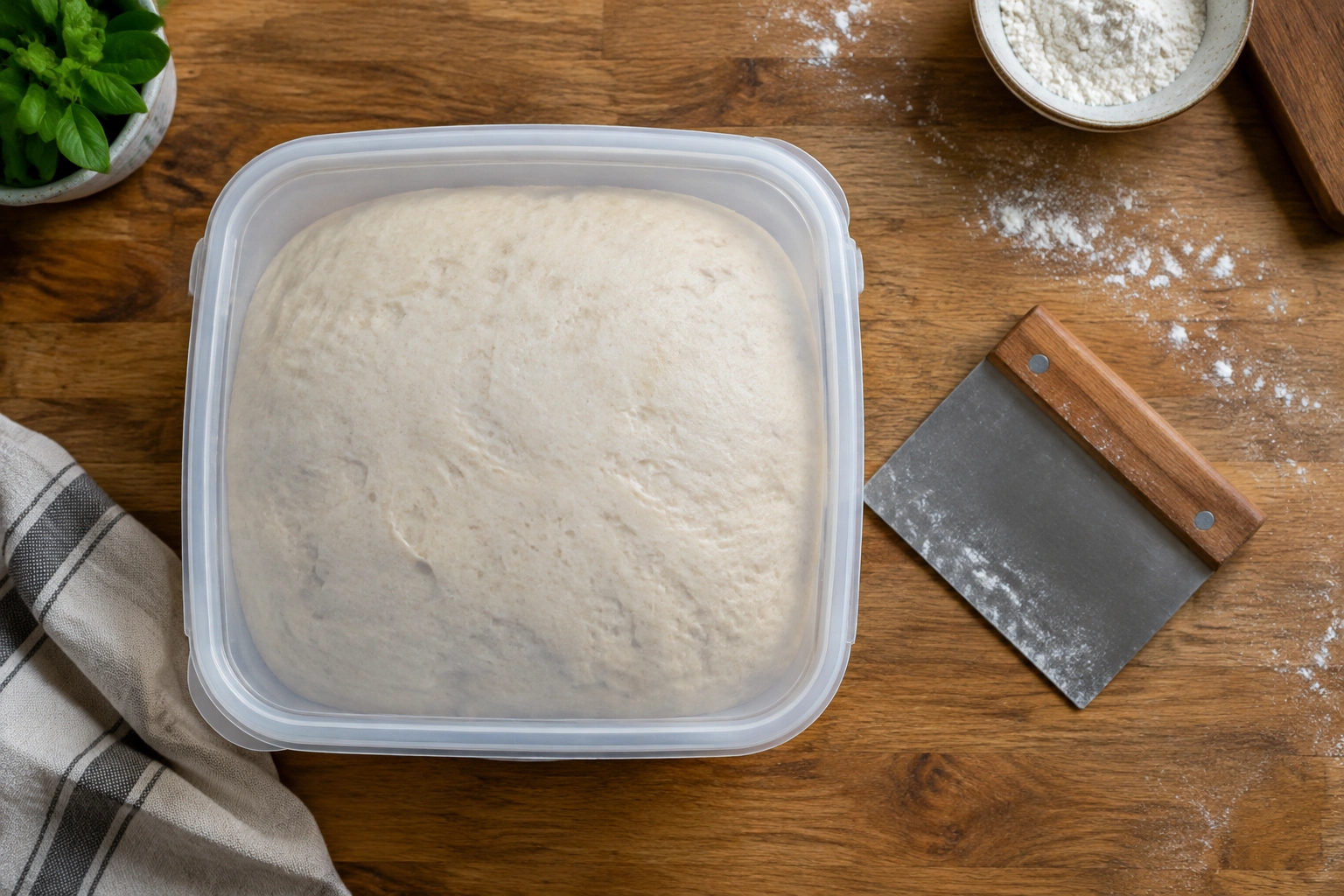
- The dough has increased in volume
- The surface is smoother and slightly domed
- Bubbles appear along the edges or beneath the surface
- The dough feels lighter and more aerated
- It jiggles gently when the container is moved
- It still has strength and does not collapse when handled lightly
Add tactile checks
- When you poke the dough lightly, the indentation should spring back slowly, not snap back immediately and not stay collapsed.
- When you lift or tilt the container, the dough should feel airy and elastic, not dense and rubbery.
- When you turn it out, it should release with some tension but not tear or puddle instantly.
What rise is typical?
Not every dough should double. As a rough guide:
– Lean yeasted doughs may be ready with a noticeable rise, often close to doubled if the formula is designed that way.
– Sourdough country loaves are often ready before a full double, especially when they are warm and well developed.
– High-hydration doughs may show a more modest rise and still be ready if they are bubbly, domed, and strong enough to shape.
A better question is: Does the dough look airy, organized, and strong enough to shape?
How Temperature, Hydration, and Flour Change Bulk Timing
Temperature
Warmer dough ferments faster because yeast and bacterial activity speed up. Cooler dough moves more slowly. That is why two identical doughs can behave very differently in different kitchens.
Hydration
Higher hydration doughs often ferment with a looser, more open feel. They can produce a more open crumb, but they are also harder to judge because they spread more and may seem “less done” than they really are.
Flour strength
Strong flour can usually handle a longer bulk and more folding. Weak flour may lose structure if bulk runs too long, especially in a warm room. If your dough collapses easily after folds, the flour may not be the problem alone, but it is part of the equation.
Decision rule
If the dough is warm, active, and already showing bubbles and lift, check it earlier. If the dough is cool and still dense, give it more time before deciding.
Room-Temperature Bulk vs Cold Bulk Fermentation
| Approach | What it does well | Trade-off |
|---|---|---|
| Room-temperature bulk | Faster fermentation, easier to monitor in one session | Less scheduling flexibility; overfermentation can happen quickly in a warm kitchen |
| Cold bulk fermentation | Slows activity, gives scheduling flexibility, can support flavor development | Slower progress and harder-to-read dough if you are new to fermentation |
Cold bulk can be useful when you need to pause the process or fit baking around your day. It is especially helpful when a dough is moving too fast at room temperature. The downside is that cold dough often needs a longer recovery period before shaping or final proofing, and the visual cues are less obvious while it is chilled.
If your schedule is unpredictable, cold bulk is a valuable tool. If you are learning to read dough, room-temperature bulk is often easier to understand because the changes happen more visibly.
Common Bulk Fermentation Mistakes
Relying on time alone
A recipe time is a reference point, not a verdict. Your dough may be ready earlier or later.
Waiting for every dough to double
Some doughs are best shaped before they fully double. Others need more rise, depending on formula and temperature.
Overhandling the dough
Too many folds or too much rough handling can knock out gas and leave the dough feeling tight or torn.
Ending bulk too early
If the dough is still dense and under-aerated, the final loaf may bake up compact and bland.
Letting bulk go too long
Overfermented dough can become slack, sticky, and difficult to shape. Once structure weakens too far, shaping cannot fully repair it.
Troubleshooting: What to Do If the Dough Seems Too Tight, Too Slack, or Overfermented
If the dough is too tight
The dough may simply need more time. If it still feels dense and resistant, let it rest and reassess in 20 to 30 minutes. If it is only slightly tight but still holds together, one gentle fold can help it relax and organize. If it remains very stiff after resting, continue bulk rather than shaping right away.
If the dough is too slack
First ask whether it is underdeveloped or just very high hydration. If it still has some strength, do a gentle fold and give it another short rest. If it feels loose but not fragile, continue bulk and check again after 20 to 30 minutes. If it is spreading quickly, tearing, or losing shape after folds, move toward shaping sooner rather than trying to build much more strength.
If the dough is properly fermented
If the dough is aerated, slightly domed, and still resilient, shape it now. Don’t wait for it to look dramatically bigger if the texture and rise already point to readiness. This is the point to divide, pre-shape, and rest before final shaping.
If the dough seems overfermented
If the dough feels fragile, sticky, and hard to hold together, stop bulk and refrigerate it briefly if you need to slow things down before shaping. Then handle it gently and shape with minimal manipulation. You are no longer trying to build much more strength; you are trying to preserve what remains.
A practical point: once dough is clearly overfermented, more waiting usually makes things worse, not better.
Practical Examples of Bulk Fermentation in Real Doughs
A sourdough country loaf at 75% hydration
This kind of dough often benefits from several early folds and careful observation near the end of bulk. It may look puffy, with bubbles around the edges and a slightly domed top. The key is not to wait for a dramatic doubling if the dough already feels aerated and strong.
A yeasted sandwich loaf in a warm kitchen
Commercial yeast can move quickly, especially in warm conditions. The dough may reach readiness sooner than the recipe suggests. If it is visibly expanded, smooth, and elastic, trust the dough rather than the clock.
A dough moved to the refrigerator partway through bulk
This is useful when life interrupts baking. The cold slows fermentation, buying you time. Just remember that once the dough comes back to room temperature, fermentation resumes and the dough may need a little extra observation before shaping.
Bulk Fermentation Checklist Before Shaping
Use this quick check before you divide or shape:
- The dough has visibly expanded
- The surface looks smoother and slightly domed
- Bubbles are visible at the edges or beneath the surface
- The dough feels lighter and more elastic than when mixed
- It jiggles gently in the container
- It still holds together when turned out
- A light poke springs back slowly rather than snapping back instantly
- It feels airy and resilient, not dense, rubbery, or soupy
If most of those signs are present, bulk is probably ready. If the dough still feels dense, tight, and flat, give it more time. If it feels fragile, slack, and overly gassy, move on carefully and avoid further delay.
Final Thoughts
Bulk fermentation is where bread becomes bread. It is the stage that shapes flavor, structure, and the way your loaf behaves in the oven. Once you learn to read the dough—its rise, its bubbles, its jiggle, its strength—you stop depending on a single timer and start making better decisions.
That shift is what separates guesswork from good baking.