
Candy Thermometer vs Meat Thermometer: Which One Belongs in Your Kitchen?

If you cook at home often, the question is simple: do you need a candy thermometer, a meat thermometer, or one tool that can do both? The short answer is that they are built for different jobs, and that difference matters more than most people realize.
Yes, a candy thermometer can sometimes be used for meat if it reaches the needed internal temperature range and can be used safely in the food. No, it should not be used as a substitute for meat cooking if it is hard to place accurately, hard to read, or outside the range you need.
A candy thermometer is made for higher heat, especially sugar work and hot oil. A meat thermometer is made to check safe internal temperatures in foods like chicken, roasts, and pork. Some thermometers can overlap, but not all of them do. In practical home cooking, the best thermometer is the one with the right temperature range and probe style for the task. If you use the wrong one outside its range, you can get a bad reading at best and risk ruining a batch of caramel or missing a safe poultry temperature at worst.
For busy home cooks and budget-conscious families, the goal is not to collect gadgets. It is to buy the few tools that actually help you cook safely and avoid waste.
Can You Use a Candy Thermometer for Meat?
Yes, sometimes. If a candy thermometer also reads accurately in the temperature range you need for meat, it can work for checking doneness. That said, it is usually not the most convenient tool for everyday meat cooking.
The main issue is design. Candy thermometers are often made to stay clipped to a pot while syrup or oil heats. Meat thermometers are often designed to measure the internal temperature of food, either as an instant-read tool or a leave-in probe. That difference affects how easy the tool is to use in a roast, chicken breast, or meatloaf.
A candy thermometer can make sense for meat only if:
– it can be inserted safely into the food,
– it gives a reliable reading in the meat temperature range,
– and it is easy to read without burning yourself or guessing.
Where it falls short is speed and placement. If you are checking a chicken thigh in a hot oven, a tool designed for internal food temperature is usually easier and safer to use.
Candy Thermometer vs Meat Thermometer: What’s the Difference?
The biggest difference is what each tool is built to measure.
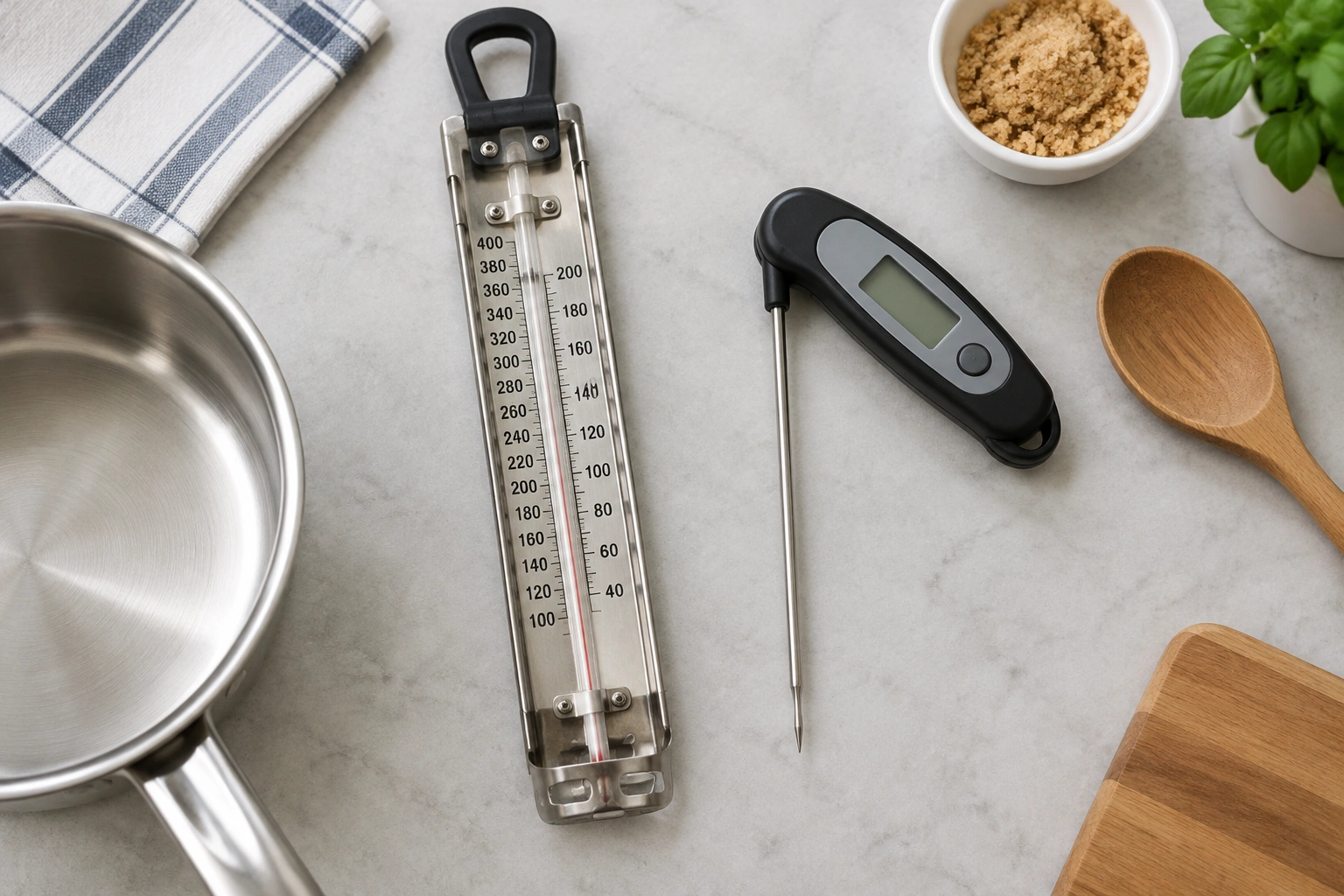
A candy thermometer is meant for sugar stages and other high-heat cooking tasks. Many models are designed to handle temperatures up to about 400°F/200°C or more, which is why they are useful for caramel, fudge, syrup, and frying oil. That higher range is the key feature.
A meat thermometer is built around internal food temperature. That matters because food safety depends on the center of the food reaching the right temperature, not just the surface. For example, poultry and ground meats need accurate internal readings, and that is exactly what meat thermometers are meant to provide.
There is also a design difference:
– Candy thermometers are often clip-on, so they can hang on the side of a pan.
– Meat thermometers are often probe-style, either instant-read or leave-in.
Those design choices are not cosmetic. They change how the thermometer behaves in real cooking. A clip-on thermometer is handy for a pot of syrup, but awkward for a roast. A probe-style meat thermometer is excellent for checking a turkey breast, but may not be ideal for a pan of boiling sugar.
Temperature Range: Which One Handles the Heat You Need?
This is the section that matters most if you want one tool to do a lot.
A candy thermometer usually needs a higher maximum range than a meat thermometer. Sugar stages and frying oil can climb well above the temperatures used for most meat doneness checks. As a general rule, if a thermometer is only designed to read around 200–210°F, it may not be suitable for high-heat candy work.
That is why a candy thermometer is often the safer choice for:
– caramel and toffee,
– sugar syrups,
– deep frying oil,
– and other high-heat stovetop tasks.
A meat thermometer, on the other hand, is usually the better fit for:
– chicken, turkey, pork, and beef,
– meatloaf,
– casseroles with a protein center,
– and other foods where the internal temperature matters most.
A practical way to decide:
– If your highest-heat task is frying or candy, choose the higher-range thermometer first.
– If your main concern is safe doneness in meat, choose a meat thermometer first.
– If you do both regularly, check the manufacturer’s temperature range before assuming one tool can cover both jobs.
For a quick reference, this is the simplest way to think about it:
| Task | Better Tool | Why |
|---|---|---|
| Checking chicken or turkey | Meat thermometer | Measures internal doneness |
| Checking steak or pork roast | Meat thermometer | Fast, targeted internal reading |
| Deep frying | Candy thermometer | Handles higher oil temperatures |
| Caramel or sugar syrup | Candy thermometer | Built for high-heat sugar stages |
| Occasional all-purpose use | Either, if specs fit | Only if range and design match the task |
Best Uses for Each Thermometer in Home Cooking
When a meat thermometer earns its keep
A meat thermometer is the more practical everyday tool for most households. If you roast chicken once a week, cook pork chops, or want to avoid cutting into meat to “check,” this is the tool to buy first.
It is especially useful when:
– you need a quick internal reading,
– you want to avoid overcooking,
– or you cook foods where safety depends on doneness.
A good example is roast chicken. You do not want to guess based on color or juices alone. A thermometer gives you a clearer answer and helps prevent both undercooking and drying the meat out.
When a candy thermometer is the better fit
A candy thermometer shines when heat climbs and timing gets less forgiving. Sugar can move from nearly done to burnt very quickly, and oil temperature can swing enough to affect texture and browning.
Use it for:
– caramel,
– brittle,
– fudge,
– syrup,
– and deep frying.
If you have ever had oil that was too cool and made greasy food, or too hot and browned the outside before the inside cooked, you already know why this matters. A thermometer removes a lot of that guesswork.
Can One Thermometer Do Both Jobs?
Sometimes, yes. But the key word is sometimes.
A single thermometer can cover both candy and meat if it has:
1. a high enough temperature range for sugar work and frying,
2. a design that works for internal food readings,
3. and a response time that is useful in real cooking.
That said, one multiuse tool is not always the most convenient answer. A clip-on candy thermometer can be awkward for checking a roast. A fast instant-read meat thermometer may not be ideal for holding in hot oil or syrup for long periods.
Here is the trade-off in plain language:
- One thermometer saves money and drawer space.
- Two specialized thermometers are easier to use correctly and usually less frustrating.
For most home cooks on a budget, the better first buy is a reliable instant-read meat thermometer, because it covers the most common everyday need: safe, accurate internal temperatures for meat. Add a candy thermometer only if you fry food or make candy often enough to justify it. If you rarely make sweets or fry food, a single high-quality meat thermometer may be enough for most of your cooking.
Digital vs Analog, Instant-Read vs Leave-In: Which Type Is Better?
The style matters almost as much as the category.
Digital vs. analog
Digital thermometers are usually easier to read quickly. That helps when you are checking meat or trying to avoid overcooking. Many home cooks prefer them for speed and convenience.
Analog thermometers are simple and do not need batteries, which some people like. They can be useful for candy work or frying if the model is built for high heat and is easy to clip to a pot.
Instant-read vs. leave-in
An instant-read thermometer is meant for quick checks. Insert it, wait for the reading, and remove it. That makes it great for steaks, chicken, and pork.
A leave-in thermometer stays in the food while it cooks. That is useful for roasts or larger cuts where you want to monitor temperature without opening the oven repeatedly.
For candy and frying, a clip-on style is often more useful than a leave-in meat probe because you are watching the temperature of the liquid itself, not the center of a solid food.
If you want the simplest setup for everyday cooking, an instant-read digital meat thermometer is usually the most versatile first buy. If you regularly make candy or fry food, add a high-heat thermometer designed for that job.
How to Check Accuracy and Use a Thermometer Safely
Even a good thermometer can mislead you if it is used badly.
Here is the practical checklist I use when teaching home food preservation and safe cooking:
- Keep the sensing area in the right place. For meat, that means the thickest part of the food, away from bone and the bottom of the pan. For syrup or oil, follow the clip placement instructions so the tip is submerged correctly.
- Wait for the reading to settle. A fast glance is not the same as a stable reading.
- Do not let the thermometer touch the pan bottom unless the manufacturer says it can. The pan can be hotter than the food or liquid and give you a false high reading.
- Check the thermometer occasionally for accuracy. A simple home sanity check is to test it in ice water, which should read close to 32°F (0°C), and then compare it with a known boiling-water reading adjusted for your elevation. If the reading seems off, follow the manufacturer’s instructions for calibration.
For meat, accuracy matters because undercooked poultry or ground meat is a food safety problem, not just a texture issue. For candy, accuracy matters because a few degrees can change the result from soft and smooth to grainy or burnt.
For specific safe internal temperature guidance, the USDA Food Safety and Inspection Service lists poultry at 165°F, ground meats at 160°F, and whole cuts of beef, pork, veal, and lamb at 145°F with a rest time.
What Budget-Conscious Home Cooks Should Buy
If you only want to buy one thermometer right now, I would choose based on your most common cooking job:
- Mostly meat, casseroles, and weeknight dinners: buy a digital instant-read meat thermometer.
- Mostly candy, frying, and sugar work: buy a high-range candy thermometer.
- A mix of both: buy a meat thermometer first, then add a candy thermometer later if you actually use it.
That recommendation is practical, not fancy. Most families get more day-to-day use from a good meat thermometer because it helps with safe doneness in chicken, pork, and roasts. If you only make candy a few times a year, it may not justify becoming your first purchase.
If you are also organizing your kitchen for safer meal prep, these guides may help:
– Where Should Meat Be Stored in the Fridge? A Practical Food Safety Guide
– Where Should Raw Meat Be Stored in a Refrigerator? A Practical Food Safety Guide
When to Ask a Food Safety Expert
If you are unsure whether a thermometer is accurate enough for a specific food, or you are cooking for someone with a higher food safety risk, ask a qualified food safety professional or follow official guidance from trusted sources. That is especially wise if you are relying on a thermometer for poultry, ground meats, or large-batch food prep.
For most home cooks, though, the decision is straightforward: match the thermometer to the highest heat or most safety-critical task you do most often.
Bottom Line
The candy thermometer vs meat thermometer decision comes down to purpose. Candy thermometers are built for higher heat and are best for sugar work and frying. Meat thermometers are built for internal food temperature and are best for safe, accurate doneness checks.
If you cook mostly meat, buy the meat thermometer first. If you make candy or fry food regularly, add a high-heat candy thermometer. If you want one tool to do both, check the temperature range carefully before you buy.