
Do Air Fryers Cause Health Issues? What the Evidence Says

Quick Answer
Air fryers are not known to cause a unique health problem when used as intended. The main concerns come from high-temperature cooking, over-browning foods, improper food handling, overheated or damaged cookware surfaces, and burns or smoke—not from the air fryer technology itself. The FDA’s information on acrylamide explains one of the most discussed cooking-related concerns.
Health concerns worth understanding
- Acrylamide: High-temperature browning can produce acrylamide in starchy foods such as potatoes and grain products.
- Food safety: Meat and poultry can still be unsafe if the center does not reach a safe internal temperature.
- Nonstick surfaces: Use baskets and trays within their intended temperature range and follow the manufacturer’s care instructions.
- Smoke and residue: Old grease, crumbs, and excess fat can smoke when exposed to intense heat.
- Burns: Baskets, racks, pans, steam, and heating elements become hot enough to cause injury.
The simplest approach
- Cook food until golden rather than heavily browned, keep the appliance clean, use a thermometer for meat, and follow the manual for your specific model.
If you’ve wondered, “Do air fryers cause health issues?” you’re asking a reasonable question. Air fryers combine high heat, strong airflow, nonstick cooking surfaces, and intense browning, so several different safety topics often get lumped together.
As of 2026, the evidence does not show that normal air-fryer use creates a special disease risk. What matters more is what you cook, how dark you cook it, how you maintain the appliance, and whether food reaches a safe temperature.
In This Guide
- What health issues are actually linked to air fryers?
- Does air frying produce acrylamide?
- Are nonstick air fryer baskets a health concern?
- Can an air fryer cause food poisoning, burns, or smoke?
- Is air frying healthier than deep frying or baking?
- How can you use an air fryer more safely?
- Air fryer health and safety FAQs
What Health Issues Are Actually Linked to Air Fryers?
Air fryers themselves are not known to create a unique health condition. The meaningful risks are mostly the same ones found with other high-temperature cooking appliances.
An air fryer is a compact convection cooker that uses an electric heating element and a powerful fan to move hot air rapidly around food. That airflow dries the surface and promotes browning without submerging the food in oil.
The health discussion makes more sense when you separate the appliance from the cooking process.
- High-temperature browning: It can create compounds such as acrylamide in certain carbohydrate-rich foods.
- Diet quality: Air-fried fries, nuggets, and pastries do not become nutritionally balanced simply because they were air fried.
- Undercooking: Fast exterior browning can make meat look finished before the center reaches a safe temperature.
- Cookware condition: Baskets and accessories should be used according to their temperature and care instructions.
- Heat exposure: Hot metal, steam, and rendered fat can cause burns.
One thing I pay attention to is appearance versus actual doneness. Strong convection can brown chicken or baked food quickly, so color alone is not a reliable food-safety test.
That distinction matters. A dark, crisp exterior tells you about surface browning—not necessarily the center temperature.
Does Air Frying Produce Acrylamide?
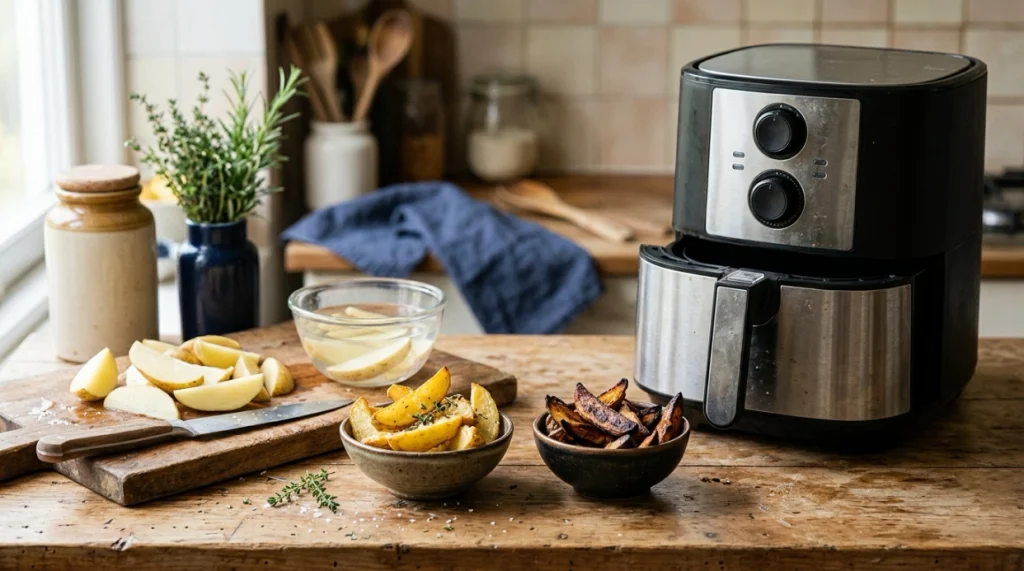
Yes, air frying can produce acrylamide in certain foods because it uses high-temperature dry heat. Acrylamide is mainly associated with plant foods such as potatoes and grain products rather than meat, dairy, or seafood.
Acrylamide forms through chemical reactions between naturally occurring sugars and the amino acid asparagine. Frying, roasting, and baking can all create it.
The FDA notes that laboratory animals developed cancer after exposure to much higher acrylamide levels than people normally encounter in food. The exact risk from typical dietary exposure in humans remains uncertain.
Which air-fried foods deserve the most attention?
Starchy foods that become deeply browned deserve more attention than foods that do not contain the same acrylamide-forming combination.
- French fries and potato wedges
- Hash browns
- Toast and bread products
- Crackers and grain-based snacks
- Some baked goods
Cooking potatoes longer or darker generally increases acrylamide formation. The FDA recommends aiming for a golden-yellow rather than dark-brown color when cooking cut potatoes.
When I air-fry potatoes, that is the visual target I use. I would rather stop at crisp and golden than chase a nearly burnt crust.
Can you reduce acrylamide when using an air fryer?
Yes. You can reduce unnecessary browning without giving up the appliance.
- Cook potato products until golden rather than dark brown.
- Avoid intentionally charring starchy foods.
- Don’t add extra cooking time just for darker color.
- Soak freshly cut raw potatoes in water for 15 to 30 minutes, then drain and dry them before cooking.
- Eat a varied diet instead of relying heavily on browned potato and grain snacks.
The FDA provides more preparation guidance in its information on reducing acrylamide during food preparation.
Are Nonstick Air Fryer Baskets a Health Concern?
Many air fryer baskets use nonstick coatings, and concern about PFAS or PTFE often appears in discussions about air fryer safety. The important details are the coating type, its condition, and whether you use it as intended.
The FDA states that certain polymerized PFAS are authorized for nonstick cookware applications. Available migration data indicate that negligible amounts from these coatings are capable of moving into food under their intended use.
You can read the FDA’s current explanation of PFAS in food-contact applications for more context.
What if the basket is scratched or peeling?
A visibly deteriorating cooking surface is different from a basket in good condition. I would replace a basket with extensive peeling, flaking, or damage instead of continuing to scrub and cook on it indefinitely.
Use silicone, wood, or other utensils recommended by the manufacturer. Avoid aggressive abrasive pads unless the care guide specifically allows them.
- Follow the air fryer’s maximum temperature limit.
- Do not place unknown plastic containers inside the cooking chamber.
- Use only heat-safe accessories that fit without blocking airflow.
- Inspect removable trays and baskets during regular cleaning.
- Replace badly damaged parts with compatible replacements.
Health Canada also advises using and maintaining nonstick cookware according to manufacturer instructions and avoiding excessive overheating.
Can an Air Fryer Cause Food Poisoning, Burns, or Smoke?
Yes, these are more immediate risks than most long-term claims discussed online. An air fryer can undercook food, cause burns, or smoke if it is used or maintained poorly.
Food can brown before it is safely cooked
Airflow can produce a crisp exterior quickly. Thick chicken breasts, frozen meat, stuffed foods, and crowded baskets may need more time for heat to reach the center.
Use a food thermometer rather than relying only on cooking time or exterior color.
| Food | Safe Minimum Internal Temperature | Important Note |
|---|---|---|
| Chicken and turkey | 165°F / 74°C | Includes ground poultry |
| Ground beef, pork, lamb, or veal | 160°F / 71°C | Measure in the center |
| Beef, pork, lamb, or veal steaks/chops/roasts | 145°F / 63°C | Rest for 3 minutes |
| Fish | 145°F / 63°C | Check the thickest portion |
| Leftovers | 165°F / 74°C | Reheat thoroughly |
Pro tip: For raw meat and poultry, use the verified FoodSafety.gov minimum internal temperature chart rather than relying on minutes alone.
Why does an air fryer sometimes smoke?
Grease, crumbs, marinades, cheese, and fatty drippings can reach hot surfaces. Residue left near the heating element may smoke again during later cooking.
- Clean the basket and crisper tray after greasy foods.
- Check the area near the heating element after the unit cools.
- Avoid pouring excessive oil into the basket.
- Stop the appliance if you see unusual heavy smoke or smell melting plastic.
Some light vapor from moisture or cooking fat can occur. Persistent smoke, electrical smells, sparking, or melting components are reasons to unplug the appliance and inspect it.
Is Air Frying Healthier Than Deep Frying or Baking?
Air frying can reduce the amount of added cooking oil compared with deep frying because food is not submerged in hot oil. That does not automatically make every air-fried meal healthy.
A frozen breaded snack remains a processed snack after air frying. The appliance changes the cooking method, not the basic nutritional makeup of the food.
Air frying versus deep frying
The biggest practical difference is oil. Deep frying surrounds food with hot oil, while an air fryer uses rapidly circulating heated air and usually needs little or no added oil.
For someone trying to cut back on large amounts of frying oil, that difference can be useful. Portion size, sodium, saturated fat, refined carbohydrates, and the food itself still matter.
Air frying versus baking
These methods are much closer. Both rely primarily on dry heat, while the air fryer concentrates convection airflow in a smaller chamber.
I think of an air fryer as a compact convection oven rather than a magical health appliance. That description keeps expectations realistic.
It can be a good way to cook vegetables, fish, chicken, potatoes, or small portions quickly. It can also cook fries, pastries, pizza, and highly processed snacks.
The health difference therefore depends heavily on what goes into the basket.
How Can You Use an Air Fryer More Safely?
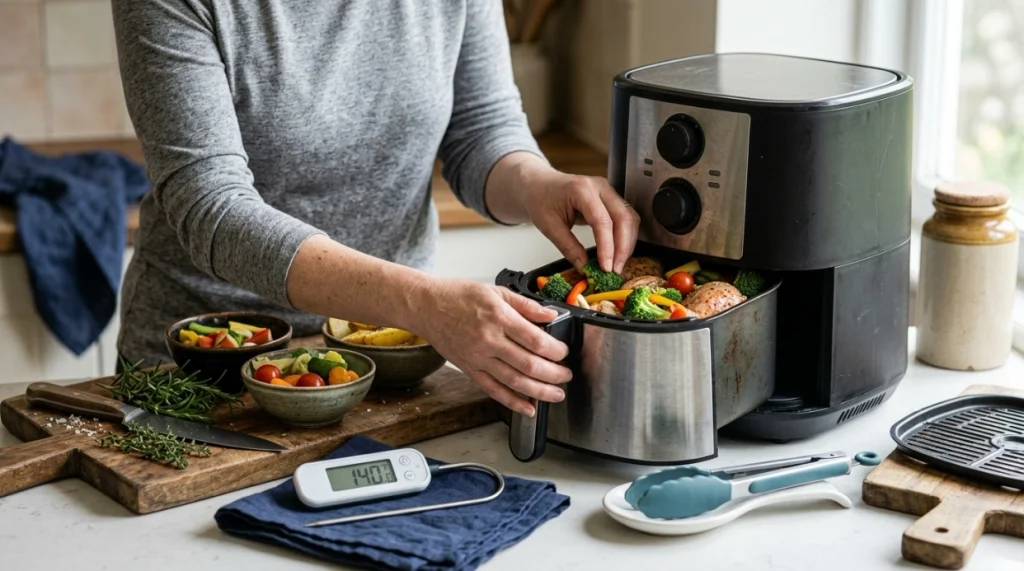
You don’t need a complicated routine. A few habits address most realistic air fryer health and safety concerns.
- Read your model’s manual. Temperature limits, cleaning instructions, accessories, clearances, and operating procedures vary by appliance.
- Keep it clean. Remove grease, crumbs, and burnt residue once the appliance has cooled.
- Avoid excessive browning. Aim for golden potato and grain foods rather than intentionally dark or burnt surfaces.
- Use a thermometer. Check thick meats and poultry at the center instead of trusting color or a timer.
- Don’t overcrowd the basket. Leave enough space for moving air to reach the food.
- Inspect the cooking surface. Replace badly peeling or damaged baskets and trays.
- Use heat-safe accessories. Don’t assume every plastic, paper, glass, or silicone item belongs in an air fryer.
- Give the appliance ventilation. Keep it on a stable, heat-resistant surface with the clearances required by its manufacturer.
One mistake I avoid is treating preset buttons as proof that food is finished. A preset is a convenient starting point, not a measurement of internal doneness.
Batch size, food thickness, starting temperature, and individual air fryer design can all affect cooking speed. Check the food itself.
Air Fryer Health and Safety FAQs
Do air fryers cause cancer?
There is no established evidence that normal air fryer use itself causes cancer. High-temperature cooking can produce compounds such as acrylamide in some starchy foods, but the FDA says the precise human health risk from typical dietary acrylamide exposure remains uncertain.
Is it unhealthy to use an air fryer every day?
Daily use is not automatically unhealthy. What matters more is the foods you prepare, overall diet quality, cooking temperatures, how heavily foods are browned, and whether the appliance is maintained and used correctly.
Are air fryer fumes toxic?
Normal cooking odors are not the same as toxic fumes. Heavy smoke, melting-plastic smells, electrical odors, or unusual fumes should be treated as warning signs, and the appliance should be switched off and inspected after it cools.
Is air-fried food inflammatory?
There is no single answer because “air-fried food” describes a cooking method, not one food. Air-fried vegetables, salmon, French fries, chicken nuggets, and pastries have very different nutritional profiles.
Should I worry about PFAS in an air fryer?
Some nonstick cookware coatings involve polymerized PFAS such as PTFE. The FDA says studies show negligible amounts of PFAS capable of migrating from authorized nonstick coatings into food, but consumers should still follow the manufacturer’s intended-use and care instructions.
Can an air fryer make chicken safe without a thermometer?
A thermometer is the most reliable way to confirm doneness. FoodSafety.gov lists 165°F (74°C) as the safe minimum internal temperature for chicken and other poultry.
Is an air fryer healthier than a microwave?
Neither appliance is automatically healthier because they cook food differently. A microwave is useful for heating and steaming, while an air fryer excels at dry browning and crisping; the nutritional result depends mainly on the food and preparation method.
Bottom line: Air fryers do not appear to create a special health threat when used correctly. The sensible approach is to avoid excessive browning, cook raw food to safe temperatures, maintain the basket and heating area, and use the appliance within its manufacturer’s instructions.
If you already enjoy using an air fryer, there is no evidence-based reason to panic about the appliance itself. Focus on safe cooking habits and the quality of the food you put into it.