
Do Air Fryers Cause Health Problems?

Quick Answer
Air fryers do not appear to cause health problems simply because they use rapidly circulating hot air. The bigger concerns involve what you cook, how dark or hot you cook it, food safety, burns, and the condition of nonstick surfaces. High-temperature cooking can form acrylamide in some starchy foods, whether you use an air fryer, oven, or conventional fryer.
What matters most
- Cooking temperature: Excessive heat and long cooking can increase browning and acrylamide formation in foods such as potatoes and bread.
- Food choice: Air-fried vegetables and homemade meals are different nutritionally from heavily processed frozen snacks.
- Oil use: Air frying normally needs far less added oil than deep frying.
- Basket condition: Replace baskets with badly scratched, peeling, or flaking nonstick coatings.
- Food safety: Raw meat and poultry still need to reach safe internal temperatures.
- Appliance safety: Hot baskets, vents, grease, and poor ventilation can cause burns or fire hazards.
Simple rule
- Cook food until properly done, but avoid routinely taking starchy foods from golden brown to very dark brown.
If you’ve wondered, “Do air fryers cause health problems?” you’re asking a sensible question. Air fryers cook fast and run hot, so it is worth separating genuine concerns from scary claims that lack context.
As of 2026, I would not treat an air fryer as either a dangerous appliance or a magic health machine. The health impact depends far more on the food, temperature, cooking time, appliance condition, and how you use it.
In This Guide
- Do air fryers cause health problems?
- Can air fryers cause cancer because of acrylamide?
- Are nonstick air fryer coatings a health concern?
- Is air frying healthier than deep frying?
- What mistakes can make air-fried food less healthy?
- How can you use an air fryer safely every day?
- Air fryer health and safety FAQ
Do Air Fryers Cause Health Problems?
For most people, normal air fryer use is not known to cause a unique health problem. An air fryer mainly changes how heat reaches your food.
Definition: An air fryer is a compact convection-style appliance that circulates hot air rapidly around food. The moving air speeds surface browning and crisping without submerging food in hot oil.
That matters because the appliance itself is only part of the picture. A basket of vegetables cooked with a teaspoon of oil has little in common nutritionally with a basket full of highly processed frozen snacks.
- The appliance: Produces intense circulating heat.
- The food: Determines most of the meal’s calories, sodium, fat, fiber, and nutrients.
- The cooking level: Influences browning and formation of heat-related compounds.
- Your technique: Affects food safety, smoke, burns, and cleaning.
I find it more useful to ask, “What risks can come from high-temperature air frying?” That question leads to practical answers instead of treating every air-fried meal as equally healthy or unhealthy.
There are four concerns worth understanding: acrylamide in certain browned foods, nonstick coating condition, food safety, and physical burn or fire hazards. None of these is exclusive to air fryers.
Section Takeaway: Air fryers are hot-air cooking appliances, not a special source of disease. The meaningful risks come from cooking conditions, food choices, damaged equipment, and unsafe handling.
Can Air Fryers Cause Cancer Because of Acrylamide?
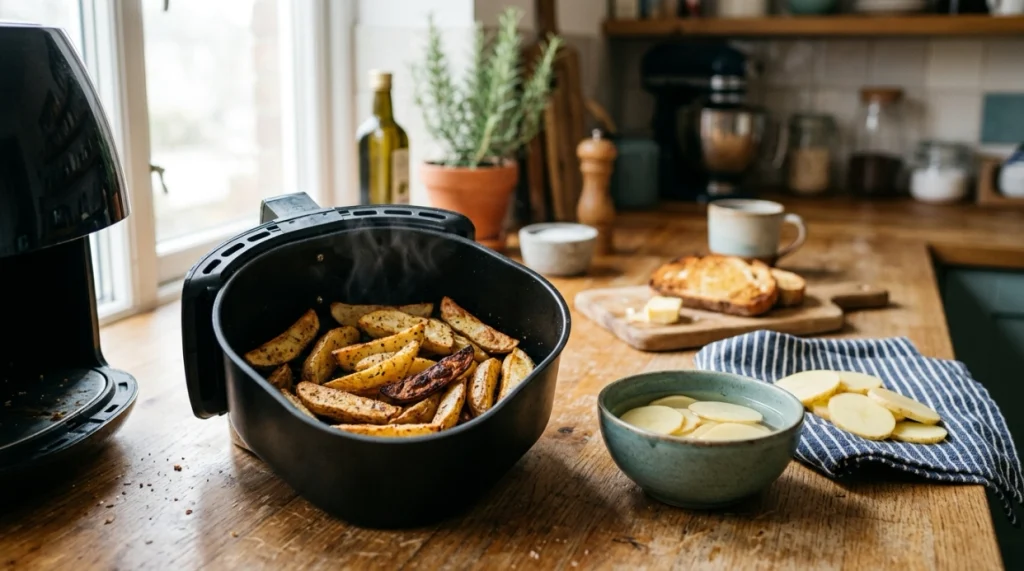
Air frying can form acrylamide in certain foods, but that does not mean eating air-fried food automatically causes cancer. Acrylamide also forms during baking, roasting, and conventional frying.
The FDA explains that acrylamide forms from natural sugars and the amino acid asparagine during high-temperature cooking. It occurs mainly in plant foods such as potatoes and grain products.
Which air-fried foods deserve the most attention?
Starchy foods that become deeply browned are the main ones I would watch. Think French fries, potato wedges, toast, crackers, and some baked grain products.
- French fries and potato wedges
- Potato chips or thin potato slices
- Toast and bread products
- Cookies and crackers
- Other starch-heavy foods cooked until dark brown
Meat, fish, and dairy are not considered major sources of acrylamide formation. Their safety concerns are different, especially adequate internal cooking temperature.
Does air frying produce less acrylamide than deep frying?
The research is not consistent enough for a blanket claim. Results change with temperature, cooking time, potato variety, thickness, moisture, soaking, and final color.
One controlled potato study published in 2015 reported substantially less acrylamide with air frying than conventional deep frying under its test conditions. A later study found higher average acrylamide in its air-fried potatoes, although differences between cooking methods were not statistically significant.
That is why I would not buy an air fryer based on an “acrylamide-free” promise. Cooking technique matters too much.
How can you reduce acrylamide?
- Aim for golden: Stop potatoes and toast before they become heavily browned or burned.
- Watch cooking time: Do not add extra minutes simply to chase maximum crispness.
- Avoid needless heat: Use the temperature needed for the recipe rather than automatically selecting the highest setting.
- Soak potatoes: The FDA notes that soaking raw potato slices for 15 to 30 minutes before frying or roasting can help reduce acrylamide formation.
- Dry after soaking: Drain and blot potatoes before putting them into the appliance.
The FDA’s broader advice is not to eliminate every baked, roasted, or fried food. A varied eating pattern matters more than obsessing over one appliance.
Section Takeaway: Acrylamide is a high-temperature cooking issue, not an air-fryer-only issue. Avoid excessive browning, especially with potatoes and grain-based foods.
Are Nonstick Air Fryer Coatings a Health Concern?
Some air fryer baskets use PTFE or other nonstick materials, so coating type and condition are worth checking. A damaged basket deserves more attention than an intact coating used according to its instructions.
Consumer Reports notes that some nonstick kitchen products, including air fryer components, may use PFAS-based materials. A label saying “PFOA-free” does not necessarily mean a product is free from every type of PFAS.
What should you do with a scratched air fryer basket?
I would stop using a basket if the coating is visibly peeling or flaking. Replacement is a better option than continuing to scrape and cook on a deteriorating surface.
- Do not clean nonstick baskets with steel wool.
- Avoid sharp metal utensils unless the manufacturer allows them.
- Use soft sponges or nonabrasive cleaning tools.
- Replace components with widespread peeling or flaking.
- Check the manufacturer’s material description when buying a new appliance.
If avoiding PFAS is important to you, look for products that clearly identify the food-contact materials. Stainless-steel interiors and baskets are available on some models.
Be careful with marketing language. “Ceramic,” “PFOA-free,” and “nonstick” do not all mean the same thing.
Section Takeaway: Check what your basket is made from, protect its surface, and replace badly damaged nonstick components rather than continuing to use them.
Is Air Frying Healthier Than Deep Frying?
Air frying can be a useful alternative to deep frying because it usually needs little or no added oil. That advantage does not automatically make every air-fried food healthy.
Consumer Reports describes air fryers as countertop convection ovens that cook with extremely hot circulating air. Traditional deep frying surrounds food with hot cooking oil.
| Cooking method | Cooking environment | Added oil | Acrylamide in starchy foods | Main practical concern |
|---|---|---|---|---|
| Air frying | Fast circulating dry heat | Usually little or none | Can form | Over-browning, hot surfaces |
| Deep frying | Food submerged in hot oil | High | Can form | Oil absorption, splatter, burns |
| Oven baking/roasting | Dry radiant or convection heat | Recipe dependent | Can form | Long cooking and heavy browning |
| Boiling/steaming | Moist heat | Usually none | Typically not formed | Avoiding overcooking |
The biggest nutritional advantage appears when air frying replaces deep frying rather than when it simply reheats processed food. Swapping a pot of oil for circulating air changes the cooking method substantially.
The ingredient list still wins. Air-fried broccoli, salmon, potatoes, chicken, or homemade pastries can fit into a balanced diet differently from heavily salted frozen fries and breaded snacks.
For baking, air fryers can also work like small convection ovens. King Arthur Baking’s air fryer guidance explains how the intense circulating heat affects browning and cook time.
Section Takeaway: Air frying’s strongest health advantage is reducing reliance on deep frying. It does not turn highly processed food into a nutrient-dense meal.
What Mistakes Can Make Air-Fried Food Less Healthy?
The most common health mistake is assuming the appliance matters more than the food. An air fryer can cook nutritious ingredients or become a reheating machine for salty, ultra-processed snacks.
Cooking everything until extremely dark
Deep browning can taste appealing, but darker is not always better. For potatoes and toast, I prefer a golden finish rather than pushing every batch toward dark brown.
The FDA specifically recommends lighter cooking for people who want to reduce dietary acrylamide. Its guidance says longer cooking and higher temperatures generally increase formation.
Depending too heavily on frozen convenience foods
Frozen nuggets, fries, pizza bites, and breaded snacks are easy in an air fryer. Their nutrition still depends on the ingredient list and portion size.
Check sodium, saturated fat, serving size, and added sugars instead of assuming “air fried” means healthy.
Overcrowding the basket
Overcrowding blocks airflow and can create uneven cooking. That can leave some pieces browned while thicker areas remain underdone.
- Leave space for air to circulate.
- Cook large amounts in batches.
- Turn or shake foods when the recipe calls for it.
- Check thick meat pieces with a thermometer.
Ignoring smoke and grease buildup
Old grease and food debris can smoke when reheated repeatedly. Keep the basket, drawer, crisper tray, and accessible interior areas clean.
Smoke is a signal to stop and check what is happening. Do not simply keep cooking through heavy smoke.
Section Takeaway: Good air frying is more about sensible food choices, controlled browning, proper airflow, and regular cleaning than chasing maximum crispness.
How Can You Use an Air Fryer Safely Every Day?
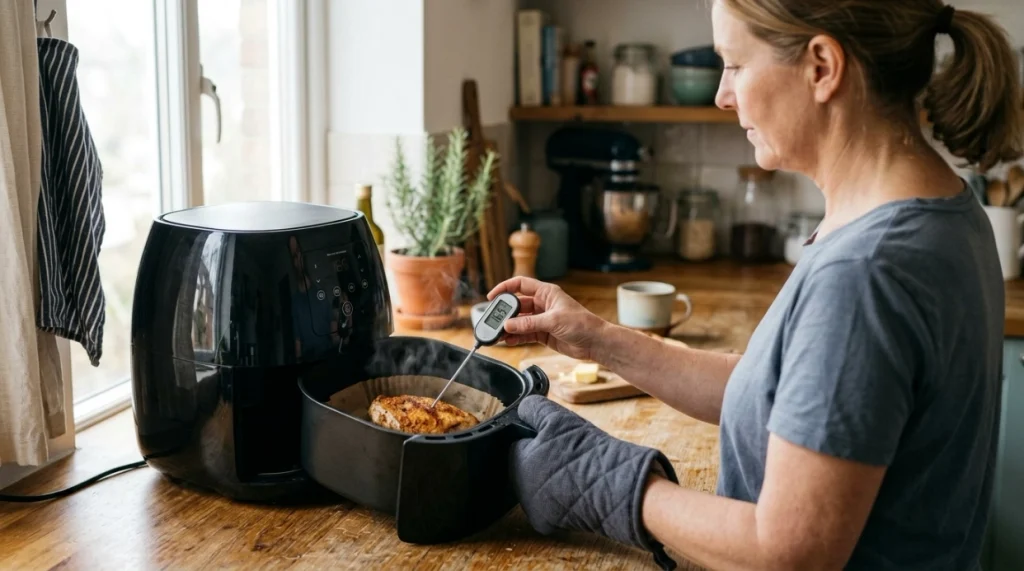
Treat an air fryer like a high-heat oven sitting on your countertop. The basket, exterior surfaces, exhaust air, and nearby objects can become hot.
Consumer Reports found potentially hazardous temperatures on several exterior areas during laboratory testing. Its air fryer heat-safety guidance recommends leaving clearance around the appliance and avoiding hot exterior parts.
Use this basic safety checklist
- Give it space: Keep the exhaust vent away from walls, cords, curtains, paper, and other heat-sensitive objects.
- Use a stable surface: Place the appliance on a heat-resistant countertop.
- Keep vents open: Never block air intake or exhaust openings.
- Watch loose liners: Do not let lightweight parchment contact the heating element.
- Handle carefully: Use the handle and oven mitts when necessary.
- Clean grease: Remove accumulated grease and crumbs regularly.
- Inspect the cord: Stop using an appliance with heat-damaged or frayed wiring.
Use a thermometer for raw meat
Air fryer timing charts are useful starting points, but thickness, starting temperature, basket load, and appliance power all change cooking time. A food thermometer provides a better safety check.
FoodSafety.gov lists 165°F (74°C) for chicken, turkey, casseroles, and leftovers. Whole cuts of beef, pork, lamb, and veal are generally listed at 145°F (63°C), with the required rest period where applicable.
Pro tip: Check the current safe minimum internal temperature chart instead of relying on cooking time alone.
One small habit makes a big difference: let the appliance cool before deep cleaning. Hot grease, hot metal, and water are a poor combination.
Section Takeaway: Safe air frying means good ventilation, clean equipment, careful handling, and thermometer-verified cooking when food safety is involved.
Air Fryer Health and Safety FAQ
Is eating air-fried food every day bad for you?
Not necessarily. The overall diet matters more than the appliance. Daily meals based on vegetables, whole grains, lean proteins, and minimally processed foods are different from eating air-fried frozen snacks every day, even though both use the same machine.
Do air fryers release harmful chemicals into food?
High-temperature cooking can create compounds such as acrylamide in certain starchy foods, but this is not unique to air fryers. If your basket has a damaged nonstick coating, replace it rather than continuing to cook on a badly peeling surface.
Are air fryers safer than deep fryers?
Air fryers avoid a large container of hot cooking oil, which removes some splatter and oil-handling risks. However, they still reach high temperatures, and their baskets, vents, and exterior surfaces can cause burns if handled carelessly.
Can an air fryer cause acrylamide in French fries?
Yes. Potatoes can develop acrylamide during high-temperature air frying. Cooking them to a golden color instead of dark brown, limiting excessive cooking time, and soaking raw potato slices before cooking can help reduce formation.
Should I worry about PFAS in an air fryer?
If PFAS exposure is a personal concern, check the manufacturer’s material information before buying. Some nonstick products use PTFE or related materials, while other appliances use stainless steel or alternative coatings. Replace surfaces that become badly chipped or flaky.
Is an air fryer healthier than an oven?
Neither method is automatically healthier. Both use dry heat and can cook nutritious foods with little oil. The advantage depends on the recipe, added fat, cooking temperature, browning level, serving size, and what the air-fried or oven-baked food contains.
Final takeaway: You do not need to fear your air fryer. Use moderate cooking times, avoid routinely burning starchy foods, keep the basket in good condition, cook raw foods safely, clean grease buildup, and remember that what you put in the basket matters more than the appliance itself.
If an air fryer helps you cook more vegetables, homemade meals, lean proteins, or small-batch baked foods with less deep frying, it can be a practical kitchen tool. Use it thoughtfully rather than assuming every air-fried meal is automatically healthy.