
Do Air Fryers Use Radiation to Cook Food?

Quick Answer
No, a standard air fryer does not use microwave, X-ray, or similar radiation to cook your food. It works mainly by heating air with an electric heating element and moving that hot air rapidly around the food with a fan, which is a form of convection cooking.
What happens inside an air fryer?
- Electric heat: A resistance heating element converts electricity into heat.
- Rapid airflow: A powerful fan circulates hot air around the basket or tray.
- Convection: Moving hot air transfers heat to the food’s surface.
- Some radiant heat: Like an oven or toaster, the hot heating element can also transfer ordinary infrared heat.
- No microwave generator: A typical air fryer does not contain the magnetron used to generate microwaves in a microwave oven.
The important distinction
- The word “radiation” can also describe ordinary heat transfer from a hot object. That is different from saying an air fryer cooks food using microwave or ionizing radiation.
If you’ve wondered whether an air fryer somehow “radiates” food because it cooks so quickly, you’re not alone. The speed can make the appliance seem more mysterious than it is.
I find the easiest way to understand an air fryer is to picture a small, powerful convection oven. Once you understand the heating element and fan, the radiation question becomes much easier to answer.
In This Guide
How Does an Air Fryer Actually Cook Food?
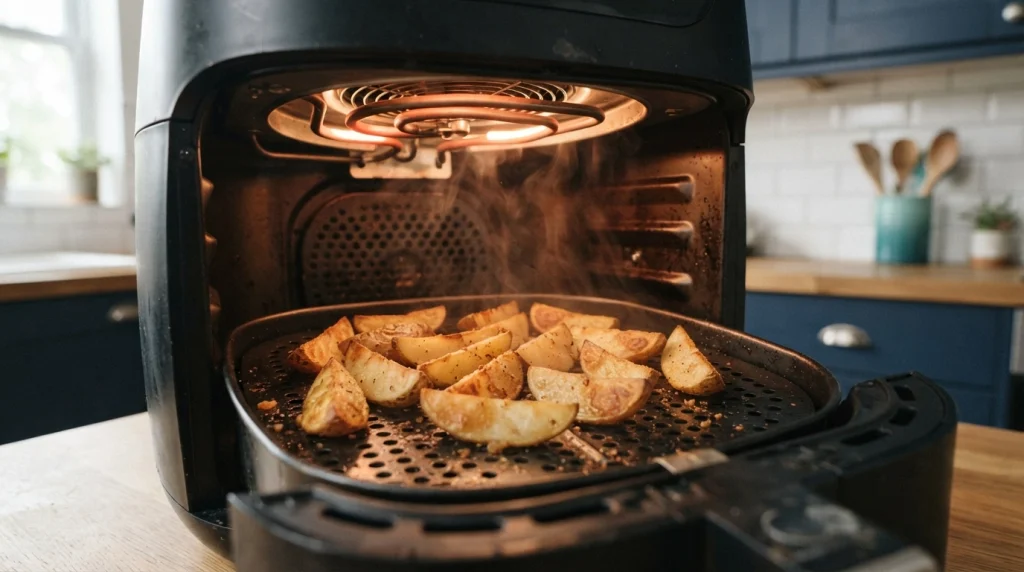
An air fryer cooks primarily through forced convection. An electric element creates heat, while a fan pushes the heated air rapidly around the food.
Convection cooking simply means transferring heat through moving air. A conventional convection oven uses the same basic principle.
The heating element creates the heat
Most countertop air fryers have an electric resistance heating element near the top of the cooking chamber. Electricity passing through that element causes it to become hot.
This basic mechanism isn’t unusual. Electric ovens, toaster ovens, and many countertop cooking appliances also use resistance heating elements.
The fan moves hot air around the food
The fan is what gives an air fryer its distinctive cooking style. It continually moves hot air across the exposed surfaces of your food.
That airflow makes surface moisture evaporate quickly. It also helps the exterior brown and become crisp.
- Heating element: Produces the heat.
- Fan: Circulates that heat.
- Basket or tray: Allows air to reach more of the food’s surface.
- Compact chamber: Keeps the heated air close to the food.
This is why crowding an air fryer basket can hurt the results. Food packed too tightly blocks airflow and reduces the appliance’s ability to cook evenly.
Consumer Reports likewise describes air fryers as appliances that circulate hot air around food rather than technically frying it.
Section Takeaway: An air fryer is essentially a compact forced-convection cooker. Its primary cooking tools are an electric heating element and rapidly moving hot air.
Does an Air Fryer Produce Any Radiation at All?
Yes, in the broad physics sense, a hot air fryer can produce thermal radiation. However, this does not mean it cooks food with dangerous ionizing radiation or microwave energy.
This distinction matters because the word “radiation” describes several very different physical processes.
What does thermal radiation mean?
A hot object can transfer energy through electromagnetic waves, mainly in the infrared part of the spectrum. This is called radiant heat or thermal radiation.
You encounter the same process near a conventional oven, toaster, grill, fireplace, or even a hot baking sheet.
The U.S. Department of Energy explains that heat moves through three basic mechanisms:
- Conduction: Heat travels through direct contact.
- Convection: Heat moves through air or another fluid.
- Radiation: Heat energy travels across space.
You can read the Department of Energy’s overview of heat-flow mechanisms for a broader explanation.
Does radiant heat make an air fryer radioactive?
No. An air fryer does not become radioactive, and it does not make your food radioactive.
Thermal infrared energy from a hot heating element is not the same thing as ionizing radiation from sources such as X-rays or radioactive materials.
The heating element simply becomes hot while electricity flows through it. Once the appliance cools, that heat dissipates.
Section Takeaway: Air fryers can involve ordinary infrared heat transfer, just as ovens and toasters do. That is fundamentally different from radioactive or ionizing radiation.
Air Fryer vs. Microwave: What Is the Difference?
An air fryer heats food mainly from the outside with circulating hot air. A microwave oven intentionally generates microwave-frequency electromagnetic energy that interacts with the food.
That difference explains why these appliances cook the same meal in noticeably different ways.
| Feature | Air Fryer | Microwave Oven | Conventional Oven |
|---|---|---|---|
| Primary cooking method | Forced convection | Microwave electromagnetic energy | Hot air, radiant heat, and conduction |
| Main heat-producing component | Electric heating element | Magnetron in conventional microwave designs | Gas burner or electric element |
| Fan commonly used? | Yes | Not required for microwave cooking | Yes in convection models |
| Best-known texture | Browned and crisp surfaces | Fast heating with limited surface crisping | Baking, roasting, and browning |
| Uses microwave energy? | No, in a standard standalone air fryer | Yes | No |
Why microwaves heat differently
The FDA defines microwave ovens as appliances designed to cook or heat food through electromagnetic energy in specified microwave-frequency bands. That’s a deliberate part of how a microwave oven operates.
The FDA also regulates microwave ovens under federal radiation-performance standards. You can review its information about microwave and radiofrequency-emitting products.
What about microwave-air-fryer combination appliances?
This is where the answer needs one qualification. Some appliances combine microwave cooking, convection heating, grilling, and air-fry modes in a single machine.
When such a combination appliance operates in microwave mode, it can use microwave energy. When its air-fry system operates, the air-fry function generally relies on heating elements and convection airflow.
Always check the manual for your exact appliance. A combination microwave-air-fryer is different from a standard standalone basket air fryer.
Section Takeaway: Standard air fryers and microwave ovens use different primary cooking technologies. Combination appliances can contain both technologies, so the selected cooking mode matters.
Is Air Fryer Radiation Dangerous?
For a normal standalone air fryer, “radiation exposure” isn’t the main safety concern. Heat, hot surfaces, steam, electrical safety, and correct appliance use deserve far more attention.
An air fryer can become extremely hot during operation. The basket, cooking chamber, exhaust area, and surrounding surfaces may remain hot after cooking ends.
Infrared heat is part of everyday cooking
Infrared thermal radiation is produced by warm objects all around us. Your oven walls, stovetop pan, toaster coils, and grill all emit thermal energy when hot.
That doesn’t make food radioactive. The food simply absorbs energy and becomes warmer.
What should you genuinely watch for?
- Hot surfaces: Touch the handle rather than the basket or metal cooking chamber.
- Hot exhaust: Keep the rear and upper vents clear.
- Steam: Open the basket carefully when cooking moist foods.
- Electrical damage: Stop using an appliance with a damaged cord or plug.
- Grease buildup: Clean residue to reduce smoke and unpleasant odors.
- Blocked airflow: Follow the manufacturer’s required clearance around vents.
Consumer Reports has found that some external air-fryer surfaces can become hot enough to create a burn hazard. Treat an operating air fryer much like another high-temperature cooking appliance.
If you smell burning plastic, see sparks, or notice damaged electrical parts, unplug the appliance when safe to do so. Follow the manufacturer’s troubleshooting and service instructions.
Section Takeaway: Ordinary air-fryer heat transfer should not be confused with dangerous ionizing radiation. Burns, steam, ventilation, and electrical condition are the practical safety issues to manage.
Why Does an Air Fryer Cook and Bake So Quickly?
An air fryer can feel surprisingly fast because it combines a compact cooking chamber with vigorous airflow. Less space must be heated compared with many full-size ovens.
The moving hot air also reaches exposed food surfaces continuously. That makes air fryers especially effective when browning and surface drying matter.
Why crisp food develops quickly
Crisping depends heavily on removing moisture from the exterior of food. Rapid airflow helps carry that surface moisture away.
Once the surface becomes drier, browning can develop more readily. That is why fries, breaded foods, vegetables, and reheated pastries can become crisp.
Air fryers are also useful for baking
You can bake cookies, rolls, small cakes, pastries, and other foods in many air fryers. King Arthur Baking describes an air fryer as essentially a small convection oven with a powerful fan.
Its air-fryer baking guide suggests starting with manufacturer recipes and adjusting conventional recipes carefully because airflow and chamber size affect baking.
One commonly used starting point for adapting conventional baking recipes is reducing the oven temperature by about 25°F. Cooking time may also need to be shortened.
Those figures aren’t universal rules. Air-fryer size, fan strength, pan material, food quantity, and recipe structure can all change the result.
Why I would check baked goods early
Air circulation can brown the top of a pastry before its center finishes baking. A smaller cake can behave differently from the same batter in a full-size oven.
For that reason, I recommend treating conversion formulas as starting points rather than guarantees. Check the food early and learn how your particular machine behaves.
Section Takeaway: Air fryers cook quickly because they concentrate heat and high-speed airflow inside a small chamber. Their speed comes from convection and appliance design, not from microwave radiation.
How Can You Use an Air Fryer Safely?
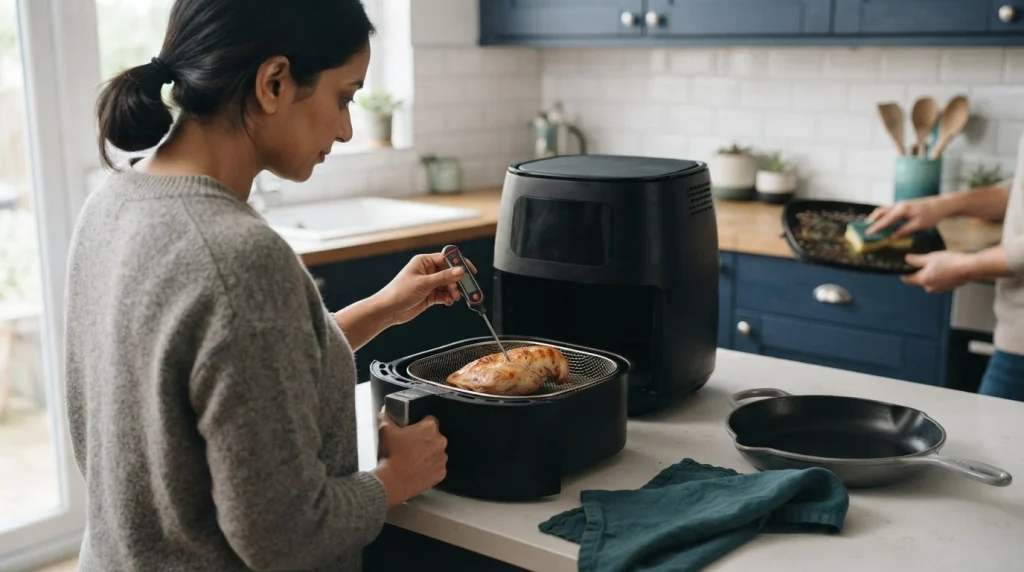
Use an air fryer as you would any powerful countertop heating appliance. Give it ventilation space, keep combustible materials away, and follow the model’s manual.
A few simple habits cover most everyday safety concerns.
- Place it on a stable, heat-resistant surface. Don’t operate it on an unstable tray, soft surface, or near the edge of a counter.
- Keep the vents unobstructed. Hot exhaust needs somewhere to escape.
- Don’t overfill the basket. Overcrowding can restrict airflow and produce uneven cooking.
- Use heat-safe accessories. Check that pans, racks, and dishes are appropriate for your appliance and temperature.
- Clean grease and crumbs regularly. Residue near hot components can smoke or burn.
- Unplug before deep cleaning. Let the appliance cool completely first.
- Check raw foods by temperature. Don’t rely solely on an air-fryer timer when food safety is involved.
Pro tip: When cooking raw meat or poultry, use a food thermometer and follow the verified FoodSafety.gov minimum internal temperature guidance rather than judging safety by cooking time or surface color alone.
As of 2026, air fryers come in many designs, including baskets, dual baskets, toaster-oven styles, and microwave combination appliances. Your manufacturer’s instructions should take priority over generic operating advice.
Section Takeaway: Treat your air fryer as a high-temperature convection appliance. Safe placement, ventilation, cleaning, and proper food-temperature checks matter much more than concerns about radiation.
Frequently Asked Questions
Do air fryers emit harmful radiation?
Standard standalone air fryers are not designed to cook using ionizing radiation or microwave energy. They cook mainly with an electrical heating element and rapidly circulated hot air, although their hot components can emit ordinary infrared thermal energy like an oven or toaster.
Do air fryers use electromagnetic radiation?
A hot heating element can emit infrared electromagnetic radiation as part of ordinary heat transfer. However, that is different from a microwave oven intentionally producing microwave-frequency energy to heat food.
Can an air fryer make food radioactive?
No. Cooking food in a standard air fryer does not make the food radioactive. The appliance transfers thermal energy to the food through hot air, surface contact, and some ordinary radiant heat.
Is an air fryer safer than a microwave?
They use different cooking systems, so safety depends on correct use rather than declaring one appliance universally safer. Air fryers involve high temperatures and burn risks, while microwave ovens are engineered and regulated to contain the microwave energy they produce.
Does an air fryer have a magnetron?
A normal standalone air fryer does not need a magnetron because it heats food with resistance heating and forced convection. A microwave-air-fryer combination appliance can contain microwave-generating hardware because it also has a microwave cooking function.
Why does my air fryer cook faster than an oven?
The cooking chamber is much smaller than a typical oven, while a powerful fan constantly moves heated air around the food. This combination can speed surface heating, moisture removal, and browning, particularly with smaller portions.
Are air fryers just small convection ovens?
That’s a useful description. Both rely heavily on moving hot air, but air fryers typically use a compact chamber and concentrated airflow that can produce faster browning and crisping than many larger convection ovens.
Final Takeaway: Do Air Fryers Use Radiation?
If you’re worried that an air fryer cooks food by blasting it with microwave-style or dangerous ionizing radiation, you can separate that concern from how the appliance actually works.
A standard air fryer primarily uses electric resistance heat and forced convection. Its fan circulates hot air around food to cook, brown, roast, reheat, and crisp it.
Yes, its hot components can transfer some energy as ordinary infrared thermal radiation. The same thing happens in ovens, toasters, grills, and around other hot objects.
So the short answer remains simple: air fryers don’t use microwave or ionizing radiation as their cooking method. Their speed comes from concentrated heat, rapid airflow, and a small cooking chamber.