
How Does an Air Fryer Cook Food?
Quick Answer
An air fryer cooks food by using a heating element and powerful fan to circulate hot air rapidly around the food. This concentrated convection cooking transfers heat quickly, dries the surface, promotes browning, and creates a crisp exterior without submerging food in oil.
What happens during air frying?
- Heat is produced: An electric heating element raises the temperature inside the cooking chamber.
- Air moves quickly: A powerful fan pushes heated air around the food.
- Moisture escapes: Surface moisture evaporates, helping the outside become drier and crisper.
- Browning develops: High surface temperatures encourage the reactions responsible for golden color and roasted flavor.
- The inside cooks: Heat continues moving toward the center until the food reaches the desired doneness.
The important difference
- An air fryer does not deep-fry food. It behaves more like a compact, high-airflow convection oven.
If you’ve wondered how an air fryer can turn frozen fries, vegetables, chicken, or even baked goods golden so quickly, the answer is mostly about concentrated heat and airflow. I find it easiest to understand an air fryer as a small convection oven designed to move a lot of hot air through a limited space.
That simple idea explains most of its strengths and limitations. Once you understand what the hot air is doing, choosing temperatures, arranging food, and avoiding soggy results becomes much easier.
In This Guide
What Happens Inside an Air Fryer?
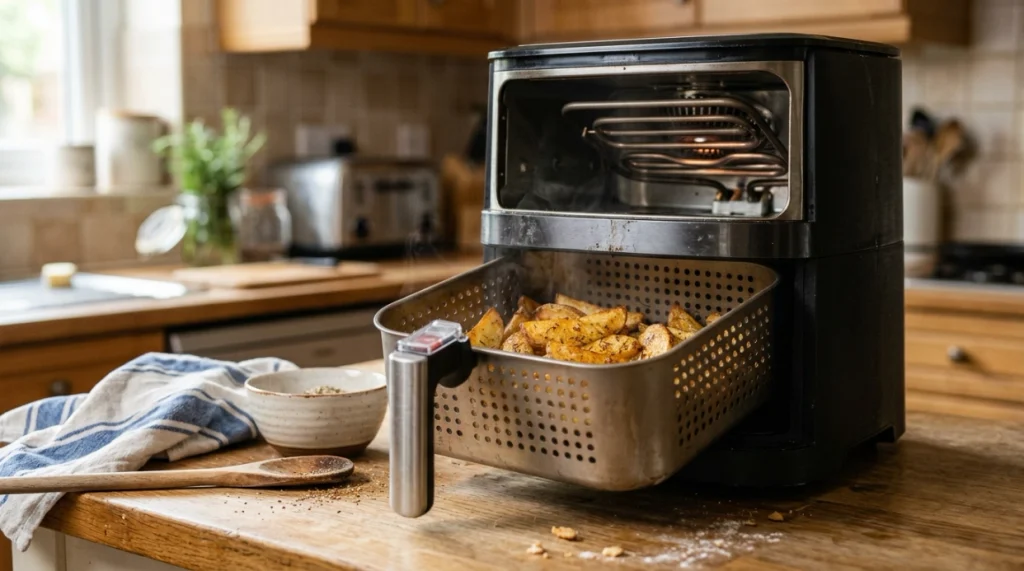
An air fryer heats air and forces it around food at high speed. The combination of a heating element, fan, compact chamber, and perforated basket creates its characteristic cooking environment.
Definition: An air fryer is a compact countertop convection appliance that cooks by circulating heated air around food, usually through or around a perforated basket or tray.
Step 1: The heating element warms the air
Most basket-style air fryers have an electric heating element near the top of the cooking chamber. After you choose a temperature, the element heats the air surrounding it.
The selected temperature might be 325°F (163°C) for gentler baking or around 400°F (204°C) for foods that benefit from strong browning. The exact operating pattern depends on the appliance.
Step 2: The fan circulates that heat
A fan moves the hot air rapidly around the basket and food. Serious Eats explains the air-fryer mechanism as a form of convection cooking operating in a much smaller chamber than a full-size oven.
The compact space matters. Less empty oven volume allows hot air to reach food quickly, while the strong fan continually moves heated air across exposed surfaces.
Step 3: Heat moves into the food
Hot moving air transfers energy to the food’s surface through convection. The basket or cooking tray can also transfer some heat where it touches the food.
Heat then travels from the hotter exterior toward the cooler center. This is why the surface may become brown before the center has finished cooking, especially with thick foods.
- Convection: Moving hot air transfers heat to the food’s exterior.
- Conduction: Direct contact with a hot basket or tray transfers additional heat.
- Internal heat movement: Energy gradually travels toward the center of the food.
Why Does an Air Fryer Make Food Crispy?
An air fryer creates crispness mainly by removing moisture from the food’s surface while heating it quickly. A drier, hotter surface can brown more effectively than a wet one.
Fast airflow removes surface moisture
Moisture works against crispness because water keeps a wet surface relatively cool while it evaporates. Strong airflow speeds that evaporation and allows the exterior to dry.
This is one reason overcrowding often gives disappointing results. When moist foods are packed tightly together, steam becomes trapped and less surface area receives direct airflow.
- Leave space between pieces when possible.
- Shake or turn small foods during cooking.
- Pat especially wet ingredients dry before seasoning.
- Avoid filling the basket so deeply that airflow is blocked.
Browning creates color and flavor
Once the surface becomes hot and dry enough, browning reactions create deeper color and roasted flavors. Proteins, starches, and sugars respond differently, which is why a potato and chicken wing develop different crusts.
A light coating of oil can improve surface contact and browning on some foods. You usually need much less oil than you would for traditional deep frying.
Why some foods stay soft inside
The air fryer’s intense surface heat can cook the exterior faster than the center. That can be an advantage for foods where you want a crisp outside and tender middle.
The same effect can complicate baking. King Arthur Baking’s air-fryer guidance notes that the appliance can brown baked goods rapidly because of its concentrated convection heat.
Is Air Frying the Same as Deep Frying?
No. Deep frying cooks food while it is surrounded by hot oil, whereas an air fryer relies primarily on circulating hot air.
The methods can both produce browned exteriors, but the heat-transfer environment is fundamentally different. That is why air-fried food should not be expected to duplicate every characteristic of food submerged in frying oil.
| Feature | Air Fryer | Convection Oven | Deep Fryer |
|---|---|---|---|
| Main heat medium | Rapidly moving hot air | Circulating hot air | Hot cooking oil |
| Cooking chamber | Small and concentrated | Much larger | Oil-filled vessel |
| Typical oil use | None to a light coating | Recipe dependent | Enough to immerse food |
| Surface result | Dry, browned, crisp | Browned and roasted | Deeply fried crust |
| Best batch size | Small to medium | Medium to large | Depends on fryer capacity |
That distinction is useful when setting expectations. Air frying excels at quick browning and crisping, but it does not replace hot-oil frying in every recipe.
How Is an Air Fryer Different From a Convection Oven?
An air fryer and convection oven use the same broad principle: a fan circulates heated air. The major differences are chamber size, airflow intensity, food placement, and capacity.
A smaller chamber changes cooking behavior
A full-size oven contains much more air and has a larger cooking cavity to heat. A basket air fryer surrounds a smaller amount of food with a comparatively compact stream of hot air.
That concentrated setup often means shorter warm-up periods and fast surface browning. It also explains why blindly copying conventional oven times can overcook smaller foods.
The perforated basket exposes more food
Air fryer baskets usually contain openings that let air reach the underside and sides of food. A solid baking sheet blocks much of that airflow in a conventional oven.
This exposure is particularly useful for fries, breaded foods, roasted vegetables, and chicken wings. Air can contact more of the surface during the cook.
Capacity is the trade-off
The compact chamber improves concentrated airflow, but it limits how much food can cook efficiently at once. Large batches may require several rounds.
Trying to overcome that limitation by piling food too deeply can defeat the advantage. Air needs open paths through and around the ingredients.
Section Takeaway: Air fryers and convection ovens share the same basic cooking technology, but an air fryer’s small chamber and basket design concentrate the airflow around smaller batches.
What Foods Cook Well in an Air Fryer?
Air fryers work best when strong airflow and rapid surface drying help the desired texture. Foods meant to become roasted, browned, or crisp are natural candidates.
- Frozen fries and snacks: The dry circulating heat can restore a crisp exterior quickly.
- Roasted vegetables: Brussels sprouts, cauliflower, potatoes, and similar vegetables benefit from browning around exposed edges.
- Chicken wings: Strong airflow helps dry and brown the skin while the meat cooks.
- Breaded foods: A light oil coating can help breadcrumbs brown and become crisp.
- Leftover pizza: Dry heat can crisp the crust while reheating the toppings.
- Small baked goods: Cookies, rolls, and some pastries can work well when temperature and timing are adjusted.
What foods can be more difficult?
Wet batter can drip through a basket before it sets, while lightweight ingredients may move under a powerful fan. Large cakes and thick foods can also brown outside before the center finishes.
- Very loose wet batter
- Extremely lightweight toppings
- Oversized baked goods
- Large crowded batches
- Foods that need a lot of liquid during cooking
Food safety still depends on internal temperature
Fast browning does not prove that meat or poultry is safely cooked inside. The exterior can look finished while the center still needs more heat.
Pro tip: When cooking raw meat or poultry, use a food thermometer and check the verified FoodSafety.gov minimum internal temperature guidelines rather than relying on cooking time or exterior color alone.
How Do You Get Better Air Fryer Results?
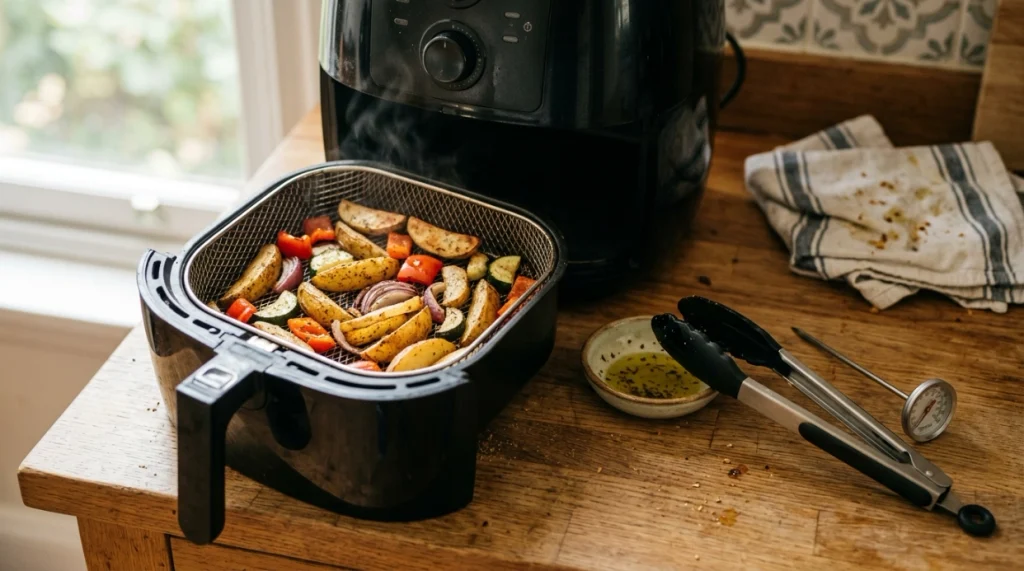
The most useful air-fryer habits all support the same goal: keeping hot air moving freely around the food. Small adjustments can make a noticeable difference to browning and consistency.
1. Do not overcrowd the basket
Start with a single loose layer when crispness matters most. Some overlap may be workable, but tightly packing the basket restricts airflow and holds moisture near the food.
2. Shake, turn, or rotate when needed
Airflow is strong but not always perfectly uniform throughout the chamber. Turning larger pieces or shaking fries can expose new surfaces to direct heat.
3. Use oil strategically
A thin coating can help seasonings adhere and encourage surface browning. More oil is not automatically better, because an air fryer is not designed to immerse food.
4. Adjust conventional oven recipes carefully
Because air fryers move concentrated hot air through a small chamber, conventional oven recipes often need adjustment. King Arthur commonly suggests starting air-fryer baking experiments around 25°F lower and checking sooner than the original oven recipe.
Treat that as a starting point rather than a universal law. Basket size, food thickness, fan speed, and appliance design can all affect the result.
5. Check food before the timer ends
I prefer to treat the first attempt with any new food as a calibration cook. Checking early tells you more than assuming one online time will work in every appliance.
As of 2026, air fryers vary widely in size, basket shape, heating control, and available cooking modes. Your own appliance’s manual should remain the first reference for model-specific instructions.
- For better crisping: Leave airflow space and remove excess surface moisture.
- For even cooking: Turn or shake food when appropriate.
- For baking: Watch browning closely and consider a lower starting temperature.
- For meat: Verify doneness with a thermometer.
- For repeatability: Note the time and temperature that work in your particular model.
Frequently Asked Questions
Does an air fryer actually fry food?
No. An air fryer does not normally immerse food in hot oil. It uses rapidly circulating heated air to dry, brown, roast, and crisp the exterior, which can create some textures associated with fried foods.
Does an air fryer use radiation or microwaves?
A standard air fryer is not a microwave oven. It normally relies on an electric heating element, a fan, convection heat transfer, and direct heat from surfaces touching the food.
Why does food cook faster in an air fryer?
The cooking chamber is small, and a powerful fan keeps hot air moving across the food. That concentrated convection can heat and brown smaller portions quickly compared with many full-size conventional ovens.
Why is my air-fried food not crispy?
Common causes include overcrowding, too much surface moisture, insufficient heat, or poor airflow around the food. Try a smaller batch, dry the ingredients first, and shake or turn them during cooking.
Do you have to add oil to an air fryer?
Not always. Many frozen foods already contain oil, while fresh vegetables or breaded foods may benefit from a light coating to improve browning, flavor, and seasoning adhesion.
Does an air fryer cook food from the inside out?
No. The exterior receives heat first from the hot air and cooking surfaces, then heat moves inward. Thick food may therefore brown on the outside before its center reaches the desired temperature.
Can an air fryer bake as well as fry?
Yes. Because an air fryer is a compact convection appliance, it can bake foods such as cookies, rolls, small cakes, and pastries, though recipe temperature, pan size, and cooking time may need adjustment.
The simplest way to remember how an air fryer works is this: it surrounds a small amount of food with fast-moving hot air. That combination removes surface moisture, speeds browning, and gives many foods their familiar crisp air-fried texture.
Once you understand airflow, the rest becomes easier. Give food room, watch moisture, check doneness early, and adjust time and temperature to your particular air fryer.

