
How Much Food Can You Cook in an Air Fryer?
Quick Answer
How much food you can cook in an air fryer depends more on usable basket area than the advertised quart capacity. A typical 4-quart air fryer works well for roughly two to three servings, while many 6-quart models are practical for about two to four servings; larger models can handle more, but air fryer size and design matter as much as the capacity number.
What determines the real cooking capacity?
- Basket surface area: A wide basket usually holds more food in one crisping layer than a narrow, deep basket.
- Type of food: Wings, fries, vegetables, steaks, cookies, and casseroles use basket space differently.
- Air circulation: Leaving space around food helps hot air reach more of its surface.
- Desired texture: You can sometimes load more food when reheating than when you want maximum browning and crispness.
- Basket design: Dual baskets and oven-style racks distribute their advertised capacity differently from one wide basket.
Simple rule to remember
- For crisp foods, prioritize a loose layer and cook another batch instead of packing the basket tightly.
If you’re wondering how much food can you cook in an air fryer, the quart number on the box only tells part of the story. Basket shape, food thickness, airflow, and whether you’re crisping or simply reheating can change the useful capacity considerably.
I treat the advertised capacity as a starting point, not a guaranteed serving count. That approach makes it much easier to decide whether dinner will fit in one batch.
In This Guide
- What does air fryer capacity actually mean?
- How much food can different air fryer sizes cook?
- How much of common foods can you air fry at once?
- What happens when you put too much food in an air fryer?
- Basket vs. oven-style air fryers: which holds more food?
- How do you calculate the right batch size?
- Air fryer capacity FAQ
What Does Air Fryer Capacity Actually Mean?
Air fryer capacity describes the approximate volume of the cooking chamber or basket, commonly stated in quarts or liters. It does not tell you exactly how many fries, chicken breasts, burgers, or servings you can cook successfully at one time.
An air fryer is a compact convection-style appliance. A fan moves heated air rapidly around food, while a perforated basket or crisper tray allows air to reach more of the food’s surface.
Why quart capacity can be misleading
Imagine two 6-quart air fryers. One has a broad square basket, while the other has a deeper, narrower cooking chamber.
Both can legitimately carry the same capacity label. Yet the wider basket may give you considerably more useful space for foods that need to sit in one layer.
- Wide and shallow: Better for burgers, fish fillets, chicken breasts, cookies, and other foods you don’t want stacked.
- Deep and narrow: Can hold substantial volume, but some foods become crowded before the basket looks full.
- Dual basket: Total capacity is divided between two smaller cooking zones.
- Oven-style: Capacity may be spread across several rack levels instead of one basket.
Testing reported by Serious Eats has also found basket size and shape important for crowding and airflow. That matches the practical way I think about capacity: look at the cooking floor before the quart label.
Section Takeaway: The usable cooking surface usually matters more than the advertised volume when you’re trying to brown or crisp food evenly.
How Much Food Can Different Air Fryer Sizes Cook?
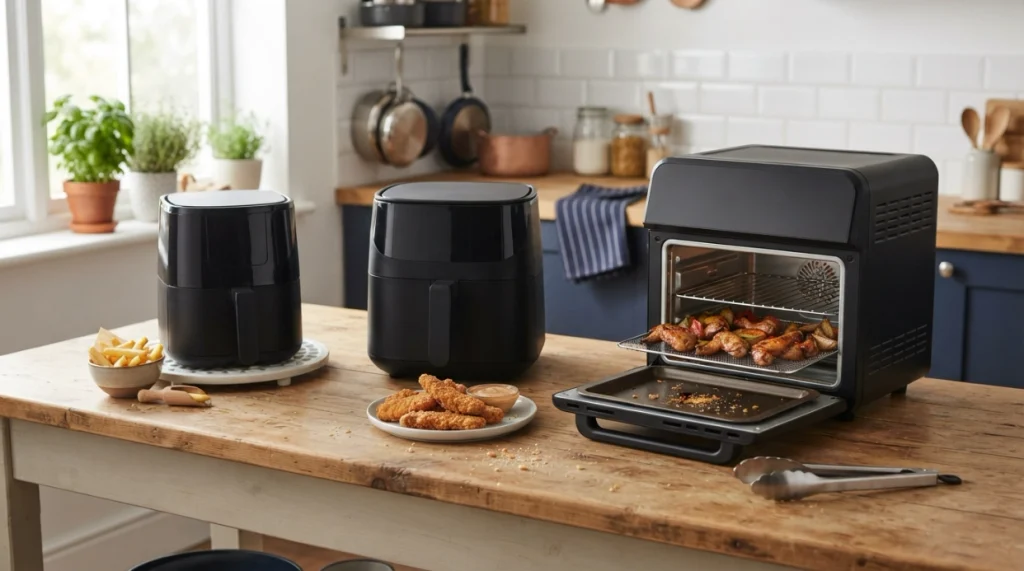
A small air fryer may suit one person perfectly, while a 6-quart basket is often more practical for a small household. Families serving several people may prefer larger, dual-zone, or oven-style machines.
The ranges below are practical planning estimates rather than manufacturer guarantees. Your actual batch depends on basket dimensions and what you’re cooking.
| Advertised Capacity | Practical Household Range | Best Suited To | Capacity Limitation |
|---|---|---|---|
| 2–3 quarts | About 1–2 servings | Singles, snacks, small sides | Limited surface area |
| 4–5 quarts | About 2–3 servings | Couples and small households | Large mains may need batches |
| 6–7 quarts | About 2–4 servings | Small families and larger portions | Four large portions may still crowd |
| 8–10 quarts | Roughly 4+ servings depending on design | Families and multi-food meals | Capacity may be split between baskets |
| 10+ quarts / oven-style | Several portions or multiple trays | Larger households and varied cooking | Rack position can affect browning |
Is a 4-quart air fryer big enough?
A 4-quart model is usually a sensible size for one or two people and can often serve three when portions are modest. Large pieces of meat or widely spaced foods reduce that practical capacity.
It also works well when the air fryer handles only one part of dinner. You might air fry vegetables while cooking rice, pasta, or another main elsewhere.
How much can a 6-quart air fryer hold?
A 6-quart basket is a useful middle ground because it gives you more cooking area without moving into a particularly bulky appliance. Two to four servings is a sensible expectation for many meals.
Don’t assume six quarts automatically means six servings. Six salmon portions, for example, may require much more flat surface area than the basket provides.
Is an 8- or 10-quart air fryer better for a family?
A larger machine gives you more flexibility, especially for family portions. However, check whether the capacity comes from one large cooking chamber or two separate baskets.
A 10-quart dual-zone fryer may effectively give you two 5-quart compartments. That’s useful for cooking two foods independently, but it isn’t the same as having one uninterrupted 10-quart cooking surface.
Section Takeaway: Choose capacity according to the number and shape of portions you cook, not just the number of people in your home.
How Much of Common Foods Can You Air Fry at Once?
The same air fryer can feel spacious for vegetables and surprisingly small for burgers. Food shape changes everything.
Use these examples as loading strategies rather than fixed weight limits. Your owner’s manual remains the final authority for your specific appliance.
French fries and frozen snacks
Fries, tater tots, and nuggets tolerate some overlap because you can shake or turn them during cooking. They still crisp better when hot air can move between the pieces.
- For maximum crispness: Keep the layer loose and relatively shallow.
- For a larger batch: Add more food only if you can shake it thoroughly several times.
- For frozen snacks: Avoid packing pieces tightly against each other.
Chicken wings
Wings can touch and overlap slightly, but a tightly packed pile tends to cook less evenly. Shaking or turning exposes new surfaces to the moving air.
I would rather run a second short batch than fill every inch of basket depth. Crisp skin depends on exposed surface, not empty basket volume being completely used.
Burgers, steaks, fish, and chicken breasts
These foods usually need a single layer. Count how many pieces fit flat without substantial overlap rather than estimating by quarts.
A wide basket can therefore outperform a deeper basket with the same stated capacity. This is one reason checking internal basket dimensions before buying can be useful.
Pro tip: For raw meat, poultry, and seafood, use a food thermometer rather than relying on cooking time alone. Check the current FoodSafety.gov safe minimum temperature guidance for the food you’re preparing.
Vegetables
Vegetables are more flexible because many pieces can be tossed during cooking. Brussels sprouts, broccoli florets, cauliflower, zucchini, and similar vegetables still brown better when they aren’t compressed into a dense pile.
Moisture matters too. Crowded vegetables release steam faster than the air fryer can carry it away, which can soften the exterior.
Cookies, rolls, and other baked foods
Baking is mostly limited by horizontal space. Cookies need room to spread, while rolls need room to expand without merging into one mass unless that’s intentional.
King Arthur Baking’s air fryer baking guidance also highlights small-batch baking as a natural strength of the appliance. A compact basket can be especially useful when you want only a few cookies or rolls.
- Cookies: Leave spreading room around each portion of dough.
- Rolls: Leave enough room for expansion and hot-air movement.
- Cake: Use an air-fryer-safe pan that leaves clearance around it.
- Pastries: Avoid blocking airflow with oversized pans or liners.
Section Takeaway: Food shape is often a better predictor of batch size than food weight. Flat foods need floor space, while small loose foods can use more basket depth.
What Happens When You Put Too Much Food in an Air Fryer?
Overcrowding reduces the airflow that makes an air fryer effective. The food can still cook, but browning and crisping usually become less consistent.
This happens because closely packed food traps moisture. Instead of dry hot air reaching each surface, steam collects between pieces.
Signs your air fryer basket is too full
- Pale spots: Surfaces touching other pieces don’t brown well.
- Soggy fries: Moisture becomes trapped between crowded pieces.
- Uneven doneness: Food near the airflow path cooks differently from buried pieces.
- Longer cooking: A packed basket may need extra time and more turning.
- Frequent rearranging: If you constantly have to separate pieces, the batch is probably too large.
Can you stack food in an air fryer?
Yes, but only certain foods handle stacking well. Small foods that can be shaken, such as fries or vegetables, are much more forgiving than burgers, breaded fillets, or pastries.
If stacking prevents one piece from exposing its surface to moving air, expect less browning there. Turn, shake, or rearrange the food when appropriate.
Can you fill an air fryer basket to the top?
A basket physically holding the food does not mean it is the ideal cooking load. The maximum-fill mark, when your model has one, is a safety or operating boundary rather than a promise of perfect crisping at that level.
For foods where crispness matters, I treat airflow as part of the recipe. A little unused space can produce a better result than squeezing in one extra serving.
Section Takeaway: A fuller basket doesn’t always produce more usable food. Two evenly cooked batches can be better than one overcrowded batch.
Basket vs. Oven-Style Air Fryers: Which Holds More Food?
Oven-style air fryers often offer more total internal space, while basket models tend to keep food closer to concentrated airflow. Neither design automatically gives you more effective capacity for every recipe.
The better choice depends on whether you value one powerful cooking zone or several racks and trays.
| Feature | Basket Air Fryer | Oven-Style Air Fryer |
|---|---|---|
| Cooking layout | One deep basket | One or more trays or racks |
| Best capacity advantage | Fast small-to-medium batches | More flat cooking area across levels |
| Shaking food | Usually easy | Usually requires tray movement |
| Baking pans | Limited by basket dimensions | Often more flexible |
| Large family meals | May require batches | Can offer more total cooking room |
What about dual-basket air fryers?
Dual-basket models solve a different problem. They let you cook two foods at separate temperatures or times without combining them in one chamber.
The trade-off is compartment size. A large roast or wide baking pan that fits a single wide basket may not fit either half of a dual-zone model.
- Single wide basket: Better for large individual items.
- Dual basket: Better for two separate foods at once.
- Oven-style: Better when multiple racks or baking pans are useful.
Section Takeaway: Total quart capacity and useful cooking layout are not the same thing. Match the layout to the food you make most often.
How Do You Calculate the Right Air Fryer Batch Size?
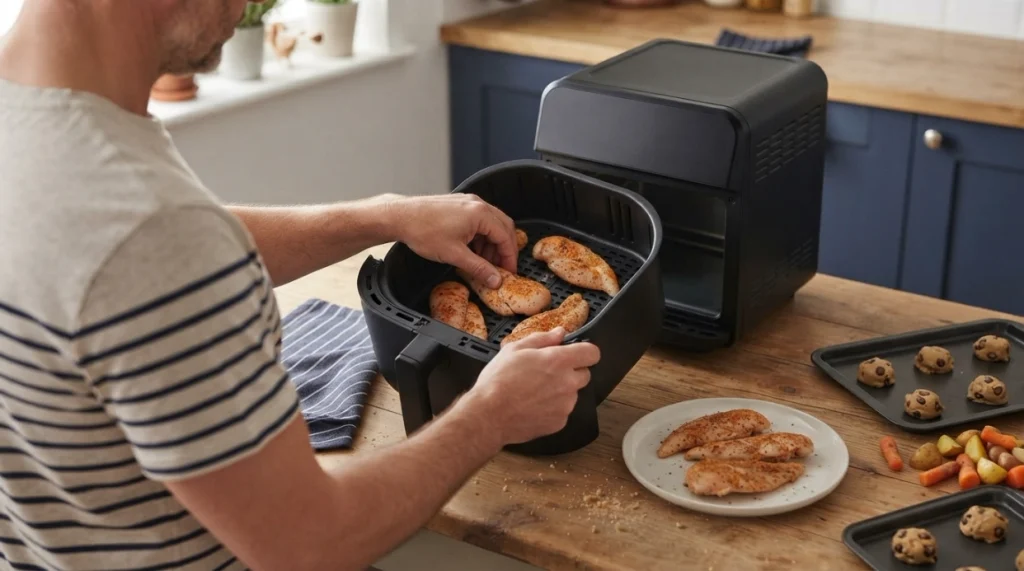
The simplest method is to plan around basket area and airflow instead of trying to convert quarts directly into pounds of food. Different ingredients occupy space too differently for one reliable conversion.
I use a quick visual check before starting.
- Check the basket floor. Place large foods flat and see how many portions fit naturally.
- Consider expansion. Cookies, rolls, and some pastries need extra space while cooking.
- Leave airflow paths. Don’t tightly seal the entire basket surface with food or an oversized liner.
- Decide whether shaking is possible. Loose foods can tolerate more overlap if you can redistribute them.
- Split the batch when needed. Foods that must remain flat should not be stacked simply to save time.
Should you buy a larger air fryer than you think you need?
Going one size larger can make sense when you regularly cook complete meals or want more flat cooking area. A larger basket also gives you room to avoid crowding.
However, don’t buy by quarts alone. Compare interior measurements, basket shape, divider layout, and the dimensions of pans or accessories you expect to use.
How much air fryer capacity does one person need?
A compact 2- to 3-quart machine can be enough for one person, especially for snacks, sides, reheating, and small mains. A larger model gives more flexibility if you meal prep or cook several components together.
What size works for two people?
Four to 5 quarts is a comfortable starting range for many two-person households. It gives you more room for two substantial portions than most mini air fryers.
If both people eat generous portions or you want meat and vegetables together, a wider 5- to 6-quart basket can be easier to work with.
What size works for four people?
For four people, I would pay particular attention to a 6-quart-or-larger cooking area, but food choice still determines whether you’ll need batches. Four burgers might fit where four large chicken breasts do not.
A dual-zone or larger oven-style unit may also make sense when you frequently prepare two different foods at once.
Section Takeaway: Start with your most space-demanding regular meal, then choose an air fryer that can accommodate it without heavy stacking or crowding.
Air Fryer Capacity FAQ
How many people can a 4-quart air fryer feed?
A 4-quart air fryer is generally best suited to about two to three servings, depending on the food. Small foods that can be shaken use the basket more efficiently than burgers, fish, chicken breasts, or baked goods that need a flat layer.
How many people can a 6-quart air fryer feed?
A 6-quart basket commonly works well for roughly two to four servings. The practical limit depends on basket width, portion size, and whether the food can overlap while still cooking evenly.
Can I cook a complete meal in an air fryer?
Yes. A sufficiently large air fryer can cook a complete meal, especially when ingredients use similar temperatures. Dual-basket machines can make this easier because two foods can occupy separate cooking zones.
Can I cook two layers of food in an air fryer?
You can when your model supports racks or when the food can be rearranged during cooking. For foods that rely on direct airflow for browning, two dense layers may cook less evenly than one loose layer.
Does a bigger air fryer cook more food at once?
Usually, but not always in direct proportion to the quart rating. Basket width, depth, divider placement, rack arrangement, and fan position affect how much food can cook efficiently at one time.
Is it okay if food touches in an air fryer?
Some touching is fine for many foods. Problems start when pieces overlap heavily or form a dense layer that prevents hot air from reaching their surfaces, particularly when you’re aiming for crispness.
How full should an air fryer basket be?
There isn’t one universal fill percentage that works for every food or model. Follow your appliance’s maximum-fill guidance, then use a lighter load when you need strong browning, crispness, or space around individual portions.
Final Takeaway: The answer to “how much food can you cook in an air fryer?” isn’t simply printed on the capacity label. A 4-quart unit may suit two to three servings, while a 6-quart model often handles roughly two to four, but basket surface area and food shape ultimately determine the useful batch size.
Before your next batch, look at how much food can sit comfortably in the cooking area rather than how much you can physically squeeze inside. You’ll usually get more even browning, better texture, and a much clearer idea of the air fryer’s true capacity.

