
How to Avoid Acrylamide in Air Fryers

Quick Answer
To reduce acrylamide in an air fryer, cook starchy foods only until golden yellow rather than dark brown, avoid unnecessarily high temperatures, and stop cooking as soon as the food is crisp. For fresh potatoes, soaking cut pieces in water for 15–30 minutes before air frying can also help, according to FDA acrylamide guidance.
The most useful steps
- Aim for golden: Stop cooking potatoes, bread, and similar foods before they become dark brown.
- Soak potatoes: Soak raw potato pieces for 15–30 minutes, then drain and dry them thoroughly.
- Control heat: Use the lowest temperature that still gives the texture you want within a reasonable cooking time.
- Check early: Start inspecting food several minutes before the recipe’s maximum cooking time.
- Avoid cold storage: Don’t store raw potatoes in the refrigerator if you plan to fry or roast them.
- Vary cooking methods: Mix air frying with boiling, steaming, and other lower-browning methods.
If you’re wondering how to avoid acrylamide in air fryers, the good news is that you don’t need to stop air frying. The most practical approach is controlling browning, temperature, cooking time, and potato preparation.
I’ve found that color is the easiest cue to use in a busy kitchen. Instead of chasing the darkest, crispiest fries possible, I aim for an even golden finish and stop there.
In This Guide
- What Is Acrylamide and Why Does It Form in Air Fryers?
- How Do You Reduce Acrylamide When Air Frying?
- How Should You Prepare Potatoes Before Air Frying?
- Does Air-Fryer Temperature or Cooking Time Matter More?
- Which Air-Fried Foods Are Most Likely to Contain Acrylamide?
- Frequently Asked Questions
- My Practical Takeaway
What Is Acrylamide and Why Does It Form in Air Fryers?
Acrylamide is a chemical that can form naturally when certain carbohydrate-rich plant foods are cooked at high temperatures. It is associated mainly with frying, roasting, baking, and similar dry-heat cooking methods.
The reaction becomes important once food is heated to roughly 120°C (248°F) or higher under relatively low-moisture conditions. Air fryers easily operate above that temperature.
What causes acrylamide to form?
Acrylamide can develop when natural sugars react with the amino acid asparagine. This happens during the same collection of browning reactions that gives toasted and fried foods their familiar color and flavor.
This browning process is commonly called the Maillard reaction. It isn’t something unique to air fryers.
- High heat: Frying, roasting, baking, and air frying create suitable conditions.
- Low moisture: Dry surfaces brown more readily than wet ones.
- Starchy ingredients: Potatoes and cereal-grain foods are important sources.
- Long cooking: Extended heating can increase browning and acrylamide formation.
The European Food Safety Authority notes that acrylamide forms particularly in starchy foods during high-temperature cooking and that home cooking choices can influence exposure.
Does an air fryer create acrylamide by itself?
No. The appliance isn’t adding acrylamide to your food.
An air fryer uses rapidly circulating hot air, a form of convection cooking. That hot, dry airflow makes the surface of foods brown efficiently, which means the cooking conditions can also support acrylamide formation in susceptible foods.
Meat, fish, eggs, and dairy aren’t generally the foods people focus on when discussing dietary acrylamide. Potato and cereal-based foods deserve much more attention.
Section Takeaway: Acrylamide isn’t an air-fryer ingredient. It forms naturally when susceptible starchy foods experience enough heat, dryness, time, and browning.
How Do You Reduce Acrylamide When Air Frying?
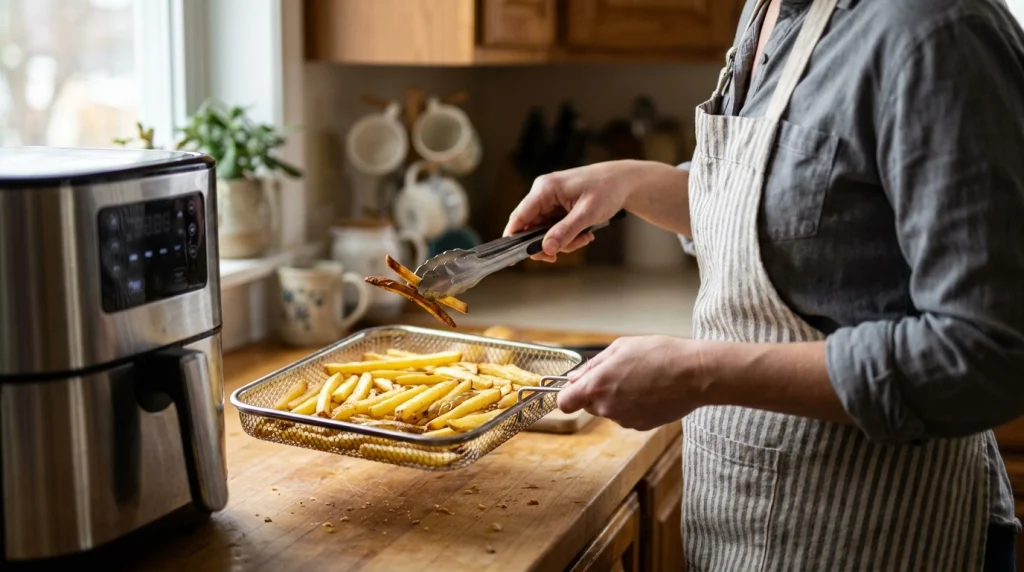
The simplest strategy is to cook starchy food until it is golden rather than dark brown. You can then support that goal with sensible temperature settings, shorter cooking times, and better preparation.
I treat the recipe’s cooking time as a range, not a deadline. Once fries are evenly golden and crisp enough, I take them out even if the timer says another three minutes remain.
Use these six habits
- Stop at golden yellow. Don’t deliberately push fries, toast, potatoes, or breaded starches toward a dark brown finish.
- Check the basket early. Begin checking several minutes before the suggested maximum time.
- Avoid excessive heat. Don’t automatically choose the highest temperature just because the air fryer can reach it.
- Flip or shake food. More even cooking helps prevent individual pieces from becoming excessively dark.
- Remove dark pieces. Thin fries and small crumbs often brown before larger pieces.
- Keep portions reasonable. An even layer makes it easier to judge doneness without repeatedly extending the cook cycle.
Use color as your everyday guide
The FDA advises cooking cut potato products to a golden yellow color rather than brown. Darker areas tend to contain more acrylamide.
This makes visual inspection especially useful with basket-style air fryers. Pull the basket out, shake it, and inspect the smallest pieces before adding more time.
| Cooking Choice | Better Approach | Why It Helps |
|---|---|---|
| Dark brown fries | Golden-yellow fries | Less intense browning generally means less acrylamide formation. |
| Maximum heat by default | Moderate effective temperature | Higher temperatures can accelerate browning. |
| Cooking until the timer ends | Stop once golden and cooked | Unnecessary extra heating can deepen browning. |
| Unsoaked fresh potato | Soak 15–30 minutes | FDA guidance says soaking can reduce acrylamide formation during cooking. |
Section Takeaway: You don’t need complicated equipment or testing. Lighter browning, sensible heat, early checking, and stopping when the food is ready are the most practical controls.
How Should You Prepare Potatoes Before Air Frying?
For homemade air-fryer potatoes, soak cut raw potatoes in water for 15–30 minutes before cooking. Drain them well and dry the surfaces before seasoning and air frying.
Potatoes deserve special attention because fried and roasted potato products are among the better-known dietary sources of acrylamide.
My basic potato-preparation routine
- Cut the potatoes into evenly sized fries or wedges.
- Place the pieces in clean water for 15–30 minutes.
- Drain the soaking water completely.
- Pat the potato pieces dry with a clean towel.
- Add a modest amount of oil and seasoning if desired.
- Air fry until cooked and golden, not deeply browned.
Drying after soaking matters for texture. Wet potatoes steam at first and often take longer to become crisp.
Don’t refrigerate raw potatoes for this purpose
The FDA advises storing potatoes outside the refrigerator, preferably somewhere cool and dark. Refrigeration can increase potato sugars that may later contribute to greater acrylamide formation during high-temperature cooking.
A pantry or similar cool, dark storage area usually makes more sense. Avoid storing potatoes where they become hot or receive direct sunlight.
What about frozen air-fryer fries?
You can’t soak frozen commercial fries in the same way without changing their texture and surface coating. Follow the package directions while using color as the final cue.
I start checking thin frozen fries early because the smallest pieces can move from golden to dark brown surprisingly fast. Removing finished pieces is better than waiting for every fry to reach the same dark color.
The FDA’s broader acrylamide questions and answers also explains why high-temperature cooking matters more for plant-based starchy foods than for meat or dairy.
Section Takeaway: For fresh potatoes, soaking for 15–30 minutes, drying well, avoiding refrigerated raw potatoes, and cooking only to golden are four useful habits to combine.
Does Air-Fryer Temperature or Cooking Time Matter More?
Both matter because hotter temperatures and longer cooking generally encourage additional browning. Temperature, however, can accelerate surface browning quickly once food becomes dry.
There isn’t one universal “acrylamide-safe” air-fryer temperature. Food type, thickness, moisture, sugar content, and cooking time all change the result.
Should you always cook below 350°F?
No universal rule says every air-fried food must remain below 350°F (177°C). That would oversimplify how acrylamide forms.
Instead, use enough heat to cook the food properly without taking it far beyond the desired golden stage. For many potato recipes, checking color is more useful than blindly following one temperature number.
A practical temperature strategy
- Start with the recipe: Use its tested temperature as your baseline.
- Avoid unnecessary increases: Don’t jump from 375°F to 400°F simply to save a minute or two.
- Watch thin food closely: Thin fries, bread edges, and crumbs brown rapidly.
- Reduce heat if needed: If the outside becomes dark before the center cooks, lower the temperature on the next batch.
- Stop when finished: Don’t extend cooking merely for a darker appearance.
The FDA notes that acrylamide generally accumulates more when susceptible foods are cooked for longer periods or at higher temperatures. Its acrylamide guidance also outlines mitigation strategies used more broadly in food production.
Does preheating increase acrylamide?
Preheating the empty air fryer doesn’t put acrylamide into food. What matters is the conditions the food experiences after it enters the hot cooking chamber.
If preheating makes your particular air fryer cook faster, check the basket sooner. I’ve seen this matter most with thin foods where a few extra minutes noticeably changes the surface color.
Section Takeaway: Don’t chase one supposedly perfect temperature. Control the combination of heat, cooking time, surface dryness, and final browning.
Which Air-Fried Foods Are Most Likely to Contain Acrylamide?

Acrylamide is mainly associated with carbohydrate-rich plant foods rather than every food placed in an air fryer. Potatoes and grain-based products deserve the most attention in a typical home kitchen.
This distinction matters because some people assume that any air-fried food automatically carries the same acrylamide concern. It doesn’t.
Foods where browning deserves attention
- French fries
- Potato wedges
- Hash browns
- Roasted potato cubes
- Bread and toast
- Crackers and grain-based snacks
- Cookies and certain baked grain products
Foods that aren’t typical major acrylamide sources
- Chicken
- Fish
- Eggs
- Cheese
- Other primarily meat or dairy foods
That doesn’t mean meat can be cooked without regard for food safety. Acrylamide and safe internal cooking temperature are separate issues.
Pro tip: For meat and poultry, verify doneness with a food thermometer and follow current government internal-temperature guidance rather than relying only on air-fryer cooking time.
Should you stop eating crispy food?
No major food authority tells consumers to eliminate all fried, roasted, or baked foods solely because acrylamide can form. The FDA instead emphasizes an overall balanced eating pattern while offering preparation methods for people who want to reduce exposure.
As of 2026, I think the most workable kitchen rule remains simple: enjoy crisp texture without routinely burning or heavily browning susceptible foods.
Section Takeaway: Focus acrylamide-reduction efforts mainly on browned potato and cereal-grain foods. You don’t need to treat every air-fried ingredient as an equal source.
Frequently Asked Questions
Do air fryers cause acrylamide?
Air fryers don’t add acrylamide directly. Acrylamide can form naturally in certain starchy plant foods when high temperatures and low moisture produce browning, so air frying can create conditions where it develops.
What temperature prevents acrylamide in an air fryer?
There is no single air-fryer temperature that guarantees zero acrylamide. Use the lowest practical cooking temperature for the desired result, avoid unnecessary cooking time, and stop starchy foods when they become golden rather than dark brown.
Does soaking potatoes remove acrylamide?
Soaking doesn’t remove acrylamide that already exists. Instead, the FDA says soaking raw potato slices in water for about 15–30 minutes before frying or roasting can help reduce the amount that forms during cooking.
Why shouldn’t I refrigerate potatoes before air frying?
Cold refrigerator storage can increase sugars in raw potatoes. Those sugars can contribute to greater acrylamide formation when the potatoes are later fried, roasted, or air fried at high temperatures.
Are brown air-fryer fries dangerous?
A darker fry doesn’t automatically mean immediate harm. However, darker browned portions of susceptible foods generally contain more acrylamide, so food-safety authorities recommend aiming for golden-yellow potato products rather than routinely cooking them dark brown.
Is air frying healthier than deep frying for acrylamide?
You shouldn’t assume air frying automatically produces less acrylamide simply because it uses less oil. Acrylamide formation depends on the food, temperature, cooking time, moisture, preparation method, and degree of browning.
Can acrylamide be completely eliminated?
Completely eliminating dietary acrylamide isn’t practical because it forms naturally in several commonly cooked foods. The practical goal is reducing unnecessary formation through ingredient storage, preparation, temperature control, shorter cooking, and lighter browning.
My Practical Takeaway
For me, avoiding unnecessary acrylamide in the air fryer comes down to one visual rule: golden is enough. I don’t keep cooking fries simply because darker looks crispier.
Prepare fresh potatoes well, soak them for 15–30 minutes, dry them thoroughly, and don’t store raw potatoes in the refrigerator. Then use reasonable heat and check the basket before the maximum recipe time.
- Choose golden rather than dark-brown results.
- Avoid burning starchy foods.
- Soak fresh cut potatoes before air frying.
- Store raw potatoes somewhere cool and dark rather than refrigerated.
- Use only as much cooking time and heat as you need.
- Shake or turn food for more even browning.
- Mix air frying with boiling, steaming, and other cooking methods.
You don’t have to give up an air fryer to take acrylamide seriously. A few small changes to how you store, prepare, brown, and finish starchy foods can make your everyday cooking more sensible.