
How to Bake Cookies on Two Racks Evenly (Without Burnt Bottoms)
You have four dozen cookies to make and one afternoon to do it. Every recipe in your collection says the same thing: bake one sheet at a time, rotating halfway through. That instruction is not superstition — it’s a workaround for how home ovens move heat. But it’s a workaround you can manage.
Two racks can produce cookies that look and taste like they came from a careful single-batch bake, provided you handle airflow, rack height, and timing deliberately. Here’s how to handle it: what’s actually happening inside the oven, where the racks go, and the small adjustments that keep the bottom tray from scorching while the top tray stays pale.
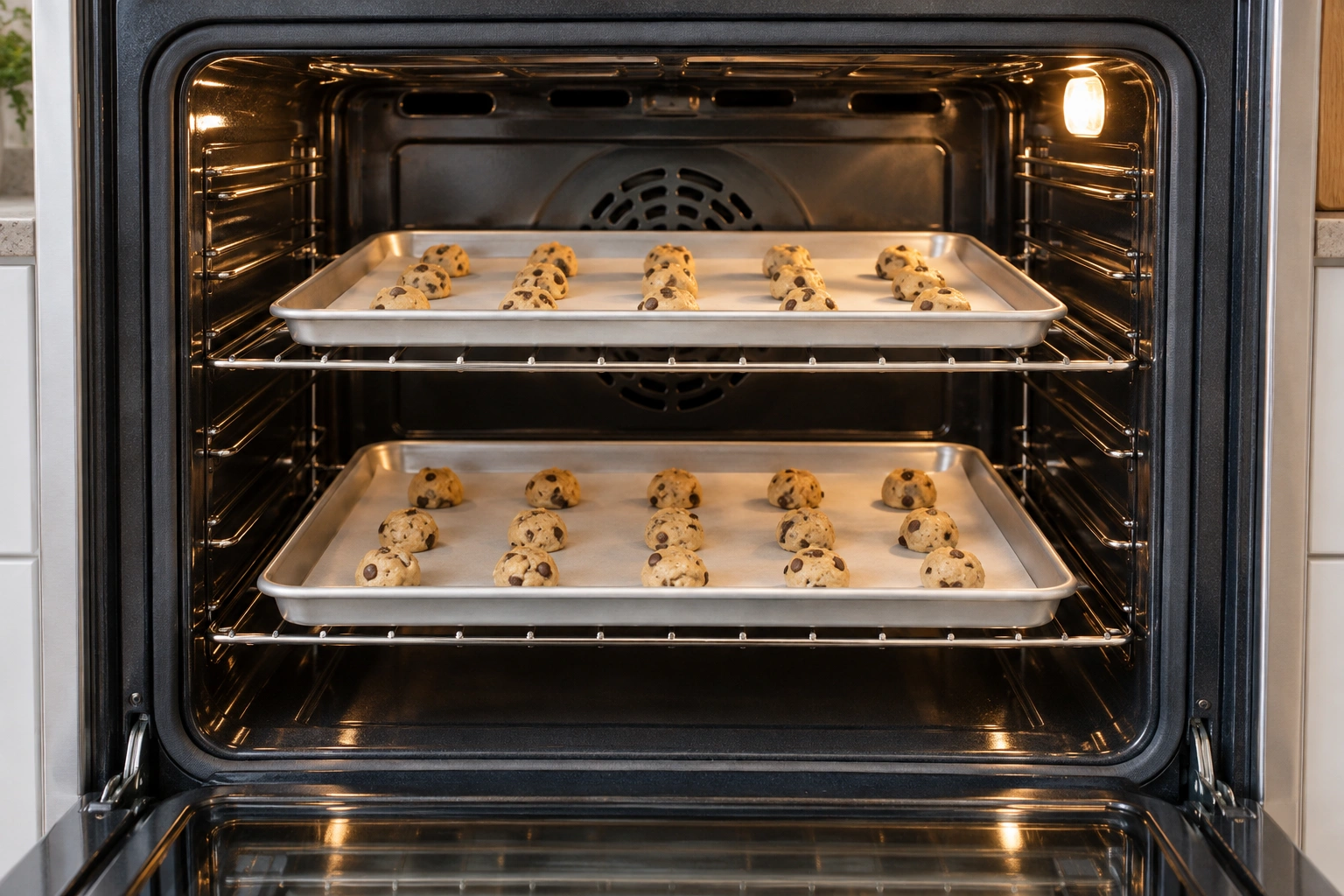
Can You Bake Cookies on Two Racks? The Short Answer
Yes — with three conditions. The racks go in the upper and lower thirds of the oven rather than hard against the heating elements. You rotate and swap the trays partway through the bake. And you accept that the two trays will not finish at the same minute.
The payoff can be real. As an illustrative example, if a single sheet of drop cookies takes about 12 minutes and you would otherwise need four batches, that’s roughly 48 minutes of oven time; baking two trays at once might bring the total closer to the mid-20s to high-20s, but treat that as an estimate, not a measured result. Actual timing depends on your oven, dough temperature, and how quickly you load and swap trays. If you’re making cookies for a cookie exchange, a classroom, or a holiday tray, that kind of savings can turn an evening project into a manageable task.
The cost is quality margin. Single-rack baking gives you a wider forgiveness window — a minute of inattention rarely ruins a tray. Two-rack baking narrows that window because two sheets of cool dough plus an open oven door cost you heat, and the two trays sit in genuinely different thermal environments. If you’re baking for a gift box, a photo, or a judged event, bake one sheet at a time in the center and don’t think twice about it.
Why Two Trays Brown Differently: Airflow, Radiant Heat, and Blocked Circulation
In a conventional oven, the primary heat source sits at the bottom. That single fact explains most two-rack problems. As Taste of Home’s rack-position breakdown puts it, the bottom rack sits closest to that heat source and can produce burnt bottoms, while the top rack is furthest from it and can let cookies spread more than intended.
Layer two trays into that setup and three things happen at once:
Airflow gets blocked. A single tray in the middle of the oven lets hot air rise around it freely. Two trays split the oven into three chambers, and the space between them becomes the stillest, coolest zone in the appliance. The trays themselves are the obstruction.
Radiant heat stops being symmetrical. The lower tray absorbs direct radiant energy from the bottom element, which drives bottom browning hard. The upper tray is shielded from below by the lower tray and only catches radiant heat from the top element if you’re broiling — so its tops and edges set more gradually. Same recipe, different physics.
Hot spots get amplified. Nearly every home oven has one or two zones that run hotter than the rest, usually a back corner. With one tray, a hot spot affects a few cookies. With two trays, it affects a different group of cookies on each level, which is why “I rotated them and they still came out uneven” is such a common complaint. That complaint is usually about top-to-bottom variation, which is why the method uses both a rotation and a swap; see “Rotate, Swap, or Both?” below.
Two Racks vs. One Rack in Batches: The Quality-vs-Volume Trade-Off
Think of this as a slider rather than a rule.
Slide toward one rack when: the cookies need to be uniform for presentation, the dough is high-butter or delicate (shortbread, tuiles, lace cookies, thin sugar cookies), or the recipe is new to you and you don’t yet know how it behaves.
Slide toward two racks when: the cookies are sturdy drop cookies, the volume matters more than perfect uniformity, and you can stay near the oven for the swap.
A practical middle path many bakers overlook: bake two trays at once, but stagger them. Load the lower tray, wait two or three minutes, then load the upper tray. The lower tray gets a head start that partially offsets the extra heat it receives, and you’re still finishing both trays within a few minutes of each other. It is slightly more hands-on, but it’s a genuinely effective trick for very large batches.
The Best Rack Positions for Two Cookie Sheets
Avoid the two obvious extremes. The very top position puts cookies close to the broiler element and the oven’s top vent; the very bottom position puts them directly in the path of the bottom element. Both invite the specific failures — scorched tops or scorched bottoms — that two-rack baking already makes more likely.
Instead, aim for the upper third and lower third of the oven cavity, which is the arrangement bake the Cookie Shoppe recommends for two simultaneous sheets so heat can circulate around both pans. In a five-position oven, that usually means the second slot from the bottom and the second slot from the top. In a four-position oven, it’s the two middle slots.
If the trays are close enough that a cookie on one could touch a cookie on the other, or that you’d struggle to slide a spatula between them, they’re too close. Give the middle of the oven room to breathe.
Convection vs. Conventional Mode for Two-Rack Cookie Baking
This is the single biggest lever you have, and it’s the one most recipes ignore because they’re written for whatever oven the author owns.
| Conventional (bake) | Convection | |
|---|---|---|
| How heat moves | Still air, natural rise | Fan circulates air continuously |
| Two-rack evenness | Moderate; depends on swapping | Generally more even |
| Temperature setting | Recipe temperature | Reduce (see note below) |
| What to watch | Burnt bottoms on the lower tray | Fast browning at edges, drying |
| Best suited to | Delicate, high-butter doughs; custardy centers | Sturdy drop cookies, large batches |
Convection works by stripping away the still-air boundary layer around each cookie. That’s why it browns more evenly and also why it can dry a cookie out. When you run the fan with two trays loaded, make sure nothing blocks the fan intake — usually a perforated panel at the back of the cavity. A tray pushed all the way back can choke the airflow you’re using convection to get. One clear temperature rule: in convection mode, reduce the recipe’s stated temperature by about 25°F unless your oven’s manual says otherwise. The table above and the FAQ both point back to that single adjustment. Some bakers report that their convection oven’s manual limits baking to two racks at a time; in one attributed forum report, a baker said a third rack produced three different bake speeds. Check your own manual, and if it gives a rack limit, follow it.
If you’re working in a countertop convection oven rather than a full-size range, the same logic applies but the margins are tighter — smaller cavities, less headroom between racks. Check the manufacturer’s guidance for rack limits, and check at 60–70% of the expected bake time the first time you try two levels.
Decision rule: if your oven has convection and your cookies aren’t delicate, use it, follow the temperature reduction noted above, and check early. If you’re baking something buttery or thin, stay conventional and do the swap.
Preheat Fully, Verify with an Oven Thermometer, and Map Hot Spots
Recipes assume your oven is at the temperature you dialed. Many aren’t. A thermometer sitting on the middle rack is a five-dollar fix for an enormous number of baking problems, and it’s especially valuable with two trays because an oven running 25°F hot will burn the lower tray long before you notice anything wrong on top.
Preheating needs to be complete, not just announced. The chime means the air has reached temperature; it doesn’t mean the walls, racks, and floor have. Give it another ten minutes. bake the Cookie Shoppe’s guidance on two-sheet baking puts preheating first for exactly this reason — cookies need to start baking at the right temperature to rise and set correctly.
To find your hot spots before they find your cookies, spread a single layer of shredded coconut or coarse breadcrumbs across a sheet pan and bake it at 350°F for a few minutes, watching for the corners that brown first. On a gas range this is often the back-left. Once you know, you can rotate in the correct direction rather than guessing.
Pans, Liners, and Sheet Size That Help or Hurt Even Browning
Pan color matters more on the lower rack than anywhere else, because that tray is already absorbing direct radiant heat.
Size matters as much as material. Two-rack baking needs clearance. If a sheet pan is wide enough to touch the oven walls or sit almost against the back, it blocks the airflow that keeps both levels even. You also need a visible gap between the two pans on different racks. Half-sheet pans are popular because they fit many full-size ovens with room around the edges, but a quarter-sheet pan is the better call in a narrow oven or when you want more air movement. The goal is simple: no pan should touch a wall, the door, or another pan.
| Setup | Bottom browning | Two-rack note |
|---|---|---|
| Light aluminum + parchment | Even, moderate | Best default; reliable on both levels |
| Light aluminum, bare | Slightly crisper | Grease the pan; browns a touch faster |
| Dark nonstick | Fast, dark | Risky on the lower rack; drop the oven 25°F |
| Light aluminum + silicone mat | Slowest, palest | Good for pale-centered cookies; swap earlier |
A dark nonstick sheet on the bottom rack is the most common cause of “my bottoms burned before the tops browned.” If you only own dark pans, use parchment as a buffer and reduce the oven temperature, and expect the two trays to need a swap rather than just a rotation.
Parchment should never overhang the pan’s edge — an overhanging flap can contact a heating element. Check the temperature rating on any silicone mat before using it at 400°F or above.
Dough Setup: Spacing, Size, and Temperature
Two racks compress your timing window, so reduce every variable you can.

Portion evenly. A scoop or scale that gives you 30-gram balls instead of somewhere between 25 and 40 grams means every cookie on both trays hits its set point together. Uneven portions are the quiet cause of “some cookies on the tray are perfect and some are raw.”
Space generously. Two inches between cookies, and keep them away from the pan edges where browning is fastest.
Chill dough that spreads. Cold dough spreads more slowly, giving the structure time to set before the edges run. On two racks, where heat is uneven by design, that extra few minutes of margin is worth a lot. Thirty minutes in the refrigerator is usually enough for drop cookie dough; cutout doughs benefit from longer.
Rotate, Swap, or Both? A Simple Timing Rule
These are two different actions, and conflating them causes most of the frustration.
Rotating means spinning the pan 180 degrees in place, front-to-back, on the same rack. It equalizes the front and back of the oven.
Swapping means moving the upper tray down and the lower tray up. It equalizes the top and bottom of the oven.
Do both, once, at about 50 to 75 percent of the way through the bake. For a 12-minute cookie, that’s the 6-to-8-minute mark. The signal to watch for: edges just set and firm, centers still soft and glossy. At that point the cookies have enough structure to survive being moved.
Move them too early — at three minutes, when the dough is still fluid — and the jolt can cause irregular spread, collapse, or a lopsided shape you can’t fix afterward.
If your cookies are extremely thin or delicate, skip the swap and rotate only. Accept a slight difference between levels rather than risk deforming the batch. If you know your oven has a strong bottom element and the lower tray always races ahead, swap at the 50 percent mark rather than 75.
Time and Temperature Adjustments for Two Racks
Two trays of dough are thermal mass. The oven has more to heat, and you’ll open the door at least once. Expect one of the following:
- Conventional mode: keep the recipe temperature, and expect the same time or one to two minutes longer. If the edges brown aggressively before centers set, drop 25°F and add a couple of minutes.
- Convection mode: use the temperature reduction noted in the convection section above and start checking two to three minutes early.
- Check the lower tray first. In most conventional ovens it sets and colors on the bottom ahead of the upper tray. Pulling both trays on the upper tray’s schedule is how you get a batch of overbaked cookies on the bottom.
How to Judge Doneness When Trays Are at Different Heights
Time is a rough guide. The cookies themselves are the actual instrument.
For the upper tray, look at the surface: the sheen should be gone except at the very center, the edges should be set and lightly golden, and the middle should look slightly underdone. It will finish on the hot pan.
For the lower tray, look underneath. Slide a spatula under one cookie and tip it up. The bottom should be an even golden brown, not dark, and not pale. If the underside is already deep brown while the top looks blond, that tray is done — pull it.
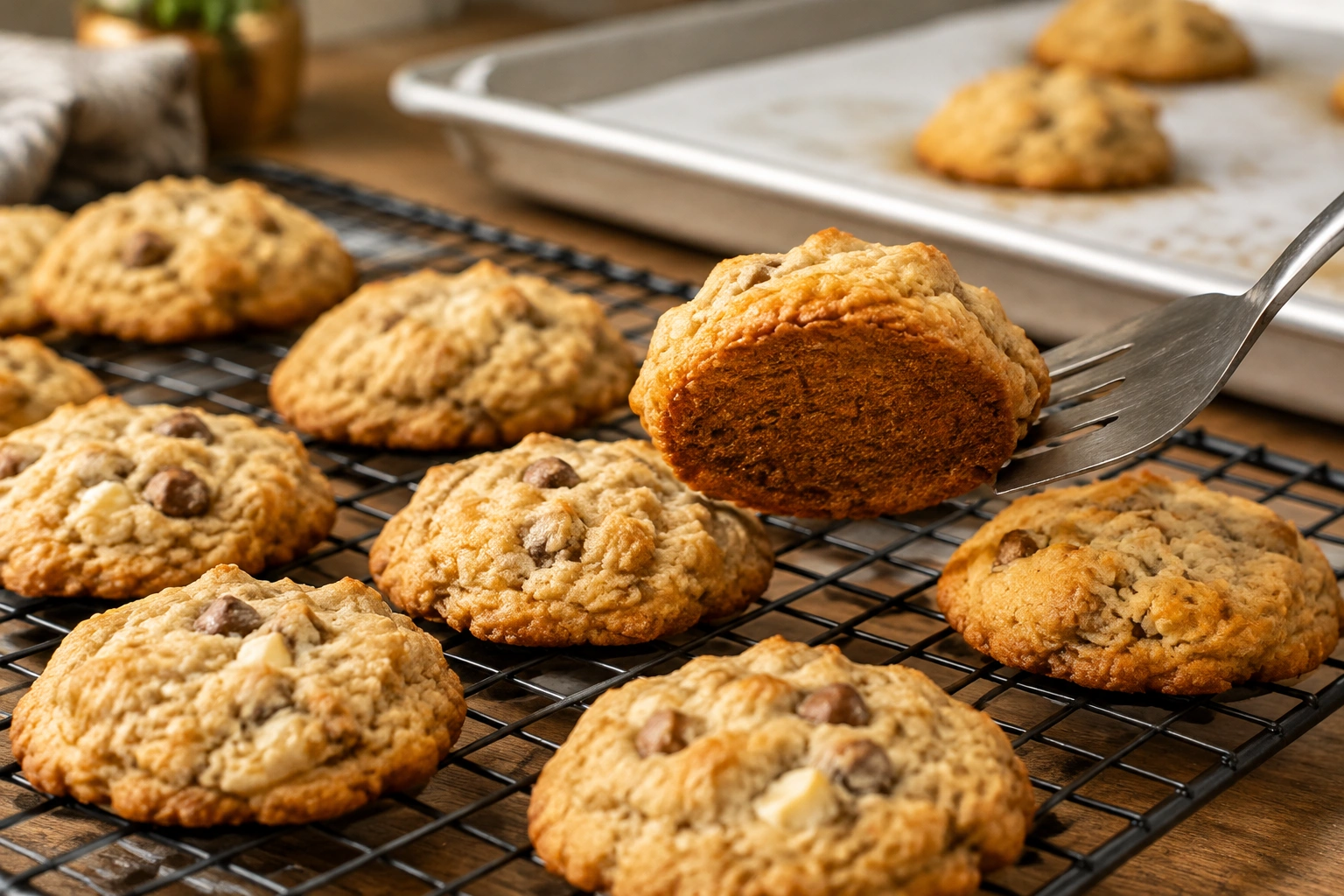
Once out of the oven, let cookies rest on the pan for two to three minutes, then move them to a wire rack. Carryover baking continues on a hot sheet; leaving them there for ten minutes turns a good cookie into a hard one.
Troubleshooting Uneven Two-Rack Cookies
| Symptom | Likely cause | Adjustment |
|---|---|---|
| Burnt bottoms on lower tray | Proximity to bottom element; dark pan; no parchment | Raise that rack one slot; light pan; add parchment; drop 25°F |
| Pale tops, done bottoms | Upper tray shielded from radiant heat; airflow blocked | Swap earlier; switch to convection; lower the upper rack slightly |
| Brown edges, raw centers | Oven running hot for the pan and dough mass | Confirm with a thermometer; drop to 325°F; smaller scoops |
| One tray done, the other pale | Vertical heat imbalance, not a front-to-back problem | Swap racks at the midpoint instead of rotating only |
| Cookies spread and merged | Warm dough; pans overcrowded; two trays slowing the set | Chill 30 minutes; two-inch spacing; fewer cookies per sheet |
| Identical color, greasy texture | Underbaked; two trays genuinely slowed the bake | Add one to two minutes; check the underside, not the top |
Can You Bake Different Cookie Types on Two Racks Together?
Only if they’re genuinely similar. Pair cookies by size, thickness, and bake time — not by flavor.
Thin sugar cookies that finish in 8 minutes and thick oatmeal cookies that need 12 to 14 minutes cannot share an oven on two racks. One tray will be pulled early or left too long, and the swap will be mistimed for both. Bake them separately, or bake the faster dough first while the oven is coming to temperature and use the residual heat for the slower one.
A workable pairing: two different drop cookie doughs at roughly the same scoop size and the same bake window — chocolate chip and snickerdoodle, for instance. Those swap and rotate together without compromise.
Batch-Size Limits: How Many Sheets Can Your Oven Handle?
Two sheets, one per rack. That’s the ceiling for even baking.
Four sheets — two per rack, side by side — blocks the airflow that makes two-rack baking work at all. You’ll get pale tops from reduced radiant exposure and burnt bottoms from the trapped heat below, plus a completely unpredictable timeline. It’s the classic “why do my cookies taste steamed?” scenario.
If two sheets aren’t enough capacity, bake in waves and reuse a single tray rather than loading all four at once. A rotation of two trays in and out keeps the oven at temperature better than four trays sitting inside it. And if you find yourself baking large volumes regularly, a second oven or a dedicated multi-rack convection unit is a more honest solution than trying to force a standard residential oven past its airflow limits.
Frequently Asked Questions About Two-Rack Cookie Baking
How often should I rotate and swap the trays?
Once, at 50 to 75 percent of the bake. More frequent door opening drops the oven temperature and does more harm than good.
Do I need to reduce the temperature for two racks?
In conventional mode, usually not — unless browning runs ahead of setting, in which case drop the oven temperature slightly. In convection mode, yes: use the single reduction noted in the convection section above.
Do two racks need extra baking time?
Often the same time, occasionally one to two minutes longer, because two trays of cold dough slow the oven’s recovery. Judge by the cookies, not the clock.
Should I chill the dough before baking two trays?
If the recipe produces thin, spread-prone cookies, yes — 30 minutes in the refrigerator. Cold dough sets before it runs, which buys you tolerance for uneven heat.
Can I bake on three racks?
I wouldn’t. A third rack adds a third thermal environment and makes swapping impossible to do fairly. Reported experience with consumer convection ovens suggests the middle rack of three bakes slowest, forcing you to choose which tray gets shortchanged.
Why were my cookies uneven even though I rotated them?
Because rotating and swapping correct different kinds of unevenness. See “Rotate, Swap, or Both?” above for the distinction and timing.
Two-rack baking rewards attention more than equipment. Know where your oven’s heat comes from, put the racks in the upper and lower thirds, map the hot spots before you load, rotate and swap once at the right moment, and check the lower tray first. Do those five things and your two-tray batch will come out indistinguishable from a single-sheet bake — with half the evening spent at the counter.

