
How to Convert Baking Powder Teaspoons to Grams (With a Fast Chart)
Precision in baking usually comes down to knowing how much of an ingredient is actually going into the bowl. Baking powder is a small ingredient with an outsized job, and it’s the one most often fudged when a recipe crosses between metric weights and US spoons.
One level teaspoon of baking powder weighs about 4 grams. If your recipe source uses a density-based figure instead, that same spoonful comes out closer to 4.6 grams. Everything below explains when each number applies, how to measure accurately without a scale, and what to do when a metric recipe lands on your counter and all you own are spoons.

How Many Grams of Baking Powder Are in a Teaspoon?
Use 4 grams per level teaspoon. That is the working standard in home baking, and it’s the number most recipe writers reach for when they publish a metric version of a spoon-based recipe.
If your source specifies something different, 4.6 grams per level teaspoon is the most common alternate. It comes from measured density rather than convention. Measured values for a level teaspoon commonly land between about 4.4 grams and 4.8 grams, depending on how the powder is filled and settled.
That spread looks dramatic on paper and isn’t in practice. In a batch of scones or a single round cake, the gap between 4 g and 4.6 g sits comfortably inside normal recipe tolerance. Two things matter far more:
- These figures are for level teaspoons. A heaped spoon can hold 1–2 g more.
- They apply to baking powder, not baking soda. The two are not interchangeable by weight or by chemistry.
Quick Conversion Chart: Teaspoons to Grams for Baking Powder
Find your amount, then use the column that matches your recipe’s convention. If the recipe doesn’t specify, the 4 g column is the safer choice.
| Amount | At 4 g per tsp | At 4.6 g per tsp |
|---|---|---|
| 1/4 tsp | 1 g | 1.2 g |
| 1/2 tsp | 2 g | 2.3 g |
| 3/4 tsp | 3 g | 3.5 g |
| 1 tsp | 4 g | 4.6 g |
| 1 1/2 tsp | 6 g | 6.9 g |
| 2 tsp | 8 g | 9.2 g |
| 1 Tbsp (3 tsp) | 12 g | 13.8 g |
Notice the tablespoon row. One tablespoon of baking powder is roughly 12 grams, not 15, because a tablespoon is three teaspoons — a detail that trips up a lot of conversions.
The Conversion Formula for Any Amount
The math is one multiplication:
grams = teaspoons × 4 (or × 4.6 if you’re following a density-based source)
A few worked examples using the 4 g standard:
- 1 1/4 tsp → 5 g
- 1 3/4 tsp → 7 g
- 2 1/2 tsp → 10 g
- 4 tsp (1 Tbsp + 1 tsp) → 16 g
- 1/3 tsp → 1.3 g
That last one is worth pausing on. At 1.3 g, you gain nothing by weighing — rounding to 1 g or 2 g introduces more error than simply measuring the 1/3 teaspoon with the spoon. For amounts under about 1/2 teaspoon, the spoon is often the more accurate tool.
Why You’ll See 4 g, 4.6 g, or 5 g per Teaspoon
Three different figures float around, and they come from three different places.
4 g is a rounding convention. Recipe developers who publish in both cups and grams often pick 4 because it produces a clean chart: 1/4 tsp = 1 g, 1/2 tsp = 2 g, 2 1/2 tsp = 10 g.
4.4–4.8 g is a measured density value. Reference charts derived from real measurements land in that band.
5 g is likely a rounding artifact. It may come from applying water’s density (1 tsp of water weighs about 5 g) to a powder, or simply from rounding a 4.6–4.8 figure up. If a recipe says 5 g per teaspoon, treat it as a rounded 4.6 and move on.
The rule that resolves all of this: use 4 g unless the recipe tells you otherwise. And if a recipe states the baking powder in grams directly, use those grams — no conversion needed.
What Changes the Weight of a Teaspoon of Baking Powder
The 3.5–5 g range reported by different sources isn’t only about brand. It’s about how the powder is handled.
- Compaction. Scooping directly from the tin with the measuring spoon packs powder into the bowl of the spoon, often adding 1–2 g.
- Settling. Powder that has sat undisturbed in a canister is denser than powder you’ve just stirred.
- Humidity. Moist air makes baking powder clump and pack, increasing weight per spoon.
- Sifting or fluffing. Aerating the powder lowers the weight in a given spoon.
- Spoon geometry. Rims and bowl depths vary, and a slightly deeper spoon holds more.
This is why “level teaspoon” is a method, not just a shape. Stirring first, then spooning and leveling, lands you consistently near the 4 g figure.
US vs UK and Australian Teaspoons: Does the Conversion Change?
A US teaspoon holds about 4.93 mL. A UK or metric teaspoon holds 5 mL. That’s a difference of roughly 1.4%, which at 4 g per teaspoon works out to about 0.06 g. Ignore it.
The tablespoon is where international recipes actually bite. A US tablespoon is 14.79 mL — three US teaspoons. A UK tablespoon is 15 mL. An Australian tablespoon is 20 mL, which is four teaspoons. So “1 Tbsp baking powder” in an Australian recipe is closer to 16 g than 12 g. That’s a genuine 33% difference and worth catching before you bake.
How to Measure Baking Powder with Spoons Accurately
Stir the powder to break up any clumps before you measure. Then:
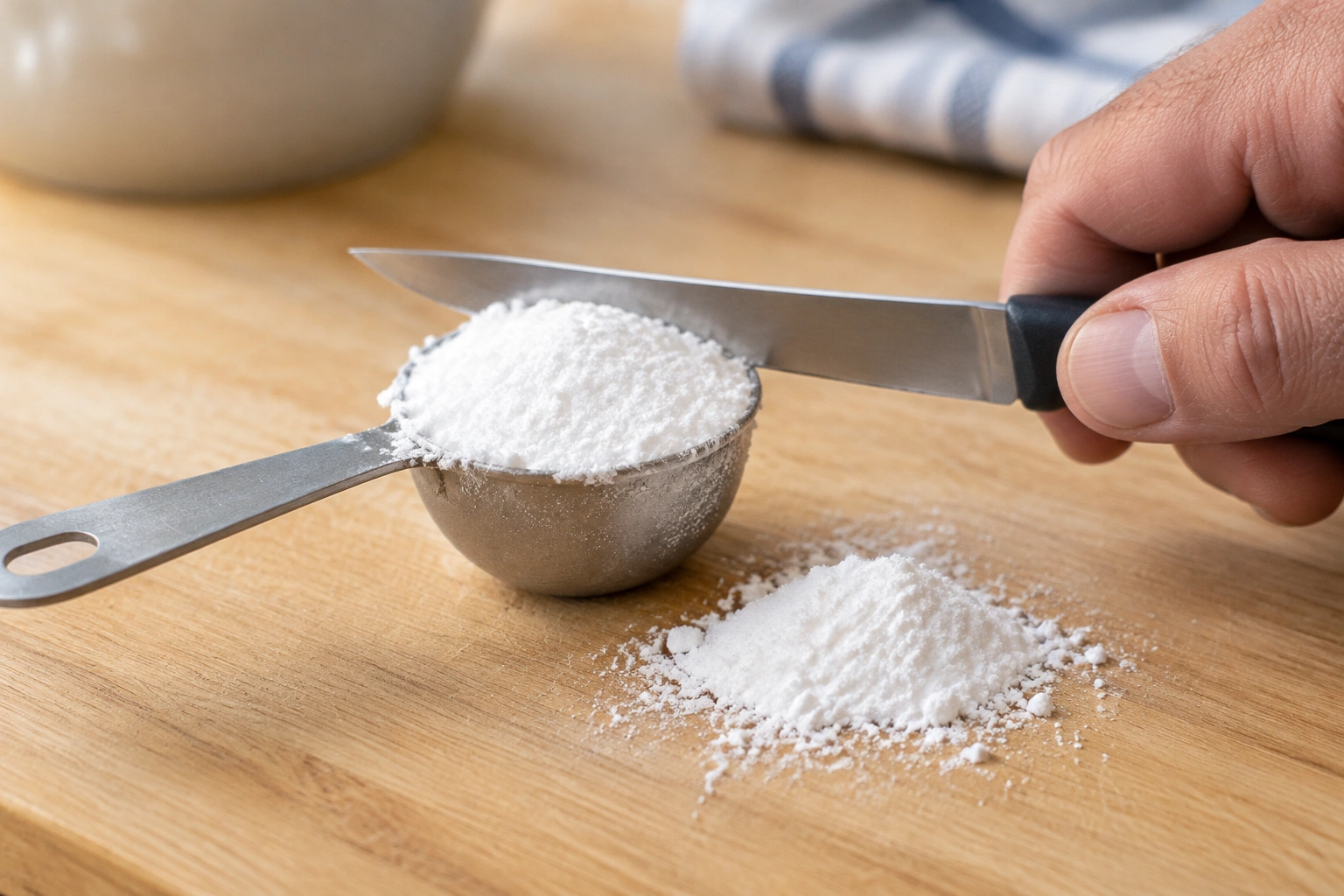
- Spoon the powder into the measuring spoon rather than diving the spoon into the container.
- Fill it until it’s slightly mounded.
- Level it with the straight edge of a knife or the back of another spoon.
- Don’t tap, shake, or press the spoon to settle the powder.
- Work over a small dish if you’re worried about spills.
The goal is a loosely filled, level spoon every time — the same spoonful whether you measure on a dry day or a humid one.
Weighing vs Measuring Spoons: Which Is More Accurate?
Weight is more reproducible in theory: 4 g is 4 g no matter how you scoop. But that advantage shrinks at small quantities, and it’s worth knowing where the line falls.
Most inexpensive digital kitchen scales are accurate to about ±1 g at the low end, sometimes worse. On a single teaspoon of baking powder (about 4 g), that is roughly a 25% error, and a 1/4 teaspoon may not register reliably at all. Professional test kitchens generally recommend weighing dry ingredients for consistency, and that’s sound advice for flour and sugar — but for leavening agents in home-sized batches, a scale’s low-end tolerance can be worse than a careful spoon.
A practical split:
- Under 2 tsp: measure with a level spoon.
- 2 tsp and up: a scale is fine, and it’s convenient in large batches.
- Always tare the scale first, and add the powder into a small cup rather than over your mixing bowl.
Baking Powder vs Baking Soda: They Don’t Convert the Same Way
Both are white powders that make baked goods rise, and that’s roughly where the similarity ends.
Baking soda is a single compound — sodium bicarbonate — that needs an acid in the batter to work. Baking powder contains baking soda plus an acid and a starch, which is why it’s self-contained. Conversion charts typically list baking soda around 4.6–4.8 g per teaspoon, slightly heavier than the 4 g standard used for baking powder.
That 0.6 g gap is not the real issue. The real issue is that weighing one in place of the other doesn’t correct the chemistry. Use the conversion for the ingredient your recipe actually names.
Do Brand, Double-Acting, or Aluminum-Free Baking Powder Change the Conversion?
Double-acting versus single-acting: this is about when the powder releases gas, not how much it weighs. No conversion change.
Aluminum-free: a formulation difference, not a density difference. No conversion change.
Brand: this is the one variable that genuinely shifts things a little. Granulation and starch content vary slightly between manufacturers, so a specific product’s bulk density can differ from the generic figure. If the label gives a gram equivalent, use it. Otherwise, 4 g per teaspoon is the sensible starting point and is rarely worth adjusting.
How to Convert Grams of Baking Powder Back to Teaspoons
Divide the gram figure by four to get teaspoons. With the alternate standard, divide by 4.6.
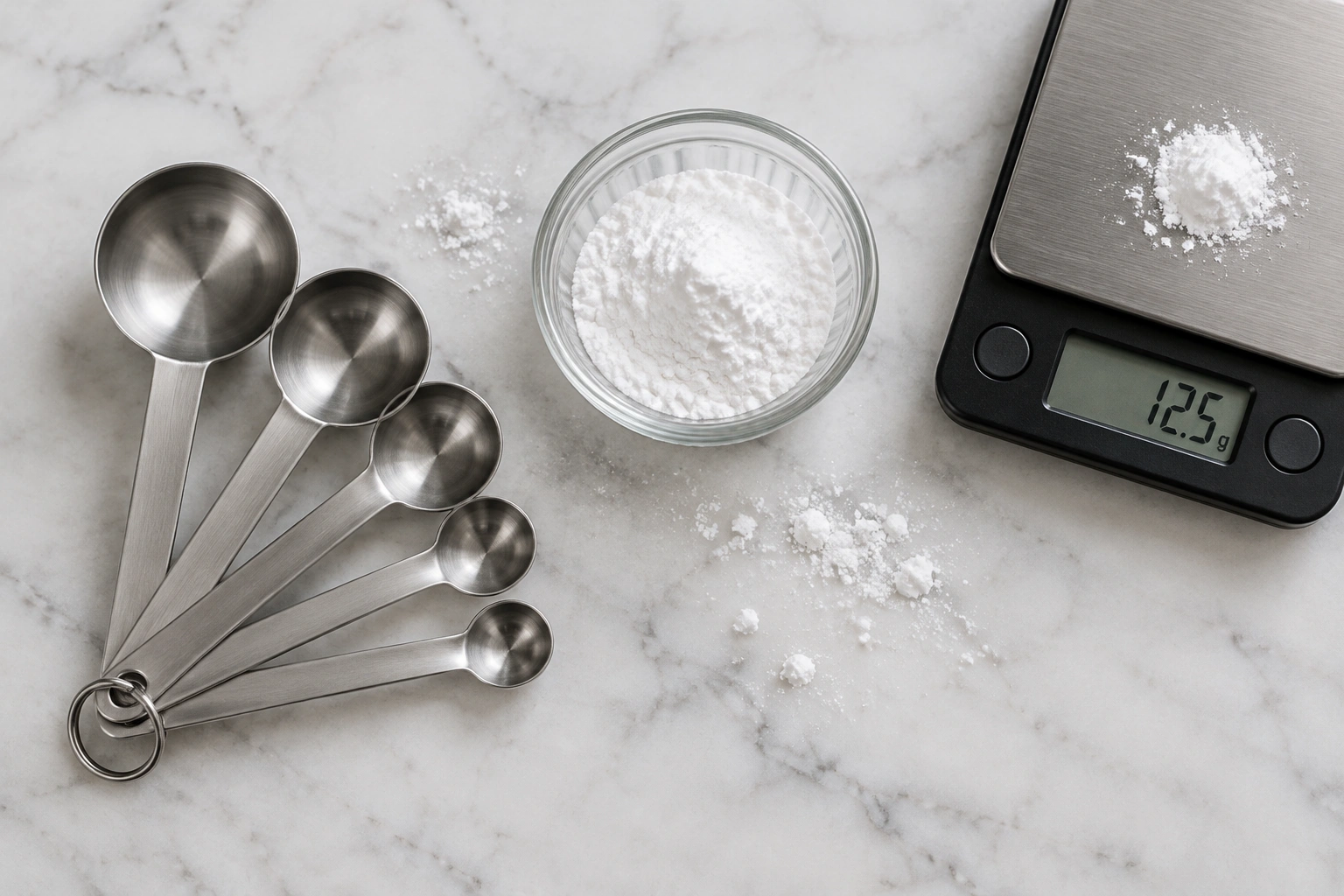
- 3 g ÷ 4 = 0.75 → 3/4 tsp
- 5 g ÷ 4 = 1.25 → 1 1/4 tsp
- 7 g ÷ 4 = 1.75 → 1 3/4 tsp
- 10 g ÷ 4 = 2.5 → 2 1/2 tsp
- 12 g ÷ 4 = 3 → 1 Tbsp
The common mistake here is dividing by 5. That gives 2 tsp for a 10 g call-out instead of 2 1/2 tsp, which undershoots the leavening by about 20%.
Using the 4.6 standard, 10 g ÷ 4.6 = 2.17, which rounds to a slightly generous 2 1/4 tsp. Either answer bakes fine — just pick one convention and stay with it through the recipe.
What to Do If the Recipe Is in Grams but You Only Have Measuring Spoons
Work through it in order:
- Check whether the recipe supplies a conversion. Some do, in a chart or a note. If so, use theirs.
- If it only gives grams, divide by 4.
- Round sensibly. To the nearest 1/4 tsp if your spoon set allows it, otherwise the nearest 1/2 tsp.
- Measure level, every time.
- For anything under 2 g (below 1/2 tsp), skip the math and just measure the closest spoon size — the rounding error is larger than the measurement error.
Examples: 12 g becomes 1 tablespoon. 6 g becomes 1 1/2 teaspoons. 4 g becomes 1 teaspoon. Small compromises, and none of them will sink a bake.
How Accurate Does This Conversion Need to Be?
Leavening agents have real tolerance, but not unlimited tolerance.
Rounding within about half a gram on a teaspoon-sized amount will not change the outcome of a full batch. The relative error grows, however, as batch size shrinks: in a quarter-batch, 1/4 tsp versus 1/2 tsp is a doubling of the leavening, and that can matter. Small batches, delicate sponge-style cakes, and high-altitude conditions are all situations where being closer to the recipe’s stated amount is worth the extra care.
In the other direction, don’t treat “a little extra” as harmless. Overshooting baking powder can leave a bitter, soapy edge and can cause a risen cake to collapse; undershooting leaves you with a dense, flat result.
Worth keeping in perspective: chasing the last decimal place of a gram rarely changes a bake, while pan size, mixing method, and the oven you bake in change it constantly.
Quick Decision Rules and Common Pitfalls
- Default: 4 g per level teaspoon.
- Recipe specifies otherwise: follow the recipe’s number.
- Recipe gives grams only: divide by 4, round to the nearest 1/4 tsp.
- No scale available: spoon and level, and treat 1/2 tsp as 2 g.
- Weighing? Tare first, use a scale for 2 tsp and up, spoons for smaller amounts.
- Converting for baking soda? Use roughly 4.6 g per teaspoon, and don’t substitute it for baking powder.
Common pitfalls: scooping straight from the tin compacts the powder; heaped spoons can add 1–2 g; 1 Tbsp is about 12 g, not 15 g; an Australian tablespoon is 20 mL (four teaspoons); and converting grams to teaspoons means dividing by 4, not 5.
Frequently Asked Questions
Is 1 teaspoon of baking powder exactly 4 grams?
No. It’s approximately 4 grams, and that’s the figure most home-baking charts use. Measured values from density-based references run closer to 4.4–4.8 grams depending on how the spoon is filled. The 4 g figure is a practical standard, not a physical constant.
How many grams is 1/2 teaspoon of baking powder?
About 2 grams at the 4 g standard, or 2.3 grams at 4.6 g per teaspoon. For half-teaspoon amounts the difference is negligible.
Is 1 tablespoon of baking powder 15 grams?
No — about 12 grams. A tablespoon equals three teaspoons, and 3 × 4 = 12. In an Australian recipe the tablespoon is 20 mL (four teaspoons), which brings it closer to 16 grams.
Does the conversion change for double-acting or aluminum-free baking powder?
Not meaningfully. Double-acting and single-acting powders differ in how and when they release gas, not in how much a level teaspoon weighs. The same applies to aluminum-free formulas.
Is baking powder the same weight as baking soda?
Close, but not identical. Baking soda is commonly listed around 4.6–4.8 g per teaspoon against baking powder’s 4 g standard. The more important difference is chemical: they are not interchangeable in a recipe.
How do I convert 15 grams of baking powder to teaspoons?
Divide by 4, which gives 3.75 — so 3 3/4 level teaspoons. If your recipe uses the 4.6 standard, 15 ÷ 4.6 ≈ 3.26, or about 3 1/4 teaspoons.
My scale only measures in 1 g increments. Can I still weigh baking powder?
For 2 teaspoons and up, yes — and 8 g or 9 g both work fine. For smaller amounts, the scale’s margin of error is proportionally large, so use a level measuring spoon instead.

