
How to Measure Flour for Better Bread, Dough, and Baking Results

If you’ve ever followed a bread recipe and ended up with dough that felt too stiff, too sticky, or strangely inconsistent, flour measurement is often the first place to look. Flour is the backbone of most doughs, so even a small measuring error can change hydration, texture, and how the dough behaves at the bench.
The good news: measuring flour well is not complicated. You mainly need to decide whether you want the accuracy of a scale or the convenience of measuring cups. Once you understand the difference between weighing, spooning, and scooping, your bread and dough recipes become much more predictable.
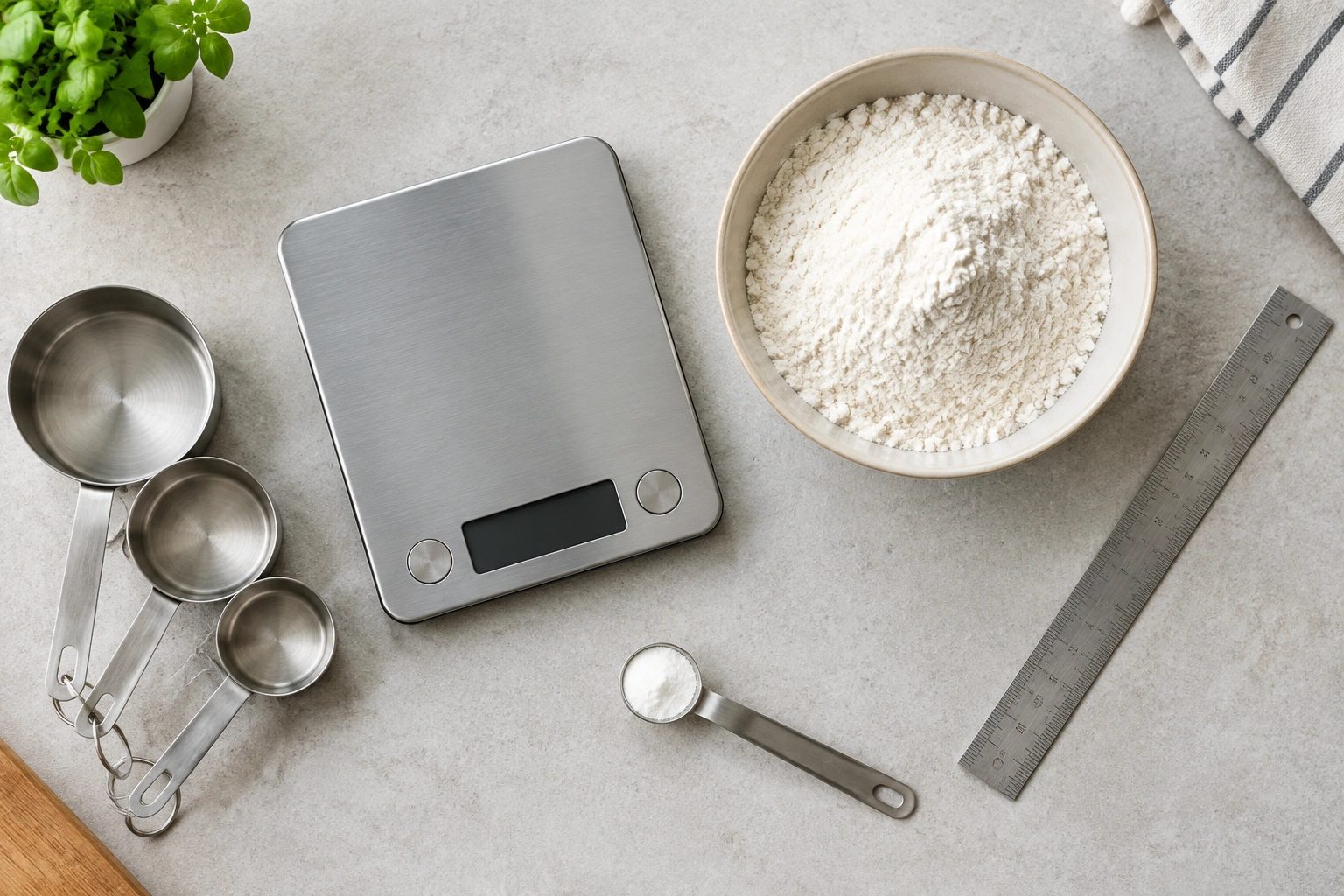
Why Accurate Flour Measurement Matters
Flour does not behave like a liquid. It settles, compacts, and changes how much fits into a cup depending on how it’s handled. That matters because flour controls how much water a dough can absorb.
If you add too much flour, the dough can turn dry, tight, and hard to knead. In bread, that often means a loaf with less oven spring and a denser crumb. If you add too little flour, the dough may feel sticky and slack, which can make shaping harder and may affect structure.
For bread and pizza dough, consistency is especially valuable. If you measure flour differently each time, the same recipe can produce different results even when your technique is solid. That is why professional bakeries and many serious home bakers rely on weight.
What You Need to Measure Flour
At minimum, you need one of these:
- A kitchen scale if you want the most accurate measurement
- Dry measuring cups if you’re measuring by volume
Helpful extras:
- A spoon for transferring flour into the cup
- A straight edge for leveling, such as a knife, bench scraper, or offset spatula
- A bowl if you’re weighing flour by grams
If your flour has been sitting in a bin or bag and looks compacted, give it a quick stir or fluff before measuring. That simple step helps loosen settled flour so you don’t accidentally pack more into the cup than intended.
The Most Accurate Way: Measuring Flour by Weight
If a recipe gives flour in grams, use grams. That is the cleanest path to repeatable dough.
King Arthur Baking recommends hitting the Tare button so the scale reads zero before adding flour, which keeps the bowl from affecting the measurement. Their recipes also include gram and volume measurements, which makes it easier to choose the method that fits your kitchen. You can see their guidance on measuring flour by weight and by volume.
How to do it
- Place your bowl on the scale.
- Press Tare so the display returns to 0 grams.
- Spoon or pour in flour until the scale reaches the recipe’s target weight.
- Stop exactly there—no need to level, sift, or pack unless the recipe specifically asks for it.
Why this method wins
Weight removes guesswork. A cup can vary depending on how it was filled, but grams stay the same. That matters most in bread dough, where hydration is sensitive. If a formula calls for 500 grams of flour, you know exactly what you’re using every time.
When weight is the better choice
Use a scale when:
- The recipe lists flour in grams
- You want consistent bread dough from batch to batch
- You’re scaling a recipe up or down
- You’re working with a dough that is already hydration-sensitive, such as sandwich bread, pizza dough, or enriched doughs
If you bake often, a scale can be a very helpful tool to have.
How to Measure Flour with Cups Using the Spoon-and-Level Method
If you do not have a scale, the spoon-and-level method is the best volume method for home baking. It is more reliable than scooping directly with the cup.
Here’s the process:
- Fluff the flour first. Stir it in the bag or container if it looks packed.
- Spoon flour into the measuring cup. Let the flour fall lightly into the cup until it is overflowing.
- Do not shake or tap the cup. Tapping settles the flour and can increase the amount.
- Level off the top. Use a straight edge to sweep away the excess so the flour is even with the rim.
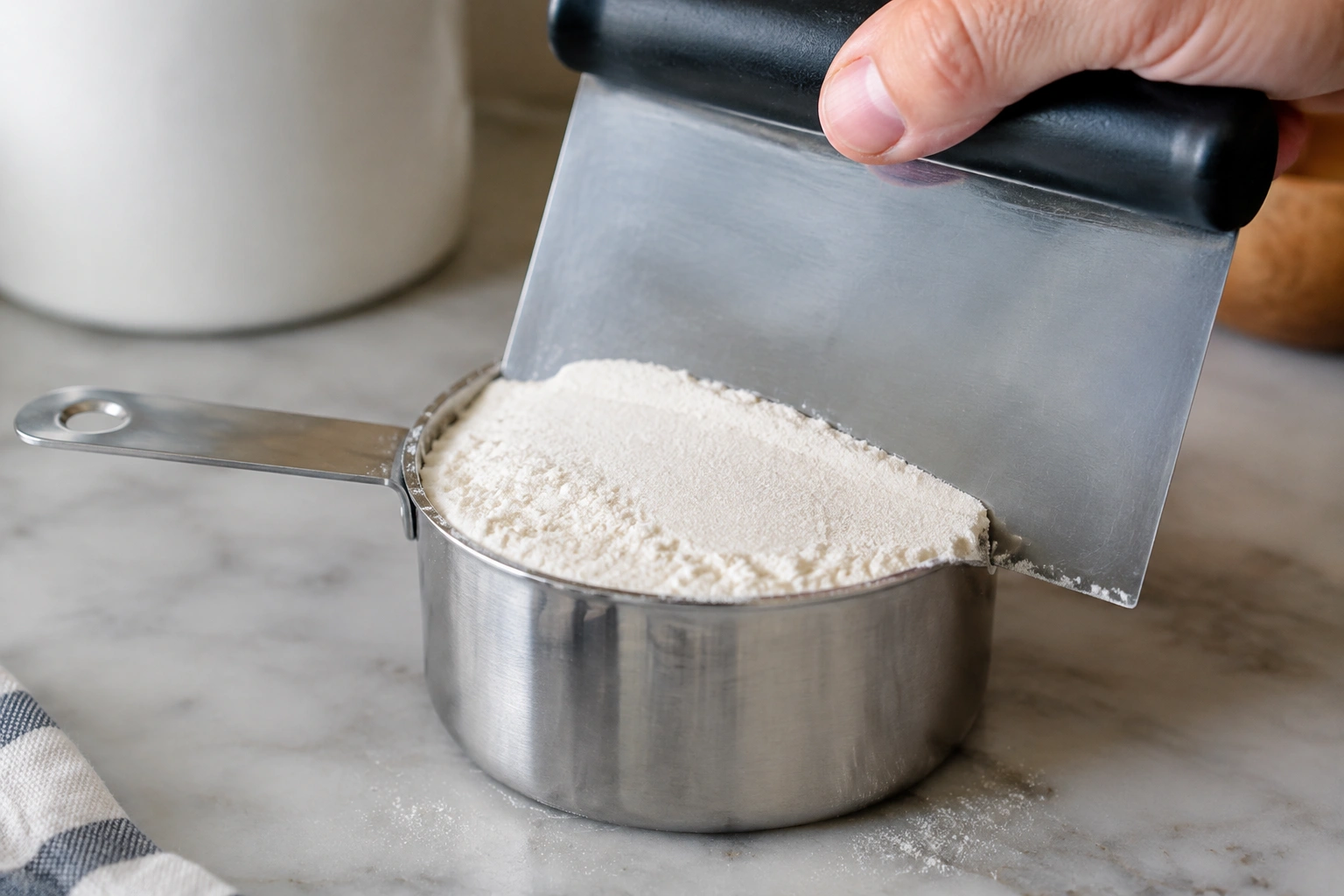
That’s the method King Arthur Baking recommends: fluff, spoon into the cup, then level with a straight edge. Sally’s Baking Addiction also advises using the spoon-and-level approach and not scooping directly from the container because it can lead to using far more flour than needed.
Why this works better than scooping
When you spoon flour in lightly, you limit compaction. The cup ends up closer to a standard amount instead of a packed one. It still won’t be as precise as weighing, but it is a solid method when cups are your only option.
Scoop vs. Spoon: What Changes and Why It Matters
This is the decision that trips up a lot of bakers.
Scooping directly
When you plunge the measuring cup into the flour bag or bin, the cup compresses the flour as it fills. That can leave you with more flour than the recipe intended. Sally’s Baking Addiction warns that scooping can add a lot more flour than spooning, and packing or tapping makes the problem worse.
Spoon-and-level
When you spoon flour into the cup, the flour stays lighter and less compressed. That makes the measurement more consistent.
Practical trade-off
Scooping is faster, but speed is not the same as accuracy. For some cookies, the difference may be small enough that you do not notice much in the finished result. For bread dough, it can be the difference between a supple dough and one that feels stiff from the first mix.
If your bread keeps turning out dry, the measuring cup may be the reason before anything else in the recipe is to blame.
How Flour Type Affects Cup-to-Gram Conversions
There is no single universal cup-to-gram number that works perfectly for every flour and every measuring style. In practice, the measuring method can change the weight as much as, or more than, the flour type itself. That is why grams are the most reliable reference whenever a recipe provides them.
A useful reference point for many recipes is this:
| Flour type | 1 cup by volume | Notes |
|---|---|---|
| All-purpose flour | about 120–125 g | Common in many home recipes |
| Bread flour | about 120–125 g | Often close to all-purpose by weight, but brand and measuring style matter |
| Cake flour | about 110–115 g | Lighter and more finely milled, so a cup can weigh less |
These are practical kitchen references, not absolute laws. Different brands, flour types, and measuring methods can shift the result.
What to do with this information
- If the recipe gives grams, trust the grams.
- If the recipe gives cups, use the spoon-and-level method for the closest result.
- If you are converting a recipe from cups to grams, check whether the source assumes spooned and leveled flour or a different method.
Bread flour vs. all-purpose flour
Bread flour and all-purpose flour may look similar in the measuring cup, but they can behave differently in the dough. If you are comparing them in a bread recipe, keep the measuring method the same so you are only changing the flour type, not the amount.
When to Sift Flour Before Measuring
Sifting gets discussed a lot, but it is not always necessary.
Sift before measuring when:
- The recipe explicitly says “sifted flour”
- You need a very light, airy measure for a specific formula
- The flour is lumpy and the recipe depends on a delicate texture
Do not sift unless needed when:
- The recipe gives a normal bread dough formula
- The recipe does not mention sifting
- You are measuring by weight
Here’s the key point: if a recipe says “1 cup flour, sifted,” that can mean something different from “1 cup flour, then sifted.” Those are not automatically interchangeable. If the formula is written in grams, you avoid that ambiguity entirely. Standard bread dough usually does not require sifting unless the recipe specifically says so.
For most bread recipes, sifting is usually unnecessary. Fluffing is enough if you are measuring by cups.
Common Mistakes to Avoid When Measuring Flour
A few small habits can throw off your dough more than you might expect.
Packing the flour
Pressing flour into the cup increases the amount. This is one of the easiest ways to overshoot a recipe.
Tapping the cup
A tap settles the flour, which can make the cup hold more than intended. That extra flour can dry out the dough.
Leveling too aggressively
Scraping off too much can under-measure the flour. Use a light pass with a straight edge, not a digging motion.
Measuring straight from a compacted bin
If the flour has been sitting undisturbed, stir or fluff it first. Otherwise, the top layer may be denser than you think.
Assuming every cup weighs the same
A cup is a volume measure, not a weight measure. That means the same cup can contain different amounts depending on how it was filled.
Troubleshooting Dry, Dense, or Sticky Dough
Flour measurement problems often show up in the dough before they show up in the finished loaf.
If the dough is dry or tight
You may have used too much flour. This often happens when flour was scooped directly from the bag or packed into the cup. The dough may resist kneading and feel stiff early on.
If the dough is overly sticky
Too little flour is one possibility, but don’t rush to add a lot more. Some doughs, especially high-hydration or enriched doughs, are meant to feel tacky. First check whether the recipe was measured consistently and whether the flour type matches the formula.
If the loaf is dense
Dense bread can have many causes, and flour measurement is one possible factor. Too much flour can limit expansion and make the crumb tighter.
A useful adjustment rule
If your dough feels off, make one small correction next time rather than changing everything at once. For example, if you measured by scooping, try spoon-and-level or weight on the next bake before changing water, yeast, or kneading time.
Quick Conversion Guide for Cups and Grams
Use this as a practical starting point, especially when a recipe lists cups but you want to verify the amount:
- 1 cup all-purpose flour: about 120–125 g
- 1 cup bread flour: about 120–125 g
- 1 cup cake flour: about 110–115 g
If you need a simple bread-baking shortcut, many bakers treat 1 cup flour as roughly 120 g when converting a cup-based recipe. That said, if a recipe is precise, the best answer is still the one written in grams.
Example conversion
If a bread recipe calls for 4 cups of all-purpose flour, that is roughly 480–500 g depending on the flour and how it was measured. That range is exactly why weight is better for repeatable results.
Simple Examples for Bread and Dough Recipes
Sandwich loaf
A recipe calls for 500 g flour. Weigh 500 g directly into a bowl. Your dough should be easier to repeat each time because the flour amount is fixed.
Pizza dough
A recipe gives 3 1/2 cups flour. Fluff the flour, spoon it into the cup, and level off each cup carefully. If the dough feels unusually stiff, the most likely reason is that the cups were overfilled.
Beginner bread recipe
You only have measuring cups and the recipe was written in cups. Stir the flour in the container, spoon it into the cup, and level it off. Do not scoop straight from the bag. That one change often improves consistency right away.
A Simple Decision Guide
If you only remember one thing, make it this:
- Use a scale when the recipe gives grams or when accuracy matters most.
- Use spoon-and-level cups when the recipe is written in cups and you do not have a scale.
- Do not scoop and pack unless the recipe specifically says to do so.
- Do not sift unless the recipe asks for it.
That’s the cleanest way to measure flour without letting the cup do the work of the recipe for you.
FAQ
How many grams are in 1 cup of flour?
For many baking recipes, 1 cup of all-purpose flour or bread flour is about 120–125 grams. Cake flour is often a little lighter by weight per cup.
Is weighing flour really better than using cups?
Yes, if you want the most consistent results. Weight removes the compaction problem that comes with cups.
Should I fluff flour before measuring?
Yes, if you are measuring by cups. Fluffing helps loosen compacted flour so you don’t accidentally pack too much into the cup.
Do I need to sift flour before measuring?
Usually no, unless the recipe specifically calls for sifted flour or you need a very light measure for a particular formula.
Why does my dough keep turning out dry?
Flour over-measurement is a common cause. Scooping directly from the bag or packing the cup can add more flour than the recipe intended.
Final Takeaway
The best flour measurement method is the one that matches your recipe and your tools. If you have a scale, weigh the flour. If you’re using cups, fluff, spoon, and level. Once you make that habit automatic, bread dough becomes easier to judge, easier to shape, and much more consistent from bake to bake.