
How to Store Chocolate Ganache for Cake Decorating Without Ruining the Texture
Chocolate ganache is one of the most useful tools in cake decorating, but it behaves differently from buttercream or plain melted chocolate. Because it contains cream, the way you store it affects both safety and texture. If you need it for frosting, filling, drip cakes, piping, or a crumb coat, the goal is simple: keep it covered, keep it cool when needed, and bring it back to the right consistency before you decorate.
Quick answer: the best storage method depends on when you’ll use it
If you are decorating the same day, chocolate ganache can usually sit at room temperature for a short window if the recipe and environment are stable enough for that use. If you are making it ahead, refrigeration is the practical choice for most cake decorators. For longer storage, freeze it in an airtight container and thaw it slowly in the refrigerator.
That is the basic rule I teach students:
– Use it soon: keep it covered and let it sit until it reaches the texture you need.
– Use it in a day or two: refrigerate it.
– Use it weeks later: freeze it.
For a food-safety baseline, remember that ganache contains dairy, so it should not be treated like dry pantry frosting. The USDA’s general guidance on perishable foods is a useful reference point for why chilled storage matters for dairy-based mixtures: USDA food safety basics.
How long chocolate ganache lasts in each storage method
Storage time depends on the recipe, the room temperature, and how much cream is in the ganache. A darker, firmer ganache tends to hold up better than a softer white chocolate version, but the storage method still matters more than the chocolate color alone.
Here is the practical comparison most bakers need:
| Storage method | Typical use case | Texture impact | Practical notes |
|---|---|---|---|
| Room temperature | Same-day decorating | Stays soft and workable | Best for short holding only; cover well to prevent skin |
| Refrigerator | Make-ahead frosting, filling, piping prep | Firms up significantly | Needs time to warm before spreading or piping |
| Freezer | Long-term make-ahead batches | Becomes very firm after thawing | Best for leftovers or planned future projects |
A few reliable recipe sources give similar storage ranges: refrigerated ganache is commonly kept for several days, and frozen ganache can be held for months. Sally’s Baking Addiction notes refrigerated storage up to 5 days and frozen storage up to 3 months, while RecipeTin Eats also recommends freezing for up to 3 months and thawing overnight in the fridge. Those timelines are practical for cake decorating when the ganache is cooled, sealed, and handled cleanly.
– Sally’s Baking Addiction ganache storage guidance
– RecipeTin Eats ganache freezing and thawing method
For room-temperature holding, use caution. Ganache is not a dry shelf-stable frosting. If your kitchen is warm, or if the ganache will sit for more than a short decorating session, move it to the refrigerator instead of guessing.
Should you store ganache in the bowl or transfer it to a container?
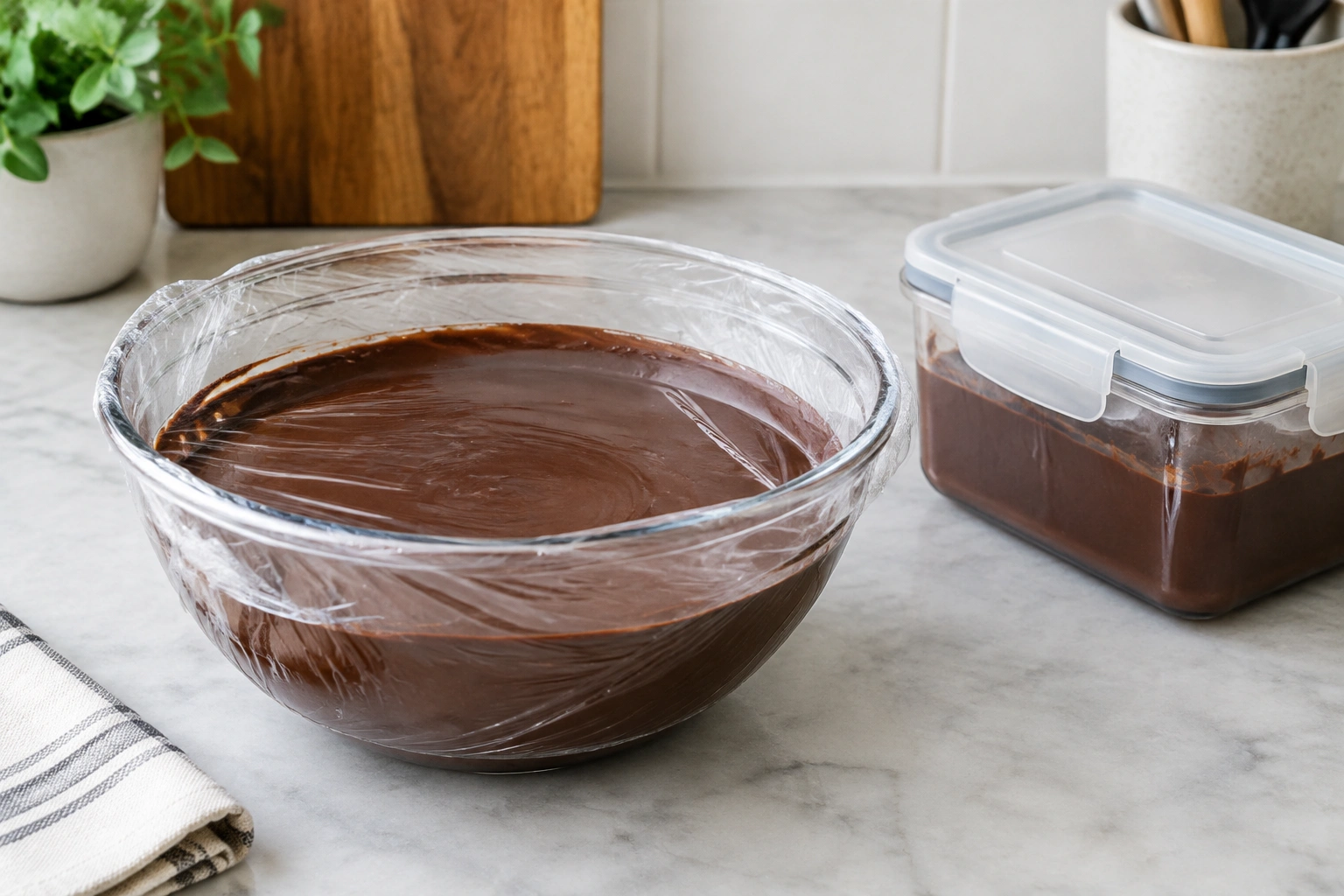
For short cooling, the bowl you made it in is fine if it is clean and covered. For longer storage, transfer it to an airtight container.
That distinction matters because a mixing bowl with loose wrap is more likely to let in air, collect odors, or dry out at the surface. An airtight container gives you a cleaner seal and makes stacking easier in the refrigerator or freezer.
A useful detail from recipe testing sources is to press plastic wrap directly onto the surface of the ganache to prevent a skin from forming. Once it is fully cooled, move it into an airtight container if you are storing it for later. RecipeTin Eats recommends smoothing the surface, then covering the ganache with cling wrap pressed onto the top before freezing. Chelsweets also recommends covering ganache with plastic wrap so it does not form a skin while it cools.
That gives you two layers of protection:
1. Surface contact prevents drying.
2. Airtight storage protects the whole batch.
If you are storing a small amount for a same-day drip cake, surface wrap may be enough. If you are storing a batch for later frosting or piping, use a container with a tight lid as well.
How to refrigerate chocolate ganache without ruining the texture
The biggest mistake is putting hot ganache straight into the fridge. That creates condensation, which can make the texture grainy or uneven and may also affect how cleanly it reheats later.
Use this workflow instead:
1. Let the ganache cool until it is no longer hot.
2. Press plastic wrap directly on the surface.
3. Transfer it to an airtight container once practical.
4. Refrigerate it only after it has cooled enough to avoid excess moisture.
This matters because chilled ganache firms up as the cocoa butter and cream fat set. That is normal. What you want to avoid is a wet surface from condensation, since extra water can make the emulsion less smooth when you rewarm it.
For cake decorators, refrigeration is often the best middle ground. It keeps ganache ready for a next-day crumb coat or filling, but it does mean you need to plan time for softening before use. If you are assembling a cake the next day, pull the ganache out early enough that it can become spreadable again without aggressive heating.
How to freeze chocolate ganache and thaw it safely
Freezing is useful when you made more ganache than you need, or when you want to prep components well ahead of a cake order or event.
The best method is to freeze it in portions rather than one large mass. Small portions thaw more evenly and are easier to bring back to the right texture for drip cakes, filling, or piping.
A practical freezing method:
– Cool the ganache completely.
– Portion it into airtight containers or freezer-safe bags.
– Press wrap onto the surface if you are using a container.
– Label it with the date and intended use.
– Freeze it flat when possible so it thaws more evenly.
For thawing, the safest approach is slow thawing in the refrigerator overnight. RecipeTin Eats recommends leaving frozen ganache overnight in the fridge, then wiping away condensation before mixing. That step matters because moisture on the surface can make the ganache look broken even when it is only cold and wet.
Once thawed, stir gently before judging the texture. If it looks slightly separated, do not panic. Many ganache batches need a little help after freezing, especially if they were stored for a long time or thawed too quickly.
How to bring stored ganache back to spreadable or pipeable consistency
Rewarming ganache is less about “melting it again” and more about restoring the emulsion to the texture you need.
For spreadable ganache:
– Let refrigerated ganache sit at room temperature until it loosens.
– Stir it to even out the temperature before testing it on a spatula.
– If it is still too firm, warm it gently.
For pipeable ganache:
– You want it soft enough to move through a piping bag without cracking, but not so warm that it loses shape.
– If it was frozen, thaw first, then soften gradually.
Concrete texture cues help here. Spreadable ganache should feel soft enough that a spatula can glide through it without dragging, and when you lift the spatula, the ganache should slump back slowly rather than hold a sharp, stiff peak. Pipeable ganache should be smooth and flexible, with no hard cold center; when you squeeze a small amount from the piping bag, it should come out in a continuous ribbon instead of breaking or forcing the bag to bulge.
Sally’s Baking Addiction recommends rewarming ganache over low heat using either a double boiler or a heatproof bowl set over simmering water, with the bowl not touching the water. That is a good method when the ganache is very firm. A microwave can also work, but use short bursts and stir often so the chocolate does not overheat. If it becomes too warm, stop heating and let it sit at room temperature, stirring occasionally, until it thickens back up.
If the ganache is too thick, warm it in tiny steps. If it is too thin, let it cool and stir again before adding more heat. Overheating is one of the fastest ways to turn a smooth ganache into a greasy or split mixture.
If stored ganache splits, try gentle warming and stirring first. RecipeTin Eats notes that split ganache can often be fixed with a warmed milk method. That is a useful rescue step, but it is better to avoid the problem by warming slowly from the start.
How storage changes by ganache ratio and chocolate type
Not all ganache behaves the same after storage. The chocolate-to-cream ratio changes how firm it sets, and the type of chocolate changes how stable it feels after chilling.
Dark chocolate ganache
Dark chocolate ganache is usually the most forgiving for decorating. A firmer dark chocolate ratio sets more solidly, so it tends to hold shape better in the fridge and recover well for crumb coats, drip work, and piping. A looser dark ganache is easier to pour, but it is less stable for long storage or detailed piping.
Milk chocolate ganache
Milk chocolate ganache is softer and sweeter, but it generally needs a little more care after chilling because it can become very soft at room temperature. If you are using it for piping or a drip, test the consistency before committing to the cake. A medium-to-firm milk chocolate ratio is usually more reliable than a very loose one for decorating.
White chocolate ganache
White chocolate ganache is often the most delicate. It can set very firmly in the fridge but also soften quickly once it warms. That makes timing especially important for piping and smooth finishes. Because white chocolate ganache is usually made with a higher chocolate-to-cream ratio for decorating, it may store well chilled but still need a gentler hand when you bring it back to working temperature.
A higher chocolate-to-cream ratio usually gives you a firmer ganache that stores and stacks better for decorating. In practical terms, that means:
– Firmer ratios are better for frosting, filling, and piping because they set more cleanly and hold shape better after chilling.
– Medium ratios are often the best all-purpose choice for drip cakes and spreadable fillings.
– Looser ratios are easier to pour but are less stable in storage and more likely to need careful rewarming before use.
How storage changes for pouring, spreading, piping, and whipped ganache
The decorating job should guide the storage choice.
Pouring for drip cakes
Drip ganache needs to be fluid but controlled. If you refrigerate it, allow enough time for it to soften, then test a drip on the side of a chilled bowl or cake board before using it on the cake itself.
Spreading for crumb coating or frosting
Spreadable ganache should be cool enough to hold together but soft enough to smooth without tearing the crumb coat. Refrigerated ganache often needs a brief rest at room temperature and a good stir before it becomes workable again.
Piping borders or rosettes
Piping needs the firmest control. If the ganache is too warm, the design slumps. If it is too cold, it can crack or clog the piping tip. Bring it back gradually and test a small amount first.
Whipped ganache
Whipped ganache is lighter and airier, which makes it great for piping and softer frosting finishes. But it can be less forgiving in storage than unwhipped ganache. Chill it covered, then let it soften slightly before piping. If needed, whip briefly again after it warms a little. Avoid overmixing after storage, because that can make it lose volume or become grainy.
How to tell if ganache has gone bad or no longer works for decorating
Not every texture problem means spoilage. Sometimes ganache is just too cold, too warm, or slightly separated. Still, there are clear signs that mean it should be discarded.
Throw it out if you notice:
– a sour or off smell
– visible mold
– an unusual taste
– severe separation that will not come back together
– a texture that remains grainy or broken after gentle rewarming
If the ganache simply looks dull, firm, or slightly separated after chilling, it may still be usable. Stir it first. Then warm it gently and check whether it becomes smooth again.
For decorating, also check whether it behaves the way you need. A ganache can be technically safe but still unusable if it is too stiff for piping or too loose for a drip. In cake work, texture matters almost as much as shelf life.
Practical make-ahead timeline for cake decorators
Here is a simple workflow that fits most decorating projects:
Same-day use
Make the ganache, let it cool, and hold it covered at room temperature until it reaches the right texture. This works best for short decorating windows in cool conditions.
Next-day frosting or filling
Make it ahead, cool it fully, cover it tightly, and refrigerate it. The next day, let it warm gradually before spreading or piping.
Several days ahead
Refrigerate if you will use it soon, or freeze in portions if you are building a longer project schedule. Thaw overnight in the refrigerator before bringing it to working temperature.
Leftover ganache
Freeze small portions so you can use them later for cupcakes, drip accents, or test piping. Small portions are easier to revive than one large block.
That planning step saves time and keeps the texture more predictable. If you know the ganache will be used for a crumb coat tomorrow and a drip the day after, portion it before chilling so you are not repeatedly warming and cooling the whole batch.
When to Consult a Pastry Chef
If your ganache keeps splitting, feels oily after storage, or refuses to reach the consistency you need for a cake order, it is worth getting help from a pastry chef or experienced baking instructor. The issue may be the ratio, the chocolate type, the temperature change, or the way it was reheated. A professional can help you troubleshoot without wasting a full batch.
Final take
The best way to store chocolate ganache for cake decorating is to match the storage method to your timeline. Keep it covered for short use, refrigerate it for next-day decorating, and freeze it when you need a longer hold. Use airtight storage, thaw slowly, and rewarm gently so the ganache returns to a smooth, workable texture instead of turning greasy or grainy.
For decorators, that is the real skill: not just making ganache, but bringing it back to the exact consistency the cake needs.

