How to Store Homemade Pastry Cream Safely Without Losing Texture
Homemade pastry cream is one of those fillings that rewards careful handling. It is rich, delicate, and highly perishable because it contains milk, egg yolks, and starch. If you made a batch at home and have leftovers, the main goal is simple: cool it quickly, keep it covered, and get it into the refrigerator before it spends too long in the temperature range where bacteria can grow.
The good news is that pastry cream stores well when you treat it like the custard it is. The texture may change a little after chilling, and freezing changes it more, but safe storage is very manageable at home.
How Long Homemade Pastry Cream Can Sit Out Safely
Pastry cream should not sit at room temperature for long. Because it is an egg-and-milk custard, it belongs in the fridge as soon as it is no longer steaming hot.
As a practical home guideline, try to refrigerate it within about 2 hours of cooking, and sooner if your kitchen is warm. If the room is especially hot, shorten that window. If you are serving it as part of a dessert, a brief serving window is fine, but don’t leave the whole batch out for an extended period.
The longer it stays out, the more food safety risk you take on, especially in a warm kitchen or if the custard is left in a deep bowl that holds heat.
If you are working through a dessert project, think in terms of short handling windows. For example, if you make pastry cream for cream puffs, transfer it to a cooler container, cover it, and chill it the same day. If it has been sitting out for a while and you are unsure how long, err on the side of caution and discard it.
For general food-safety guidance on keeping perishable foods out of the temperature danger zone, the USDA’s food safety resources are a useful reference.
How to Cool Pastry Cream Quickly Before Refrigerating
The safest way to cool pastry cream is to reduce its thickness and surface heat without leaving it exposed for too long.
A shallow container helps more than a deep bowl because it lets heat escape faster. Spread the custard into a clean, food-safe container rather than keeping it in one tall mass. If you need to speed cooling further, you can set the container in a shallow ice bath and stir occasionally until the steam dies down.
A few practical points matter here:
- Use a clean spatula or spoon each time you handle it.
- Don’t leave it uncovered on the counter while you “wait for it to cool.”
- Transfer it to the fridge only after the very hot steam has mostly stopped and the container is no longer piping hot.
- Never seal a very hot batch in an airtight container and put it straight into the refrigerator.
A common mistake is refrigerating pastry cream while it is still very hot in a tightly sealed container. That traps heat, slows cooling, and can make the refrigerator work harder than it should. The goal is not to chill it instantly; the goal is to get it cold safely and efficiently.
Best Way to Store Pastry Cream in the Refrigerator
The best refrigerator storage method balances two things: food safety and texture.
Use an airtight container when possible
A clean airtight container is the easiest way to protect pastry cream from contamination, odors, and excess moisture loss. It also makes it easier to stack and store without disturbing the surface too much.
Press plastic wrap directly onto the surface
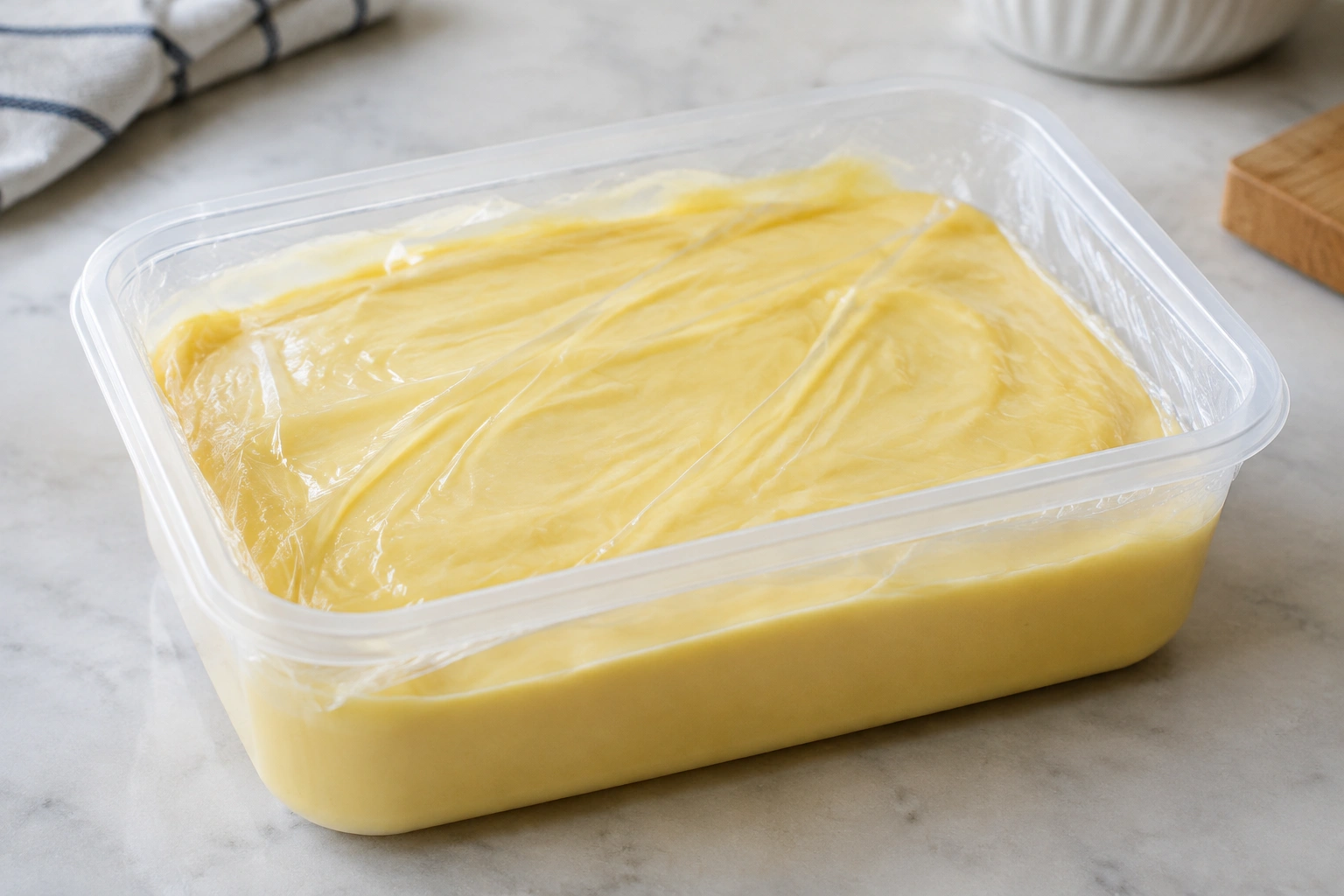
Pastry cream forms a skin quickly if air touches it. That is why many bakers press plastic wrap directly onto the surface of the custard. This direct-contact covering helps prevent drying and skin formation.
In practice, the best setup is often this:
- Spoon the pastry cream into a shallow container.
- Smooth the top.
- Press plastic wrap directly against the surface.
- Put a lid on the container if it has one.
That gives you both coverage and a better seal. Some bakers ask whether they should poke holes in the plastic wrap. For home storage, that is not necessary and defeats part of the point of using the wrap in the first place. The wrap should stay in contact with the pastry cream.
Keep the refrigerator cold and steady
Store the custard in the coldest stable part of the refrigerator, not in the door where temperatures fluctuate. Aim for a refrigerator temperature of 40°F (4°C) or below. A refrigerator that stays at a safe cold temperature is the foundation of the whole method.
If you want a useful comparison, here is the short version:
| Storage choice | Best for | Trade-off |
|---|---|---|
| Airtight container | Better protection from contamination and odors | May still allow a skin if the surface is exposed |
| Bowl covered with plastic wrap pressed on top | Better at preventing a skin | Slightly less tidy than a lidded container |
| Airtight container plus direct-contact wrap | Best overall for home storage | Uses one extra step |
| Open bowl in the fridge | Not recommended | Dries out, absorbs odors, and risks contamination |
How Long Homemade Pastry Cream Lasts in the Fridge
A common guideline for homemade pastry cream is about 5 days in the refrigerator when it has been cooled properly, kept covered, and stored at a refrigerator temperature of 40°F (4°C) or below. That is a practical general window, not a guarantee, and it can vary by recipe, how quickly the custard was cooled, and how steady your fridge runs.
Use this decision rule:
- If it has been refrigerated promptly, kept cold, and still smells and looks normal, it is usually the best candidate for use within that short window.
- If it has been held too long, left uncovered, or stored in a fridge that runs warm, do not stretch the timeline.
Texture also matters. Pastry cream often firms up after chilling, and that is normal. But firmness is different from spoilage. If it is still within the storage window and the smell, color, and consistency are normal, a chilled custard can often be whisked smooth again before use.
For a professional-style storage note, pastry cream is commonly covered directly and chilled, and one pastry educator source notes it will last about 5 days in the refrigerator and should be thawed in the refrigerator if frozen: Pastry cream storage guidance.
Can You Freeze Pastry Cream?
Yes, pastry cream can be frozen, but freezing is a backup plan, not the best option for texture.
Refrigeration vs. freezing
Refrigeration is the better choice if you plan to use the pastry cream soon and want the smoothest texture. Freezing is useful when you made too much and need to keep it longer.
Here is the practical comparison:
| Method | Best use case | Texture after storage |
|---|---|---|
| Refrigeration | Use within a few days | Usually best overall |
| Freezing | Longer storage | Often less smooth after thawing |
| Room temperature | Not suitable for holding | Food safety risk |
What freezing does to pastry cream
Freezing can cause separation, graininess, or a looser texture after thawing. That does not always make it unsafe, but it often makes it less attractive for fillings that need a very smooth finish.
If you freeze it, use a freezer-proof container and leave a little headspace if needed for expansion. Then thaw it in the refrigerator, not on the counter. That slow thaw helps keep the custard in a safer temperature range.
A pastry cream source from Pastries Like a Pro notes that it can be frozen for an extended period in a freezer-proof container and thawed in the refrigerator to use. That is a helpful home-baking reference, but even then, expect texture changes once it thaws.
How to Tell if Pastry Cream Has Gone Bad
Do not rely on smell alone, but do use smell as part of a larger check.
Discard pastry cream if you notice any of the following:
- Sour or off smell
- Mold
- Unusual discoloration
- Excessive liquid separation that does not mix back in
- Visible bubbling or signs of fermentation
- A curdled or broken texture that stays broken after whisking
- Any sign it may have been left out too long
Some separation is possible after chilling, especially if the custard has been frozen and thawed. That is not automatically spoilage. The key difference is whether the texture can be brought back with whisking and whether the smell and appearance still seem normal.
If it smells wrong, looks wrong, or you are unsure how long it sat out, throw it out. Custards are not the place to gamble.
How to Restore Chilled Pastry Cream for Use
Chilled pastry cream often needs a little adjustment before it is ready to fill tart shells, cream puffs, or layered desserts.
Whisk it gently first
If the custard is simply firm from refrigeration, whisk it until smooth. This usually loosens the texture enough for piping or spreading.
Check for lumps or stiffness
A few small lumps can often be worked out with a whisk or spatula. If the pastry cream feels very stiff, let it sit briefly at cool room temperature while you prepare your pastry shell or piping bag, then whisk again.
Handle thawed pastry cream more carefully
Thawed pastry cream may need extra whisking because freezing can weaken the structure. If it comes back smooth and the smell is normal, it may still be usable for fillings. If it stays broken, watery, or grainy in a way that does not improve, it is not a good candidate for a finished dessert.
One useful habit is to test a small spoonful before committing the whole batch to a tart or cake. If the texture is acceptable there, it will usually behave the same way in the final dessert.
Common Storage Mistakes to Avoid
A few simple missteps cause most pastry cream problems.
Leaving it out too long
This is the biggest food-safety mistake. Pastry cream should be cooled and refrigerated promptly, not forgotten on the counter after dinner.
Using a deep container
A deep bowl holds heat longer. That slows cooling and leaves the custard in an unsafe zone for too much time.
Skipping the surface covering
If the wrap is not pressed onto the cream, a skin will form. That skin is not dangerous by itself, but it changes texture and makes the custard harder to use smoothly.
Freezing without planning for texture loss
Freezing is fine when you need longer storage, but it is not ideal if the pastry cream must be perfectly silky after thawing. If the filling needs a flawless finish, refrigeration is the better path.
Trusting appearance alone
Pastry cream can look fine and still be unsafe if it was mishandled. Time and temperature matter just as much as smell or appearance.
When to Use Refrigerated vs. Frozen Pastry Cream
If you are deciding what to do with leftovers, use this simple rule:
- Choose refrigeration if you will use the pastry cream within a few days and want the best texture.
- Choose freezing only if you need to hold it longer and can accept some loss in smoothness.
- Discard it if it was left out too long, smells off, or shows signs of spoilage.
That decision is usually easier when you know the final use. For a custard tart, texture matters a lot, so fresh refrigerated pastry cream is the better choice. For a baked pastry filling where the cream is only one part of the dessert, a thawed batch may still be workable if it smooths out well.
FAQ: Storing Homemade Pastry Cream
Can I leave pastry cream out overnight?
No. Pastry cream should not be left at room temperature overnight. It is a dairy-egg custard and needs prompt refrigeration.
Is it okay to leave pastry cream out briefly for serving?
Yes, for a short serving window only. Keep it out just long enough to plate or serve, then return leftovers to the refrigerator promptly.
Should pastry cream cool before going into the fridge?
Yes, but only briefly and safely. Let the steam subside and transfer it to a shallow container so it can cool efficiently, then refrigerate it promptly.
Why does pastry cream get a skin on top?
Air exposure dries the surface. Pressing plastic wrap directly onto the cream helps prevent that.
Can I use pastry cream after freezing it?
Sometimes. Thawed pastry cream may still be safe if it was frozen and thawed properly, but the texture often changes. Whisk it well and judge whether it is smooth enough for your dessert.
How do I know if it is still good after chilling?
Check the smell, color, and texture. If it smells sour, looks moldy, or stays broken and watery after whisking, discard it.
Final Takeaway
The safest way to store homemade pastry cream is straightforward: cool it quickly, cover it well, and refrigerate it promptly. Keep the fridge at 40°F (4°C) or below, and treat about 5 days as a general storage guideline only when the custard was cooled properly and kept cold. For short-term use, the fridge is the best choice because it preserves texture better than freezing. If you do freeze it, thaw it in the refrigerator and expect some change in consistency.
Once you get used to handling it like the custard it is, storing pastry cream becomes routine. That means fewer wasted leftovers, better texture, and a lot more confidence when you make fillings ahead of time.