
Is Air Frying Chicken Faster?
Quick Answer
Yes, air frying chicken is usually faster than cooking the same small batch in a conventional oven. The compact cooking chamber, powerful fan, and short preheat time move hot air around chicken quickly. Regardless of cooking time, use a thermometer and follow FoodSafety.gov poultry temperature guidance before serving.
Why the air fryer can be quicker
- Compact chamber: There is less empty space to heat than in a full-size oven.
- Fast airflow: A powerful fan continually pushes hot air across the chicken.
- Short preheat: Many air fryers reach cooking temperature in only a few minutes.
- Better exposure: A perforated basket lets hot air reach more of the chicken’s surface.
- Small batches: Wings, tenders, thighs, and breasts fit the air fryer’s strengths particularly well.
The important exception
- A large family-size batch may take longer overall if you need two or three air-fryer batches.
When dinner needs to move quickly, chicken is one of the foods I like most in an air fryer. The appliance heats quickly, browns well, and doesn’t require warming a full-size oven.
That doesn’t mean every piece of chicken finishes dramatically faster. Cut size, basket space, temperature, breading, and the air fryer itself all affect the final cooking time.
In This Guide
- Why Is Air Frying Chicken Usually Faster?
- How Much Faster Can Air-Fried Chicken Be?
- Which Chicken Cuts Benefit Most From Air Frying?
- What Can Make Air-Fried Chicken Take Longer?
- How Can You Cook Chicken Faster Without Ruining It?
- Frequently Asked Questions
- Is an Air Fryer the Faster Choice for Chicken?
Why Is Air Frying Chicken Usually Faster?
Air frying is often faster because an air fryer is essentially a compact convection cooker. A heating element creates heat while a high-speed fan moves that heat around the food.
Convection cooking simply means that moving hot air transfers heat around the food instead of relying mainly on still hot air. You can read a detailed explanation of the technology at Serious Eats.
A smaller chamber heats quickly
A conventional oven may have to heat several cubic feet of space before cooking begins. An air fryer surrounds your chicken with a much smaller volume of hot air.
That difference matters most when I’m cooking two chicken breasts or a basket of wings. Heating an entire oven for a small meal can take longer than necessary.
- Less space to heat: The air fryer reaches useful cooking temperatures quickly.
- Food sits near the heat source: The chicken receives strong radiant and convective heat.
- Constant airflow: Moving air removes surface moisture and encourages browning.
- Perforated basket: Air can circulate underneath as well as around the food.
Preheating can be much shorter
A large oven’s preheat period can erase a surprising amount of time before chicken even starts cooking. Air fryers commonly require a much shorter preheat, and some recipes begin without one.
I still preheat when crisp skin or breading matters. Starting with a hot basket gives the exterior an immediate blast of heat.
Traditional convection ovens also cook efficiently. America’s Test Kitchen has reported faster roast-chicken cooking with convection than with standard oven settings, which shows why strong airflow matters.
Section Takeaway: Air fryers gain speed through a small chamber, strong airflow, and minimal preheating rather than through a fundamentally different type of heat.
How Much Faster Can Air-Fried Chicken Be?
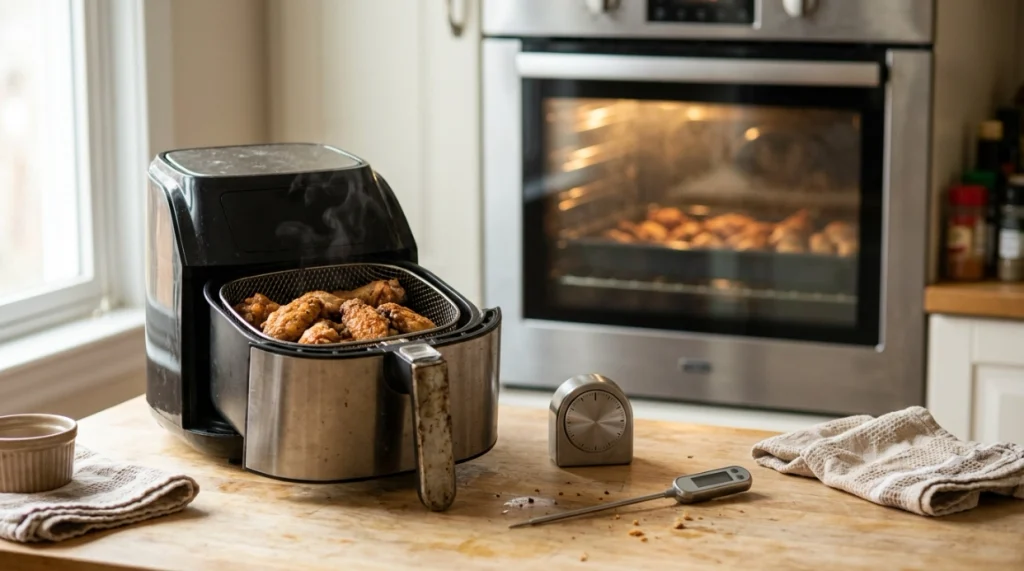
There isn’t one percentage that applies to every chicken recipe. The saving can range from modest to substantial depending on the chicken cut, amount of food, and appliance.
The best way to think about speed is to separate cooking time from total meal time. Air fryers often gain their biggest advantage before cooking even starts.
| Example | Temperature | Published Time | What It Shows |
|---|---|---|---|
| Philips air-fryer chicken wings, about 1.1 lb | 360°F | About 10 minutes after preheating | Small portions can cook quickly with strong circulating heat. |
| Conventional-oven boneless chicken breast, 4 oz | 350°F | About 20-30 minutes | Oven cooking can require more time for similar small portions. |
| Conventional-oven bone-in breast, 6-8 oz | 350°F | About 30-40 minutes | Bone and greater thickness naturally extend cooking time. |
| Conventional-oven whole chicken, 3-4 lb | 350°F | About 1¼-1½ hours | Large pieces reduce the simple speed advantage of countertop cooking. |
These aren’t direct head-to-head recipes, so I wouldn’t use the table as a conversion chart. It illustrates how strongly portion size and cooking method affect published cooking times.
Consumer Reports has also found air frying especially useful for chicken wings, noting the combination of faster cooking, browning, and convenience compared with some oven methods.
Total time matters more than the timer
Imagine an oven recipe needs 10-15 minutes of preheating plus 25 minutes of cooking. Even if an air fryer only trims several minutes from active cooking, its short warm-up can make dinner noticeably quicker.
The calculation changes when you’re feeding six people. An oven may hold all the chicken at once while a smaller basket requires repeated batches.
Section Takeaway: Air frying often wins for one small batch, but capacity determines whether it remains faster for a large meal.
Which Chicken Cuts Benefit Most From Air Frying?
Small and medium chicken pieces usually benefit most. They expose plenty of surface area to the circulating air without requiring the heat to travel through an unusually thick center.
Chicken wings
Wings are almost made for an air fryer. Their small size and skin-to-meat ratio help them brown while the inside cooks through.
A manufacturer recipe from Philips, for example, uses an air fryer for a relatively small batch of wings and emphasizes leaving enough room for circulation.
Chicken tenders and thin cutlets
Tenders and thin breast cutlets cook quickly because heat doesn’t need to travel far to reach the center. Breaded versions also benefit from the dry, moving air around their surface.
- Tenders: Good for quick weeknight meals.
- Thin breasts: Faster and easier to cook evenly than unusually thick breasts.
- Breaded cutlets: The circulating air helps dry and brown the coating.
- Boneless thighs: Their manageable thickness works well in a basket.
- Wings: Excellent airflow around their irregular shape encourages browning.
Bone-in thighs and breasts
These can still be quicker than oven cooking, but thickness matters more. A browned outside doesn’t mean the center has reached a safe temperature.
I start checking the thickest piece with an instant-read thermometer before assuming the batch is finished. Color alone isn’t a dependable safety test.
Whole chicken
Whole chickens are more complicated. They can cook successfully in large air fryers, but appliance capacity and the bird’s weight become critical.
A crowded chicken sitting close to the heating element may brown faster than its deepest meat cooks. Follow the appliance manufacturer’s capacity guidance rather than forcing an oversized bird into the basket.
Section Takeaway: Wings, tenders, cutlets, and modest portions get the biggest practical speed benefit because hot air can reach them efficiently.
What Can Make Air-Fried Chicken Take Longer?
Overcrowding is probably the fastest way to lose the air fryer’s speed advantage. When chicken pieces touch or overlap heavily, airflow cannot reach their surfaces evenly.
The result can be pale areas, slower browning, and repeated cooking cycles. One loosely arranged batch is usually better than one tightly packed basket.
- Overcrowding: Blocks hot air from circulating freely.
- Very thick pieces: Need extra time for heat to reach the center.
- Frozen chicken: Can require more cooking than properly thawed chicken.
- Wet marinades: Excess surface moisture delays browning.
- Heavy breading: Thick coatings can need extra time to cook and crisp.
- Low cooking temperature: May stretch the cook unnecessarily.
Multiple batches can reverse the advantage
This is the limitation people sometimes overlook. A basket-style air fryer may be faster per batch while still being slower for the entire dinner.
If four chicken breasts fit comfortably in your oven but only two fit in the air fryer, two consecutive cycles can erase the time you saved.
Not every air fryer cooks identically
Basket dimensions, wattage, fan strength, temperature calibration, and food placement vary. Two machines set to 375°F can therefore finish the same chicken at different times.
As of 2026, I still treat recipe times as starting points rather than guarantees. I check early, then let internal temperature determine when the chicken is ready.
Section Takeaway: Airflow is the air fryer’s advantage, so overcrowding, excessive moisture, and oversized portions directly work against its speed.
How Can You Cook Chicken Faster Without Ruining It?
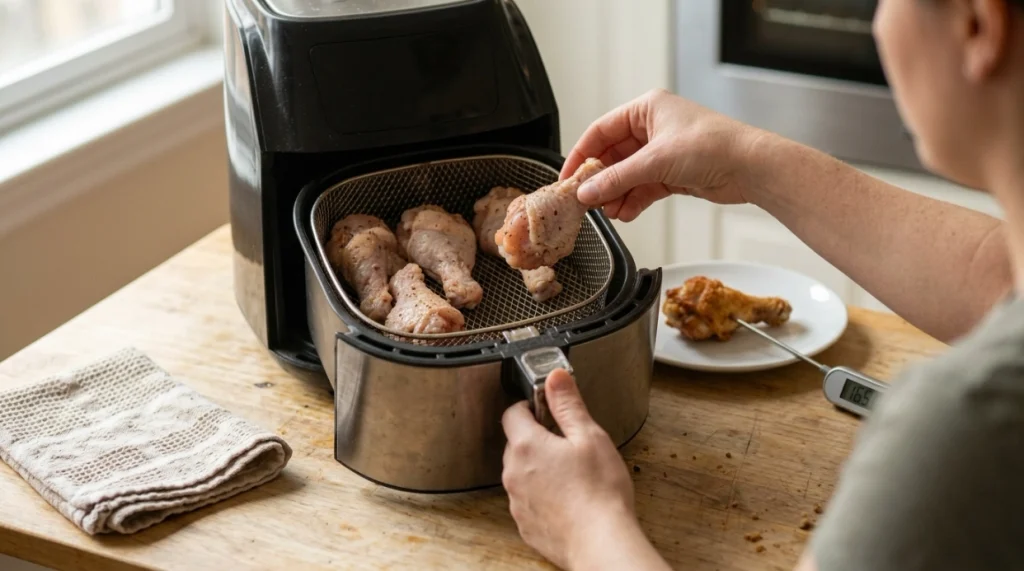
For faster chicken, focus on even thickness and open airflow rather than simply increasing the temperature. Excessive heat can darken the outside while leaving a thick center undercooked.
- Use similarly sized pieces. Uneven chicken forces you to keep smaller pieces cooking while the largest one finishes.
- Pat the surface dry. Removing excess moisture helps browning begin sooner.
- Preheat when crispness matters. A hot basket gives skin and breading a stronger start.
- Leave space between pieces. Give circulating air a path around the chicken.
- Turn or shake when appropriate. This exposes different surfaces to the strongest airflow.
- Check temperature early. Don’t automatically add extra minutes because a recipe says so.
Don’t confuse browning with doneness
Air fryers can brown chicken aggressively. That makes an instant-read thermometer more useful, not less.
FoodSafety.gov lists 165°F (74°C) as the safe minimum internal temperature for chicken and other poultry. Check the thickest area and avoid touching bone with the thermometer probe.
Pro tip: Use verified USDA/FoodSafety.gov internal-temperature guidance rather than relying on color, crispness, or cooking time alone.
A little oil can help texture
Chicken skin often contains enough fat to brown without much added oil. Lean breaded chicken may benefit from a light coating or spray.
You don’t need to soak the food. Too much oil can collect in the basket and defeat the dry, crisp texture you’re trying to create.
Section Takeaway: Make the chicken thinner and more evenly spaced before making the air fryer hotter. Speed should never replace temperature verification.
Frequently Asked Questions
Is air frying chicken faster than baking it?
Usually, yes, especially for small batches of wings, tenders, thighs, or chicken breasts. An air fryer has a smaller chamber and strong circulating airflow, so it heats quickly and can reduce both preheat time and cooking time.
Is air frying chicken faster than pan frying?
Not always. Thin chicken cutlets can cook extremely quickly in a hot skillet. The air fryer may still be more convenient because it requires less hands-on attention and contains more splatter.
Does chicken cook faster at 400°F in an air fryer?
A higher temperature can shorten cooking, but 400°F isn’t automatically better. Thick chicken may brown too rapidly outside before reaching a safe temperature inside, so choose the temperature appropriate for the cut and recipe.
Do I need to preheat an air fryer for chicken?
Not every air fryer or recipe requires preheating. However, a short preheat can improve repeatability and help skin or breading begin browning immediately, especially when crisp texture is important.
Can I put frozen chicken directly in an air fryer?
Some frozen chicken products can be air fried directly when their package or appliance instructions allow it. Cooking time will usually differ from fresh chicken, so verify the center with a thermometer rather than assuming a fixed time.
What temperature should air-fried chicken reach?
Chicken should reach a safe minimum internal temperature of 165°F (74°C). Measure the thickest portion with a food thermometer and avoid placing the probe directly against bone.
Why does my chicken take longer than an air-fryer recipe says?
Your pieces may be thicker, colder, more crowded, or larger than those used in the recipe. Air fryer power and temperature calibration also vary, so recipe times should be treated as estimates.
Is an Air Fryer the Faster Choice for Chicken?
For a small or medium batch, air frying chicken is usually faster than using a conventional oven. The advantage comes from fast preheating, a compact chamber, and strong convection airflow.
The biggest gains appear with wings, tenders, cutlets, boneless thighs, and modest chicken-breast portions. These pieces let hot air circulate freely and don’t require heat to travel through a huge mass of meat.
A conventional oven can make more sense when you’re cooking a large family-size batch. One full oven tray may finish sooner than running several air-fryer loads back to back.
My rule is simple: use the air fryer when the food fits comfortably in one batch. Give every piece room, start checking early, and let 165°F (74°C) internal temperature—not the clock—tell you when the chicken is safe to serve.
Final Takeaway: Air frying usually wins on speed for smaller portions, while the oven can win on capacity. Choose the appliance around the amount of chicken you’re cooking, not just the advertised cooking time.

