
Is Air Frying Healthy? Benefits, Risks, and Better Ways to Cook
Quick Answer
Yes, air frying can be a healthy cooking method, especially when it replaces deep frying. An air fryer circulates hot air around food and usually needs far less added oil, which can reduce total fat and calories, although the final nutrition still depends heavily on what you cook. The Cleveland Clinic’s air fryer guidance also emphasizes that healthier ingredients matter as much as the appliance.
What makes air frying healthier?
- Less added oil: Most foods need only a light coating instead of being submerged in cooking oil.
- Lower calorie potential: Using less cooking fat can substantially reduce calories compared with deep frying.
- Good for vegetables: Hot circulating air can make vegetables browned and crisp without heavy breading.
- Helpful for lean proteins: Chicken, fish, tofu, and similar foods can brown well with modest amounts of oil.
- Not automatically healthy: Air-fried bacon, fries, nuggets, and pastries still contain whatever saturated fat, sodium, sugar, or refined carbohydrates were present before cooking.
The simplest rule
- Use the air fryer mainly for vegetables, potatoes, whole foods, and lean proteins rather than treating it as a health upgrade for every frozen fried food.
I like air fryers because they make crisp food practical without filling a pan with oil. Still, calling every air-fried meal “healthy” misses the bigger picture.
This guide explains what air frying changes nutritionally, what it does not change, and how I use the appliance when I want a lighter meal without giving up browning and crunch.
In This Guide
- Why can air frying be healthier than deep frying?
- Is air frying good for weight and heart health?
- Does air frying create acrylamide or cancer-causing compounds?
- What are the healthiest foods to cook in an air fryer?
- Air fryer vs. deep fryer vs. oven: which is healthier?
- How can you make air-fried food healthier?
- Frequently asked questions
Why Can Air Frying Be Healthier Than Deep Frying?
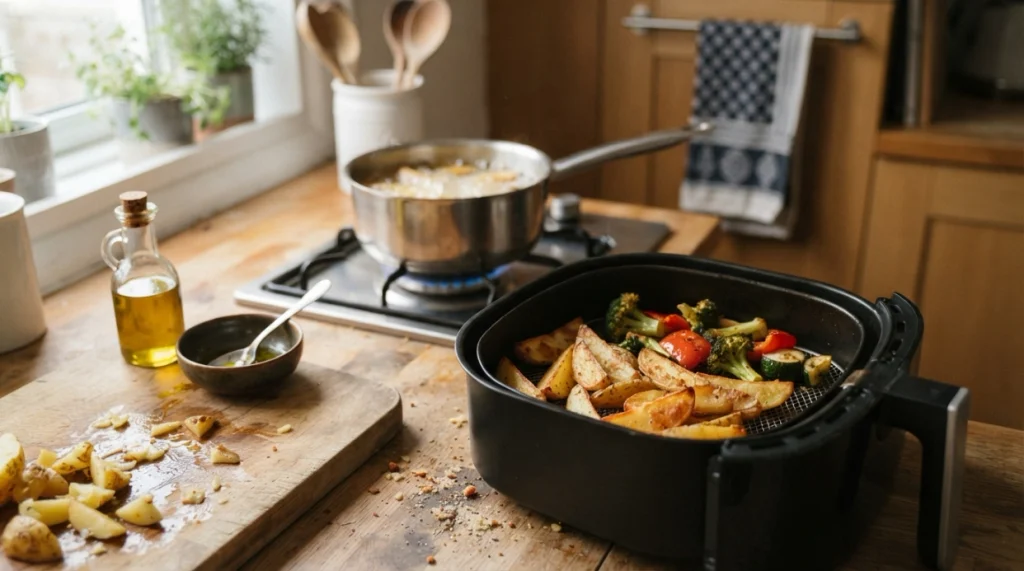
Air frying can be healthier because food cooks in rapidly circulating hot air instead of sitting in a large volume of oil. That difference can substantially reduce how much cooking fat ends up in the meal.
Definition: An air fryer is a compact convection-cooking appliance. A heating element creates heat while a powerful fan circulates that hot air rapidly around the food.
Despite the name, an air fryer does not fry food in the traditional sense. It behaves more like a small, intense convection oven.
Air frying usually requires much less oil
Deep frying works by surrounding food with hot cooking oil. Some of that fat remains on or inside the food after cooking.
With an air fryer, I can often get good browning with a teaspoon or two of oil, a light spray, or no added oil at all.
- Fresh vegetables: A thin coating of oil can help browning and seasoning stick.
- Frozen fries: Many arrive with oil already added and need none from me.
- Chicken breast: A light brush of oil is usually enough for surface browning.
- Breaded foods: A small oil mist can improve color without soaking the coating.
Fat itself is not something you need to eliminate. Dietary fat has important functions, and unsaturated oils can fit comfortably into a balanced diet.
The advantage is control. Air frying lets me decide how much oil gets added instead of requiring enough oil to immerse the food.
Crisp texture does not require deep frying
The fast-moving air removes surface moisture while encouraging browning. That combination creates the crisp exterior people usually associate with frying.
The best results happen when I leave enough room around the food. Overcrowding traps steam and produces softer results.
- Keep pieces in a loose single layer when possible.
- Shake or turn foods during longer cooking sessions.
- Pat wet ingredients dry before seasoning.
- Use only enough oil to support browning.
Section Takeaway: Air frying’s main nutritional advantage is not a special health effect from hot air. It is the ability to create crisp food while using considerably less added cooking oil than deep frying.
Is Air Frying Good for Weight and Heart Health?
Air frying can support a lower-calorie eating pattern when it replaces oil-heavy frying. It does not cause weight loss by itself, and it cannot make an otherwise unbalanced diet heart-healthy.
Oil is energy-dense, so cutting unnecessary cooking oil can reduce the calorie content of a meal. The size of that reduction depends on the food and preparation method.
The ingredients still matter most
Consider two air-fryer dinners. One contains broccoli, potatoes, and seasoned chicken breast, while the other contains frozen mozzarella sticks, bacon, and breaded chicken nuggets.
Both use the same appliance. Their overall nutrition is still quite different.
- Choose more vegetables: Brussels sprouts, cauliflower, zucchini, peppers, and green beans brown well.
- Use leaner proteins: Chicken breast, fish, shrimp, tofu, and lean cuts of meat work well.
- Watch packaged foods: Frozen fried foods can still contain substantial sodium, saturated fat, and refined starch.
- Control portions: Crisp food can be easy to overeat, even when it contains less oil.
If heart health is the goal, the whole meal matters. Using less saturated fat, choosing more minimally processed foods, and eating enough vegetables are more meaningful than owning a particular appliance.
Section Takeaway: Air frying can make calorie and fat control easier, but the biggest health gains come from what goes into the basket.
Does Air Frying Create Acrylamide or Cancer-Causing Compounds?
Air frying can produce acrylamide in certain starchy foods because acrylamide forms during high-temperature browning. However, the evidence does not support saying that an air fryer automatically creates more or less acrylamide in every situation.
Acrylamide is most relevant to plant foods such as potatoes and grain products. According to the FDA’s guidance on acrylamide and food preparation, it can form during frying, roasting, and baking.
What determines acrylamide formation?
Temperature is only part of the equation. Cooking duration, moisture, food composition, browning level, and preparation method can all influence the final amount.
- Food type: Potatoes and grain-based foods deserve more attention than meat or dairy.
- Browning: Heavily browned or burnt starches may contain more acrylamide.
- Temperature: High-temperature cooking encourages browning reactions.
- Cooking time: Excessive cooking can increase darkening and thermal reactions.
- Preparation: Potato soaking and other pretreatments can change acrylamide formation.
Some studies have reported substantially less acrylamide in air-fried potatoes than in conventionally deep-fried potatoes. Other research has found smaller differences or results that vary with the exact cooking conditions.
A published comparison of air-fried, deep-fried, and oven-fried potatoes, for example, found that the differences in acrylamide were not statistically significant in that experiment. That is why I would not promise a fixed percentage reduction.
Does air frying cause cancer?
There is no good basis for saying that normal air-fryer use itself causes cancer. The more useful question is how high-temperature cooking changes particular foods.
The FDA notes that acrylamide caused cancer in laboratory animals at much higher exposure levels than those typically found in food. The human health implications of ordinary dietary exposure remain less certain.
As of 2026, the practical approach is straightforward: avoid routinely burning or heavily darkening starchy foods. Aim for golden rather than very dark brown.
- Cook potatoes until golden, not scorched.
- Avoid leaving breaded foods in the basket after they are already crisp.
- Use the lowest temperature that still gives the result you want.
- Check food early when trying a new air fryer or recipe.
Section Takeaway: Air frying is not free from high-heat cooking reactions, but acrylamide risk depends on the food and cooking conditions. Avoiding excessive browning is more useful than fearing the appliance itself.
What Are the Healthiest Foods to Cook in an Air Fryer?
The healthiest air-fryer choices tend to be foods that are nutritious before they enter the basket. Vegetables, potatoes, lean proteins, fish, tofu, and simple homemade foods give the appliance its biggest advantage.
Vegetables
This is where my air fryer earns the most counter space. Vegetables develop caramelized edges quickly without needing much oil.
- Broccoli florets at roughly 375°F to 400°F (190°C to 204°C)
- Brussels sprouts around 375°F (190°C)
- Cauliflower around 375°F to 400°F (190°C to 204°C)
- Zucchini around 375°F (190°C)
- Green beans around 375°F to 390°F (190°C to 199°C)
Exact times vary with basket size and piece thickness. I start checking several minutes before the recipe’s stated finish time.
Potatoes and sweet potatoes
Potatoes are naturally low in fat before oil, cheese, sauces, and toppings are added. Air frying gives me control over those additions.
For homemade wedges, a small amount of oil spread across the entire batch is often enough. Leaving space between pieces improves crispness more than pouring on extra oil.
Chicken and other lean proteins
An air fryer can brown proteins rapidly, but cooking time alone should never be your food-safety test. Thickness and appliance performance vary too much.
Pro tip: Use a food thermometer and follow FoodSafety.gov’s verified minimum internal temperature guidance. Poultry should reach 165°F (74°C).
- Chicken breast
- Turkey meatballs
- Fish fillets
- Shrimp
- Tofu cubes
- Lean pork chops
Small-batch baked foods
An air fryer can also function as a compact convection oven. I find it especially useful when making a few cookies or reheating a pastry without heating a full-size oven.
For conventional baking recipes, King Arthur Baking’s air-fryer baking guidance recommends starting about 25°F lower and shortening baking time by roughly 20% to 25%.
The healthfulness of a cookie or pastry does not change simply because it was air-fried. The benefit here is mainly convenience and small-batch control.
Section Takeaway: Use your air fryer as a fast convection cooker for whole foods first. That approach provides a much bigger nutritional benefit than using it mainly to reheat packaged fried snacks.
Air Fryer vs. Deep Fryer vs. Oven: Which Is Healthier?

An air fryer usually has the clearest health advantage when it directly replaces deep frying. Compared with oven cooking, the nutritional difference can be small because both methods can work with little added fat.
| Cooking method | Common temperature range | Oil requirement | Main health consideration |
|---|---|---|---|
| Air fryer | About 325°F-400°F (163°C-204°C) | Often none to a light coating | Can create crisp food with little added fat |
| Deep fryer | About 325°F-375°F (163°C-191°C) | Enough oil to immerse the food | Food can absorb considerably more cooking fat |
| Conventional oven | About 300°F-450°F (149°C-232°C), recipe dependent | Often none to a light coating | Can be equally suitable for low-fat cooking |
The air fryer is not automatically superior to baking, roasting, steaming, or grilling. Those techniques can also produce healthy meals with modest amounts of added fat.
Where air frying shines is texture. It makes it easier to get a crisp exterior without moving back to a pot of oil.
Section Takeaway: Think of the air fryer as a healthier substitute for deep frying, not as a nutritional upgrade over every other cooking method.
How Can You Make Air-Fried Food Healthier?
Start with better ingredients, use oil deliberately, and avoid excessive browning. Those three habits matter more than chasing special “healthy air fryer” settings.
- Fill more of your basket with vegetables. Crisp vegetables can replace part of the fries, chips, or breaded sides on your plate.
- Measure oil instead of pouring freely. A teaspoon, brush, or light spray gives you much better control.
- Choose unsaturated oils when suitable. Olive, avocado, and other liquid plant oils can fit into a balanced diet.
- Limit heavily processed frozen foods. Check labels for sodium, saturated fat, and added sugars.
- Do not overcrowd the basket. Better airflow gives you crispness without needing extra oil.
- Stop at golden brown. Darker is not always better, especially with potatoes and grain-based foods.
- Use a thermometer for meat. Do not judge food safety only by exterior color or cooking time.
A simple plate formula I use
I try to make the air fryer one part of the meal rather than the whole meal. A typical plate might combine air-fried vegetables, a lean protein, and a whole-grain or potato side.
- Half the plate: Vegetables or vegetables plus fruit
- One quarter: Lean protein
- One quarter: Potatoes, whole grains, beans, or another carbohydrate source
That approach prevents the common trap of assuming that a basket full of frozen snacks becomes nutritious simply because it was cooked without deep frying.
Section Takeaway: Healthier air frying is mostly about ingredient selection, sensible oil use, portion size, and avoiding unnecessary overcooking.
Frequently Asked Questions About Air Frying and Health
Is air-fried food healthy enough to eat every day?
It can be. Daily air-fryer use is not the issue; what you cook matters more. Vegetables, lean proteins, potatoes, fish, and minimally processed foods can fit into regular meals, while heavily breaded frozen foods are better treated as occasional choices.
Is air frying healthier than baking?
Not necessarily. Both air frying and oven baking can use little or no added oil. An air fryer mainly provides faster airflow and more concentrated convection, which can create crisp surfaces quickly.
Is air frying healthier than deep frying?
Usually, yes, particularly when the same food would otherwise be submerged in oil. Air frying generally requires far less added oil, which can reduce the finished meal’s fat and calorie content.
Does an air fryer destroy nutrients?
Heat can change some heat-sensitive nutrients no matter whether food is roasted, baked, boiled, or air-fried. Air frying does not uniquely remove nutrients, and its relatively short cooking times may be useful for certain foods.
Can you use olive oil in an air fryer?
Yes. A small amount of olive oil works well for many air-fryer recipes. I usually coat the food lightly rather than pouring oil directly into the basket.
Are air-fried French fries healthy?
Air-fried fries can contain less added fat than deep-fried fries, especially when made from fresh potatoes with a small amount of oil. Portion size, salt, toppings, and excessive browning still matter.
Does air frying cause acrylamide?
It can produce acrylamide in starchy foods cooked at high temperatures, just as baking, roasting, and traditional frying can. Acrylamide formation varies with food type, temperature, time, moisture, and browning, so avoid routinely cooking potatoes or grains until very dark.
Bottom line: Air frying can absolutely be part of a healthy kitchen, especially when it replaces deep frying. I get the most value from mine when I use it for vegetables, potatoes, lean proteins, fish, tofu, and small-batch cooking instead of treating every packaged fried food as a healthier choice.
If you’re deciding whether to use an air fryer for health reasons, focus less on the appliance label and more on what goes into the basket. Better ingredients plus less unnecessary oil is where the real advantage begins.

