
Is an Air Fryer Good for College Students? A Practical Guide for Dorms and Small Apartments
If you are trying to decide whether an air fryer is worth buying for college, the short answer is: often yes, but only if your housing rules and cooking habits actually fit it.
For a student in a dorm, a compact apartment, or a shared house, an air fryer can make a lot of everyday food easier. It is useful for frozen snacks, quick proteins, roasted vegetables, and reheating leftovers with better texture than a microwave usually gives.
That said, an air fryer is not automatically the best purchase for every student. If your dorm bans countertop appliances, if you barely cook, or if you already rely on a microwave for most meals, it may end up taking up space instead of saving it.
Quick Answer: Is an Air Fryer Worth It for College Students?
An air fryer is usually worth it for college students who cook for themselves several times a week and have enough room to store and use it safely.
It tends to make sense if you want:
- fast single-serving meals
- simple controls
- less cleanup than a full oven
- a way to cook frozen foods, leftovers, and basic proteins without much effort
It is less useful if:
- your dorm or apartment does not allow it
- you have almost no counter space
- you already eat mostly cafeteria food or takeout
- you only need one appliance and a microwave already covers your needs
A good rule: if you can picture yourself using it at least a few times a week for one-person meals or snacks, it has a fair chance of earning its spot.
What Makes an Air Fryer Useful in College Life
The biggest advantage for students is convenience. College schedules are irregular. You may get back from class late, have a short break between labs, or need food after a study session when every minute matters. An air fryer is built for that kind of cooking.
Fast meals with little setup
A basket-style air fryer can handle foods like frozen fries, chicken nuggets, mozzarella sticks, fish sticks, or a small portion of vegetables with very little prep. For a student, that matters because quick, low-effort cooking is often what gets used consistently.
Better texture than a microwave for some foods
Microwaves are excellent for reheating soup, rice, or pasta, but they often leave breaded foods soft. An air fryer can crisp up frozen snacks, leftover pizza, and breaded chicken more effectively. If you want a more satisfying texture after class, that is where the air fryer earns its keep.
Small-batch cooking
Most students are cooking for one, maybe two. Air fryers are well suited to that scale. You do not need to heat a large oven just to make one salmon fillet and a handful of broccoli. That smaller scale is a real advantage in tight living spaces.
Simple controls
For student use, simple knobs or a basic digital panel are usually enough. Temperature control, a timer, and a basket that is easy to pull out matter more than a long list of presets you may never touch.
When an Air Fryer Is a Bad Fit for Dorms or Small Apartments
There are plenty of situations where an air fryer sounds useful but becomes annoying in real life.
Tight storage and counter space

Some dorm rooms barely have room for a microwave, much less another appliance. If you need to stash the air fryer under a bed, in a closet, or in a shared cabinet every time you use it, the convenience drops fast.
Shared living can make it awkward
In a roommate situation, an air fryer can become a shared object whether you planned that or not. That is fine if everyone agrees, but not so great if one person is always cleaning it, moving it, or finding it unplugged because the outlet is needed for something else.
Outlet access matters more than people expect
Dorm rooms and student apartments often have limited outlets. An air fryer should be plugged directly into a suitable outlet, not into a crowded setup with overloaded power strips. If the only workable outlet is already serving a laptop charger, lamp, and mini fridge, the air fryer may be more trouble than it is worth.
Noise and heat are real considerations
Air fryers are not usually loud enough to be a major problem, but they do make fan noise. More importantly, they give off heat. In a cramped room with bedding, curtains, papers, and other clutter nearby, that heat can be inconvenient and potentially unsafe if the unit is placed badly.
Dorm Rules, Safety, and Shared-Space Considerations
Before buying anything, check the housing policy. Do not assume an air fryer is allowed just because it is small.
Many schools have specific appliance rules for dorms, and those rules can differ by building or by room type. Some allow compact cooking appliances in shared kitchens but not in bedrooms. Others restrict any heating appliance with an exposed cooking element or set wattage limits for room use.
Before you buy, check these exact policy details:
- whether countertop cooking appliances are allowed in private rooms or only in shared kitchens
- whether there is a wattage limit for room appliances
- whether the appliance must have an automatic shutoff
- whether it needs to be UL-listed, ETL-listed, or approved by housing
- whether open-coil, toaster-oven-style, or high-heat appliances are banned
- whether extension cords or power strips are prohibited for cooking appliances
- whether the unit must be unplugged when not in use
- whether only one major appliance is allowed per room
If you are unsure, look at your campus housing page or ask residence life directly. That one step can save you from buying something you cannot use.
A few practical safety habits matter in any student housing setup:
- Keep the air fryer on a stable, heat-resistant surface.
- Leave space around it so heat can escape.
- Keep it away from bedding, curtains, paper, and clutter.
- Do not leave it running unattended in a room where you are not nearby.
- Let it cool before cleaning or storing.
- Wipe out crumbs and grease regularly so smoke and odors do not build up.
For food safety and general kitchen handling, the USDA’s food safety guidance is worth following, especially if you are cooking chicken, reheating leftovers, or handling raw ingredients in a small shared kitchen.
Best Air Fryer Size for One Student or Two Roommates
For most college students, smaller is usually smarter.
Compact models for one person
For one student, a compact air fryer in the roughly 2- to 3-quart range is usually the best fit. That size is enough for single servings like frozen snacks, one chicken breast, a salmon fillet, or a side of vegetables without taking over a dorm desk or kitchenette.
If you mainly cook for yourself, a larger basket is usually unnecessary unless you want to make leftovers in one batch.
Larger models for roommates or more frequent cooking
For two roommates, a 4- to 6-quart model is usually more practical. It gives you enough room for shared portions, a couple of chicken breasts, fries plus a protein, or a small batch of vegetables without feeling cramped.
If two people plan to use it regularly, this is often the best balance of capacity and convenience. Bigger than that can work, but it usually starts to feel bulky in student housing.
Basket-style vs oven-style for college use
A basket-style air fryer is usually the better college choice because it is compact and simple. It is easier to pull out, shake, and clean.
An oven-style air fryer offers more versatility. You may be able to toast, bake, or cook multiple items at once. But that extra flexibility comes with a bigger size, more counter demand, and more cleaning surfaces. In a dorm or small apartment, that trade-off is often not worth it unless you know you will use those extra functions.
Air Fryer vs Microwave vs Toaster Oven vs Oven
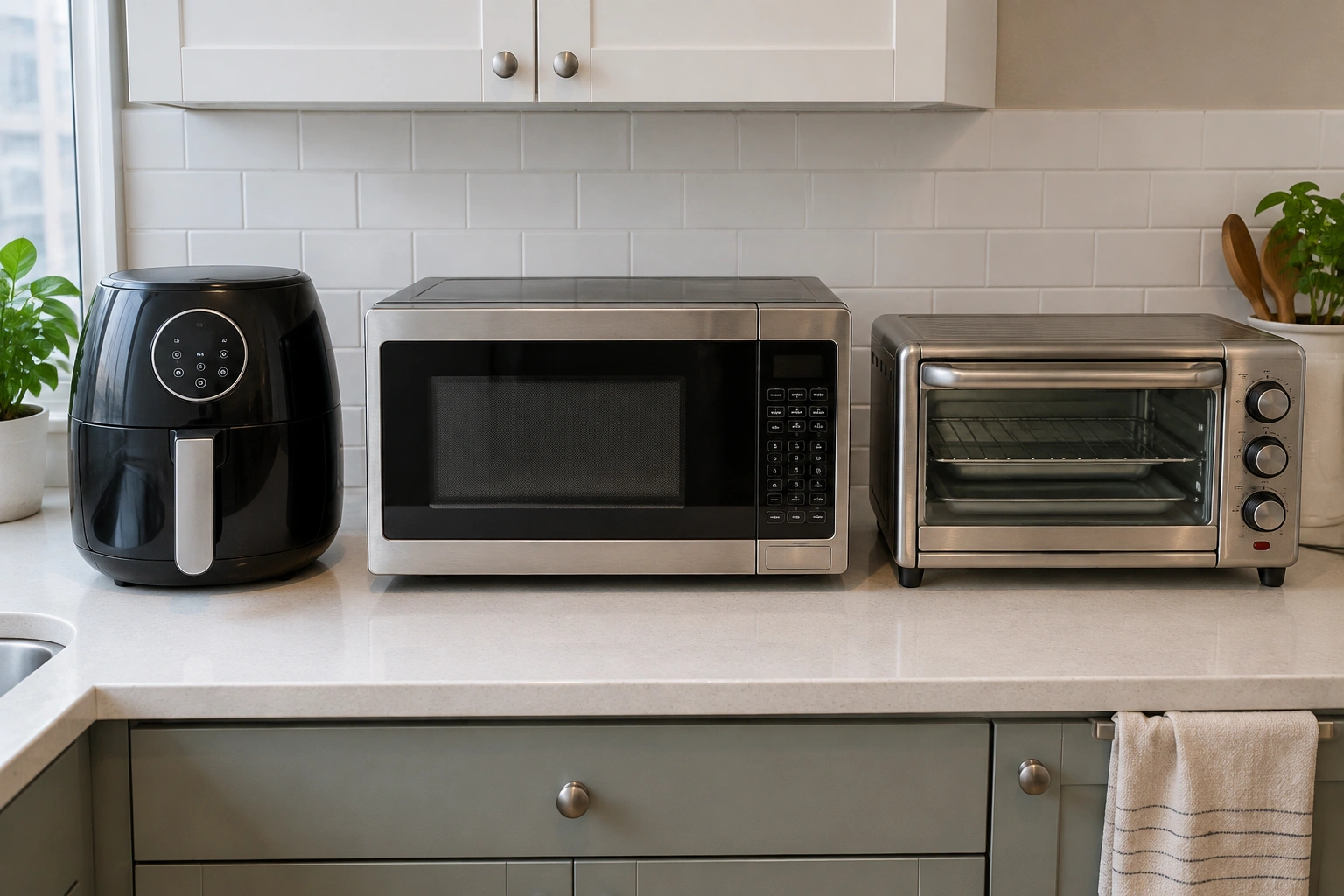
Here is the practical comparison most students need:
| Appliance | Best for | Main advantage | Main drawback |
|---|---|---|---|
| Microwave | reheating leftovers, soup, rice, quick meals | fastest and most common dorm appliance | soft texture on crispy foods |
| Air fryer | frozen snacks, small proteins, crisping leftovers | better texture with minimal oil | takes counter space and may not be allowed in some housing |
| Toaster oven | toast, small bakes, reheating, some air-fry-style use | more versatile than a microwave | usually bulkier and slower to clean |
| Full oven | larger meals, baking, batch cooking | best for capacity | too large and impractical for dorm life |
If you already have a microwave, the air fryer is not a replacement. It is more of an upgrade for texture and small-batch cooking. If you already have a toaster oven in a shared apartment, the air fryer may feel redundant unless you specifically want faster crisping.
What College Students Can Actually Cook in an Air Fryer
The best student air fryer meals are the ones that use few ingredients and little cleanup.
Easy snack and meal ideas
These are realistic examples for college life:
- frozen fries or tater tots
- chicken nuggets or tenders
- mozzarella sticks
- fish sticks
- roasted broccoli or green beans
- Brussels sprouts with oil and seasoning
- salmon fillets
- sausage links
- reheated pizza slices
- quesadillas or tortilla melts, if your model and basket shape fit them
If you want an easy frozen-food approach, our guide to air frying frozen meals can help you avoid soggy results.
A few useful student combinations
A practical dinner might be a salmon fillet with frozen broccoli on the side. Another could be breaded chicken tenders with fries and a simple dipping sauce. For late-night food, many students use the air fryer to re-crisp leftover pizza or frozen appetizers.
If you are mostly reheating food, our article on reheating leftovers in an air fryer covers which foods benefit most.
What an air fryer is not great for
It is not the best tool for soups, pasta, rice, oatmeal, or anything that needs a pot and liquid. It also is not ideal for very wet batters or oversized baked dishes unless the model is specifically designed for that kind of cooking.
Best Features to Look For on a College Budget
You do not need a long list of extras. A few basics matter much more.
Must-have features
- Temperature control: lets you handle frozen foods, vegetables, and proteins more reliably
- Timer: useful when you are studying or multitasking
- Compact footprint: easier to fit in a dorm or small apartment
- Removable basket or tray: makes cleanup much easier
- Nonstick interior: helpful for student use, though it still needs gentle cleaning
Nice-to-have features
- preset buttons
- viewing window
- shake reminder
- multiple racks
- dehydrator or bake modes
Those extras can be useful, but they should not push you into a bigger or more expensive model unless you know you will use them.
How Much an Air Fryer Costs and Whether It Is Worth the Price
For a college budget, value matters more than features.
A realistic budget range for students is about $40 to $100 USD. In that range, you can usually find a solid compact model that handles everyday dorm or apartment cooking without paying for extras you may not use.
A simple value recommendation:
- Under $50: good for students on a tight budget who want a basic compact air fryer and do not need many extras
- About $50 to $80: often the best value tier for most college buyers because it usually balances size, reliability, and useful features
- About $80 to $100+: better if you want a larger basket, quieter operation, or extra functions, but not necessary for most students
A basic compact air fryer is often the most sensible buy because it covers the main student use cases without taking over your kitchen. More expensive models may offer better build quality or extra functions, but those upgrades only matter if you will cook often enough to justify them.
If you are a parent or gift buyer, a compact model can be a genuinely practical freshman gift because it is useful every week rather than something decorative that sits in a closet. If the student already has access to a shared kitchen and does not enjoy cooking, the money may be better spent elsewhere.
The simplest value test is this: if the air fryer helps replace repeated takeout, snack runs, or microwave-only meals, it can pay off in convenience. If it will mostly sit unused, it is not a smart purchase.
Cleaning, Maintenance, and Long-Term Convenience
Cleanup is one of the biggest reasons students stop using appliances, so this part matters.
An air fryer is usually easier to maintain than a full oven because the cooking area is smaller. But “easy” depends on how you use it. Greasy foods, breaded foods, and sugary sauces can leave residue that is annoying to scrub later.
A few habits help:
- wash the basket and tray soon after use
- line the basket only if the manufacturer allows it
- avoid scraping nonstick surfaces with metal tools
- wipe out crumbs before they burn on
- clean the exterior vents occasionally so dust and grease do not collect
If you are the type of student who hates dishes, a model with fewer parts and a straightforward basket design will usually be more livable than a complicated oven-style machine.
How to Decide If an Air Fryer Fits Your College Lifestyle
Use this simple checklist before you buy:
Buy one if most of these are true:
- your housing allows countertop cooking appliances
- you cook for yourself several times a week
- you want better texture than a microwave gives
- you have space to store it and use it safely
- you are likely to make frozen foods, snacks, or small meals
Skip it for now if most of these are true:
- your dorm rules are strict about appliances
- you have almost no storage or outlet access
- you rarely cook
- you already have a microwave and that covers your needs
- you do not want another appliance to clean and maintain
For many college students, a compact air fryer is a smart, practical appliance. It is especially useful for dorm residents and students in small apartments who want quick food without relying on a full oven. But the best choice is not the biggest or fanciest model. It is the one that fits your housing rules, your space, and the way you actually eat.
When to Consult a Professional
If you are unsure whether your housing setup can safely support another electrical appliance, contact your residence hall staff, housing office, or building management. If you suspect an outlet is overloaded, damaged, or unsafe, have it checked by a qualified professional before plugging in any cooking appliance.
FAQ
Can you use an air fryer in a dorm room?
Sometimes, but not always. Dorm policies vary by campus and building, so check the rules first. Some schools allow small appliances only in shared kitchens, not in bedrooms.
What size air fryer is best for one student?
A compact model in the 2- to 3-quart range is usually the best fit for one person. It is easier to store and more realistic for single servings than a large family-size unit.
What size air fryer works for two roommates?
A 4- to 6-quart model is usually the most practical choice for two roommates sharing one appliance. It gives you enough room for shared meals without becoming too bulky.
Is an air fryer better than a microwave for college?
Not as a replacement. A microwave is better for reheating soup, rice, and leftovers quickly. An air fryer is better when you want crisp texture on frozen or breaded foods.
Are air fryers hard to clean?
They can be easy to clean if you wash the basket and tray soon after use. Greasy foods and burned-on residue make cleanup more annoying, so regular maintenance helps.
What can a student cook in an air fryer?
Frozen fries, nuggets, fish sticks, vegetables, salmon, sausage, and reheated pizza are all common student-friendly options.
Is a toaster oven a better choice than an air fryer?
It can be, if you want one appliance that toasts, bakes, and reheats more broadly. But for a small dorm or apartment, a compact air fryer usually takes up less space and is simpler to use.
Should parents buy an air fryer as a college gift?
It can be a thoughtful gift if the student has room for it and actually cooks. A compact, easy-to-clean model is usually the safest choice.