
Is an Air Fryer Worth It for Families? A Practical Buying Guide
If you’re deciding whether an air fryer is worth buying for a family, the short answer is: often yes, but only if you’ll use it for the kinds of meals it handles well.
For busy households, an air fryer can be a genuinely useful countertop appliance for weeknight chicken, frozen foods, vegetables, reheated leftovers, and quick sides. It tends to shine when you want faster cooking than a full oven and better texture than a microwave. But it is not a magic replacement for every family meal, and smaller models can feel cramped once you start cooking for four or more.
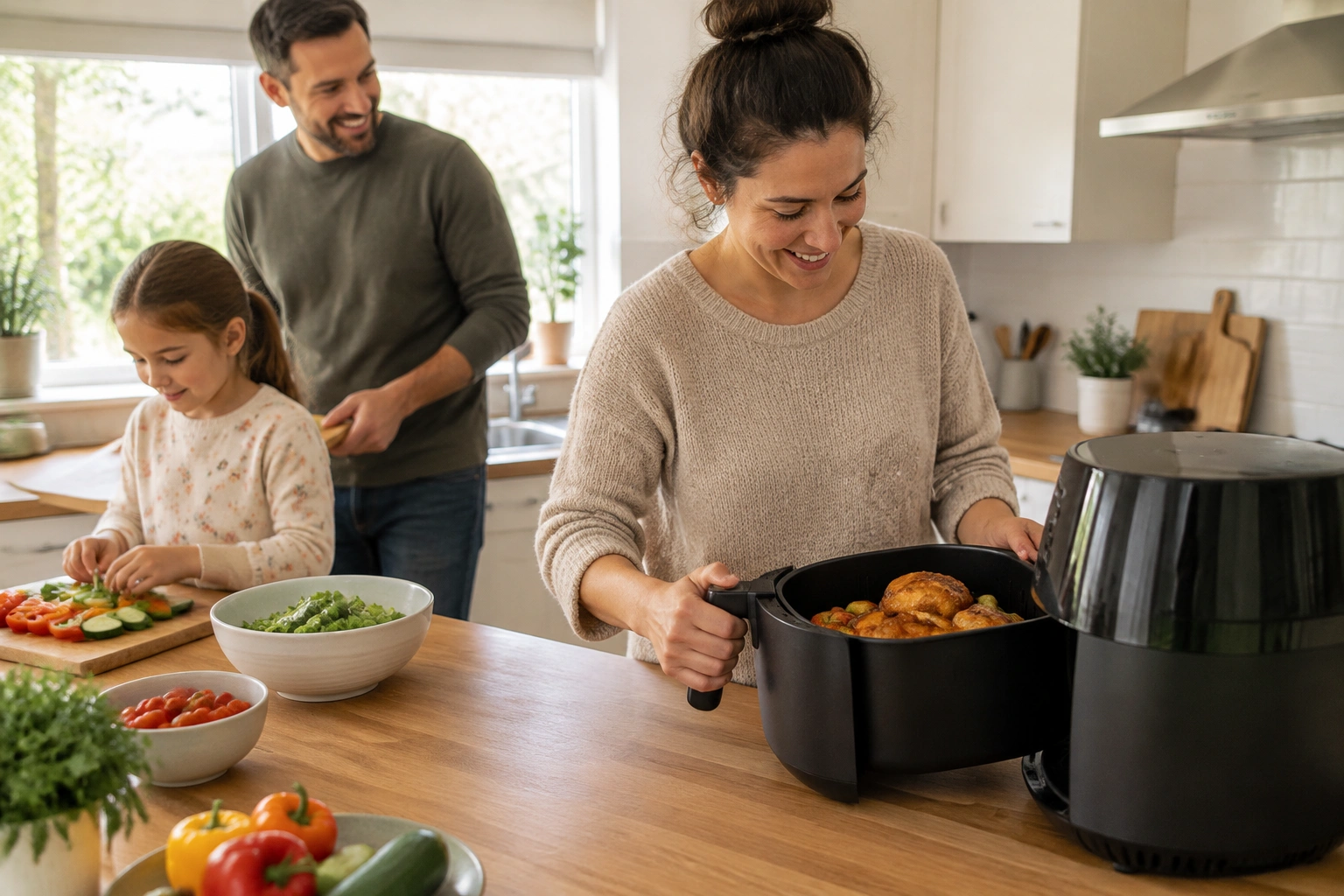
The real question is not whether air fryers are good in general. It’s whether one fits your family size, your cooking habits, your counter space, and your budget.
Quick Verdict: Is an Air Fryer Worth It for Families?
For many families, yes — especially if you cook at home several nights a week and want a faster way to handle sides, snacks, frozen foods, or smaller portions of protein and vegetables.
An air fryer is usually worth it when:
- you make a lot of weeknight meals from simple ingredients
- your family eats frozen foods, nuggets, fries, or reheated leftovers often
- you want a quicker alternative to preheating the oven
- you’re comfortable cooking in batches when needed
- you have enough counter space to leave it out or access it easily
It is less likely to be worth it if your household already relies on a toaster oven or a large oven for most meals, or if you rarely cook foods that benefit from crisping. A family that mostly makes full-sheet-pan dinners, casseroles, and large roasts may not get much extra value from another appliance.
A useful way to think about it: an air fryer is best as a high-use helper, not a complete kitchen replacement.
What an Air Fryer Actually Does for Family Cooking
An air fryer is basically a compact convection cooker. It moves hot air quickly around food so it cooks and browns faster than a standard oven in many everyday situations.
In a family kitchen, that matters most for foods where texture is part of the appeal:
- chicken tenders or nuggets
- fries and potato wedges
- roasted vegetables
- fish sticks
- leftovers that need crisping back up
- quick snacks after school or before sports practice
That speed and texture are why many households end up using the appliance more often than they expected. For small batches, an air fryer can be faster to use than heating a full-size oven, and it may deliver better crisping than a microwave. Compared with a toaster oven, it usually does a better job when you want a more fried-like exterior.
That does not mean it replaces every cooking method. It is not the best tool for soups, pasta, large casseroles, or big cuts of meat. But for the kinds of foods families make repeatedly, it can take a lot of friction out of dinner.
When an Air Fryer Is Worth It for a Family
An air fryer earns its place when it solves a real weekly problem.
Busy weeknights
If dinner has to come together quickly, the air fryer can be a practical time-saver. You can cook chicken tenders, salmon portions, Brussels sprouts, or frozen snacks without waiting for a full oven to heat up. That makes it easier to get food on the table when everyone is hungry and schedules are tight.
Families that use frozen foods often
Frozen fries, onion rings, nuggets, mozzarella sticks, and similar foods are where air fryers often feel most convenient. For these foods, the air fryer usually gives a better result than the microwave and often a crispier result than a toaster oven.
Households that like crisp food
If your family likes crunchy edges and browned surfaces, an air fryer is more appealing than a microwave and often more satisfying than reheating in a toaster oven. It can make leftovers feel more like a fresh meal.
Smaller portions inside a larger routine
Even in bigger households, the air fryer can be useful for sides or one part of the meal while the oven handles the rest. For example, you might roast broccoli in the air fryer while a casserole bakes in the oven.
When an Air Fryer Is Not Worth It
There are also plenty of households where an air fryer ends up underused.
You already cook mostly large meals
If most dinners are sheet-pan meals, family-size roasts, baked pasta, or dishes that serve everyone at once, the air fryer may not add much. It can still help with sides, but it may not justify the space and cost on its own.
Your family is large and expects one-batch cooking
A family of five or more can absolutely use an air fryer, but the expectation needs to be realistic. Many models will not fit enough food for a full dinner in one round. If batch cooking feels annoying, the appliance may become more of a side-dish machine than a main-meal solution.
Counter space is already tight
This matters more than people expect. If the appliance has to be stored away after every use, it often gets used less. A toaster oven or a multi-use countertop oven may be the better choice if you want one appliance to handle more types of cooking.
You rarely cook foods that benefit from crisping
If your household mostly eats fresh salads, stovetop meals, slow cooker dishes, or oven-baked dinners, an air fryer may not change your routine enough to be worth buying.
Recommendation by Family Size: Capacity and Best Air Fryer Type
Here is a simple way to match family size to capacity and style:
- Family of 1–2: a 2 to 4 quart basket model is often enough for sides, snacks, and small meals.
- Family of 3: a 4 to 5.5 quart basket model is usually the sweet spot if you want a simple, compact option.
- Family of 4: a 5.5 to 8 quart basket model or a small oven-style air fryer is often the better fit for regular use.
- Family of 5+: an 8 quart-plus oven-style model is usually the most practical buy if you want to cook more than just sides.
General style guidance:
– Basket-style is best when you want simplicity, faster cleanup, and mostly cook fries, nuggets, vegetables, or leftovers.
– Oven-style is better when you need more room, want to cook multiple items at once, or hope to use it like a second oven.
If you mainly want a helper for snacks and sides, a basket model is enough. If you want a more flexible family appliance, especially for four or more people, oven-style is usually the stronger long-term choice.
What Size Air Fryer Do You Need?
The right size depends less on the number on the box and more on how you cook.
Choose a smaller basket model if:
- you mainly cook for 1 to 3 people
- you want something simple and easy to store
- you plan to use it for sides, snacks, and leftovers
- you do not mind cooking in batches
Choose a larger basket model if:
- you cook for 3 to 4 people regularly
- you want enough room to spread food out
- you want fewer batch-cooking headaches
- you mostly make quick family dinners with frozen or simple foods
Choose an oven-style air fryer if:
- you want more room for trays or layered cooking
- you cook for 4 or more and want more flexibility
- you like the idea of using it more like a compact second oven
The trade-off is simple: smaller units are easier to fit in the kitchen and easier to clean, but larger ones are more practical for families.
Basket-Style vs Oven-Style Air Fryer for Families
These two styles solve different problems.
Basket-style air fryer
Basket models are usually the simplest. They are straightforward to load, easy to shake or toss, and often faster to clean. For families, they work well when you want quick crisping and do not need a lot of cooking space.
Best for:
– fries
– nuggets
– vegetables
– reheating leftovers
– smaller family meals
Downside:
– limited capacity
– batch cooking becomes necessary sooner
Oven-style air fryer
Oven-style models usually offer more usable space and more flexibility. Some can fit multiple trays or racks, which is helpful for families cooking several items at once.
Best for:
– larger batches
– mixed foods
– families who want more versatility
– households that may use it as a second oven
Downside:
– larger footprint
– sometimes more parts to clean
– can be less simple for quick, everyday use
If your family values convenience above all, basket-style is usually the easier fit. If capacity is the main concern, oven-style is often the better family choice.
Does an Air Fryer Save Time, Energy, or Money?
This is where expectations need to stay realistic.
Time
An air fryer often saves time compared with a conventional oven because it usually heats up faster and cooks small batches quickly. That matters most on weeknights. If you are only cooking one tray of food, the air fryer can be noticeably more convenient. If you are already using a toaster oven for small meals, the time savings may be smaller.
Energy
It may use less electricity than heating a large oven for a small amount of food, simply because it is smaller and preheats faster. That said, the actual savings depend on what you cook and how often you use it. If you end up running multiple batches for a large family, the advantage shrinks. For families who mostly cook one small side or a few portions at a time, the energy case is stronger than for full-dinner batch cooking.
Money
The appliance itself is usually not a major purchase compared with bigger kitchen gear, but the value comes from whether you use it often enough. If it replaces takeout side dishes, reduces oven use for small meals, or gets used several times a week, it may feel worthwhile. If it sits unused, even a modest price is too much. If you already own a toaster oven and use it regularly, an air fryer is most likely to be worth the extra cost only if you want noticeably better crisping or faster small-batch cooking.
So the real question is not “Does it save money?” but “Will it replace enough other cooking steps to matter in your household?”
Air Fryer vs Oven, Toaster Oven, and Deep Fryer: Which Makes Sense for Families?
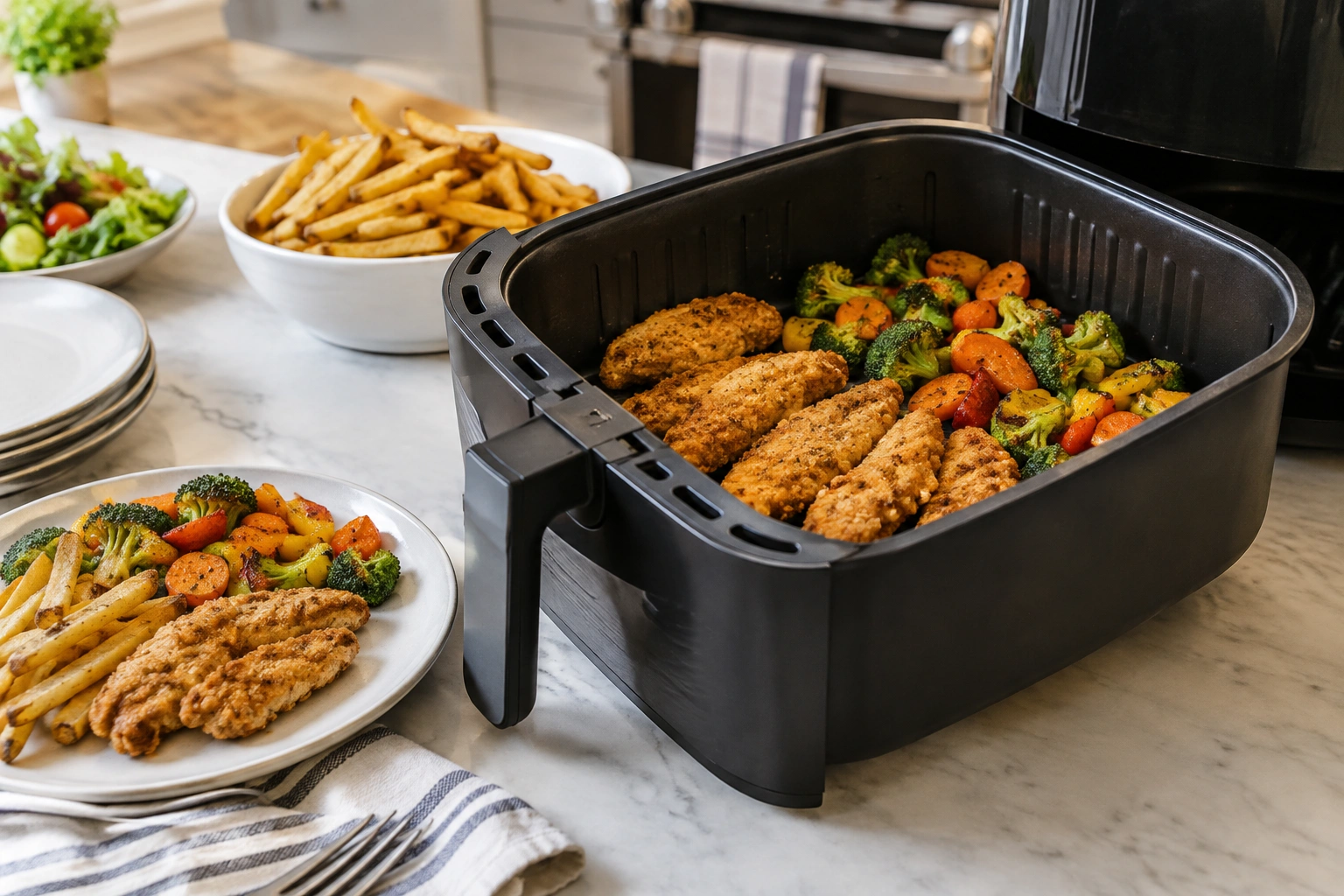
The best choice depends on what problem you are trying to solve.
Air fryer vs oven
- Air fryer: better for small batches, faster preheating, and crisp texture.
- Oven: better for large family meals, sheet-pan dinners, casseroles, and anything that needs more space.
Practical trade-off: If you cook for one to four people and want quick sides or proteins, the air fryer can be more convenient. If you regularly cook one big dinner for everyone, the oven is still the better main tool.
Air fryer vs toaster oven
- Air fryer: usually better for crisping and frozen foods.
- Toaster oven: more versatile for toast, baking, melting, and general countertop use.
Practical trade-off: If you already own a toaster oven, the air fryer is most useful when you want better fried-like texture or faster results on small portions. If your toaster oven already handles most of your small meals well, the upgrade may not be urgent.
Air fryer vs deep fryer
- Air fryer: uses much less oil and is easier to live with day to day.
- Deep fryer: gives the most classic fried texture, but it is messier, oil-heavy, and less practical for frequent family use.
Practical trade-off: For families that want a lighter, lower-fuss way to make crispy foods, the air fryer is the easier choice. A deep fryer only makes sense if you specifically want true deep-fried results often enough to justify the cleanup and oil use.
Health and Oil Use: What Families Can Realistically Expect
Air fryers are often marketed as healthier, but that needs some context.
The clearest advantage is oil reduction. Compared with deep frying, an air fryer generally uses far less oil. That can be helpful for families trying to cut back on greasy meals without giving up crispy textures.
But “healthier” does not automatically mean “healthy.” Food quality still depends on what you put in the basket and how often you serve it. Air-fried fries are still fries. Chicken nuggets are still processed convenience food. The appliance changes the cooking method, not the basic nutrition profile of every meal.
If your family is trying to make better everyday choices, the best use is usually for:
– vegetables with a light coating of oil
– homemade chicken or fish
– reheated leftovers instead of greasy takeout
– lighter versions of favorite comfort foods
For food safety, follow official guidance on safe internal temperatures and handling, especially with poultry and leftovers. The USDA’s food safety resources are a good reference for that.
What Families Use Air Fryers For Most Often
In everyday family cooking, air fryers tend to earn their keep in a few specific jobs.
Frozen foods
This is often the easiest win. Fries, nuggets, onion rings, and similar items usually come out with better texture than in a microwave.
Chicken and fish portions
Small pieces cook well, especially when you do not want to heat a full oven for just a few servings.
Vegetables
Broccoli, Brussels sprouts, green beans, zucchini, and similar vegetables can roast nicely in an air fryer when you want browning without much effort.
Leftovers
Pizza slices, fried chicken, and other leftovers often reheat better in an air fryer than in a microwave because the texture holds up better.
Quick sides
For many families, this is the real everyday use case. The air fryer becomes the appliance for “one more thing” when the main meal is already underway.
Cleaning, Noise, Counter Space, and Other Everyday Trade-Offs
The best appliance is the one you will actually use, and daily convenience matters.
Cleaning
Many air fryers are fairly easy to clean, especially basket models with removable parts. Greasy foods can still leave residue, though, and cleanup is not always as effortless as the marketing suggests.
Noise
Air fryers are not silent. The fan noise is usually manageable, but if your kitchen is open to a living room or you cook late at night, it can be noticeable.
Counter space
This may be the biggest hidden cost. A model that seems compact in a store can feel bulky on a real kitchen counter. If you have to move it every time you use it, that friction can reduce how often you reach for it.
Odor and smoke
Foods with more fat can create odor or smoke if the basket is overcrowded or the appliance is not monitored. That is not unusual, but it is worth remembering if you cook bacon, breaded foods, or heavily seasoned items often.
How to Decide If an Air Fryer Fits Your Family
Use this simple decision check before buying:
-
Do you cook at home several nights a week?
If yes, the appliance has a better chance of earning its space. -
Do you make foods that benefit from crisping?
Frozen snacks, chicken, vegetables, and leftovers are the strongest use cases. -
Can you live with batch cooking when needed?
If not, choose a larger model or skip it. -
Do you have counter space for regular use?
If the answer is no, the convenience drops fast. -
Will someone actually use it?
A family appliance only pays off if it becomes part of the routine.
If your answer is yes to most of those questions, an air fryer is probably worth considering. If you mainly cook big dinners, already own a toaster oven you use often, or dislike countertop clutter, you may not gain much from adding another appliance.
Final buying recommendation by family type
- Best for families of 1–3: a basket air fryer in the 2 to 5.5 quart range.
- Best for families of 4: a larger basket or small oven-style model, especially if you cook sides and proteins often.
- Best for families of 5+: an oven-style model if you want real everyday value; basket models are usually better as a side-dish helper only.
- Best if you already own a toaster oven: buy an air fryer only if you specifically want better crisping, faster preheat, or a dedicated appliance for frozen foods and small batches.
For readers comparing family-sized options, our guides to whether an air fryer is worth it for one person and the Simple Deluxe 8-in-1 Air Fryer 6.34 Qt review can help you think through capacity and everyday use.
When to Consult a Professional
If you have questions about electrical load, outlet safety, or whether a new appliance is appropriate for your kitchen setup, a licensed electrician or qualified appliance technician is the right person to ask. That is especially true in older homes or kitchens with limited outlets.
FAQ
Is an air fryer good for a family of 4?
Yes, if you choose a large enough model and are comfortable cooking some foods in batches. A small basket model may feel tight for full dinners, but it can still work well for sides and snacks.
Can an air fryer replace an oven for family meals?
Not usually. It can replace the oven for small or medium batches, but most families still need a full oven for casseroles, large roasts, and big one-pan meals.
Is a basket air fryer or oven-style better for families?
Basket models are simpler and often easier to clean. Oven-style models usually offer more capacity and flexibility. Families cooking bigger portions often prefer the oven-style format.
Do air fryers really save time?
They often do for small batches because they heat quickly and cook faster than a full oven. The time savings are less dramatic if you need multiple batches for a larger family.
Are air fryers hard to clean after family meals?
Usually not, but it depends on the model and the food. Basket-style units with removable parts are generally easier to clean than more complex oven-style appliances.
Are air fryers worth it for families with limited kitchen space?
Only if you will use it often enough to justify the footprint. If counter space is very tight, a toaster oven or another multi-use appliance may be a better fit.
Can an air fryer make healthy family meals?
It can help reduce oil use and make vegetables or lean proteins easier to cook. But it does not automatically make food healthy — the ingredients still matter.
Bottom line: is an air fryer worth it for families?
For many households, yes. The best case is a family that cooks simple meals often, likes crisp food, and will use the appliance several times a week. If you need one appliance to handle everything, though, an air fryer may feel more limited than useful.

