
Is Food Cooked in an Air Fryer Harmful?

Quick Answer
Food cooked in an air fryer is not automatically harmful. Air fryers cook with rapidly circulating hot air rather than immersing food in oil, and they can be a sensible alternative to deep frying. The bigger health factors are what you cook, how dark you brown it, how much oil and salt you add, and whether raw foods reach a safe internal temperature. The USDA’s air fryer food-safety guidance recommends checking meat and poultry with a food thermometer.
What matters most
- Food choice: Vegetables, potatoes, fish, and lean proteins are different nutritionally from heavily processed frozen snacks.
- Browning level: Avoid repeatedly cooking starchy foods until they are very dark or burnt.
- Added oil: A light coating is usually enough when oil is needed.
- Cooking temperature: High heat can create unwanted compounds in some foods, regardless of whether you use an air fryer, oven, or frying pan.
- Food safety: Use a thermometer for meat and poultry instead of judging doneness by color or cooking time alone.
If you’re asking, “Is food cooked in an air fryer harmful?”, the short answer is usually no. Air-fried food can fit comfortably into a balanced diet when you use the appliance sensibly.
I think the more useful question is whether air frying can create specific risks. Here’s what happens during air frying, which concerns deserve attention, and which ones are often overstated.
In This Guide
Is Food From an Air Fryer Harmful?
For most people, properly prepared air-fried food is not inherently harmful. The appliance mainly changes how heat reaches the food.
An air fryer is a compact convection cooker. A heating element creates heat while a fan moves that hot air rapidly around food in a basket or tray.
This is why the word “fryer” can be misleading. Food is not normally submerged in hot oil as it is during deep frying.
- Heat cooks the food: The heating element raises the temperature inside the chamber.
- Moving air dries the surface: Moisture evaporates from the outside of the food.
- Browning develops: Dry heat creates the color and roasted flavors people associate with crispy food.
- The center continues heating: Heat must still reach the middle of meat, poultry, baked goods, and other thick foods.
I’ve found it useful to think of air frying as concentrated convection cooking rather than as a special health treatment. Putting broccoli in an air fryer does not make it unhealthy, and putting heavily processed frozen food in one does not automatically make it nutritious.
The food still matters most. So do portion size, sodium, added fats, and how heavily you brown the surface.
Does Air Frying Create Acrylamide or Cancer-Causing Compounds?
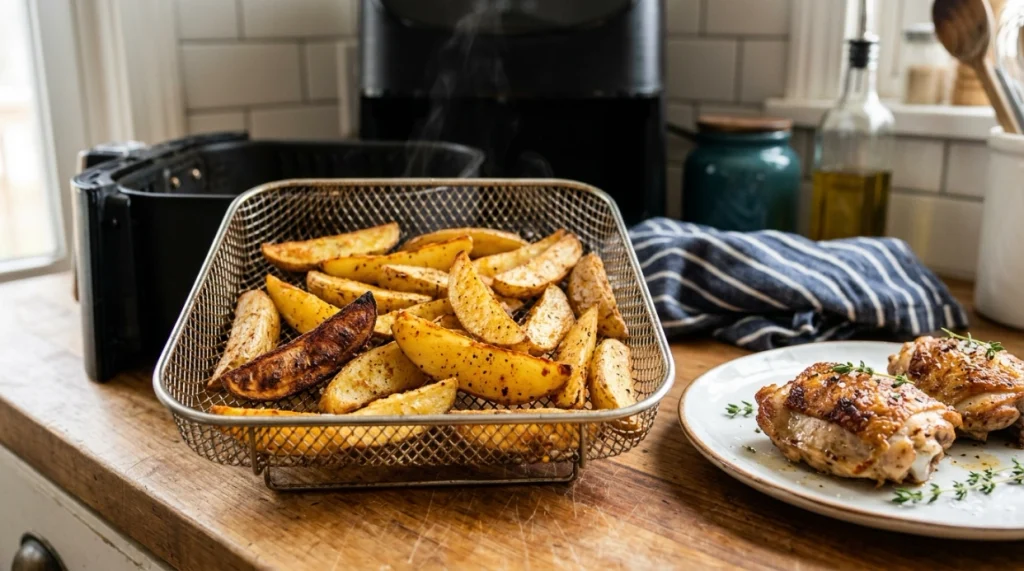
Air frying can form some of the same heat-related compounds created during baking, roasting, frying, and grilling. That does not mean eating normal air-fried food has been shown to cause cancer.
What is acrylamide?
Acrylamide is a chemical that can form naturally when certain plant foods are cooked at high temperatures. Potatoes and cereal-grain foods are common examples.
The FDA’s information on acrylamide explains that it forms from sugars and the amino acid asparagine during processes such as frying, roasting, and baking.
Animal research has raised concerns about high acrylamide exposure. However, the FDA notes that the doses causing cancer in laboratory animals were much higher than typical levels found in human food.
Should you stop air frying potatoes?
No. A more practical approach is to avoid taking starchy foods from pleasantly golden to heavily browned or burnt.
- Cook potatoes to a golden-yellow color rather than dark brown.
- Remove badly burnt pieces instead of eating them regularly.
- Avoid extending cooking time just to create an extremely dark crust.
- Vary your diet instead of relying heavily on one highly browned food.
What about meat cooked at high temperatures?
High-temperature cooking of meat can also create compounds called heterocyclic amines, or HCAs. These aren’t unique to air fryers.
The National Cancer Institute explains that HCA formation generally increases with higher temperatures and longer cooking times.
Air frying has one useful distinction from open-flame grilling. The food isn’t normally sitting above flames created by dripping fat, which is one important route for forming smoke-related PAHs.
Still, I avoid deliberately charring meat in my air fryer. Crisp chicken skin is one thing; blackened edges are another.
Section Takeaway: High-temperature cooking can form unwanted compounds, but this is not an air-fryer-only problem. Avoid routinely burning or heavily charring food.
Is Air Frying Healthier Than Deep Frying or Baking?
Air frying often has an advantage over deep frying because food does not need to be submerged in oil. Compared with oven baking, the health difference is much smaller.
| Cooking method | Main heat method | Typical added oil | Main health consideration |
|---|---|---|---|
| Air frying | Rapid hot-air convection | Little or none for many foods | Watch browning, food choice, sodium, and safe internal temperature |
| Deep frying | Food submerged in hot oil | Much more oil involved in cooking | Greater opportunity for food to absorb frying fat |
| Oven baking | Radiant heat, sometimes convection | Recipe-dependent | Similar high-heat browning concerns apply |
Air frying does not remove calories, saturated fat, or sodium already present in a food. A breaded frozen snack remains the same basic product whether you air fry or bake it.
Where air frying becomes useful is substitution. If I can get crisp potatoes with a light coating of oil rather than a pot of frying oil, that changes the cooking method significantly.
Baking is different. Both baking and air frying can cook with little added fat, so neither appliance automatically produces the healthier meal.
Air fryers also work for small-batch baking. King Arthur Baking’s air-fryer guidance describes them as compact convection appliances and recommends adjusting conventional baking temperatures and times when appropriate.
What Can Make Air-Fried Food Less Healthy?
The appliance itself is rarely the biggest issue. The recipe and cooking habits usually matter more.
1. Relying heavily on ultra-processed foods
Frozen fries, nuggets, pizza snacks, and breaded appetizers are convenient in an air fryer. Convenience does not automatically make them everyday nutritional choices.
Check sodium, saturated fat, serving size, and ingredient information when those foods make up a large share of your meals.
2. Adding more oil than you need
Oil isn’t automatically unhealthy, but pouring large amounts over food removes one of air frying’s practical advantages. I usually start with the smallest amount needed for browning and seasoning adhesion.
3. Burning food to make it extra crispy
More browning is not always better. Stop before potatoes, breaded foods, pastries, or meat develop extensive black or burnt areas.
4. Assuming crispy means safely cooked
A chicken breast can brown outside before its center reaches a safe temperature. Color and crunch are not reliable food-safety tests.
Pro tip: For meat, poultry, seafood, and leftovers, check the FoodSafety.gov minimum internal-temperature chart and use a food thermometer rather than relying on cooking time alone.
| Food | Safe minimum internal temperature |
|---|---|
| Chicken, turkey, and other poultry | 165°F / 74°C |
| Ground meat | 160°F / 71°C |
| Beef, pork, veal, and lamb steaks, chops, or roasts | 145°F / 63°C plus a 3-minute rest |
| Fish | 145°F / 63°C |
| Leftovers | 165°F / 74°C |
How Can You Use an Air Fryer More Safely?
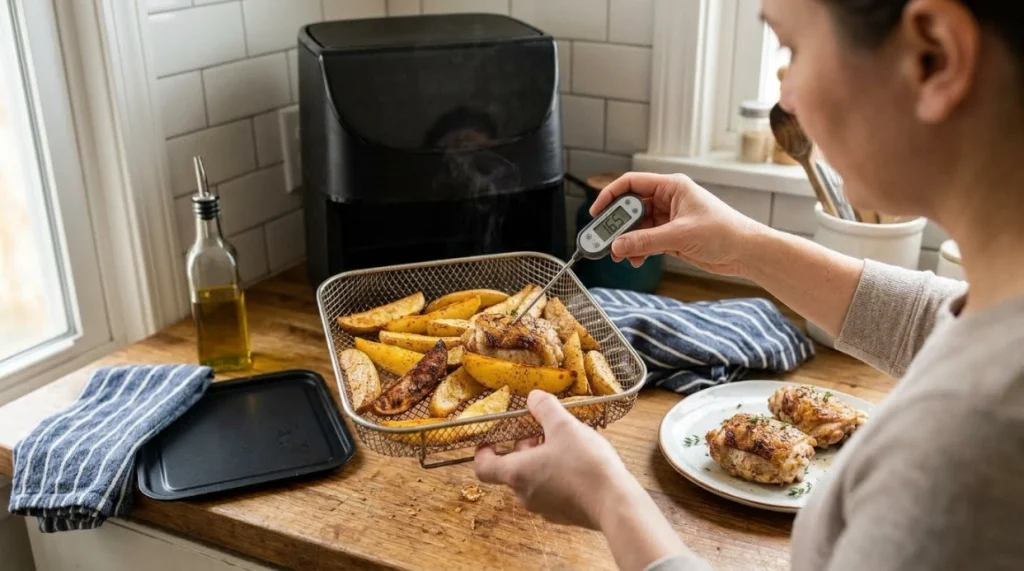
A few simple habits cover most of the practical concerns. You don’t need to be afraid of the appliance.
- Cook to safe temperatures: Check thick meat and poultry with a thermometer.
- Avoid extreme browning: Aim for golden and crisp rather than scorched.
- Use modest oil: Add only what the food needs.
- Don’t overcrowd the basket: Give hot air room to circulate around the food.
- Clean grease regularly: Residue near the basket or heating area can smoke during later cooking.
- Stop if the appliance smokes abnormally: Turn it off and investigate the cause rather than continuing the cycle.
- Inspect the basket: Follow the manufacturer’s directions if a coating becomes badly scratched, peeling, or damaged.
- Follow the manual: Basket capacity, accessories, placement, and preheating instructions vary by model.
One mistake I avoid is treating every recipe’s time as universal. A thick chicken breast, for example, can behave differently in two air fryers because basket design, wattage, airflow, and food thickness vary.
As of 2026, the thermometer is still more useful than blindly adding another three minutes. It tells you what is happening inside the food.
Section Takeaway: Air-fryer safety comes down to sensible heat, proper cleaning, undamaged equipment, and verified food temperatures.
Frequently Asked Questions
Does air-fried food cause cancer?
There is no good basis for saying that normal air-fried food itself causes cancer. High-temperature cooking can create compounds such as acrylamide in starchy foods and HCAs in meat, so avoiding excessive browning and charring is sensible.
Is it unhealthy to eat air-fried food every day?
That depends mainly on what you’re eating. Daily air-fried vegetables, potatoes, fish, or other balanced foods are very different from eating processed fries, nuggets, and salty frozen snacks at every meal.
Is air frying healthier than deep frying?
It can be, especially when it replaces cooking that submerges food in oil. Air fryers can create crisp surfaces with little or no added oil, although the nutritional quality of the original food still matters.
Is air frying healthier than oven baking?
Not necessarily. Both can cook food with little added fat. Your ingredients, amount of oil, portion size, temperature, and degree of browning usually matter more than whether the heat comes from an air fryer or oven.
Should I worry about acrylamide in air-fried potatoes?
You don’t need to stop eating potatoes. Acrylamide can form during high-temperature cooking of starchy foods, so a practical approach is to cook potatoes until golden rather than repeatedly taking them to a dark brown or burnt finish.
Can an air fryer cook raw chicken safely?
Yes, provided the chicken is suitable for air frying and reaches a safe internal temperature. Poultry should reach 165°F (74°C). Always follow package directions for products that specify a particular cooking method.
Does an air fryer use harmful radiation?
An air fryer cooks with an electric heating element and rapidly circulating hot air. It works more like a compact convection oven than a microwave and does not cook food by exposing it to ionizing radiation.
Final Takeaway: Should You Worry About Air-Fried Food?
For most home cooks, there is no reason to treat food cooked in an air fryer as inherently harmful. It is simply a fast form of convection cooking.
The healthiest approach is also the simplest: cook mostly nutritious foods, use oil modestly, avoid burning them, keep the appliance clean, and check meat and poultry with a thermometer.
I wouldn’t judge a meal by the words “air fried” alone. Look at the food in the basket and how you cooked it—that tells you much more.