
Is Parchment Paper Safe in an Air Fryer? A Practical Guide for Home Cooks
If you want the short answer first: yes, parchment paper can be safe in an air fryer when it is used correctly. The key conditions are simple: the parchment must be rated for heat, fit the basket properly, and be held down by food so it cannot lift into the heating element.
That last part matters more than most beginners realize. Loose parchment can shift around once the fan starts moving air, which creates smoke risk and can ruin the batch. Used the right way, though, parchment paper can make cleanup easier and help prevent sticking without causing problems.
One important preheating note: do not put parchment paper in the air fryer basket loose during preheating. Wait until the food is in place so the sheet is anchored from the start.
Quick Answer: Is Parchment Paper Safe in an Air Fryer?
Parchment paper is generally safe in an air fryer if it is heat-rated, trimmed to fit, and fully weighed down by food. If those conditions are not met, it can scorch, lift, or interfere with cooking. Check the packaging for the temperature limit and use that as your guide; brand examples are not universal. Midea’s guidance on air fryer parchment paper is a useful example, but the package limit on your specific parchment should always come first.
The bigger safety rule is this: never put parchment paper in the basket by itself and turn the air fryer on. It needs food on top to anchor it. If the sheet is loose, the fan can push it upward and it may contact the heating element.
A good rule of thumb:
– Use parchment with foods that fully cover or mostly cover the sheet
– Keep the sheet inside the basket footprint
– Avoid letting edges curl upward
– Stop using it if you see smoke, browning, or movement
For most home cooks, parchment paper is safe enough for practical use when fit, airflow, temperature rating, and food coverage all line up. It is not the best choice in every recipe, but it is not automatically dangerous either.
What Parchment Paper Does in an Air Fryer
Parchment paper is a food-safe, heat-resistant paper used to reduce sticking and make cleanup easier. In an air fryer, it acts like a light barrier between the food and the basket. That can be helpful when you are cooking sticky foods such as marinated chicken, salmon, or breaded items that tend to leave residue behind.
The trade-off is airflow. Air fryers work by circulating hot air around the food, so anything placed in the basket can affect browning to some degree. A liner can slightly reduce direct airflow under the food, especially if it is solid and covers most of the basket.
That does not mean parchment should never be used. It means you should use it for the right job:
– Better for cleanup: saucy or sticky foods
– Better for sticking control: delicate items like fish fillets
– Less useful: foods that already release easily, such as many frozen snacks
Think of parchment as a convenience tool, not a required accessory.
When Parchment Paper Is Safe to Use
Parchment paper is safest in an air fryer when three conditions are met.
1. The paper is heat-rated for the job
Check the package. Some parchment paper is made for oven use, but brands can vary. If the product does not list a heat limit, I would not guess. Use a liner only when the packaging clearly supports the temperature you plan to cook at.
2. The food holds the paper down
This is the most important safety step. The paper should be placed in the basket only after the food is on top of it, or at least immediately covered by the food before cooking begins.
Good examples:
– A salmon fillet sitting on a small sheet
– Chicken tenders arranged over a perforated liner
– A burger patty anchoring the center of the paper
Poor examples:
– An empty basket with parchment inside
– A tiny piece of food sitting on a large loose sheet
– A sheet that extends beyond the food and can flap upward
3. The sheet fits the basket
The liner should sit flat and stay below the basket rim. Oversized parchment can block airflow, curl at the edges, or drift toward the heating element.
If you are cutting your own sheet, trim it to the basket shape and size. Leave enough room around the edges for air to move.
Why Loose Parchment Paper Can Be Dangerous
Loose parchment is the main reason people worry about safety, and the concern is valid. Air fryers use strong convection, so a lightweight sheet can move.
If parchment lifts off the basket:
– it may touch the heating element
– it can brown or scorch
– it may smoke
– it can interfere with cooking
The risk is higher with very light food or during preheating, which is why the key rule is to keep parchment out of the basket until food is already in place. If you notice the paper moving during cooking, stop and reassess. A liner that shifts is not worth forcing.
Perforated Liners vs Plain Parchment Sheets
Perforated parchment liners are usually the better choice for air fryers because the holes leave more open basket surface for air to move through. That matters when you want crisping instead of steaming: less solid material blocking the basket means better circulation around the food.
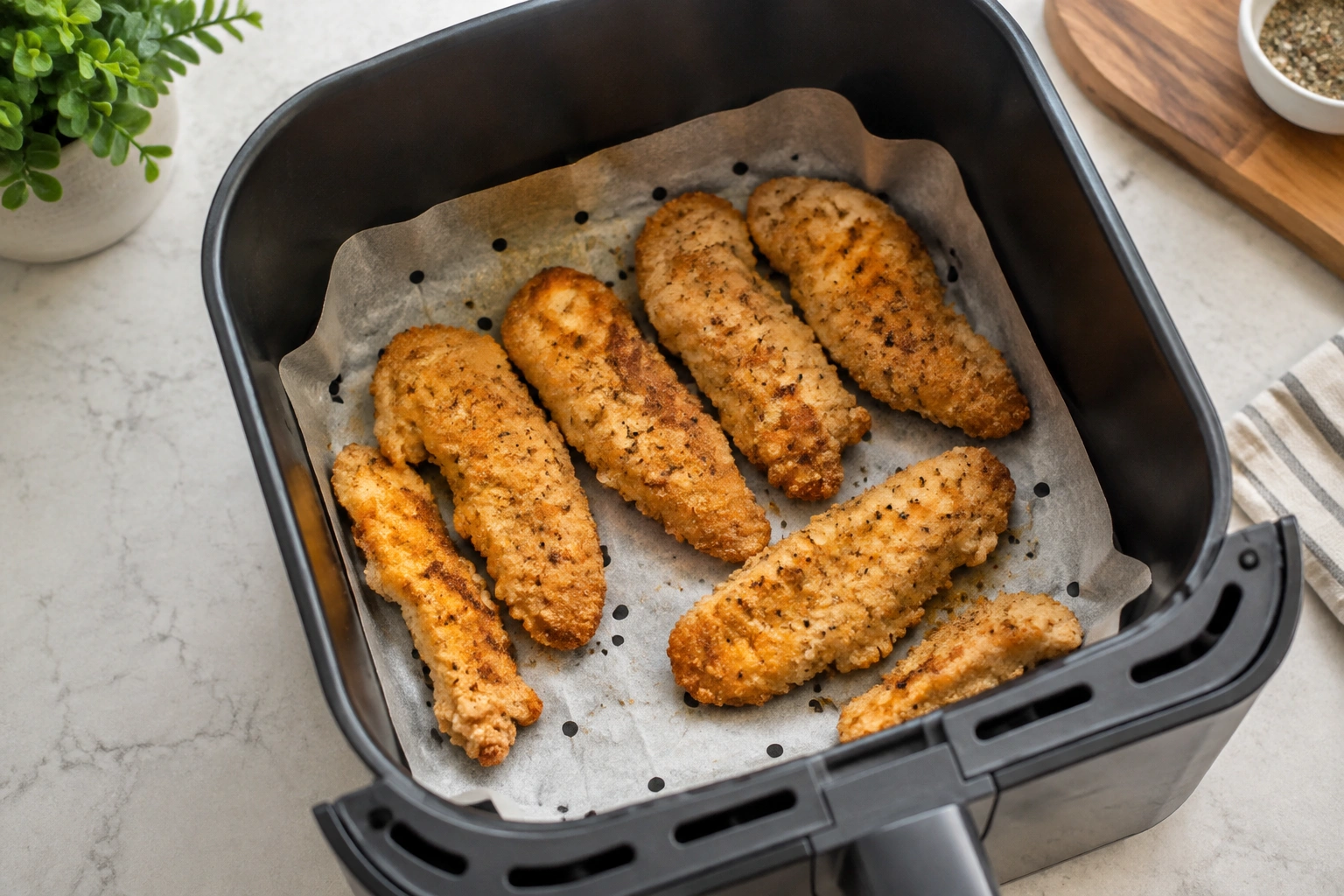
Perforated parchment liners
Best for:
– fries
– chicken nuggets
– breaded fish
– frozen snacks
– foods where browning matters
Pros:
– better airflow
– less chance of trapping steam
– often sold pre-cut for common basket sizes
Cons:
– more expensive than plain parchment
– may not match every basket size exactly
Plain parchment sheets
Best for:
– sticky foods
– small batches
– easier cleanup when airflow is less critical
Pros:
– cheap
– easy to cut to size
– widely available
Cons:
– less airflow
– more likely to interfere with browning if the sheet covers too much of the basket
Simple rule of thumb: choose perforated liners for crisping, and plain sheets for sticky foods and easier cleanup when airflow is less important. If you air fry often, perforated liners are usually the more practical option. If you only need a liner once in a while, plain parchment can still work as long as it is sized carefully and anchored by food.
Parchment Paper vs Wax Paper vs Aluminum Foil
These three materials are not interchangeable, even though they are all used in kitchens.

| Material | Safe in Air Fryer? | Airflow | Cleanup | Best Use |
|---|---|---|---|---|
| Parchment paper | Yes, when used correctly | Moderate, better with perforations | Good | Sticky foods, easier cleanup |
| Wax paper | No, not for air fryer heat | Not suitable | Good in cold prep only | Wrapping or prep, not cooking |
| Aluminum foil | Sometimes, depending on recipe and basket style | Can block airflow more than parchment | Good | Messy foods, some low-airflow recipes |
Parchment paper
This is the most common liner for air fryers because it handles heat better than wax paper and is less rigid than foil.
Wax paper
Wax paper is not the same thing as parchment paper. It is coated with wax, which is not intended for the high heat of an air fryer. Keep wax paper out of the basket.
Aluminum foil
Foil can be useful, but it can also block airflow and change how food cooks. It is acceptable only when it does not cover the basket in a way that traps heat, does not block circulation too much, and does not contact the heating elements. I reach for foil only when I need it for a specific reason, such as containing drips or lining a basket for a messy recipe where crisping is less important.
If your main goal is crisp texture, parchment usually makes more sense than foil. If your main goal is containing mess, foil may be the more practical tool for certain recipes.
How Parchment Paper Affects Airflow and Cooking Results
Air fryers depend on circulation. Anything that sits under the food changes the way hot air moves, even if only a little. That is why parchment paper can improve cleanup while slightly affecting results.
Here is the practical difference:
– Direct basket cooking: best airflow, often best browning
– Perforated parchment: a good middle ground
– Solid parchment sheet: more protection, but more likely to soften crisping
For foods that already release moisture, a liner can make the bottom less crisp. That is not always a problem. For example, if you are cooking a marinated chicken thigh or a saucy salmon, you may care more about cleanup than about a perfectly crunchy base.
For foods like frozen fries or breaded appetizers, I usually prefer perforated liners or no liner at all. Those foods benefit from maximum airflow.
A simple decision rule:
– Need crisping? Use perforated liner or skip the liner
– Need cleanup help? Use parchment
– Need both? Use the smallest liner that safely fits the basket
Best Practices for Different Air Fryer Basket Styles
Not all air fryers handle liners the same way. Basket shape and depth matter.
Deep basket air fryers
These are the easiest to use with parchment because the liner can sit flat under the food. Just make sure the sheet does not curl up the sides too far. Deep baskets are a good match for pre-cut perforated liners when you want quick setup with minimal trimming.
Wide basket air fryers
A wide basket may tempt you to use a larger sheet, but that can reduce airflow if the liner covers too much surface area. Cut it to fit the bottom, not the full basket wall. If you cook in wide, shallow batches, pre-cut liners can save time, but homemade sheets are fine if you size them carefully.
Oven-style air fryers
These can be trickier because airflow comes from more directions. Parchment can work, but only if it stays clear of heating elements and does not block too much circulation. In some oven-style models, a perforated liner is the safer choice than a solid sheet. For trays or racks, pre-cut perforated liners are often worth buying because they are easier to place consistently.
Small air fryers
In a compact basket, a liner that is even slightly oversized can become a problem faster. Keep the sheet tight to the base and avoid folding it up the sides. For small baskets, pre-cut liners are often worth it if you use them regularly; otherwise, a carefully trimmed homemade sheet is usually fine.
If you are unsure, test with a small batch first. One simple meal is enough to tell you whether the liner fits properly and whether the food browns the way you want.
Common Mistakes to Avoid
Most parchment paper problems come from a few predictable mistakes.
Using parchment without food on top
This is the biggest one. A loose sheet can move, lift, and scorch.
Cutting the sheet too large
A liner that reaches too high or covers too much of the basket can interfere with airflow and may get too close to the heating element.
Using wax paper by mistake
Wax paper is for prep, not air frying.
Ignoring temperature limits
Do not assume every parchment brand handles the same heat. Check the box.
Using parchment for every recipe
Sometimes the air fryer works better with no liner at all. If the recipe depends on crispness, a liner may not be worth the trade-off.
Not watching the first few minutes
If you are trying a new liner setup, stay nearby. Early warning signs like shifting paper or smoke are easier to catch right away.
When to Skip Parchment Paper Entirely
There are times when the safest and best-performing choice is no liner at all.
Skip parchment if:
– you are cooking very light food that will not anchor the paper well
– you want the strongest possible crisping
– the recipe already releases easily from the basket
– the basket is small and the liner would crowd the space
– you are preheating and the paper would sit loose before food goes in
For many frozen snacks, direct basket cooking gives the best result. The food browns more evenly, and there is nothing extra to manage. That is especially true when the basket already has a solid nonstick coating.
If cleanup is your main concern, you can also use a liner only for especially messy foods rather than every batch.
A Simple Way to Decide Before You Cook
When I am deciding whether to use parchment in the air fryer, I ask three questions:
- Will the food hold it down?
- Does this recipe need maximum airflow?
- Is cleanup worth the small trade-off in browning?
If the answer to the first question is no, I skip the liner. If the answer to the second is yes, I use perforated parchment or cook directly in the basket. If the answer to the third is yes and the food is heavy enough, parchment is a sensible choice.
That keeps the decision practical instead of theoretical.
Frequently Asked Questions
Can parchment paper catch fire in an air fryer?
It can scorch or smoke if it lifts and touches the heating element, or if it is used outside its heat rating. Used correctly and held down by food, it is much less likely to be a problem.
Do I need perforated parchment paper for an air fryer?
No, but perforated liners usually work better for airflow and crisping. Plain parchment can still be used if it fits well and does not block too much of the basket.
Can I put parchment paper in the air fryer basket without food on top?
No. That is one of the main safety mistakes. The paper should be anchored by food before cooking starts.
Is parchment paper better than foil in an air fryer?
Neither is always better. Parchment is usually better for airflow and sticky foods. Foil can be useful for certain messy recipes, but it can block circulation more.
Can I reuse parchment paper in the air fryer?
Sometimes, if it is still clean, flat, and not browned or brittle. Once it is damp, scorched, or curled, replace it.
Is wax paper the same as parchment paper for air fryers?
No. Wax paper is not a safe substitute for parchment paper in an air fryer.
Does parchment paper change cooking time?
It can slightly affect browning and airflow, which may change results a little. If you use a liner, watch the food rather than relying only on the clock.
Final Take
Parchment paper is safe in an air fryer when it is the right kind of parchment, cut to fit, and held down by food. The main risk is not the paper itself; it is loose paper moving around in strong air circulation.
If you want easier cleanup and less sticking, parchment can be a smart tool. If you want the most crisping possible, cook directly in the basket or use a perforated liner sparingly. The safest choice is the one that fits the food, the basket, and the recipe instead of forcing a one-size-fits-all approach.

