
Kitchen Scale vs Measuring Cups for Baking: Which Tool Gives Better Results?

If you bake often, a kitchen scale is the better tool for baking accuracy. It gives you repeatable results, especially for flour-heavy recipes like cookies, muffins, quick breads, and cakes. Measuring cups still have a place, but they are better treated as a backup or convenience tool—not the most reliable way to measure baking ingredients.
The main reason is simple: baking is formula-based. A small change in flour, sugar, or cocoa can shift texture, rise, and moisture. With cups, the amount you add depends on how you scoop, pack, level, or shake the ingredient. With a scale, you measure the same amount every time.
That does not mean measuring cups are useless. They are fine for casual baking, quick recipes, and liquids when you are working from a familiar recipe. But if you want fewer failed batches and less ingredient waste, weighing ingredients is the more dependable method.
Quick Answer: Which Is Better for Baking?
Use a kitchen scale if you want:
– more consistent cakes, cookies, muffins, and breads
– easier recipe repeatability
– less guesswork with flour and other dry ingredients
– fewer wasted batches from measurement drift
Keep measuring cups if you:
– bake only occasionally
– mostly follow simple recipes
– prefer convenience over precision
– are measuring liquids and don’t want another tool on the counter
If you can only buy one tool, buy the scale first. Keep your measuring cups for liquids and for the recipes where volume is still practical.
Why Weight Is More Accurate Than Volume in Baking
Weight measures how much of an ingredient you have. Volume measures how much space it fills.
That difference matters most with ingredients that are light, fluffy, or easy to compress. Flour is the classic example. A cup of flour can be measured several ways: scooped directly from the bag, spooned into the cup, or packed down. Those methods do not give the same result.
A scale removes that variation. If a recipe says 120 grams of flour, you weigh out 120 grams. Every time, you get the same amount.
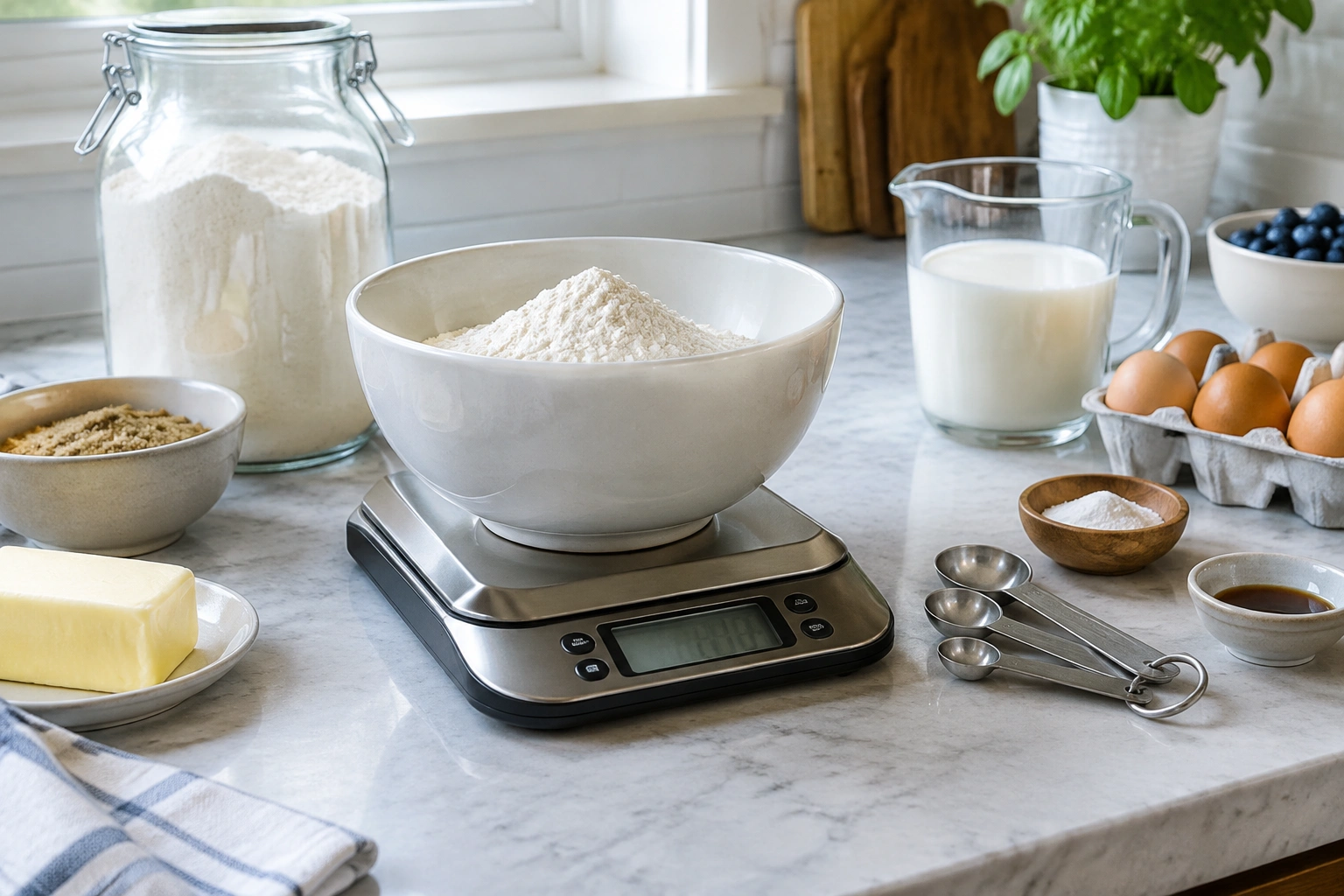
That consistency helps in two practical ways:
- Better repeatability. If a recipe works once, it is easier to make it work again.
- Fewer texture problems. Too much flour can make baked goods dry, dense, or heavy. Too little can make them spread too much or feel weak.
This is why many bakers prefer digital scales over measuring cups, especially when they want reliable results from batch to batch.
How Measuring Cups Can Change Your Results
Measuring cups are convenient, but they are not very forgiving.
The biggest source of variation is flour. If you scoop flour straight from the bag, you usually pack more into the cup than if you spoon it in lightly and level it off. That means two people can follow the same recipe and still end up with different amounts of flour.
Sugar can vary too, though usually less dramatically than flour. Brown sugar is especially sensitive because it is often packed into the cup. Butter is another ingredient that can be measured by cups, but sticks of butter are easier to use by markings or by weight.
Here is the practical problem: recipes assume a certain measuring style, but home bakers do not all measure the same way. That is where inconsistency creeps in.
If a recipe has failed before, the measuring method may be one possible reason, though other factors can also be responsible.
Kitchen Scale vs Measuring Cups: The Practical Trade-Off
| Factor | Kitchen Scale | Measuring Cups |
|---|---|---|
| Accuracy | Usually better for baking | Depends on how you scoop and level |
| Consistency | Strong repeatability | More variation from person to person |
| Speed | Fast once you get used to it | Familiar and quick for small tasks |
| Cleanup | Fewer tools for dry ingredients | More tools, more leveling, more transfers |
| Learning curve | Small adjustment to grams/ounces | Already familiar to many home cooks |
| Best for | Flour, sugar, cocoa, butter, recipe conversion | Liquids, casual baking, quick volume-based recipes |
The scale wins on precision. Cups win on familiarity.
If your baking is mostly weekend cookies or a boxed mix, cups may feel easier. If you bake bread, cakes, muffins, or desserts often enough to care about the outcome, a scale pays off in fewer surprises.
Which Ingredients Should Be Weighed and Which Can Stay in Cups
A simple rule works well in most home kitchens: weigh dry ingredients that affect structure, and use cups where volume is already stable and convenient.
| Ingredient | Best method | Why |
|---|---|---|
| All-purpose flour | Weigh if possible | Small changes affect texture and rise |
| Whole wheat flour | Weigh if possible | Heavier and more variable than white flour |
| Sugar | Weigh for best consistency | Helps keep ratios exact |
| Brown sugar | Weigh if possible | Packing changes the amount a lot |
| Cocoa powder | Weigh if possible | Light and easy to overfill |
| Butter | Weigh or use markings | Weight is precise; sticks are convenient |
| Liquids | Cups are usually fine | Volume works well for water, milk, oil, and similar ingredients |
| Chocolate chips, nuts | Either works | Less sensitive than flour, though weight is still cleaner |
For busy home cooks, the simplest hybrid method is often the best: use a scale for flour and sugar, and keep cups for liquids. That keeps the most important measurements steady without making every recipe feel technical.
How to Measure Flour Correctly If You Only Have Cups
If you do not have a scale, use the spoon-and-level method.
Here is the process:
1. Fluff the flour in its container with a spoon.
2. Spoon flour into the measuring cup lightly.
3. Do not scoop directly from the bag.
4. Level the top with a straight edge, like the back of a knife.
That method is more reliable than digging the cup into the flour container and packing it full.
The goal is to avoid compressing the flour. Packed flour can throw off a recipe enough to affect the crumb, especially in cakes, muffins, and cookies. If a recipe has been disappointing, flour measurement is one of the first things to fix.
How to Use a Kitchen Scale for Everyday Baking
A kitchen scale is easier than many people expect.
Use this basic workflow:
- Put the mixing bowl on the scale.
- Press tare or zero the scale.
- Add the first ingredient until you reach the target weight.
- Tare again.
- Add the next ingredient.
This is the cleanest way to bake from a recipe measured in grams. You can add ingredients directly into the same bowl, which saves dishes and reduces transfer mistakes.
A few practical tips:
– Make sure the scale is on a flat surface.
– Zero it before each ingredient.
– Use grams for most baking recipes; they are easier to work with than ounces for small amounts.
– If you are using a bowl, make sure the scale display remains visible after the bowl is placed.
How to Convert Baking Recipes from Cups to Grams
The safest approach is to convert recipes using ingredient-specific gram weights, not one universal cup-to-gram number.
That matters because one cup of flour does not weigh the same as one cup of sugar or one cup of chocolate chips. Density changes the conversion.
A practical starting point for common baking ingredients:
– All-purpose flour: often around 120 to 125 grams per cup
– Granulated sugar: often around 200 grams per cup
– Butter: often 227 grams per cup or 113 grams per stick
– Brown sugar: often around 200 grams per packed cup
These are common home-baking reference points, but exact values can vary by recipe source and measuring method. When available, use a trusted ingredient-specific conversion chart or the original recipe author’s conversions rather than a single universal rule.
Best practice:
– Convert the ingredients that matter most first: flour, sugar, butter, cocoa.
– Keep notes on what worked.
– Once the recipe is in grams, you can repeat it with less guesswork.
What Kind of Kitchen Scale Is Worth Buying
You do not need a fancy scale for home baking.
A practical budget-friendly digital scale should have:
– a tare function
– gram measurements
– a readable display
– enough capacity for a mixing bowl and ingredients
– a stable platform
– 1-gram increments for baking accuracy
– a capacity around 5 kg/11 lb for typical home baking
Features you can usually skip:
– specialty modes you will never use
– oversized platforms that take up too much space
– complicated app connections
For most homes, a basic digital scale is enough. If your kitchen is small or you bake only once in a while, choose one that stores easily and turns on quickly. If you bake frequently, look for a model that is easy to clean and simple to read at a glance.
The best scale is the one you will actually keep on the counter or reach for from a drawer.
When Measuring Cups Are Still Good Enough
Measuring cups still make sense in a few situations.
They are fine when:
– you are making a casual recipe that is already written in cups
– you are measuring liquids
– you are baking something forgiving, like a rustic quick bread or simple snack cake
– you do not want to convert a recipe that already works for you
Cups are also useful as a backup when a scale battery dies or when a second person in the kitchen is more comfortable with volume measurements.
The key is not to force cups into every recipe. Use them where they are convenient, and switch to weight where accuracy matters most.
Common Baking Mistakes That Weighing Can Prevent
A scale helps prevent a few very common problems:
- Too much flour from scooping
- Inconsistent brown sugar packing
- Uneven batches when multiple people measure differently
- Dry or dense texture from extra dry ingredients
- Repeated recipe failures that are sometimes measurement-related
If you have ever made the same recipe twice and gotten different results, the measuring method may be one factor. A scale takes one major variable out of the process.
That is especially helpful for families who bake on a schedule and want reliable results without wasting ingredients.
Bottom Line: Best Choice for Most Home Bakers
If you bake more than occasionally, buy a digital kitchen scale first. It is the better tool for accuracy, repeatability, and reducing ingredient waste.
If you bake only now and then, measuring cups are still workable—especially for liquids and simple recipes. But if you are tired of dry cakes, inconsistent cookies, or recipes that seem to change every time, weighing ingredients is the most practical upgrade you can make.
For most home kitchens, the smartest setup is simple: scale for dry baking ingredients, cups for liquids, and a spoon-and-level method when cups are all you have.
FAQ
Is a kitchen scale really worth it for occasional baking?
Yes, if you want more reliable results. Even occasional bakers benefit when a recipe has failed before or when flour-heavy recipes matter most.
Do I need both measuring cups and a scale?
In most kitchens, yes. A scale is better for baking ingredients, but cups are still useful for liquids and quick, familiar recipes.
Can I use ounces instead of grams?
You can, but grams are usually easier for baking because they give finer control for smaller amounts.
What is the biggest mistake people make with flour?
Scooping flour directly from the bag. That usually adds more flour than intended and can change the texture of the final bake.
Are cheap digital scales good enough?
Usually, yes for home baking. A basic digital scale with tare and gram measurements is enough for most recipes.
Should I convert all my recipes to grams?
Not necessarily. Convert the recipes you bake often or the ones that have given you inconsistent results. Those are the best candidates.
Is a kitchen scale better than measuring cups for baking bread?
Usually, yes. Bread dough is sensitive to flour and water balance, so weighing ingredients helps keep the dough consistent.
Can I test whether my measuring cups are accurate?
Yes. A kitchen scale can help you compare what your cups actually hold against the amount a recipe expects.
What if my recipe only gives cups?
You can still bake it. Use spoon-and-level for flour, measure carefully, and make notes if the results are too dry or too soft.
Should liquids always be measured by cups?
Not always, but cups are generally practical for liquids. For baking, the bigger accuracy gains usually come from weighing dry ingredients.