
Which Is Healthier: Microwave or Air Fryer?
Quick Answer
Neither a microwave nor an air fryer is automatically healthier in every situation. A microwave often has an advantage for quickly cooking vegetables with little water and preserving heat-sensitive nutrients, while an air fryer can be healthier when it replaces deep frying because it can produce crisp food with much less added oil. Microwave cooking can preserve nutrients well because cooking times are usually short.
The Healthiest Choice Depends on Your Goal
- Nutrient retention: Microwaving vegetables with little water can preserve many heat-sensitive nutrients well.
- Lower added fat: Air frying can replace deep frying while using only a small amount of oil.
- Whole foods: Both appliances can prepare vegetables, lean proteins, potatoes, and other nutritious foods.
- Crispy texture: Air fryers brown and crisp food much better because they use circulating dry heat.
- Fast reheating: Microwaves usually win for speed, especially with soups, grains, vegetables, and moist leftovers.
Simple Rule
- Use the microwave when speed and moisture retention matter. Use the air fryer when you want roasting, browning, or crispness without deep frying.
When readers ask me, “Which is healthier: microwave or air fryer?” I don’t treat it as a simple appliance contest. What you cook matters far more than the machine sitting on your counter.
A bowl of microwave-steamed broccoli can be an excellent choice. So can air-fried salmon and vegetables with a light coating of oil.
In This Guide
- How Do Microwaves and Air Fryers Cook Food Differently?
- Which Appliance Preserves More Nutrients?
- Is an Air Fryer Better for Cutting Fat and Calories?
- What About High Heat, Acrylamide, and Microwave Radiation?
- Which Is Safer for Cooking and Reheating Food?
- When Should You Use a Microwave vs. an Air Fryer?
- Frequently Asked Questions
How Do Microwaves and Air Fryers Cook Food Differently?
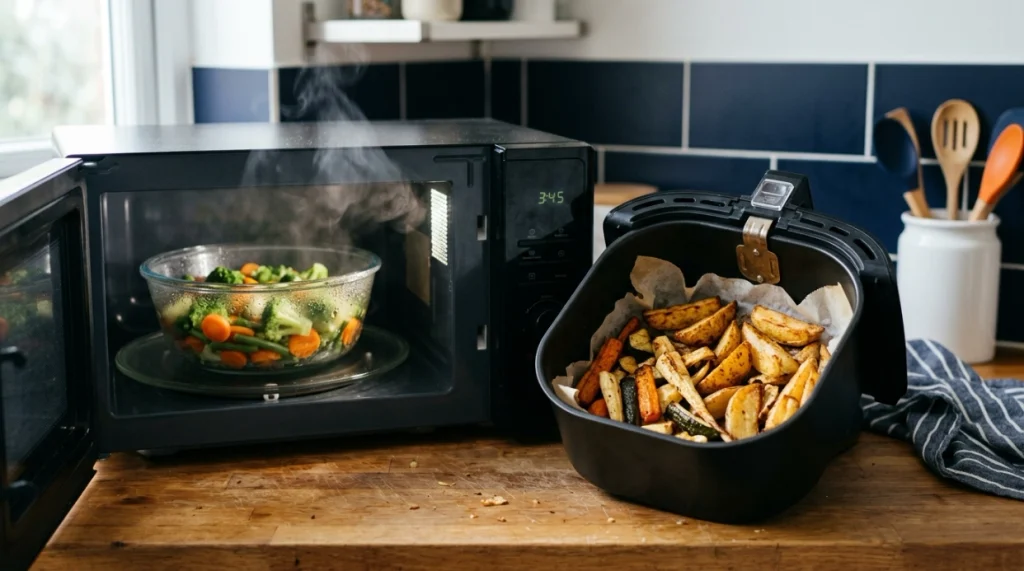
The main difference is the type of energy used to heat the food. That difference affects moisture, browning, cooking time, and the amount of oil you may want to add.
A microwave oven uses electromagnetic microwave energy that is absorbed primarily by water, fats, and sugars in food. The resulting molecular movement creates heat.
Microwaves don’t literally cook food from the inside out. The USDA explains that microwave energy penetrates only partway into thicker foods, while heat moves farther inward by conduction.
What is an air fryer?
An air fryer is a compact convection cooker that circulates very hot air around food. A fan pushes that heat rapidly across the food’s surface.
This strong airflow removes surface moisture and encourages browning. That’s why fries, roasted vegetables, breaded foods, and pizza can develop crisp edges.
- Microwave: Fast heating with limited surface browning.
- Air fryer: Dry convection heat with stronger browning.
- Microwave strength: Moist foods, vegetables, grains, soups, and fast reheating.
- Air fryer strength: Roasting, crisping, baking, and reheating foods that should stay crunchy.
I find this cooking-method distinction more useful than labeling one appliance “healthy.” The better appliance changes with the food.
Which Appliance Preserves More Nutrients?
A microwave can be one of the better cooking methods for nutrient retention, especially when vegetables cook quickly with little added water. Shorter heat exposure can help protect nutrients that are sensitive to prolonged cooking.
Some vitamins decline whenever food is heated. Vitamin C is a familiar example.
Why microwaving vegetables can work well
Water-soluble nutrients can move from vegetables into cooking water. That becomes more important when vegetables are boiled in a large pot and the water gets discarded.
Microwaving normally requires little water. It can therefore combine short cooking times with limited nutrient loss into cooking liquid.
- Use only enough water to create steam.
- Cook vegetables until just tender rather than extremely soft.
- Use a microwave-safe covered container with appropriate venting.
- Avoid repeatedly heating the same food for long periods.
Does air frying destroy nutrients?
Air frying doesn’t suddenly make vegetables nutritionally poor. However, it exposes their surfaces to relatively high dry heat, commonly around 350°F to 400°F (177°C to 204°C).
Cooking temperature is only one factor. Time, food type, surface area, moisture, and doneness all matter too.
| Health Factor | Microwave | Air Fryer |
|---|---|---|
| Typical cooking style | Fast, moist heating | High-temperature dry convection |
| Added oil needed | Usually none | None to a light coating for many foods |
| Vegetable nutrient retention | Often excellent with little water and short cooking | Can still be good, but uses stronger dry heat |
| Browning | Limited | Strong |
| Best health-focused use | Vegetables, grains, soups, moist leftovers | Vegetables, potatoes, fish, lean proteins, lower-oil crispy foods |
Section Takeaway: For quickly cooking vegetables with little water, the microwave has a strong nutritional case. Air frying remains a good option when browned flavor makes nutritious foods more appealing.
Is an Air Fryer Better for Cutting Fat and Calories?
An air fryer has its clearest health advantage when you compare it with deep frying, not with microwaving. It can create a crisp exterior without submerging food in cooking oil.
That can substantially reduce the amount of added fat in recipes that would otherwise be deep-fried.
The comparison depends on what the air fryer replaces
Imagine cooking potatoes three different ways. Microwave-steamed potatoes need virtually no oil, air-fried wedges might use a light coating, and deep-fried potatoes cook while submerged in oil.
In that example, microwaving could use the least added fat. Air frying still provides the crisp texture many people want with far less oil than deep frying.
- For minimum added oil: Microwaving often wins.
- For crispy food with less oil: Air frying is highly useful.
- For replacing deep frying: Air frying usually offers the meaningful improvement.
- For processed frozen food: Check the nutrition label because the appliance cannot remove existing fat, sodium, or refined carbohydrates.
That’s the distinction I keep in mind. The air fryer isn’t a machine that turns every food into a health food.
A plate of air-fried vegetables, chickpeas, or salmon is different from a basket filled entirely with highly processed snacks.
Consumer Reports likewise describes an air fryer as a compact convection appliance that can cook with little or no added oil compared with conventional frying methods.
What About High Heat, Acrylamide, and Microwave Radiation?
Both cooking methods have health questions attached to them, but some common fears need context. Neither appliance makes nutritious food inherently dangerous simply because of how it produces heat.
Do microwaves make food radioactive?
No. Microwave ovens use non-ionizing electromagnetic energy to heat food.
The USDA states that microwave cooking does not make food radioactive. Microwave energy is fundamentally different from ionizing radiation such as X-rays.
What is acrylamide?
Acrylamide is a chemical that can form in some carbohydrate-rich foods during high-temperature cooking. Potatoes and grain-based foods are common examples.
Browning methods such as frying, roasting, and baking can produce it. Air frying can therefore produce acrylamide too, particularly when starchy food becomes heavily browned.
- Aim for golden rather than extremely dark potatoes.
- Don’t intentionally over-brown or burn starchy foods.
- Remove heavily charred pieces.
- Use varied cooking methods instead of relying on one appliance for every meal.
The bigger practical lesson is simple. Don’t judge healthfulness by the appliance name alone.
Ingredients, temperature, cooking duration, portion size, and the amount of browning all influence the final meal.
Which Is Safer for Cooking and Reheating Food?
Both appliances can cook food safely when used correctly. The main food-safety challenge with microwaves is uneven heating.
The USDA’s microwave safety guidance explains that cold spots can remain in food. Stirring, rotating, standing time, and checking temperatures help reduce that risk.
Use a thermometer for meat and poultry
Cooking time alone isn’t a reliable safety test in either appliance. Food thickness, starting temperature, appliance wattage, and airflow can change results.
Pro tip: Use a food thermometer and follow verified USDA minimum internal-temperature guidance rather than judging raw meat or poultry by cooking time, color, or crispness alone.
- Poultry: 165°F (74°C).
- Ground meats: 160°F (71°C).
- Whole cuts of beef, pork, lamb, and veal: 145°F (63°C), followed by the recommended rest.
- Reheated leftovers: 165°F (74°C).
Microwave containers matter too
Use containers labeled as microwave-safe. Avoid disposable storage tubs or packaging that isn’t designed for microwave heating.
With an air fryer, use accessories that are heat-safe and compatible with your model. Never block airflow around the heating system unless the manufacturer’s instructions allow it.
When Should You Use a Microwave vs. an Air Fryer?
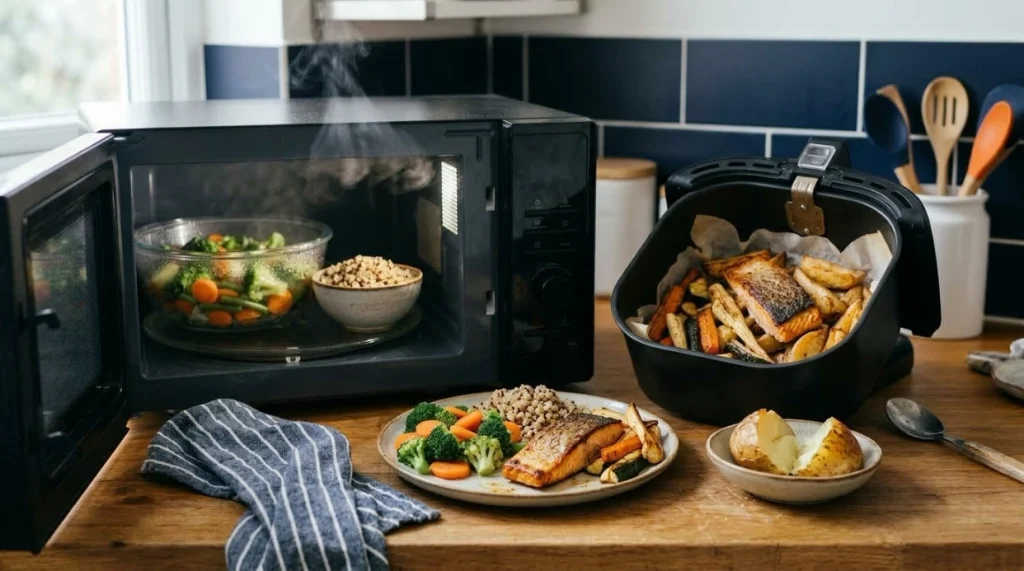
For the healthiest kitchen routine, I wouldn’t choose only one. The two appliances solve different problems.
As of 2026, I think of the microwave as the speed-and-moisture appliance and the air fryer as the crisping-and-roasting appliance.
Choose the microwave for these foods
- Steamed broccoli, carrots, peas, and other vegetables
- Oatmeal and porridge
- Rice and grain reheating
- Soups and stews
- Beans and lentils
- Moist leftovers
- Foods where crispness doesn’t matter
Microwaving works especially well when the alternative would be prolonged boiling. You can use little water and stop cooking as soon as the food reaches the texture you want.
Choose the air fryer for these foods
- Roasted broccoli and Brussels sprouts
- Potato wedges
- Chicken pieces
- Salmon and other fish fillets
- Tofu
- Chickpeas
- Reheated pizza
- Breaded foods that should stay crisp
The healthy air-fryer guidance from Consumer Reports makes the same broader point: what you put into an air fryer matters.
Use both for a practical meal
You don’t need to make this an either-or decision. One of the easiest approaches is splitting the meal between appliances.
- Microwave frozen vegetables while air-frying salmon.
- Microwave a potato first, then air-fry it briefly for a crisp skin.
- Microwave leftovers that need moisture, but air-fry the crispy components separately.
- Heat soup in the microwave while roasting vegetables in the air fryer.
This approach also makes healthy meals easier on busy days. Convenience matters when it helps you cook whole foods more consistently.
For broader perspective on air frying, the Cleveland Clinic’s air-fryer health guidance emphasizes that air fryers can be a useful alternative to deep frying, while the healthfulness of the ingredients still matters.
Section Takeaway: A microwave has the edge for fast, low-water cooking and moist foods. An air fryer is especially valuable when it helps you replace deep frying or makes vegetables and lean proteins enjoyable with minimal added oil.
Frequently Asked Questions
Is microwave food healthier than air-fried food?
It depends on the food and recipe. Microwave-steamed vegetables may require no added oil and can retain nutrients well, while air-fried vegetables or lean proteins can also form part of a healthy meal. The ingredients and cooking method matter more than the appliance label.
Does an air fryer destroy more nutrients than a microwave?
Not necessarily, but air fryers generally use hotter dry heat and encourage browning. Microwaves often cook faster and with less water, which can help preserve heat-sensitive and water-soluble nutrients in vegetables.
Is microwaving vegetables unhealthy?
No. Microwaving vegetables can be an excellent preparation method. Short cooking times and small amounts of water can help preserve nutrients that might otherwise be lost during prolonged boiling.
Is air-fried food good for weight loss?
Air frying may help reduce added calories when it replaces deep frying because much less cooking oil may be needed. Weight management still depends on overall food choices, portions, energy intake, and dietary habits.
Which is healthier for reheating leftovers?
Neither method automatically makes leftovers healthier. Microwaves are faster for moist foods, while air fryers restore crisp texture better. For perishable leftovers, proper storage and reheating to a safe internal temperature matter most.
Does microwave radiation make food harmful?
No. Microwave ovens use non-ionizing electromagnetic energy, and microwaved food does not become radioactive. Use a properly functioning appliance and cookware designed for microwave use.
Should I buy an air fryer if I already have a microwave?
They perform different jobs. A microwave excels at fast heating, steaming, and moist foods, while an air fryer excels at browning, roasting, and crisping. Owning both can be useful if you regularly use both cooking styles.
My takeaway: Don’t choose between a microwave and an air fryer based on the word “healthy.” Choose the method that lets you prepare nutritious ingredients with appropriate heat, minimal unnecessary fat, and a texture you’ll enjoy eating.
If your priority is vegetables cooked quickly with little water, reach for the microwave. If your alternative is deep frying or you want crisp vegetables and lean proteins with modest oil, the air fryer is an excellent tool.

