
Poolish vs Biga: How to Choose the Right Preferment for Better Bread

If you’ve ever looked at a bread formula and wondered whether poolish or biga would give you the better loaf, you’re asking the right question. These two preferments can both improve flavor, aroma, and dough performance, but they do it in different ways. The real trick is not memorizing definitions — it’s understanding what each one does to hydration, fermentation, and handling.
In simple terms, poolish is wetter and usually looser; biga is stiffer and more structured. That difference changes more than texture in the bowl. It affects how the dough stretches, how easily it mixes, how the crumb opens, and how the final bread feels when you bite into it.
Poolish vs Biga at a Glance
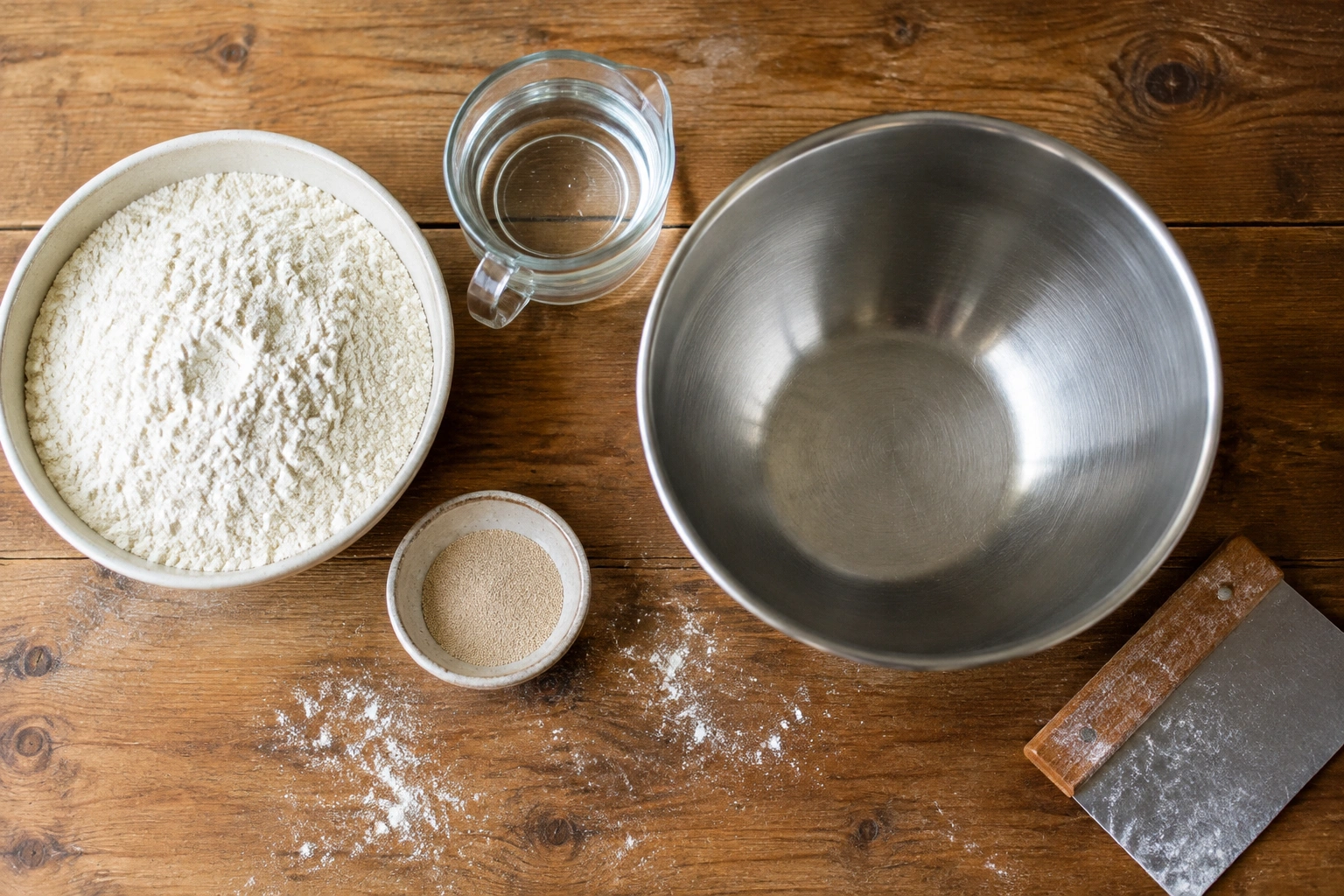
Here’s the fastest way to compare them before we go deeper.
| Feature | Poolish | Biga |
|---|---|---|
| Hydration | About 100% hydration, so equal parts flour and water by weight | Usually around 50% to 60% hydration |
| Consistency | Loose, batter-like, very wet | Stiff, shaggy, and more dough-like |
| Typical fermentation | Often 8 to 12 hours | Often 12 to 16 hours |
| Handling | Easier to mix directly into dough | Often needs to be torn into pieces before mixing |
| Main dough effect | Can increase extensibility and help create a lighter, airier crumb | Can support dough strength and a chewier texture |
| Flavor tendency | Often subtle sweetness and a mild, wheaty aroma | Often more complex, nutty notes |
| Best fit | Baguettes, lighter hearth breads, doughs needing stretch | Pizza, rustic loaves, breads needing more structure |
A useful shortcut: choose poolish when you want stretch and openness; choose biga when you want firmness and chew. That’s not a universal law, but it’s a reliable baking instinct.
What Poolish Is and How It Works
Poolish is a wet preferment made with equal parts flour and water by weight, which puts it at 100% hydration. That high water content creates a loose, pourable mixture that ferments quickly and evenly at room temperature.
Why does that matter? Because a wetter preferment tends to encourage extensibility in the final dough. In practical terms, extensibility means the dough can stretch more easily without snapping back so aggressively. That can be a real advantage when you want a baguette that expands well in the oven or a dough that shapes smoothly without fighting you.
Poolish is also often associated with a lighter crumb and subtle sweetness. That doesn’t mean every poolish bread will be airy or sweet — flour choice, yeast amount, and fermentation time all matter — but those are common tendencies when the preferment is well made and used at the right point.
What poolish looks like when it’s ready
A mature poolish usually shows:
– a domed or gently rounded surface,
– lots of bubbles across the top and sides,
– a slightly elastic, webby structure when you stir it,
– a pleasantly fermented aroma, not a harsh, alcoholic one.
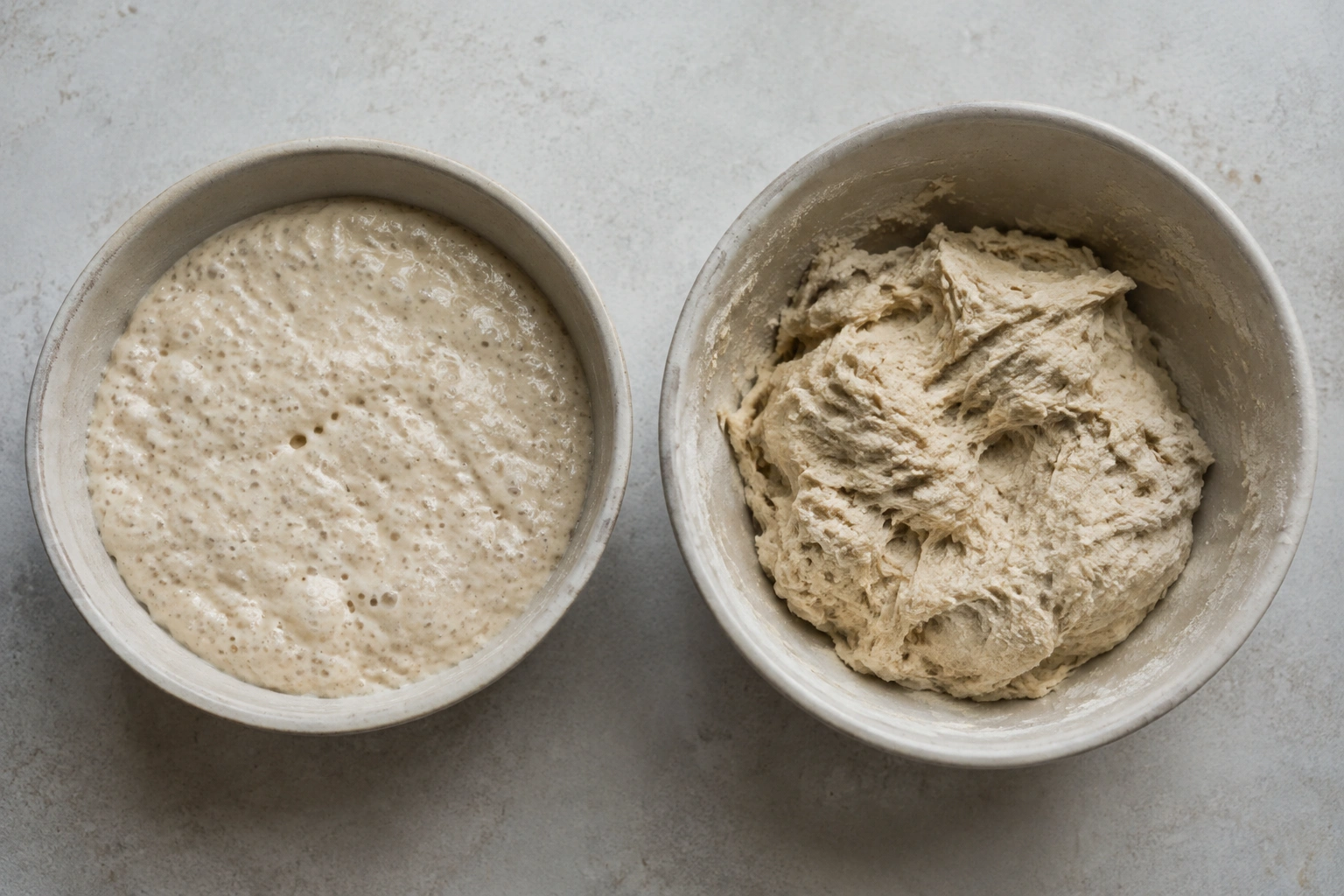
If it has collapsed completely, you’ve likely gone past peak fermentation. It may still work in a formula, but the dough can lose some of the lift and balance you were aiming for.
If it looks tight, pale, and barely aerated after the expected fermentation window, it’s probably underfermented and may still need more time.
What Biga Is and How It Works
Biga is the stiffer cousin. At roughly 50% to 60% hydration, it feels more like a rough dough than a batter. It’s common in Italian-style baking and is often chosen when the baker wants more structure in the final dough.
Because biga is drier, it behaves differently during fermentation. It tends to be less fluid, which can make it easier to hold together as a mass and easier to judge by feel once you’ve made it a few times. That stability is one reason bakers like it for breads that need strength, chew, or a more controlled dough feel.
Biga can also contribute a more complex, nutty flavor profile. Again, that depends on the formula, but it’s a common reason bakers choose it when they want depth without making the dough overly slack.
What a ready biga should look like
A properly fermented biga often has:
– a slightly domed top,
– visible fermentation activity,
– a dry, rough, uneven texture,
– a fermented aroma that still smells clean and wheaty.
If it’s dense and inactive, it likely needs more time. If it has become overly loose or sharply acidic, it may have gone too far for the intended formula.
If the surface looks torn and dry but the interior still feels tight and underexpanded, that’s usually a sign it needs more fermentation time rather than more mixing.
Why Hydration Changes More Than Texture
Hydration is the core difference, but it affects more than how the preferment feels in your hands.
A wetter preferment like poolish gives yeast and enzymes a more fluid environment. That often leads to faster, more even fermentation and can help create dough that stretches more easily later on. If your goal is an open crumb, that extra extensibility can be very useful.
A stiffer preferment like biga slows things down a bit and keeps the mass more compact. That can support dough strength and make the final dough feel a little more assertive under your hands. For breads that need chew or better shape retention, that can be the better trade-off.
So the question is not “Which one is better?” It’s “What does this dough need more of: stretch or strength?”
When to Choose Poolish vs Biga
Here’s a practical decision framework I use when looking at a formula.
Choose poolish if you want:
- more extensibility,
- a lighter, more open crumb,
- a preferment that mixes in easily,
- a dough that feels less resistant during shaping.
Poolish is especially appealing when working with lean doughs like baguettes or certain hearth breads where openness and stretch are part of the goal.
Choose biga if you want:
- more dough strength,
- a chewier bite,
- a preferment that holds its shape better,
- a dough that feels more manageable in formulas that might otherwise become too slack.
Biga is often a smart choice for pizza dough and rustic loaves where structure matters as much as flavor.
A simple rule of thumb
If your flour is already very strong and your dough tends to tighten up, poolish can help loosen it. If your dough tends to spread or feel weak, biga may give you the backbone you need.
How to Make Poolish and Biga
You don’t need special equipment for either one, just a bowl, a scale, and enough room for the preferment to expand.
Poolish method
- Weigh flour and water in equal amounts.
- Add a small amount of yeast appropriate for your fermentation window.
- Stir until no dry flour remains.
- Cover loosely and ferment at room temperature until bubbly and slightly domed.
Because poolish is so wet, it mixes quickly and smoothly. If you’re a beginner, this is often the easier preferment to combine with the rest of the dough.
Biga method
- Weigh flour and reduce the water to create a stiff mix, usually around 50% to 60% hydration.
- Add yeast and mix just until the flour is hydrated.
- Knead briefly only if needed; biga should remain rough and somewhat shaggy.
- Cover and ferment until it shows clear fermentation but still feels firm.
Biga takes a little more judgment because it won’t look as active or fluid as poolish. Don’t expect it to behave like a sponge. It should stay stiff.
How Long to Ferment Each Preferment
The verified ranges are a helpful starting point: poolish typically ferments for 8 to 12 hours, while biga often ferments for 12 to 16 hours. Those windows are not rigid rules. Temperature, flour type, and yeast amount all influence timing.
At a warm room temperature, both can move faster. In a cooler kitchen, both may take longer. Stronger flour can also slow visible expansion a bit because it typically absorbs more water and can make the preferment feel firmer and less active on the surface, even when fermentation is progressing normally. Softer flour may seem ready sooner because it loosens and bubbles more quickly.
That’s why visual cues matter more than the clock alone. A preferment is ready when it looks active, smells pleasant and fermented, and has a structure that matches its type — loose and bubbly for poolish, expanded but still firm for biga.
Signs poolish is ready
- bubbly across the surface,
- slightly domed or just starting to flatten,
- smells sweet, wheaty, and fermented,
- still looks lively, not collapsed.
Signs biga is ready
- expanded but still firm,
- rough surface with signs of fermentation,
- pleasant aroma,
- not dry and inert in the center.
If poolish is underfermented, it tends to look flat, dense, and underbubbled. If it’s overfermented, it may collapse, smell sharply alcoholic, and lose some of its structure. A biga that’s underfermented often feels tight and compact with little lift, while an overfermented biga can become overly soft, fragile, and more acidic than cleanly wheaty.
How to Use Poolish or Biga in a Final Dough
Once the preferment is ready, it becomes part of the total flour and water in your final formula. That means you must count it when calculating hydration.
This is the mistake many bakers make: they add the preferment on top of the recipe instead of folding it into the formula. The result is often a dough that feels too wet or too dry.
When using poolish
Because poolish already contains a lot of water, you may need to reduce the water in the final mix. The dough may also feel looser and more extensible, so be ready to handle it more gently during shaping.
When using biga
Because biga contributes less water, the final dough may need more added water to reach the desired consistency. It may also require a little more mixing to fully distribute the stiff preferment.
A practical handling tip: tear biga into smaller pieces before mixing it into the final dough. That helps it disperse more evenly and prevents dry pockets.
Simple conversion example
Say your final bread formula uses:
– 1000 g total flour
– 700 g total water
– 20 g salt
– 2 g yeast
If you want to use a 20% preferment based on total flour, that means 200 g of the flour goes into the preferment and 800 g stays in the final dough.
Poolish version at 100% hydration
– Preferment: 200 g flour + 200 g water
– Final dough: 800 g flour + 500 g water, plus salt and remaining yeast
Biga version at 50% hydration
– Preferment: 200 g flour + 100 g water
– Final dough: 800 g flour + 600 g water, plus salt and remaining yeast
In both cases, total flour stays at 1000 g and total water stays at 700 g. The only thing that changes is how that flour and water are distributed between the preferment and the final dough.
Can You Substitute Poolish for Biga or Vice Versa?
Yes, but not blindly. You can swap one for the other only if you adjust for hydration and timing.
If you replace poolish with biga
- reduce the preferment water,
- expect a stiffer final dough unless you add water back,
- allow for a slightly different fermentation pace,
- anticipate a bit more chew and less extensibility.
If you replace biga with poolish
- increase the preferment water,
- reduce final dough water accordingly,
- expect a looser dough,
- watch for overfermentation, especially in a warm kitchen.
The most important adjustment is hydration. If you ignore that, the dough formula changes even if the flour weight stays the same.
A simple rule: keep total flour and total water constant, then move water between the preferment and the final mix based on the hydration you want. If a formula was written for a biga and you switch to poolish, the final dough usually needs less added water. If you switch from poolish to biga, the final dough usually needs more.
Best Bread Styles for Poolish and Biga
Poolish works well for:
- baguettes,
- lighter artisan loaves,
- breads where an open crumb is a priority,
- doughs that benefit from stretch and extensibility.
Biga works well for:
- pizza dough,
- rustic loaves,
- breads where chew and structure matter,
- formulas that need a firmer, more manageable dough.
For pizza, the preference often comes down to your crust goal. If you want a dough that bakes up with more chew and a bit more backbone, biga is often the better fit. If you want a slightly lighter, more extensible dough, poolish can be a strong choice.
Common Mistakes and How to Troubleshoot Them
Mistake 1: Using the preferment too early
If the poolish or biga hasn’t fermented enough, the final dough may feel flat and underdeveloped. Give it more time before mixing.
Mistake 2: Letting poolish collapse
An overripe poolish can smell sharp and lose structure. If it has collapsed, the dough may still work, but expect less lift and a weaker fermentation profile.
Mistake 3: Treating biga like a wet sponge
Biga should not be poured or stirred like poolish. If it seems too dry to combine, that’s normal. Tear it into pieces and mix thoroughly.
Mistake 4: Forgetting to rebalance water
If you swap preferments without adjusting hydration, the dough formula changes. That’s one of the fastest ways to end up with sticky dough or a dry, tight mass.
Mistake 5: Assuming one preferment is always stronger
A stiffer preferment often supports strength, but flour quality, fermentation time, and the final mix all matter. A poorly fermented biga can underperform just as easily as an overripe poolish.
Practical Examples of Choosing the Right Preferment
Imagine you’re making baguettes and want a dough that stretches easily during shaping and opens up in the oven. Poolish is a natural fit because its wetter structure supports extensibility.
Now picture a pizza dough that needs a little more chew and better handling on the peel. Biga may be the smarter choice because its stiffness can help the dough stay more structured.
Or say you’re baking a rustic loaf and your kitchen runs warm. If you’re worried about a wet preferment overfermenting too quickly, biga may give you a more forgiving window.
That’s the heart of the decision: poolish for stretch and openness, biga for strength and chew.
When to Consult a Master Baker
If you’re developing a formula for a bakery class, a competition loaf, or a signature bread and the dough keeps behaving unpredictably, that’s a good time to consult a master baker. A skilled bread professional can help you balance preferment percentage, fermentation timing, and final dough hydration in a way that suits your flour and your kitchen conditions.
Final Takeaway
Poolish and biga are both excellent preferments, but they solve different problems. Poolish is wetter, easier to mix, and often better when you want extensibility and a lighter crumb. Biga is stiffer, more structured, and often better when you want chew and dough strength.
If you learn to read hydration, fermentation, and dough feel together, you’ll stop choosing between them by habit and start choosing them by purpose. That’s when preferments become more than a technique — they become a real baking tool.