
Silicone Spatula vs Rubber Spatula: Which One Belongs in Your Kitchen?

If you are replacing a worn-out spatula or buying your first reliable one, the silicone spatula vs rubber spatula question is really about daily kitchen use: heat, scraping, cleaning, and how long the tool will last.
| Material | Heat resistance | Durability | Cleaning | Nonstick safety | Price |
|---|---|---|---|---|---|
| Silicone | Usually better for hot cooking, but check the maker’s temperature rating | Often longer-lasting in everyday use | Often dishwasher-safe and easy to clean | Generally safe for nonstick cookware | Usually mid-range to higher |
| Rubber-style | Best for cooler or lighter-duty tasks unless clearly rated for heat | Can be fine for basic use, but varies more | Can be easy to clean, though staining can happen | Generally safe for nonstick cookware | Often lower cost |
In practice, silicone is usually the safer bet for hot cooking and longer wear, while many “rubber” spatulas are softer, less expensive, and fine for basic mixing or cooler prep. The catch is that the label can be misleading. In modern kitchens, a lot of products sold as rubber spatulas are actually silicone or silicone-coated, so the material on the package matters more than the name on the shelf.
For busy home cooks, the best choice is the one that matches your real tasks. If you bake often, stir warm sauces, or use nonstick pans, silicone usually earns its spot. If you mainly need a budget tool for cold batter, frosting, or simple mixing, a lower-cost rubber-style spatula can still do the job.
Silicone Spatula vs Rubber Spatula: The Quick Difference
The simplest way to think about it is this:
- Silicone is typically the better all-around material for heat, cleaning, and durability.
- Rubber is usually softer and can feel pleasant for scraping, but it is more limited in true high-heat use.
- Many “rubber” spatulas today are not pure rubber, so the label alone is not enough.
That matters because the average home cook does not need a lab test; you need a tool that will not warp when you stir a warm pan, smell like last night’s curry, or leave stubborn batter behind in the bowl.
If you want one spatula to handle most kitchen jobs, silicone usually offers the better long-term value. If you are buying a backup tool for light-duty mixing, a rubber-style spatula may be perfectly adequate.
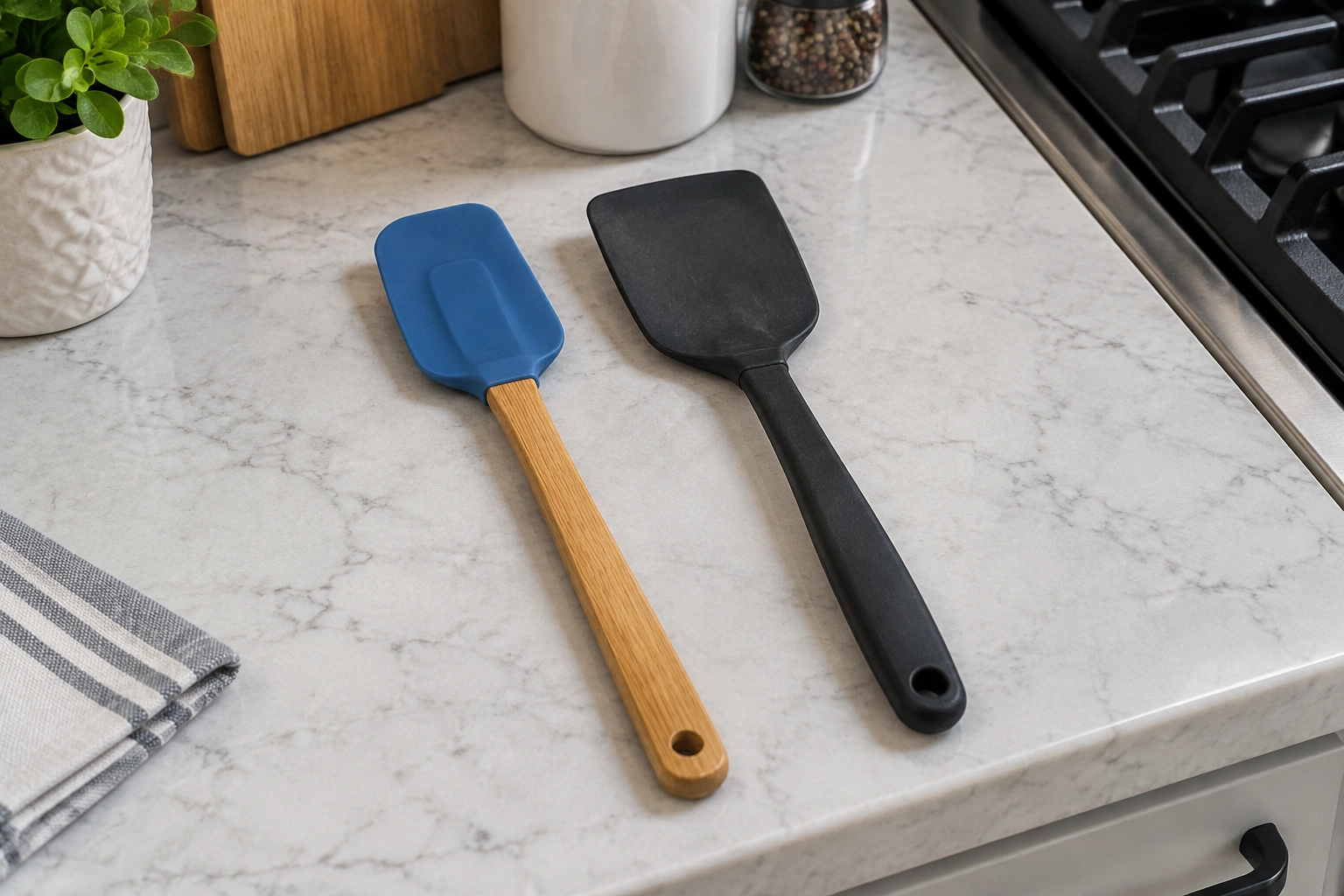
What Counts as a Silicone Spatula vs a Rubber Spatula?
This is where shoppers get tripped up.
A true silicone spatula is made from silicone, often food-grade silicone, and many are designed as one-piece tools with the head and handle molded together. Bon Appétit notes that the GIR Ultimate Spatula is made of a single piece of pharmaceutical-grade, BPA-free silicone, which is the kind of construction that tends to hold up well in everyday use.
A “rubber spatula” may mean one of three things:
- A true rubber tool
- A silicone tool sold loosely as rubber
- A silicone tool with a different handle material
That confusion is why two spatulas that look similar in the store can behave very differently in your kitchen. To tell them apart, check the packaging and product description first:
- If the label says food-grade silicone, silicone, or heat-resistant silicone, it is usually a silicone tool.
- If it says rubber, rubber-style, or rubber head, look closely for a second material listing; many of these are actually silicone-based or silicone-coated.
- If the description mentions silicone-coated, the outside may feel rubbery, but the tool is not pure rubber.
- If the package gives a clear temperature rating and says dishwasher-safe, that is a stronger sign of a silicone kitchen tool than the word rubber on its own.
For practical shopping, read the materials section before you look at the color or brand name. A flexible head, clear material listing, and a stated heat rating are usually better signs than the label category.
Heat Resistance and Food Safety
Heat is the biggest reason many cooks choose silicone.
Silicone is generally better suited to hot foods and warm pans than true rubber. Wirecutter’s testing also points toward silicone as the more dependable choice for everyday kitchen use, especially for batter, dough, and frosting. They note that the Rubbermaid Commercial High-Heat Silicone Spatula is a strong option for larger batches, and that the Vollrath high-temperature silicone spatula performed almost identically to it.
A useful rule of thumb for home cooks: if you are working with warm sauces, sautéed vegetables, or a hot pan on the stovetop, silicone is usually the safer default—provided the spatula is rated for the temperature you are using. For cooler prep, mixing, and folding, a rubber-style spatula can still be fine. The key is that not all silicone spatulas are equal, so the maker’s heat rating matters more than the material name alone.
For food safety, the practical checklist is simple:
- Look for food-grade silicone
- Prefer a clearly stated heat-safe rating
- Avoid spatulas that smell strongly out of the package
- Replace tools that show melting, peeling, or cracking
If you are regularly stirring sauces, soups, or sautéed foods, silicone is the more forgiving material. For cold prep or room-temperature mixing, rubber-style tools can still work well.
Which Spatula Works Better for Baking, Stirring, Scraping, and Folding?
This is where shape and flexibility matter as much as material.
A good spatula should do four jobs well:
- Scrape bowls clean
- Fold batter without deflating it
- Stir thick mixtures without bending too much
- Reach corners and edges
Silicone usually wins here because it can be flexible enough to sweep along the sides of a bowl while still staying sturdy. Wirecutter notes that the parallel sides, non-angled head, and flexible edges of silicone spatulas make them especially good for getting brownie batter into a pan and folding ingredients together.
Rubber-style spatulas can also scrape well, especially if they are soft and flexible. ChefEquipment notes that rubber is soft and flexible, so it will not scratch pans and handles heat fairly well. The trade-off is that rubber may not hold up as well when the task gets hotter or more repetitive.
Use these decision rules:
Choose silicone if you:
- Bake often
- Make batters, frostings, or doughs
- Need one tool for both cold prep and warm cooking
- Want better all-around flexibility and heat tolerance
Choose rubber-style if you:
- Mostly mix cold or room-temperature ingredients
- Want a softer feel for scraping bowls
- Need a lower-cost tool for occasional use
A practical example: if you are scraping cake batter from a mixing bowl, silicone is usually the better everyday choice because it can handle the task and then go straight into a warm pan or dishwasher without much fuss.
Nonstick Cookware and Bakeware Compatibility
If you use nonstick pans or coated bakeware, this section should influence your buying decision.
Both silicone and soft rubber-style spatulas are generally safe for nonstick surfaces because they are not metal. That is the main reason they are popular in home kitchens. They reduce the risk of scratching delicate coatings when compared with harder tools.
Still, not all spatulas are equally kind to nonstick cookware. A stiff edge, rough seam, or damaged tip can be more abrasive than you expect. That is why a soft, smooth, one-piece silicone spatula is often the safest everyday option for coated pans and baking surfaces.
If you cook eggs, sauces, or sheet-pan meals on nonstick cookware several times a week, I would favor silicone. It is the more dependable “leave-it-on-the-counter” tool for that kind of routine.
If your cookware is mostly stainless steel or cast iron, the nonstick advantage matters less, and your decision can lean more toward comfort, budget, and cleaning.
Durability, Cracking, Melting, and Lifespan
Durability is where silicone usually pulls ahead.
A well-made silicone spatula tends to resist heat damage better, and that usually means a longer useful life. It is less likely to warp when exposed to warm mixtures or hot pans. That matters in a busy kitchen, because a spatula that survives repeated use saves replacement costs over time.
Rubber-style spatulas can be durable enough for lighter tasks, but they are generally less forgiving when heat is involved. Over time, they may crack, stain, or wear down sooner, especially if they are used near hot cookware or washed aggressively.
The real trade-off is upfront cost versus replacement frequency:
- Cheaper rubber-style spatula: lower initial cost, but may need replacing sooner
- Higher-quality silicone spatula: higher initial cost, but often better long-term value
If you are equipping a family kitchen, I would rather see you buy one solid silicone spatula than three cheap ones that fail early.
Cleaning, Odor Resistance, and Dishwasher Convenience
For meal prep and family cooking, cleanup matters almost as much as performance.
Silicone is usually easier to live with because many models are dishwasher-safe and have fewer seams where food can hide. A seamless design can be helpful if you make sticky batters, tomato sauces, curries, or anything oily. Those foods are the ones most likely to leave residue behind if the tool has joints or texture.
Rubber can be easy to clean too, and ChefEquipment notes that it is easy to clean, though it can stain. Silicone has its own drawback: some tools may hold onto strong odors more than others, depending on quality and how they are used. That means a garlic-heavy sauce or strongly spiced dish may leave a lingering smell in some silicone tools.
In a practical kitchen, here is how I would judge the cleaning trade-off:
- Choose silicone if you want easier dishwasher cleanup and fewer seams
- Choose rubber-style if you are okay with the possibility of staining and you mainly hand-wash light-use tools
- Avoid both if the tool has cracks, peeling edges, or food-trapping seams
A smooth, easy-to-clean spatula is a small upgrade that pays off every time you wash it.
Price and Value: Which One Is Worth Buying?
If your budget is tight, it is tempting to buy the cheapest spatula on the shelf. That can work, but only if you are buying for light duty.
For frequent cooking, silicone usually offers better value because it tends to last longer and handle more tasks. That means fewer replacements and less frustration. Wirecutter’s recommendations also suggest that well-made silicone spatulas can perform at a very high level across common kitchen jobs.
A lower-cost rubber-style spatula can still make sense when:
- You need a backup tool
- You mostly mix cool ingredients
- You are replacing a temporary or seldom-used utensil
- You want to spend as little as possible right now
But if this is your main spatula, the cheapest option is often not the best value. A tool that stains, warps, or wears out quickly costs more in the long run than it first appears.
How to Choose the Right Spatula for Your Kitchen
Use your cooking habits as the filter.
Choose silicone if your kitchen looks like this:
- You bake weekly
- You stir warm sauces or soups
- You use nonstick cookware often
- You want one tool that can do most jobs
- You prefer dishwasher-friendly cleanup
Choose a rubber-style spatula if:
- You mostly mix cold batter or frosting
- You want a softer, budget-friendly tool
- You do not need high-heat performance
- You are okay replacing it sooner
Consider keeping both if:
- You bake and cook often
- You like a softer spatula for cold mixtures and a heat-safe one for stovetop use
- You want a backup when one is in the dishwasher
For most households, one good silicone spatula can replace two weaker tools. That is especially useful in a small kitchen where drawer space matters.
What to Look for Before You Buy
Before you put a spatula in your cart, check these details:
- Material label: food-grade silicone is the clearest sign of a heat-safe choice
- Construction: one-piece or seamless designs are easier to clean
- Flexibility: the edge should bend enough to scrape, not flop uselessly
- Handle comfort: a good grip matters when you are stirring thick batter
- Heat guidance: look for a clear manufacturer rating
- Dishwasher safety: helpful for busy households
- Odor and stain resistance: especially important if you cook with tomato sauce, curry, or garlic often
If a spatula feels flimsy in the store, it usually does not improve at home. A sturdy head and a smooth seam are better signs of a tool that will last.
Final Recommendation: Silicone or Rubber?
If you want the short answer, choose silicone for most home kitchens.
It is usually the better pick for heat resistance, nonstick cookware, durability, and easy cleanup. That makes it the stronger everyday option for baking, meal prep, and cooking family meals.
Choose a rubber-style spatula only if you mainly need a lower-cost tool for cooler, lighter-duty tasks. It can still work well, but it is not the better all-purpose choice for most busy households.
If you only buy one, buy the one that can handle the widest range of jobs without wearing out quickly.
FAQ
Is silicone better than rubber for spatulas?
For most home use, yes. Silicone usually handles heat better, lasts longer, and is easier to clean.
Can I use a rubber spatula on hot food?
Sometimes, but only if the manufacturer says it is heat-safe. Do not assume all rubber-style spatulas can handle high heat.
Do silicone spatulas stain or hold odors?
They can. Some tools may hold odors or show stains, especially if they are used often with heavily seasoned dishes.
What is best for scraping bowls?
A flexible silicone spatula is usually the best all-around choice because it can scrape cleanly while still handling warm mixtures.
Are silicone spatulas safe for nonstick pans?
Generally, yes. They are a common choice for nonstick cookware because they are soft and less likely to scratch coatings.