
What Are the Advantages of Air Fryer Cooking?
Quick Answer
The main advantages of air fryer cooking are using little or no added oil, crisping food quickly, shortening cooking time for many small portions, simplifying cleanup, and handling jobs from roasting to reheating and baking. An air fryer is essentially a compact convection cooker, so it can be especially practical when you do not need the capacity of a full-size oven; Consumer Reports’ air fryer guidance also explains how these appliances use fast-moving hot air rather than deep-frying food in oil.
Key advantages at a glance
- Less added oil: You can crisp many foods without submerging them in cooking oil.
- Fast small batches: The compact cooking chamber can heat and cook smaller portions efficiently.
- Crisp texture: Rapidly circulating hot air dries and browns the outside of food.
- Easy reheating: Pizza, fries, roasted vegetables, and similar foods can regain crispness better than with moist reheating methods.
- Less frying mess: There is no large pot of hot oil to manage, cool, strain, or discard.
- More versatility: Many models can roast, bake, reheat, and cook frozen foods as well as air-fry.
Keep expectations realistic
- Air frying is most efficient when the food fits comfortably in the basket without requiring several batches.
If you’re wondering what the advantages of air fryer cooking are, the answer goes well beyond making frozen fries. I find the appliance most useful when I want crisp food, a modest portion, and less cleanup than a deep fryer or full-size oven creates.
The benefits also have limits. In this guide, I’ll explain where air fryers genuinely save time or oil, where their compact design helps, and when a conventional oven still makes more sense.
In This Guide
- What are the main advantages of air fryer cooking?
- How does air fryer cooking compare with deep frying and oven cooking?
- Why is an air fryer useful for weeknight meals and reheating?
- Can you bake, roast, and reheat food in an air fryer?
- What are the disadvantages and limitations of air fryer cooking?
- Frequently asked questions
- Is air fryer cooking worth using regularly?
What Are the Main Advantages of Air Fryer Cooking?
The biggest advantages are lower oil use compared with deep frying, quick small-batch cooking, crisp browning, versatility, and simpler cleanup. Those benefits come from the appliance’s compact convection design rather than from a completely new cooking method.
Definition: An air fryer is a countertop convection cooker that uses a heating element and a fan to move hot air rapidly around food. The concentrated airflow helps remove surface moisture and encourages browning.
Does an air fryer use less oil?
Yes, when you compare it with deep frying. Deep-fried food must be surrounded by hot oil, while many air-fried foods need only a light coating or no added oil at all.
That difference can reduce the amount of cooking oil that ends up in a meal. It also removes the need to store, heat, cool, filter, and dispose of a large quantity of frying oil.
- Frozen fries: Often already contain enough surface fat to crisp without much additional oil.
- Fresh vegetables: A light coating can encourage browning without soaking the vegetables.
- Breaded foods: A small spray or brushing of oil can improve color and crunch.
- Chicken skin: Natural fat can render during cooking, reducing the need for extra oil.
Less oil does not automatically make every air-fried meal nutritious. A basket of highly processed frozen food remains highly processed even when you cook it without extra oil.
Why does food become crispy?
Fast-moving hot air removes moisture from the surface while heat encourages browning. That combination can produce crisp edges without immersing the food in fat.
The effect works best when air can reach most of the food’s surface. This is why overcrowding a basket often leaves some pieces pale or soft.
- Leave breathing room: Avoid packing food into a solid mass.
- Shake when needed: Fries and small vegetables often benefit from redistribution during cooking.
- Dry wet surfaces: Excess water works against browning.
- Use oil strategically: A thin coating is usually more useful than pouring oil into the basket.
For me, that is the core appeal of air frying. It gives me a practical middle ground between deep-fried crunch and standard oven roasting.
How Does Air Fryer Cooking Compare With Deep Frying and Oven Cooking?
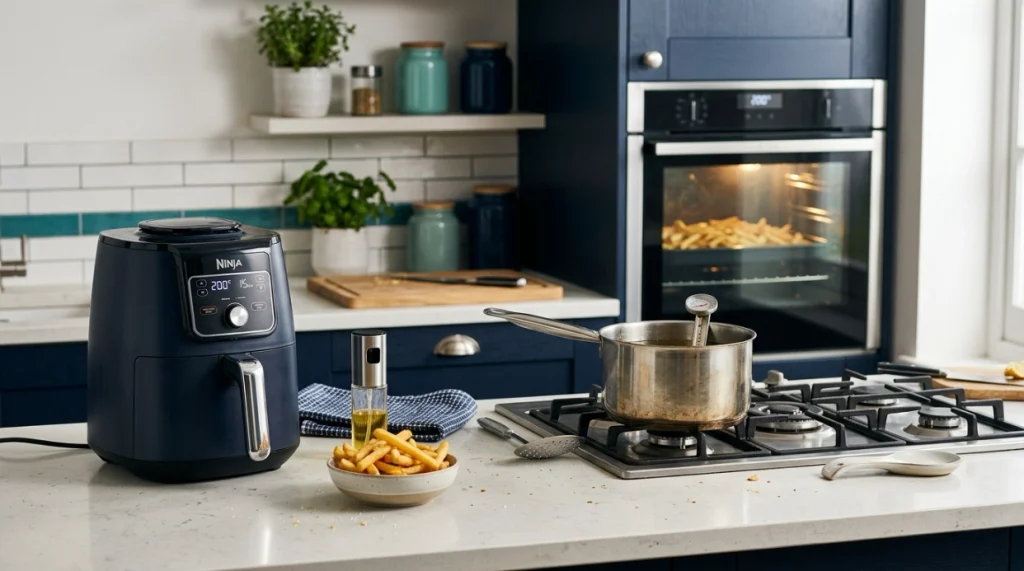
An air fryer combines some advantages of both methods. It can approach the crisp surface people associate with frying while operating more like a powerful small convection oven.
Its biggest efficiency advantage normally appears with small or moderate portions. Once you start cooking batch after batch, a full-size oven’s larger capacity becomes more useful.
Can an air fryer save cooking time and electricity?
It can, especially when you’re heating a small cooking chamber instead of a large electric oven. A September 2026 Which? air fryer versus oven laboratory comparison found substantial energy savings in several small-batch tests.
The figures below came from the appliances and quantities used in that specific test. They should not be treated as universal performance numbers for every air fryer or oven.
| Test food | Air fryer | Built-in electric oven | Practical difference |
|---|---|---|---|
| 320 g frozen chips | 23 min / 0.287 kWh | 33 min / 0.863 kWh | Air fryer used much less energy in this small batch. |
| One ~200 g jacket potato | 48 min / 0.392 kWh | 68 min / 1.084 kWh | Smaller heated space favored the air fryer. |
| 1.3–1.4 kg roast chicken | 53 min / 0.54 kWh | 76 min / 1.157 kWh | Air fryer finished sooner and used less electricity in the test. |
The important lesson is not that every air fryer uses a fixed percentage less electricity. Appliance wattage, preheating, food quantity, cooking duration, and the number of batches all change the result.
Air fryer vs. deep fryer
A deep fryer still has an advantage when you specifically want the texture created by immersion in hot fat. Air frying produces a different result, even when both foods look browned and crisp.
- Oil requirement: Air frying usually requires far less added oil.
- Mess: There is no vat of hot oil to manage after cooking.
- Flavor: Deep frying can produce a richer fried flavor.
- Texture: Air-fried coating can be crisp, but it may not duplicate deep-fried crust exactly.
- Cleanup: A removable basket is usually simpler than cleaning a deep-frying setup.
My rule is simple: if the food fits comfortably in one batch, the air fryer often makes sense. If I need several trays or portions for a crowd, oven capacity becomes more important than compact efficiency.
Why Is an Air Fryer Useful for Weeknight Meals and Reheating?
Air fryers work especially well for busy meals because the cooking chamber is small and the controls are straightforward. You can often move from refrigerator or freezer to finished food without setting up pans, racks, and a large oven.
This is one reason I see air frying as more than a substitute for frying. Its real strength is reducing friction around everyday cooking.
Small batches are where the appliance shines
Cooking one or two portions in a full-size oven can feel wasteful. An air fryer focuses the heat around a much smaller amount of food.
- Lunch portions: Heat a small serving without warming a large oven.
- Frozen snacks: Cook nuggets, fries, or similar foods directly from frozen when package directions allow.
- Vegetable sides: Roast a basket while another part of dinner cooks elsewhere.
- Quick proteins: Cook appropriately sized fish, chicken, or meat portions while checking doneness with a thermometer.
Many foods also cook well at roughly 350°F to 400°F, although the correct setting depends on the recipe and appliance. Air fryer fans can brown food quickly, so checking earlier than you would in a conventional oven is sensible.
Why is an air fryer good for leftovers?
Reheating is one of the most practical advantages. Foods that should remain crisp often respond better to circulating dry heat than to microwave reheating.
A microwave excites water molecules efficiently, which is excellent for soups, rice, sauces, and many moist foods. It can soften pizza crust, fried coatings, and roasted surfaces, though.
- Pizza: Dry heat can re-crisp the base and edges.
- Fries: Air circulation helps drive moisture from the surface.
- Roasted vegetables: Heat can restore some exterior browning.
- Breaded leftovers: A dry cooking environment can revive the coating better than steaming it.
Not every leftover belongs in an air fryer. Soups, saucy pasta, and delicate foods with loose toppings usually suit other reheating methods better.
Pro tip: When reheating perishable leftovers or cooking raw meat and poultry, use a thermometer rather than relying only on cooking time.
Can You Bake, Roast, and Reheat Food in an Air Fryer?
Yes. Modern air fryers can handle far more than fries because the underlying cooking method is forced hot-air convection.
As of 2026, air fryers are commonly used for vegetables, meat, frozen foods, baked goods, snacks, and leftovers. The basket size and available temperature controls determine what fits comfortably.
Air fryers can be useful for baking
The compact chamber is especially interesting for small-batch baking. King Arthur Baking’s guide to baking in an air fryer notes that the strong top-mounted airflow can bake cookies, rolls, bread, and other small items while creating pronounced browning.
The same powerful airflow means conventional oven recipes sometimes need adjustment. A dark crust can form before the center finishes if the temperature is too aggressive.
- Cookies: Around 350°F is a useful starting point when the recipe and appliance support it.
- Cakes: A lower setting such as 325°F may help the center cook before the top gets too dark.
- Rolls: Strong surface heat can create a browned outside and soft center.
- Small batches: You can bake a few portions without heating an entire oven cavity.
Roasting is another natural fit
Vegetables work well because convection encourages moisture loss and browning. Brussels sprouts, cauliflower, potatoes, peppers, and similar vegetables can develop roasted edges in a compact basket.
Meat and poultry can also brown efficiently, but visual color is not a food-safety test. Always judge raw animal foods by safe internal temperature.
Pro tip: FoodSafety.gov lists poultry at 165°F (74°C), ground meats at 160°F (71°C), and whole cuts of beef, pork, veal, and lamb at 145°F (63°C) with the required rest time. Check the official safe minimum internal temperature chart before relying on a recipe timer.
One appliance can cover several everyday jobs
Versatility is valuable when you have limited kitchen space. One appliance may handle crisping, roasting, reheating, and small-batch baking without requiring separate equipment for each job.
- Air fry: Fries, breaded foods, wings, vegetables.
- Roast: Potatoes, cauliflower, small cuts of meat.
- Bake: Cookies, rolls, small cakes, reheated pastries.
- Reheat: Pizza, roasted foods, crisp leftovers.
That does not mean the air fryer replaces every appliance. Its usefulness comes from doing several dry-heat tasks well within a relatively small cooking chamber.
What Are the Disadvantages and Limitations of Air Fryer Cooking?
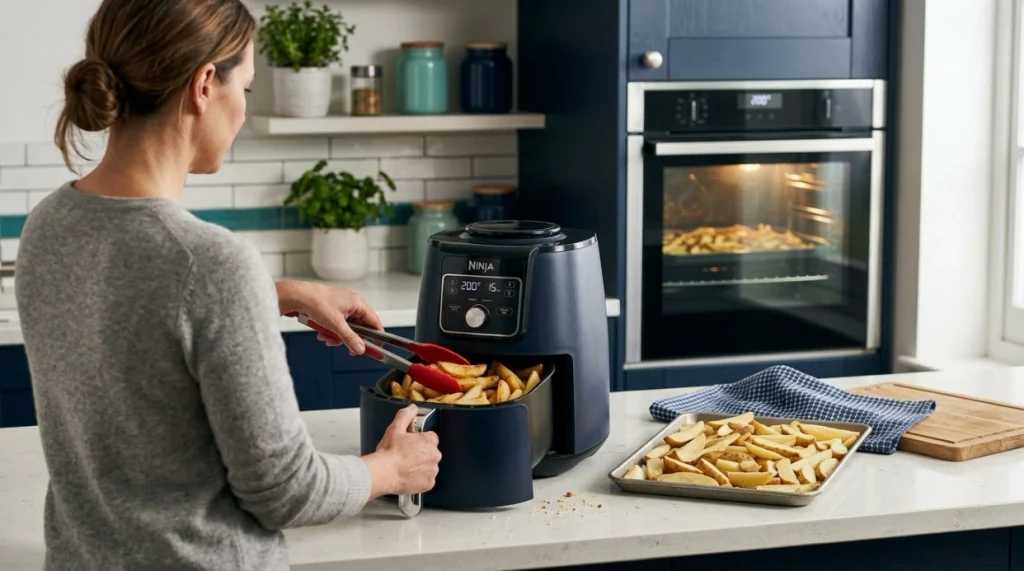
The main limitation is capacity. An air fryer can become slower rather than faster when you have to repeat the same cooking cycle several times.
There is also a learning curve because strong convection changes browning and moisture loss. A recipe developed for a conventional oven may need a lower temperature, shorter cooking time, or smaller batch.
Capacity can cancel out the speed advantage
Air circulation needs space. Filling the basket too tightly can block airflow and produce uneven browning.
- Small household: A compact basket may be ideal.
- Family meal: A larger air fryer can work if the food still has room around it.
- Large gathering: A full-size oven may cook more food simultaneously.
- Multiple dishes: Oven racks can be more useful than repeating basket cycles.
Air-fried does not always mean healthy
Using less added oil can be an advantage compared with deep frying, but the entire meal still matters. Ingredients, portion size, sodium, sugar, fiber, and overall dietary pattern do not disappear because food was cooked with hot air.
Consumer Reports similarly notes that air frying can help reduce the amount of oil used in a dish, rather than turning every air-fried food into a healthy choice. That distinction is worth keeping in mind.
Some foods simply work better elsewhere
Wet batter can drip before it sets, while light ingredients may move around in strong airflow. Large cakes, big roasts, soups, and foods that need plenty of liquid often fit a conventional oven, stovetop, or other appliance better.
- Choose an air fryer for: Crisp surfaces, modest portions, reheating, frozen foods, roasting, and small bakes.
- Choose an oven for: Large trays, multiple dishes, big baked goods, and meals for a crowd.
- Choose a microwave for: Fast reheating of moist foods and liquids.
- Choose deep frying for: Foods where immersion-fried flavor and crust are the main goal.
The best cooking method depends on what you are making. An air fryer is useful because it expands your choices, not because it wins every cooking task.
Frequently Asked Questions
Is air fryer cooking healthier than deep frying?
Air frying can reduce added fat because food does not need to be submerged in oil. However, the nutritional quality still depends on the ingredients, portion size, and overall meal, so “air-fried” should not automatically be treated as a synonym for healthy.
Does an air fryer really cook faster than an oven?
It often does for small portions because the cooking chamber is compact and can reach cooking conditions quickly. The advantage becomes smaller when you need several batches, while a large oven can cook much more food at once.
Does air frying save electricity?
It can save electricity for small meals because there is less space to heat and cooking may finish sooner. Actual savings depend on appliance wattage, cooking time, preheating, food quantity, and whether you need repeat batches.
Can I cook without oil in an air fryer?
Many foods can cook with no extra oil, particularly foods that already contain fat. Fresh vegetables and breaded foods may brown and crisp better with a thin coating of oil rather than a completely dry surface.
What foods benefit most from an air fryer?
Foods that benefit from a dry, crisp exterior tend to work particularly well. Examples include potatoes, roasted vegetables, chicken wings, breaded foods, frozen snacks, pizza, and small baked items.
Is an air fryer good for baking?
Yes, especially for small batches of cookies, rolls, pastries, and appropriately sized cakes. Strong convection can brown the surface quickly, so baking temperatures and times may need adjustment compared with a standard oven.
What is the biggest disadvantage of an air fryer?
Limited basket capacity is the most common drawback. Cooking in several batches can erase some of the time and energy advantages that make an air fryer appealing for smaller quantities.
Is Air Fryer Cooking Worth Using Regularly?
For many home cooks, yes. The strongest advantages of air fryer cooking are less dependence on frying oil, fast small-batch cooking, good crisping, convenient reheating, versatility, and manageable cleanup.
I think of an air fryer as a compact convection tool rather than a miracle fryer. Used for the jobs that suit its size and airflow, it can make everyday cooking noticeably easier.
- Use it when: You want one or two portions, crisp texture, quick reheating, roasted vegetables, or a small bake.
- Skip it when: You need multiple trays, very large portions, lots of liquid, or a recipe designed around a full-size oven.
- For best results: Leave room for airflow, check food early, and use a thermometer for safety-sensitive foods.
That balance is what makes the appliance useful in 2026. Air frying is not better for every recipe, but it gives home cooks a fast and flexible option between microwaving, conventional baking, and deep frying.

