
What Is So Special About Air Fryers?
Quick Answer
What is so special about air fryers? They combine a compact cooking chamber with fast-moving hot air, so food can brown, crisp, roast, reheat, and even bake quickly without being submerged in oil. They are essentially powerful countertop convection cookers, which is also how Consumer Reports explains air fryer cooking.
Why people like them
- Fast cooking: The small chamber heats quickly and moves hot air directly around food.
- Crispy texture: Strong airflow helps dry and brown the food’s surface.
- Less added oil: Many foods need only a light coating of oil instead of deep frying.
- Easy reheating: Pizza, fries, breaded foods, and pastries can regain a crisp exterior.
- Small-batch baking: Cookies, rolls, pizza, and some cakes can be baked without heating a full-size oven.
- Convenient cleanup: Removable baskets and trays are usually simpler to clean than deep-frying equipment.
The catch
- Air fryers have limited basket space, and overcrowding can reduce browning and crispness.
If you have wondered why people keep talking about air fryers, the answer is bigger than crispy French fries. Their real advantage is how efficiently they concentrate convection heat around a relatively small amount of food.
I find that understanding that one principle makes the appliance much easier to use. It also explains why an air fryer excels at some jobs while a regular oven still wins at others.
In This Guide
What Actually Makes Air Fryers Special?
Air fryers are special because they put powerful convection cooking inside a compact chamber. That combination lets them transfer heat to food quickly while removing surface moisture that can prevent browning.
Definition: An air fryer is a countertop convection appliance that circulates heated air rapidly around food, usually inside a perforated basket or tray.
Despite the name, it does not fry food by immersing it in hot oil. It cooks mainly through heated air, radiant heat, and contact with the hot basket or tray.
Compact size changes how convection works
A full-size convection oven also has a fan. The difference is the amount of space that needs to be heated and the distance between the food, fan, and heating elements.
An air fryer’s tighter chamber keeps the moving air close to the food. That is why it often feels more aggressive than the convection setting in a large oven.
- Small cooking chamber: Less empty space must be heated before cooking becomes effective.
- Strong fan: Rapid airflow continually moves hot air across the food’s surface.
- Perforated basket: Openings let hot air reach more sides of the food.
- Close heating element: Food sits relatively near the heat source in many basket-style models.
That design can be especially useful when I only need one or two portions. Heating a large oven for a handful of fries or one serving of roasted vegetables often feels unnecessary.
It is more versatile than the word “fryer” suggests
The appliance can roast vegetables, cook frozen foods, toast nuts, reheat leftovers, and bake small portions. Some models also include roast, bake, broil, reheat, or dehydrate modes.
The underlying cooking method remains similar. The controls mainly adjust fan behavior, temperature, and heating patterns.
Section Takeaway: Air fryers stand out because they concentrate convection heat inside a small space, giving them speed and strong surface browning without requiring deep frying.
Why Does Air-Fried Food Get So Crispy?
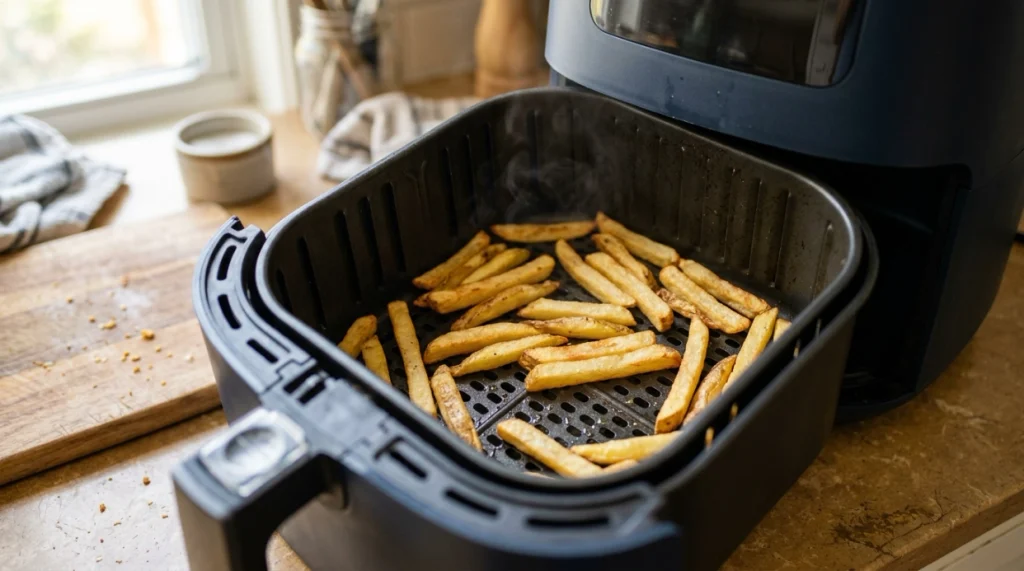
Air-fried food becomes crispy because fast-moving hot air helps remove moisture from its surface while heat drives browning. A dry, hot exterior can develop a crisp crust more readily than a damp one.
This is one reason frozen fries and breaded foods work so well. Their shape and exterior already suit fast surface browning.
Airflow matters as much as temperature
Convection cooking means a fan moves heated air around the food. The continuous movement replaces cooler air near the surface with hotter air.
That helps heat move into the food while moisture leaves the exterior. Serious Eats offers a useful explanation of how air fryers use compact chambers and rapid airflow to promote browning and crispness.
- Surface moisture escapes: Drier exteriors become crisp more readily.
- Hot air reaches multiple sides: Perforated baskets expose more surface area.
- Oil can spread thinly: A small amount can improve heat transfer and browning.
- Small batches brown better: More open space means better airflow around each piece.
Why overcrowding causes problems
Piling food into the basket blocks the circulating air. Moisture can also become trapped between touching pieces.
The result may be cooked food that is pale or soft instead of crisp. For foods such as fries, vegetables, wings, or breaded pieces, a loose single layer is a useful starting point.
Shaking or turning food partway through cooking can expose different surfaces to direct airflow. This is especially useful when pieces overlap slightly.
Section Takeaway: Crispness comes from heat, airflow, moisture loss, and enough open basket space. High temperature alone cannot compensate for a tightly packed basket.
How Does an Air Fryer Compare With an Oven or Deep Fryer?
An air fryer sits between a convection oven and a deep fryer in terms of cooking style. It uses convection like an oven but aims for the browned, crisp exterior people associate with frying.
It does not completely reproduce deep-fried food. Immersion in hot oil transfers heat differently and produces a distinctive crust.
| Feature | Air Fryer | Conventional Oven | Deep Fryer |
|---|---|---|---|
| Main heat method | Rapid convection | Radiant heat; convection on equipped ovens | Hot-oil immersion |
| Added oil | Often none or a light coating | Depends on recipe | Enough oil to immerse food |
| Batch size | Small to medium | Medium to large | Depends on fryer capacity |
| Crisping ability | Strong for exposed surfaces | Good, especially with convection | Excellent fried crust |
| Cleanup | Basket and tray cleaning | Pan plus oven spills | Oil handling and fryer cleanup |
| Best fit | Fast small batches and reheating | Large meals and full-size baking | Traditional fried texture |
Air fryer temperature conversions
When adapting an oven recipe, I do not assume the same temperature and time will work. Strong airflow can brown food sooner.
King Arthur Baking recommends a useful starting point for many baking conversions: reduce a conventional-oven temperature by about 25°F and shorten the baking time by roughly 20% to 25%.
| Conventional Oven Recipe | Air Fryer Starting Point |
|---|---|
| 350°F (177°C) | 325°F (163°C) |
| 375°F (191°C) | 350°F (177°C) |
| 400°F (204°C) | 375°F (191°C) |
| 20-minute oven time | Start checking around 15–16 minutes |
These are starting points, not universal rules. Air fryer wattage, basket shape, fan speed, food thickness, and batch size can all change the result.
Section Takeaway: An air fryer is closest to a compact, high-airflow convection oven. It can make food crisp with little oil, but it does not duplicate oil immersion or replace a large oven for every job.
What Foods Are Air Fryers Especially Good At?
Air fryers are strongest when the food benefits from a browned or crisp exterior. Small portions also match the appliance’s compact cooking chamber well.
Foods that usually suit an air fryer
- Frozen fries and potato products: Their dry surfaces respond well to strong airflow.
- Breaded foods: Nuggets, cutlets, and similar foods can develop a crisp coating.
- Roasted vegetables: Broccoli, Brussels sprouts, cauliflower, peppers, and potatoes can brown quickly.
- Chicken pieces: Wings, thighs, and other smaller cuts benefit from circulating heat.
- Leftover pizza: The air fryer can warm the center while re-crisping the crust.
- Small baked goods: Cookies, biscuits, rolls, and personal-size bakes can work well.
Why bakers should not ignore the air fryer
An air fryer can also be a practical miniature baking oven. It is particularly convenient when I want a small batch rather than a full tray.
King Arthur Baking’s air fryer baking guidance highlights cookies, cheesecake, dinner rolls, pizza, cakes, and toasted nuts among the foods that can work in the appliance.
Cookies are a good example of why the cooking style can be useful. Rapid heat can encourage browning around the outside while the center stays softer, provided the temperature and timing are controlled.
Yeast rolls and chemically leavened bakes need more care. Starting with a preheated cooking chamber can help when the recipe depends on an early burst of heat for rise.
Some baking jobs still favor the regular oven
A full-size oven remains more practical for sheet pans, multiple cake layers, large loaves, and high-volume baking. An air fryer basket simply cannot offer the same usable area.
- Choose an air fryer for: Two cookies, a few rolls, a small pizza, or a quick pastry reheat.
- Choose an oven for: Large cakes, multiple pans, big bread loaves, or party-size batches.
Section Takeaway: Air fryers shine with small foods that benefit from browning, crisping, or fast reheating. They can also be surprisingly capable baking tools when the batch and pan fit comfortably.
What Are the Limitations of an Air Fryer?
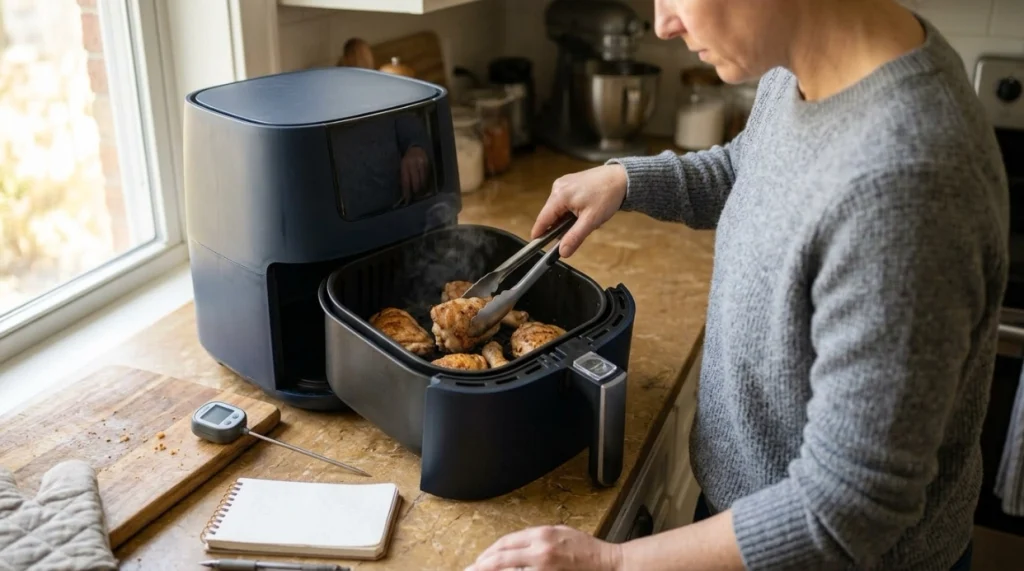
The biggest air fryer weakness is capacity. A large advertised basket does not mean every inch should be filled when crispness matters.
Air must circulate between and around the food. That often means cooking in batches.
Common air fryer drawbacks
- Limited cooking area: Large families may need multiple batches.
- Counter space: Bigger models can occupy a substantial section of a worktop.
- Fast browning: Delicate baked goods may darken before their centers finish cooking.
- Model differences: The same recipe can cook differently in two air fryers.
- Fan movement: Lightweight ingredients or loose parchment can shift around.
- Cleaning still matters: Grease and crumbs can build up on baskets, trays, and interior surfaces.
How I approach a new air fryer recipe
I start conservatively rather than trusting the full oven time. Checking early is easier than trying to rescue food that has already overbrowned.
- Read the manufacturer’s instructions. Learn the model’s basket, presets, temperature range, and preheating guidance.
- Leave room for airflow. Avoid tightly packing foods when crispness is the goal.
- Reduce oven settings when appropriate. For baking, 25°F lower is a sensible test point.
- Check early. Begin inspecting food before the original oven time expires.
- Turn or shake when needed. This exposes more surfaces to moving air.
- Record successful settings. Model-specific notes make repeat cooking easier.
Do not judge meat by cooking time alone
Air fryers can cook poultry, meat, seafood, and reheated leftovers, but time and exterior color do not prove that food is safe. Use a food thermometer when internal temperature matters.
Pro tip: Check FoodSafety.gov’s safe minimum cooking temperature charts and measure the thickest part of the food rather than relying only on an air fryer timer.
For example, FoodSafety.gov lists 165°F (74°C) as the safe minimum internal temperature for poultry. The thermometer gives you information the browned exterior cannot.
Section Takeaway: Air fryers work best when you respect their limited space, monitor fast browning, and adjust recipes for your particular machine.
Frequently Asked Questions About Air Fryers
Are air fryers really healthier than deep fryers?
Air fryers can prepare many traditionally fried-style foods with far less added oil because the food is not submerged in frying oil. The nutritional difference still depends on the food itself, portion size, breading, sauces, and how much oil you add.
Is an air fryer just a small convection oven?
That is a useful basic description. Both move hot air with a fan, but an air fryer’s compact chamber, strong airflow, basket design, and proximity to the heating element can make it especially effective at fast browning and crisping.
Can an air fryer replace a regular oven?
It can replace a regular oven for many small meals, reheating jobs, and small-batch bakes. A conventional oven remains more useful when you need large pans, several racks, large loaves, or enough food for many people.
Do you have to put oil in an air fryer?
No. Many frozen foods already contain enough fat to brown without added oil, while vegetables and fresh potatoes may benefit from a thin coating. Avoid pouring large amounts of oil into the basket as though the appliance were a deep fryer.
Do air fryers cook faster than ovens?
They often cook small portions faster because their compact chambers heat quickly and circulate hot air aggressively. The exact difference depends on the recipe, model, temperature, preheating method, food thickness, and quantity.
Can you bake cakes and cookies in an air fryer?
Yes, provided the pan fits and the recipe is adjusted for the stronger airflow. Cookies and small cakes can work well, but larger cakes may brown on the outside before the center finishes, so lower temperatures and smaller pans are often easier to manage.
Do you need to preheat an air fryer?
It depends on the food and model. Frozen fries may not always need a separate preheat, while breads, cakes, biscuits, and other bakes that rely on rapid initial heat can benefit from starting in a hot chamber.
Is an Air Fryer Worth the Counter Space?
For many home cooks, the strongest reason to own an air fryer is not that it performs an impossible cooking technique. It makes several everyday cooking jobs unusually convenient.
You can prepare a small portion without heating a large oven, crisp foods without deep-frying them, and revive leftovers that would turn soft in a microwave. That combination is what makes the appliance feel different in daily use.
As of 2026, the core appeal is still straightforward: fast heat, strong airflow, small-batch efficiency, and good surface browning. Those qualities are useful whether you cook frozen fries or bake two cookies after dinner.
If you regularly cook for a large group, your oven will remain essential. If you often cook one to four portions, reheat crispy foods, roast vegetables, or make small bakes, an air fryer can earn its place quickly.
That is what is so special about air fryers. They turn convection cooking into a compact, fast, approachable tool that solves many small kitchen jobs surprisingly well.

