
What Is the 20/20 Rule for Air Fryers?
Quick Answer
The 20/20 rule for air fryers is a quick way to convert conventional oven instructions: reduce the temperature by about 20°C and shorten the cooking time by about 20%. It is a starting point, not a fixed law, because food type, basket size, and air fryer design affect cooking speed. Instant Pot’s air fryer conversion guidance uses a similar 20°C and 20–25% reduction for fresh foods.
How to use the 20/20 rule
- Lower the heat: Subtract about 20°C from conventional oven instructions.
- Shorten the time: Multiply the original cooking time by 0.8.
- Check early: Look at the food several minutes before the calculated finish time.
- Leave airflow: Avoid packing the air fryer basket too tightly.
- Adjust next time: Record what works for your particular air fryer and food.
Simple example
- An oven direction of 200°C for 20 minutes becomes roughly 180°C for 16 minutes in the air fryer.
The 20/20 rule is one of the easiest shortcuts to remember when a recipe or food package gives oven instructions but says nothing about an air fryer. I treat it as a sensible first setting, then let the food itself decide whether it needs another minute or two.
That second part matters. Air fryers use powerful moving hot air, so the exact conversion changes with the food, quantity, appliance, and whether you’re baking, roasting, or crisping.
In This Guide
What Does the 20/20 Air Fryer Rule Actually Mean?
The most useful meaning of the 20/20 air fryer rule is to reduce a conventional oven temperature by about 20°C and reduce its cooking time by approximately 20%. It gives you a practical starting point when dedicated air fryer instructions aren’t available.
Definition: The air fryer 20/20 rule is an oven-to-air-fryer conversion method that lowers the original cooking temperature by roughly 20°C and cuts the original cooking time by roughly 20%.
An air fryer is essentially a compact convection-style cooker. A fan moves hot air quickly around the food, increasing heat transfer at the surface and encouraging browning and crisping.
Because the cooking chamber is small, it can also reach cooking conditions quickly. That’s one reason oven times often need shortening.
Why do some people give a different definition?
The phrase isn’t an official universal appliance standard. Online, you’ll occasionally see “20/20 rule” used for shaking food, basket capacity, or other cooking habits.
For oven conversion, however, the temperature-and-time interpretation is especially useful. Current Instant Pot UK guidance recommends reducing fresh-food oven temperature by 20°C and shortening time by about 20–25%.
Is the rule the same in Fahrenheit?
Not exactly. A 20°C temperature difference equals 36°F, so subtracting 20°F isn’t mathematically equivalent to subtracting 20°C.
U.S. air-fryer baking guidance often uses a slightly different shortcut. King Arthur Baking’s air fryer guidance suggests lowering baking temperature by about 25°F and shortening baking time by around 20–25%.
Section Takeaway: Think of “20/20” as a conversion shortcut, not a promise of exact cooking time. Celsius and Fahrenheit versions also shouldn’t be treated as mathematically identical.
How Do You Calculate the 20/20 Rule?
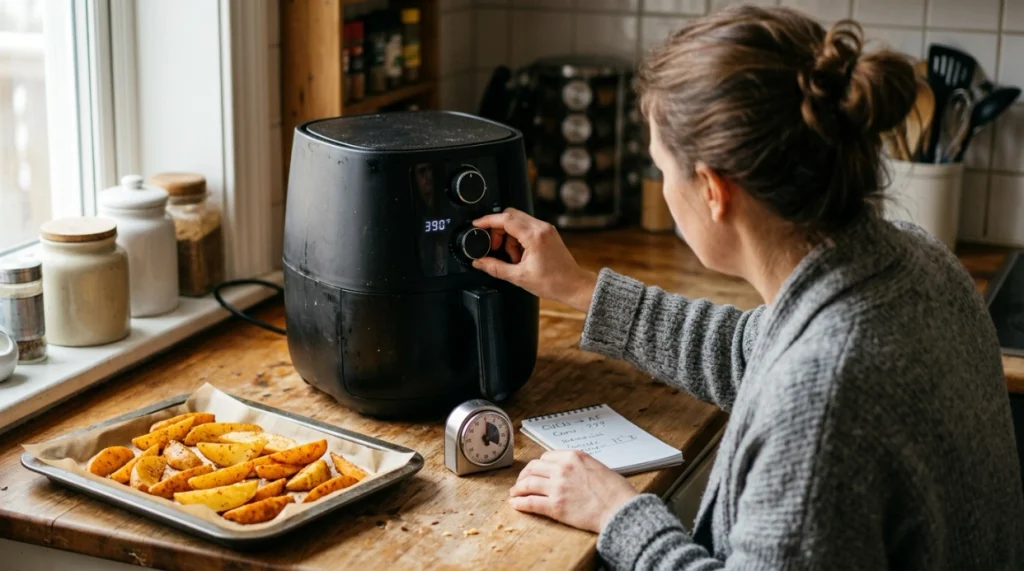
Start with the conventional oven directions. Lower the temperature, calculate 80% of the stated time, and begin checking before that calculated time expires.
- Read the oven temperature. Subtract approximately 20°C when working with Celsius instructions.
- Read the oven cooking time. Multiply the minutes by 0.8.
- Set the air fryer. Use the converted temperature and shorter time as your starting point.
- Check before the timer ends. Browning can happen quickly in the final few minutes.
- Add time gradually. Continue in one- or two-minute increments when needed.
A simple 20/20 conversion example
Suppose a package says to cook at 200°C for 25 minutes. Subtracting 20°C gives an air fryer starting temperature of 180°C.
Twenty percent of 25 minutes is five minutes. Your starting cook time therefore becomes about 20 minutes.
| Conventional Oven | 20/20 Air Fryer Starting Point | When to Start Checking |
|---|---|---|
| 180°C for 20 min | 160°C for 16 min | About 13–14 min |
| 200°C for 20 min | 180°C for 16 min | About 13–14 min |
| 200°C for 25 min | 180°C for 20 min | About 17 min |
| 220°C for 30 min | 200°C for 24 min | About 20 min |
I prefer to treat the calculated time as the outer limit for my first check, not as a reason to walk away until the timer beeps. Once you know how aggressively your own air fryer browns food, conversions become much easier.
Should you preheat first?
Follow the appliance manual or recipe when it specifically calls for preheating. Preheating can also make repeat baking results easier because the food starts in a predictable cooking environment.
For some everyday foods, preheating may matter less. The safest approach is consistency: if you preheat during one test, use the same method when refining the timing later.
When Does the 20/20 Rule Work Best?
The rule works best with oven foods that respond well to strong circulating heat. Think roasted vegetables, potato wedges, breaded foods, pastry snacks, smaller pieces of chicken, and many small-batch baked items.
- Roasted vegetables: Moving hot air can brown exposed surfaces quickly.
- Potatoes and wedges: Smaller batches leave enough space for crisping.
- Breaded foods: Dry coatings usually benefit from strong surface airflow.
- Pastry snacks: Shorter cook times can work well when you watch browning carefully.
- Small bakes: Cookies, rolls, and similar portions often suit the compact chamber.
Why does basket space matter?
Air needs room to move around the food. Packing pieces tightly together blocks circulation and changes how quickly their surfaces lose moisture and brown.
Consumer Reports’ air fryer tips also caution against crowding and recommend checking, shaking, or flipping foods during cooking when appropriate.
Practical tip: If fries are piled deeply in the basket, reducing the oven time by exactly 20% may not help much. Cook a smaller batch, shake it during cooking, and judge doneness by texture and color.
Does it work for baking?
It can, but baking needs more care than reheating fries. Cakes, muffins, bread, cookies, and pastries react differently to concentrated top heat and rapid airflow.
For baking, I use the conversion only as an initial estimate. A deep cake may need a lower temperature and more time so the center sets before the top gets too dark.
Section Takeaway: The 20/20 rule is most reliable for straightforward oven-to-air-fryer conversions, especially when food has enough space for hot air to circulate.
When Should You Not Follow the Rule Exactly?
Some foods need their own cooking strategy. The rule becomes less dependable when thickness, moisture, food safety, or delicate baking chemistry matters more than simple surface browning.
Frozen food with air fryer directions
If the package already gives tested air fryer instructions, use those first. There’s little reason to convert the oven instructions when the manufacturer has supplied appliance-specific settings.
Large cakes and deep baked dishes
A tall cake can brown on top while its center remains underbaked. Lower heat and a longer bake may work better than automatically cutting the time by 20%.
King Arthur Baking notes that full-size cakes can require a lower-and-slower approach in an air fryer. The goal is to finish the center without over-browning the crust.
Raw meat and poultry
Never use the timer alone to decide whether raw meat or poultry is safe. Cooking time can vary with thickness, starting temperature, quantity, and air fryer performance.
Pro tip: Verify doneness with a food thermometer and use FoodSafety.gov’s safe minimum internal temperature guidance rather than relying only on the calculated air fryer time.
Very small or thin foods
A 20% time reduction can still be too long for thin foods. Toasted nuts, thin bread products, delicate pastry edges, and small leftovers can move from browned to burned quickly.
Different air fryer designs
A compact basket air fryer and a large oven-style air fryer don’t always cook identically. Fan strength, heating-element position, basket geometry, wattage, and usable cooking space all affect results.
Even manufacturer conversion advice can vary. For example, some Ninja manuals tell users to reduce conventional oven temperatures by 10°C and check food frequently rather than applying a universal 20°C adjustment.
Section Takeaway: Override the 20/20 rule when dedicated manufacturer instructions, food-safety temperatures, or the structure of the food provide better guidance.
What Air Fryer Conversion Mistakes Should You Avoid?
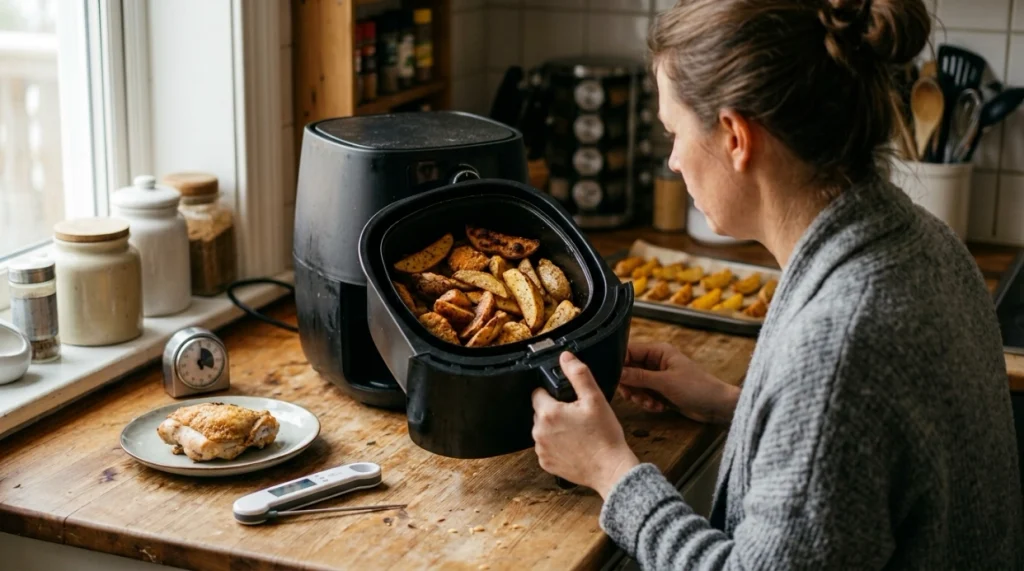
The biggest mistake is treating a rule of thumb like a laboratory formula. Air fryer conversion is easier when you expect to make small adjustments.
- Confusing Celsius and Fahrenheit: A 20°C reduction equals 36°F, not 20°F.
- Never checking early: Surface browning can accelerate near the end of cooking.
- Overcrowding the basket: Blocked airflow can leave food soft or unevenly cooked.
- Ignoring food thickness: Two foods with the same weight can cook differently when one is much thicker.
- Skipping flips or shakes: Fries, vegetables, and small breaded foods often benefit from repositioning.
- Trusting time for meat safety: Internal temperature matters more than a conversion calculation.
What if the outside cooks too quickly?
Reduce the temperature slightly and give the center more time. This is especially useful for thicker baked foods or items with a sugary surface that browns quickly.
What if the food is pale or soft?
First check whether the basket is overcrowded. If airflow is good, a small temperature increase or another minute or two may improve browning.
Keep notes when you find a setting that works. A personal conversion chart for your own air fryer is more useful than repeatedly starting from a generic rule.
Air Fryer 20/20 Rule FAQ
Does the 20/20 rule mean 20 minutes at one temperature and another 20 minutes afterward?
No. In the oven-conversion sense, it refers to lowering the conventional oven temperature by about 20°C and shortening the original cooking time by around 20%.
What is 20% less than 30 minutes?
Twenty percent of 30 minutes is six minutes. Subtract six from 30, giving an air fryer starting time of approximately 24 minutes.
What is 20% less than 25 minutes?
Twenty percent of 25 minutes is five minutes. That gives you a starting cooking time of about 20 minutes.
Can I use the 20/20 rule for frozen food?
You can use it as a rough starting point when no air fryer directions exist, but frozen foods vary widely. If the packaging includes specific air fryer instructions, follow those instead.
Should I reduce an air fryer recipe by another 20%?
No. The rule is intended mainly for converting conventional oven instructions. A recipe already developed for an air fryer should normally be followed as written unless your particular model consistently needs adjustment.
Do I need to flip food when using the 20/20 rule?
It depends on the food. Fries, vegetables, nuggets, wings, and similar pieces often cook more evenly when shaken or turned, while cakes and other baked goods should usually stay undisturbed until they have set.
Is the 20/20 rule accurate for every air fryer?
No. Air fryers differ in fan speed, heating power, basket dimensions, and cooking programs, so the rule gives you a starting point rather than an exact result.
What Is the Best Way to Use the 20/20 Rule?
The easiest method is simple: reduce conventional oven temperature by about 20°C and reduce cooking time by about 20%. Then start checking the food a little earlier than your calculated finish time.
As of 2026, I still see this as a useful shortcut rather than a replacement for the appliance manual, package instructions, visual doneness cues, or a food thermometer. Your own air fryer may need slightly more or less heat and time.
- Use the rule when you’re converting conventional oven directions.
- Give food room so hot air can circulate.
- Check before the calculated cooking time ends.
- Shake or flip suitable foods for more even browning.
- Use internal temperature, not cooking time alone, for food safety.
Once you’ve cooked the same food a few times, save the temperature and timing that work with your machine. That turns the 20/20 rule from a rough conversion shortcut into a practical starting system for everyday air frying.

