
Which Air Fryer Is Free From Chemicals?

Quick Answer
No air fryer is literally “chemical-free” because glass, steel, plastics, electronics, and coatings are all made of chemicals. If your real goal is avoiding PFAS-style nonstick coatings, choose an air fryer with a glass cooking vessel, uncoated stainless-steel food-contact surface, or a ceramic coating that the manufacturer explicitly identifies as PFAS-free. Consumer Reports explains the PFAS distinction here.
What I would look for
- Glass cooking surface: Glass eliminates the need for a conventional nonstick coating on the main vessel.
- Uncoated stainless steel: Plain stainless-steel racks and baskets avoid PTFE-based nonstick surfaces.
- Verified PFAS-free ceramic: Look for an explicit PFAS-free statement, not only “PFOA-free.”
- Clear material disclosure: The manufacturer should tell you what touches the food.
- Undamaged cooking surfaces: Follow the manufacturer’s care instructions and replace badly damaged removable parts.
Examples worth investigating
- Ninja Crispi models use a glass cooking surface the manufacturer describes as 100% PFAS-free.
- GreenPan and GreenLife offer air fryers with ceramic cooking surfaces advertised as PFAS-free.
When someone asks me, “Which air fryer is free from chemicals?” I usually start by changing the question slightly. The useful question is which materials and coatings you want to avoid.
For most shoppers, the concern is PFAS, PTFE, PFOA, or a traditional nonstick coating. This guide explains those terms and shows what to look for in a lower-coating air fryer in 2026.
In This Guide
- Can an Air Fryer Really Be Chemical-Free?
- What Do PFAS, PTFE, and PFOA Mean?
- Which Air Fryer Materials Avoid Conventional Nonstick?
- Which Air Fryers Have PFAS-Free Cooking Surfaces?
- How Do You Check an Air Fryer Before Buying?
- How Should You Use and Maintain the Cooking Surface?
- Frequently Asked Questions
Can an Air Fryer Really Be Chemical-Free?
No. A genuinely chemical-free air fryer does not exist because every physical material is made of chemical substances.
What you can do is choose an appliance that avoids a coating or material you specifically do not want in contact with your food.
What does “non-toxic air fryer” usually mean?
“Non-toxic” is mostly a shopping term rather than a precise material specification. Two products described that way may use completely different cooking surfaces.
I find material descriptions much more useful than broad safety language. I want to know whether food touches glass, stainless steel, ceramic coating, or PTFE-based nonstick.
- Glass: No conventional nonstick coating is needed on the glass vessel.
- Stainless steel: Can be used without a nonstick surface coating.
- Ceramic-coated metal: May be PFAS-free, but verify the manufacturer’s exact claim.
- Traditional nonstick: May contain PTFE or another fluoropolymer.
- Plastic: Often appears in handles and appliance housings even when it does not form the main cooking surface.
An air fryer itself is essentially a compact convection cooker. A heating element creates heat while a fan moves hot air rapidly around the food.
The basket or cooking vessel matters because that is where your food spends most of its time.
Section Takeaway: “Chemical-free” is not a realistic standard. Shop by identifiable food-contact materials and specific coating disclosures instead.
What Do PFAS, PTFE, and PFOA Mean?
PFAS are a large family of fluorinated substances. PTFE is a fluoropolymer commonly used to create slippery nonstick cookware surfaces.
PFOA is a different PFAS compound historically associated with manufacturing processes. This distinction matters when reading appliance labels.
Why “PFOA-free” is not the same as “PFAS-free”
A product can be advertised as PFOA-free without making the broader claim that its cooking surface contains no PFAS. That is why I do not treat “PFOA-free” as enough information by itself.
Consumer Reports specifically advises shoppers to pay attention to this distinction when evaluating cookware and appliances with nonstick surfaces.
- PFAS-free: Broad claim covering the PFAS family, though you should still read the manufacturer’s definition.
- PTFE-free: Says the specific fluoropolymer PTFE is not used.
- PFOA-free: Only addresses PFOA and does not automatically mean PTFE-free or PFAS-free.
- Ceramic nonstick: Often marketed as PFAS-free, but the manufacturer’s documentation should confirm it.
Does the FDA consider nonstick cookware unsafe?
The answer is more nuanced than many social posts suggest. The FDA’s current PFAS guidance says some PFAS are authorized for manufacturing nonstick cookware coatings.
The agency says these fluoropolymers are highly polymerized and tightly bound during manufacture, with negligible amounts capable of migrating to food under their intended use.
That does not mean you have to buy PTFE cookware. It simply means “contains a fluoropolymer” and “known to be exposing food to dangerous quantities during normal use” are not interchangeable statements.
If avoiding PFAS is your personal purchasing goal, glass, uncoated stainless steel, and explicitly PFAS-free ceramic are easier specifications to shop around.
Section Takeaway: Do not use “PFOA-free” as a substitute for “PFAS-free.” Look for the exact material and coating claim you care about.
Which Air Fryer Materials Avoid Conventional Nonstick?
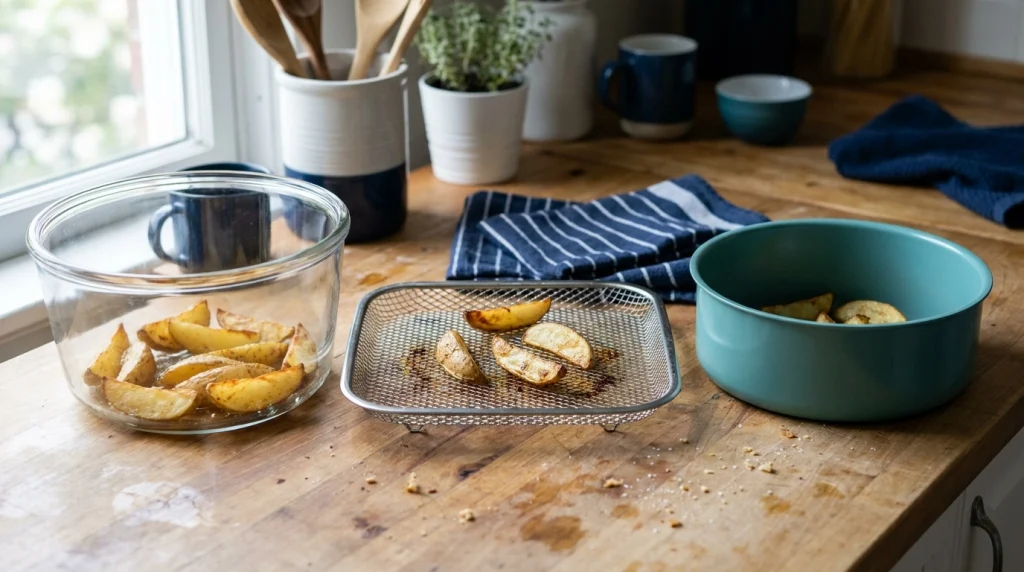
If I were choosing an air fryer specifically to minimize conventional nonstick surfaces, glass would be my simplest starting point. Uncoated stainless steel is another straightforward option.
PFAS-free ceramic coatings offer a compromise for people who still want easier food release.
| Cooking Surface | Conventional PTFE Nonstick? | Food Release | What to Check |
|---|---|---|---|
| Glass | Not required | Moderate | Crisper plate and other accessories may use different materials |
| Uncoated stainless steel | No | Lower | Verify that the basket or tray is truly uncoated |
| PFAS-free ceramic coating | Manufacturer says no | Good | Look for an explicit PFAS-free statement |
| PTFE nonstick | Yes | Very good | Follow temperature, utensil, and cleaning guidance |
Glass air fryers
A glass cooking vessel gives you the clearest material story. Food sits in glass rather than inside a conventionally coated metal drawer.
There can still be a metal crisper plate, rack, adapter, lid, or heating assembly. Check those parts separately instead of assuming the entire appliance uses one material.
Stainless-steel air fryers
Stainless steel works well when it is genuinely uncoated. Oven-style air fryers are often easier places to find stainless racks or mesh baskets.
The downside is sticking. A light layer of cooking oil and proper preheating can make cleanup easier.
PFAS-free ceramic air fryers
A ceramic-coated drawer can give you easier release without conventional PTFE nonstick. These coatings still need sensible care.
I would avoid abrasive scrubbers and metal utensils unless the manufacturer specifically allows them.
Section Takeaway: Glass and uncoated stainless steel provide the simplest way to avoid conventional nonstick. Verified PFAS-free ceramic is useful when easy food release matters more.
Which Air Fryers Have PFAS-Free Cooking Surfaces?
Two current product families provide unusually clear manufacturer disclosures: Ninja Crispi and several GreenPan or GreenLife air fryers. These are examples, not a claim that every component of either appliance is “chemical-free.”
Always recheck the current product page before purchasing because manufacturers can revise materials, accessories, and model specifications.
Ninja Crispi glass air fryer system
Ninja describes the cooking surface of its Crispi glass air fryer system as 100% PFAS-free. The system uses TempWare glass containers for the main cooking vessel.
That makes it one of the more interesting designs for shoppers trying to reduce their dependence on coated metal baskets.
- Main appeal: Food cooks inside a glass vessel.
- Capacity options: The system supports different glass container sizes depending on the version and accessories.
- What to inspect: Check the material disclosure for the crisper plate and every accessory you plan to use.
- Best fit: Shoppers who specifically prefer visible glass food-contact surfaces.
GreenPan and GreenLife ceramic air fryers
GreenPan sells air fryers with ceramic nonstick drawers and trays that it explicitly describes as PFAS-free. Its current 7-quart Clear View model, for example, lists a 1,500-watt system and an 80–400°F temperature range.
The company’s air fryer collection also states that its baskets and trays use PFAS-free ceramic nonstick.
- Main appeal: Familiar drawer-style design with ceramic nonstick.
- Coating claim: Manufacturer identifies the cooking surfaces as PFAS-free.
- Cleaning: Several removable drawers and trays are listed as dishwasher safe.
- Best fit: People who want nonstick convenience without traditional PTFE-based coating.
Which type would I choose?
My practical rule is simple. If avoiding coatings is the highest priority, I would start with glass or truly uncoated stainless steel.
If easy release matters more, I would compare explicitly PFAS-free ceramic models. The label needs to say more than PFOA-free.
Section Takeaway: Ninja Crispi provides a clearly identified PFAS-free glass cooking surface, while GreenPan and GreenLife provide verified PFAS-free ceramic options. Compare every food-contact accessory before buying.
How Do You Check an Air Fryer Before Buying?
Ignore broad phrases such as “healthy cooking” for a moment. Go straight to the specifications, manual, FAQ, and material disclosures.
A good listing should let you answer the following questions without guessing.
- What material touches the food? Identify the basket, tray, rack, bowl, and crisper plate separately.
- Is there a coating? A metal basket can still have a polymer coating.
- Does it explicitly say PFAS-free? Do not automatically translate PFOA-free into PFAS-free.
- Does it say PTFE-free? Check this separately when PTFE avoidance matters to you.
- Is “ceramic” clearly defined? Look for supporting material information from the manufacturer.
- Can removable parts be replaced? Replacement baskets and trays can extend the appliance’s useful life.
Marketing terms I treat cautiously
Some labels sound reassuring but provide little useful material information. I always look one level deeper.
- “Non-toxic”
- “Eco-friendly”
- “Healthy nonstick”
- “PFOA-free” without broader disclosure
- “Natural ceramic” without a material explanation
- “Safe coating” without identifying the coating
None of those phrases automatically means a product is bad. They simply do not answer the material question by themselves.
Do not forget accessories
This is an easy detail to miss. The main bowl may be glass while the crisper plate uses a different food-contact surface.
The same issue applies to baking trays, racks, dividers, grill plates, and replacement baskets.
Section Takeaway: Buy from the material disclosure, not the headline. Verify the basket, tray, crisper plate, and accessories separately.
How Should You Use and Maintain the Cooking Surface?
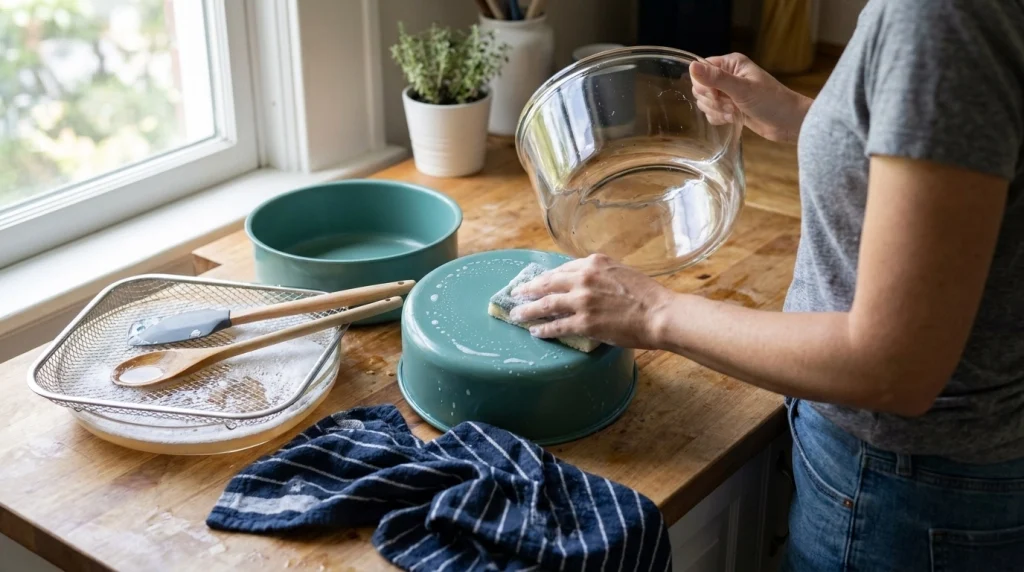
Whatever material you choose, good care matters. A damaged removable basket is not improved by continuing to scrape or scour it aggressively.
The FDA explains that approved nonstick fluoropolymers are highly polymerized and tightly bound, while its Food Code recommends following proper practices that avoid scratching coated cookware.
For coated baskets
- Use gentle utensils: Silicone, wood, or approved nylon tools are usually easier on coatings.
- Avoid abrasive pads: Use the manufacturer’s recommended cleaning method.
- Check for damage: Inspect the basket and crisper tray during cleaning.
- Replace worn parts: Use genuine compatible replacement components when practical.
For glass cooking vessels
- Follow temperature guidance: Use the vessel only within its specified operating range.
- Prevent impact: Glass can resist heat yet still be damaged by drops or hard knocks.
- Use compatible accessories: Do not improvise parts that interfere with airflow.
- Check for damage: Do not use badly chipped or cracked vessels.
For stainless-steel racks and baskets
- Oil lightly when needed: A thin coating can reduce sticking.
- Soak stubborn residue: This is often easier than aggressive scraping.
- Keep openings clear: Airflow is central to convection cooking.
Material safety is only one part of air-fryer safety
An air fryer uses high heat, so food handling still matters. Raw meat and poultry must reach appropriate safe internal temperatures.
Pro tip: Use a food thermometer rather than relying only on cooking time or surface color. Check current guidance at FoodSafety.gov.
Also avoid blocking the exhaust or placing the appliance against heat-sensitive surfaces. Follow the clearance recommendations in your model’s manual.
Section Takeaway: Choosing your preferred cooking material is only the first step. Proper utensils, cleaning, ventilation, and food-temperature checks still matter.
Frequently Asked Questions
Which air fryer is completely chemical-free?
No air fryer is literally chemical-free. Glass, metals, plastics, wiring, and electronic components are all made from chemical substances. If you mean PFAS-free, look for a glass cooking vessel, uncoated stainless steel, or ceramic cooking surface specifically identified by its manufacturer as PFAS-free.
Are glass air fryers PFAS-free?
Glass itself does not need a PFAS nonstick coating. However, a glass air fryer may also include a crisper plate, rack, lid, or accessory made from another material, so check each food-contact component instead of judging the appliance only by its bowl.
Is a PFOA-free air fryer also PFAS-free?
Not necessarily. PFOA is one specific member of the broader PFAS family. A PFOA-free label does not automatically tell you whether PTFE or another fluorinated substance is present, so look for an explicit PFAS-free or PTFE-free statement.
Are ceramic air fryers free from PFAS?
Some are, but the word “ceramic” alone is not enough proof. Several manufacturers explicitly market ceramic air-fryer baskets as PFAS-free. Check the current product specifications or manual before assuming every ceramic-coated air fryer uses the same formulation.
Is stainless steel better than a nonstick air fryer basket?
Stainless steel is attractive if your priority is avoiding a coating. It can be durable and easy to verify, but food may stick more easily. Nonstick baskets are usually easier to clean, so the better choice depends on which material tradeoff matters most to you.
Are PTFE air fryer baskets automatically unsafe?
No. The FDA says approved fluoropolymer nonstick coatings are highly polymerized and tightly bound, with negligible migration under their intended food-contact use. People who still prefer to avoid PTFE can choose glass, uncoated stainless steel, or verified PFAS-free ceramic instead.
What should I look for on an air fryer product page?
Look for the exact basket, tray, and crisper-plate materials. Search the specifications for terms such as PFAS-free, PTFE-free, glass, uncoated stainless steel, and ceramic coating rather than relying only on broad marketing phrases such as “healthy” or “non-toxic.”
So, Which Air Fryer Should You Choose?
If your goal is to minimize conventional nonstick coatings, a glass-vessel air fryer is one of the easiest options to understand. An air fryer with truly uncoated stainless-steel food-contact parts is another strong material choice.
For people who want the convenience of a slippery basket, explicitly PFAS-free ceramic is the middle ground I would investigate.
- Choose glass if avoiding conventional basket coatings is your top priority.
- Choose uncoated stainless steel if durability matters and you do not mind a little more cleanup.
- Choose verified PFAS-free ceramic if you want easier food release.
- Read past “PFOA-free” if your goal is avoiding the entire PFAS family.
As of 2026, models such as the Ninja Crispi and PFAS-free ceramic air fryers from GreenPan or GreenLife give shoppers clearer material disclosures than many generic “non-toxic” listings.
Before purchasing, verify the current manufacturer’s specifications for every surface that will actually touch your food.