
Why Your Air Fryer Fan Isn’t Working: Causes, Checks, and What to Do Next
If your air fryer powers on but the fan seems dead, weak, noisy, or inconsistent, the problem is usually one of a few things: a blockage, a misseated basket, overheating protection, a power issue, or a failed internal part. The good news is that some causes are simple and safe to check from the outside. The bad news is that a true fan, motor, wiring, or control board failure is not something to ignore.
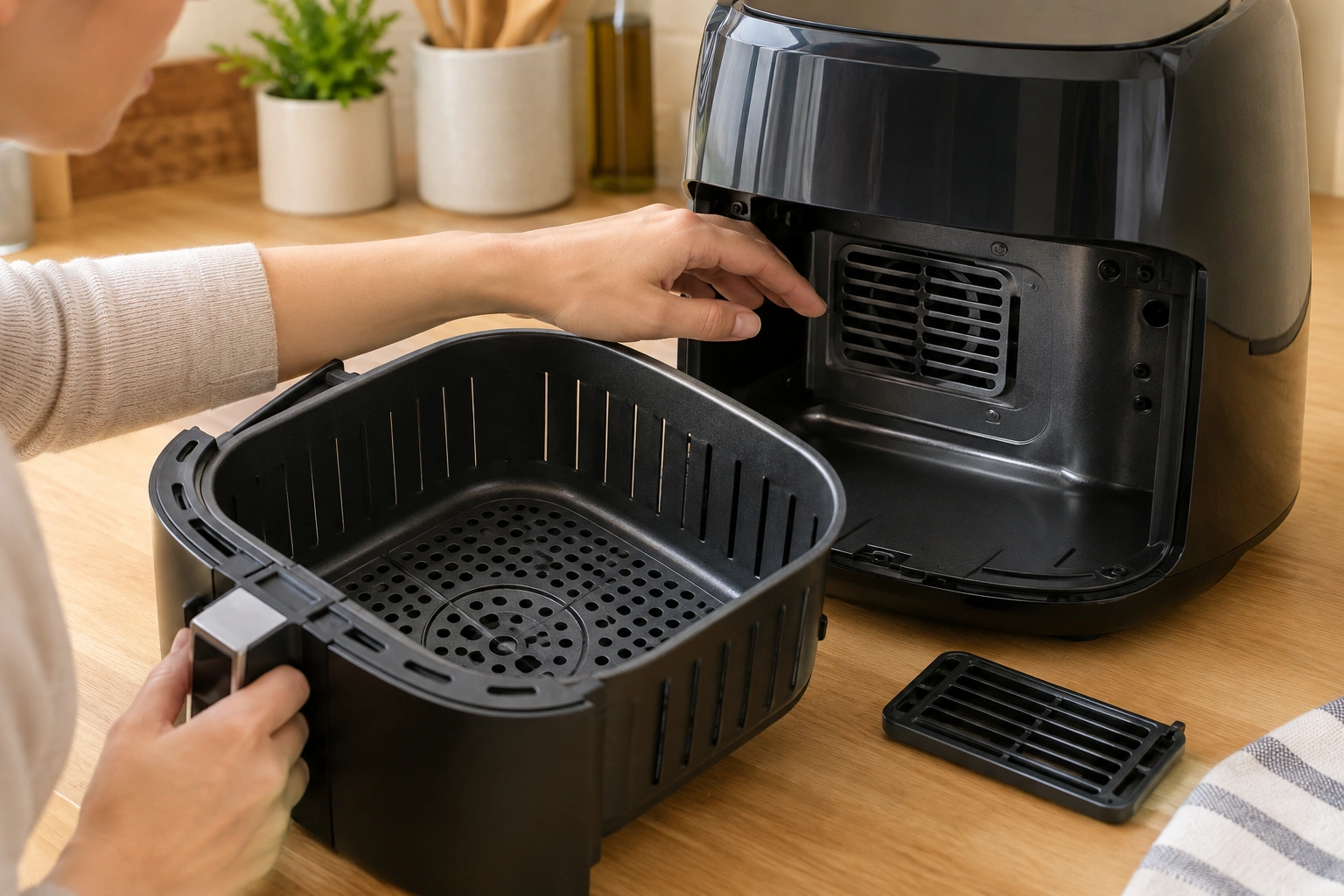
An air fryer depends on fast-moving hot air. When that airflow drops, food cooks unevenly, browns poorly, or takes much longer than usual. In some cases, the appliance may still light up and sound normal except for the fan. In others, you may hear grinding, buzzing, or repeated stopping and starting.
This guide walks through the safest way to diagnose the problem before you decide on repair or replacement.
Why the fan matters in an air fryer
An air fryer is really a compact convection oven with a strong fan. The fan moves heated air around the basket so food cooks from all sides instead of just from the bottom.
That matters for two reasons:
- Cooking performance: Without steady airflow, fries may stay pale on one side, chicken skin may not crisp properly, and frozen foods can come out unevenly heated.
- Appliance behavior: Some models may not start normally if the basket or drawer is not seated correctly.
If you want a quick comparison, think of it this way: a heating element without airflow is like a hair dryer with the fan turned off. It may still get hot, but it is not doing the job it was designed to do.
Is the fan actually not working?
Before assuming the motor has failed, check what the appliance is doing.
Signs the fan is fully stopped
- You hear the unit click on, but there is little or no airflow.
- Food cooks on one side but stays soft or pale overall.
- The basket area feels hot, but the air inside does not seem to circulate.
- The appliance may heat briefly, then shut down.
Signs the fan is weak, not dead
- Air is moving, but much less than usual.
- The unit is noisier than normal, or the sound changes during cooking.
- Cooking times are longer and results are inconsistent.
- A greasy smell or buildup may be affecting the airflow path.
Signs the problem may not be the fan itself
- The basket is not fully inserted.
- The display works, but the unit will not start cooking.
- The appliance turns off after a short time and then works again after cooling.
- The outlet, plug, or cord may be the real issue.
A weak fan can still leave the air fryer technically “working,” but the results will usually be disappointing enough that the appliance feels broken.
Safety first before troubleshooting
Unplug the air fryer before you inspect, clean, or move anything. Let it cool fully first. A hot heating chamber can stay dangerous longer than people expect.
Do not keep using the appliance if you notice any of the following:
- burning or electrical smell
- sparks
- a tripped breaker
- a damaged plug or power cord
- smoke that is not related to normal food cooking
- repeated shutdowns or error messages
If the unit is making grinding noises, rattling loudly, or shutting off because of heat, stop using it until you know what is happening. That is not a “cook through it” situation.
For food safety basics while troubleshooting cooking performance, the USDA’s food safety guidance is a better reference than guessing whether undercooked food is safe to eat.
Common reasons an air fryer fan stops spinning
Most fan problems fall into a few categories.
1. Blockage or buildup
Grease, crumbs, and dust can collect around vents and internal airflow paths. On some models, a buildup problem does not stop the fan completely, but it can make it sound strained or reduce circulation enough to hurt cooking performance.
A practical example: if the unit still powers on but food is coming out unevenly cooked, and the basket area looks greasy or dusty around the vents, airflow restriction is a real possibility.
2. Basket or drawer misalignment
Many basket-style air fryers need the drawer to seat correctly before they run normally. If the basket is not fully in place, the appliance may seem powered but not operate as expected.
This is one of the easiest things to miss because the unit can look closed even when it is not properly aligned.
3. Overheating protection
Some air fryers shut down temporarily if they get too hot. That can stop the fan or make it start and stop unpredictably. After a full cool-down, the appliance may work again.
If the unit failed in the middle of a long cook or after a very full basket, overheating protection is worth considering.
4. Power supply issues
A loose plug, damaged cord, weak outlet, or internal connection problem can interrupt fan operation. If the display is dead too, the issue may be broader than the fan.
5. Fan motor failure
If the fan motor is worn out, it may spin weakly, make grinding noises, or stop entirely. This is more likely when the appliance is older or has been used heavily.
6. Wiring or control board failure
If the display works but the fan never starts, the problem may be in the control board, wiring, or another internal component. Those issues are harder to diagnose safely without opening the appliance.
7. Thermal fuse or protection component failure
Some units use safety components that interrupt operation after overheating or a fault. If one of these fails, the unit may not recover after cooling.
Step-by-step troubleshooting you can safely do
Here is a practical sequence that separates simple fixes from likely internal failure.
Check the outlet and power cord
Plug another small appliance into the same outlet to confirm power is available. Then inspect the air fryer cord for:
- cuts or fraying
- bent plug prongs
- scorch marks
- loose connections at the base of the unit
If the cord or plug looks damaged, stop there. That is a repair-or-replace issue, not a cleaning issue.
Confirm the settings
Make sure the temperature and timer are set correctly. On some models, the fan only runs when cooking actually starts, not when the unit is just powered on.
If your model has presets, try a manual cook cycle instead of a specialty setting. Sometimes a setting issue looks like a fan problem.
Reseat the basket or drawer
Remove the basket, then insert it again firmly. It should lock into place cleanly. If the drawer feels loose or sits crooked, that may be the whole problem.
This is especially worth checking if the unit powers on but does nothing when you press start.
Look for visible blockages
With the unit unplugged and cool, inspect:
- air intake vents
- exhaust vents
- basket and tray openings
- grease buildup near the heating chamber opening
Clean only what the manufacturer says is safe to clean from the outside. Do not open panels or poke around inside the housing.
Let it cool fully, then retry
If the air fryer stopped mid-cook, unplug it and let it sit until completely cool. Then try again with an empty basket and a short cycle.
If the fan works after a long cooldown, overheating protection may have triggered. That does not mean the problem is solved, but it does give you a clue.
Test with a simple cook cycle
Try a short cycle with no food. Listen for:
- normal fan hum
- startup delay
- grinding or scraping
- fan that starts and stops
- heat without airflow
A clean, steady fan sound is a good sign. A rough or intermittent sound is not.
How to tell whether it’s a blockage, motor problem, control board issue, or something else
This part is less about guessing and more about matching symptoms.
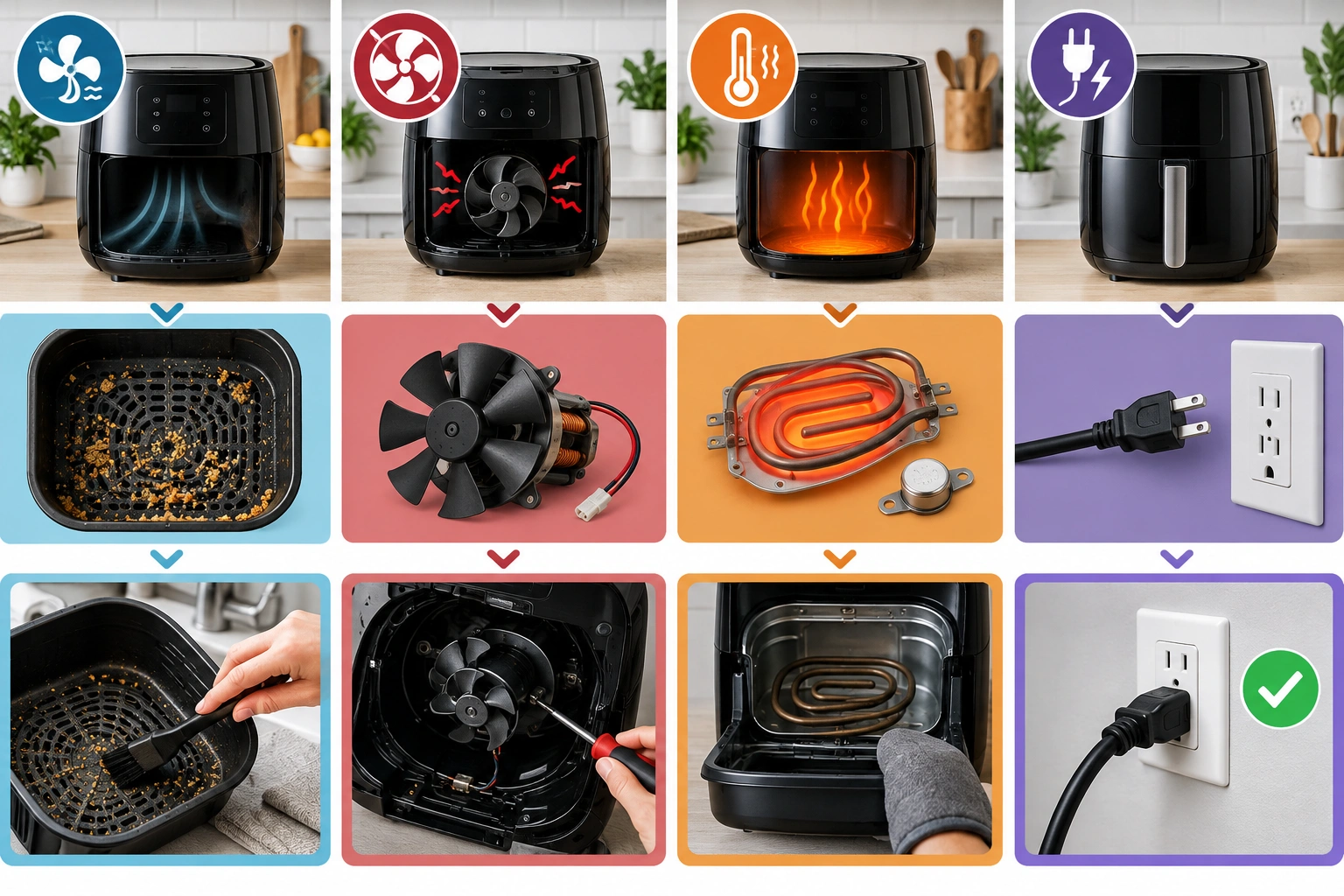
Quick diagnostic flow
- Start with power and seating
- If the display is dead, check the outlet, cord, and plug first.
-
If the display works but the unit will not start, reseat the basket or drawer and retry.
-
Check for airflow
- No spin at all: if the unit powers on but the fan never moves and there is no airflow, the likely causes are a control board issue, wiring fault, thermal fuse problem, or a seized motor.
- Weak spin or weak airflow: if the fan runs but airflow is poor, blockage, buildup, or a struggling motor is more likely.
- Intermittent spin: if the fan starts, stops, or changes speed during use, overheating protection, a loose connection, or a failing motor is a stronger possibility.
-
Fan noise without normal airflow: grinding, scraping, or rattling points more toward motor trouble or an obstruction in the fan path.
-
Separate fan trouble from heating trouble
- If the fan seems normal but the food stays pale and undercooked, the issue may be the heating element instead of the fan.
- If the unit gets hot but does not circulate air, the fan path or motor is the better place to focus.
- If the display runs but there is no heat and no airflow, the problem may be broader than one part.
Symptom-to-cause table
| Symptom | Most likely cause | Safety level | Best next action |
|---|---|---|---|
| Fan weak, but unit still runs | Buildup, partial blockage, basket misalignment, or a struggling motor | Usually lower risk | Clean vents, reseat basket, retry |
| Grinding or scraping noise | Worn or obstructed fan motor | Higher risk | Stop using and seek service |
| Display works, but no airflow or heat | Control board, wiring, thermal fuse, or motor | Medium to high risk | Check warranty, contact support |
| Unit stops after getting hot, then works later | Overheating protection | Medium risk | Full cooldown, reduce load, retest |
| Dead display and no fan | Power issue, cord, outlet, or internal failure | Higher risk | Check outlet and cord, then service |
| Burning smell or sparks | Electrical fault | Unsafe | Unplug and do not reuse |
A mechanical blockage usually gives you some warning: reduced airflow, noise changes, or uneven cooking. Electrical failure is more likely when the appliance seems dead, behaves erratically, or trips power protection.
When the air fryer can still run but cook poorly
Weak airflow can create a frustrating middle ground where the appliance still turns on, but the food never comes out right.
Common examples:
- fries brown on top but stay soft underneath
- frozen snacks cook unevenly
- chicken pieces need extra time and still look patchy
- the appliance sounds normal, but the basket feels like it is not circulating air well
In this situation, the fan may be struggling, not dead. Cleaning the airflow path and checking the basket alignment may help. If the results do not improve, the motor or control system may be wearing out.
When to stop using the air fryer
Stop using the appliance immediately if you notice:
- a burning plastic or electrical smell
- smoke that is not normal cooking smoke
- visible sparking
- repeated shutoffs
- a hot cord or plug
- a breaker that keeps tripping
- a fan that makes loud grinding or rubbing noises
Those are not signs to “test one more time.” They point to a possible safety problem.
Repair, warranty, or replace: how to decide
Not every broken fan is worth repairing.
Repair may make sense when:
- the air fryer is still under warranty
- it is a higher-end model
- the unit is relatively new
- the manufacturer offers replacement parts or service
Replacement may make more sense when:
- the air fryer is older
- the unit was inexpensive to begin with
- the fan motor, thermal fuse, or control board is likely involved
- the repair estimate is a large share of what a similar new model would cost
A more concrete way to decide is to weigh three things together: warranty status, appliance age, and the repair estimate. If the unit is under warranty, start there. If it is older and the estimate is high relative to a comparable new air fryer, replacement is usually the simpler path. If it is newer and the repair is modest, repair may be worthwhile.
If you want a related troubleshooting guide, our post on why an air fryer may not turn on covers the power-side checks in more detail. If your unit powers on but still will not heat, see why an air fryer turns on but won’t heat for a focused breakdown.
When to consult a professional
Contact the manufacturer or a qualified repair service if:
- the appliance is under warranty
- the fan issue returns after cooling and basic cleaning
- the display works but the fan never starts
- the unit makes grinding, buzzing, or rattling noises
- you suspect wiring, motor, thermal fuse, or control board failure
- the cord, plug, or housing is damaged
For a newer appliance, manufacturer support is often the best first call because it can confirm whether the model has a known issue, a replacement part, or a warranty path. For an older model, a repair estimate may quickly tell you whether replacement is the better value.
How to prevent fan problems in the future
A few habits can reduce repeat airflow issues:
- Keep vents clear on all sides of the unit.
- Avoid overfilling the basket, which can restrict circulation.
- Clean grease and crumbs regularly, especially around openings.
- Let the appliance cool before storing it in a tight cabinet.
- Use the basket and tray as the manufacturer intended so parts seat properly.
One practical example: if you often cook oily foods, wipe the basket and surrounding airflow areas more often than you would after dry foods like frozen fries. Grease buildup tends to show up gradually, then suddenly affects cooking performance.
For a compact model, airflow matters even more because the cooking chamber is small. A little buildup or a slightly misseated basket can have a bigger effect than people expect.
Final takeaway
If your air fryer fan is not working, the safest approach is to separate simple external causes from likely internal failure. Check power, basket alignment, vents, buildup, and cooldown behavior first. If the unit still has no airflow, makes unusual noise, smells burnt, or shuts down repeatedly, stop using it and move to warranty service, professional repair, or replacement.
A fan problem is often fixable when it comes from alignment, blockage, or overheating protection. Once the issue points to the motor, wiring, thermal fuse, or control board, replacement is often the more practical choice.
FAQ
Why does my air fryer turn on but the fan doesn’t spin?
The most likely causes are a basket or drawer alignment issue, a blockage, a thermal safety cutoff, a wiring fault, a failed motor, or a control board problem. Start with the easy external checks first.
Is it the fan or the heating element if my air fryer gets hot but food still cooks poorly?
If the unit heats but airflow is weak or uneven, the fan side is more likely. If the fan seems normal but the food stays pale or undercooked, the heating element may be the issue instead.
Why did my air fryer stop working after overheating?
Some models shut down to protect internal parts. After a full cool-down, the appliance may restart normally. If it keeps happening, the underlying cause may be buildup, overfilling, or a failing component.
Do air fryers show error codes after a shutdown?
Some models do, but not all. Error-code behavior and reset steps vary by brand and model, so check the owner’s manual or the manufacturer’s support page for your specific unit.
Should I repair or replace a broken air fryer fan?
If the unit is under warranty or relatively new, repair may be worth considering. If it is older and the estimate is close to the cost of a similar replacement, buying a new air fryer is often the better choice.
Can I keep using an air fryer with a weak fan?
It is not ideal. Weak airflow can lead to uneven cooking and may signal a motor or control issue that could get worse. If the fan noise changes, the unit overheats, or you smell burning, stop using it.
How do I clean airflow blockages safely?
Unplug the appliance, let it cool fully, and clean only the exterior vents and removable parts the manufacturer says are safe to clean. Do not open the housing or insert tools into the unit.
What if the fan makes a grinding noise?
Grinding usually suggests a mechanical problem, such as an obstructed or worn fan motor. Stop using the appliance and have it checked.

