
Why Your Air Fryer Food Cooks Unevenly and How to Fix It
If your air fryer keeps giving you food that’s browned on one side and pale or underdone on the other, you’re usually dealing with a airflow problem, a spacing problem, or a cooking-method mismatch. The good news is that most uneven results are fixable without buying a new appliance.
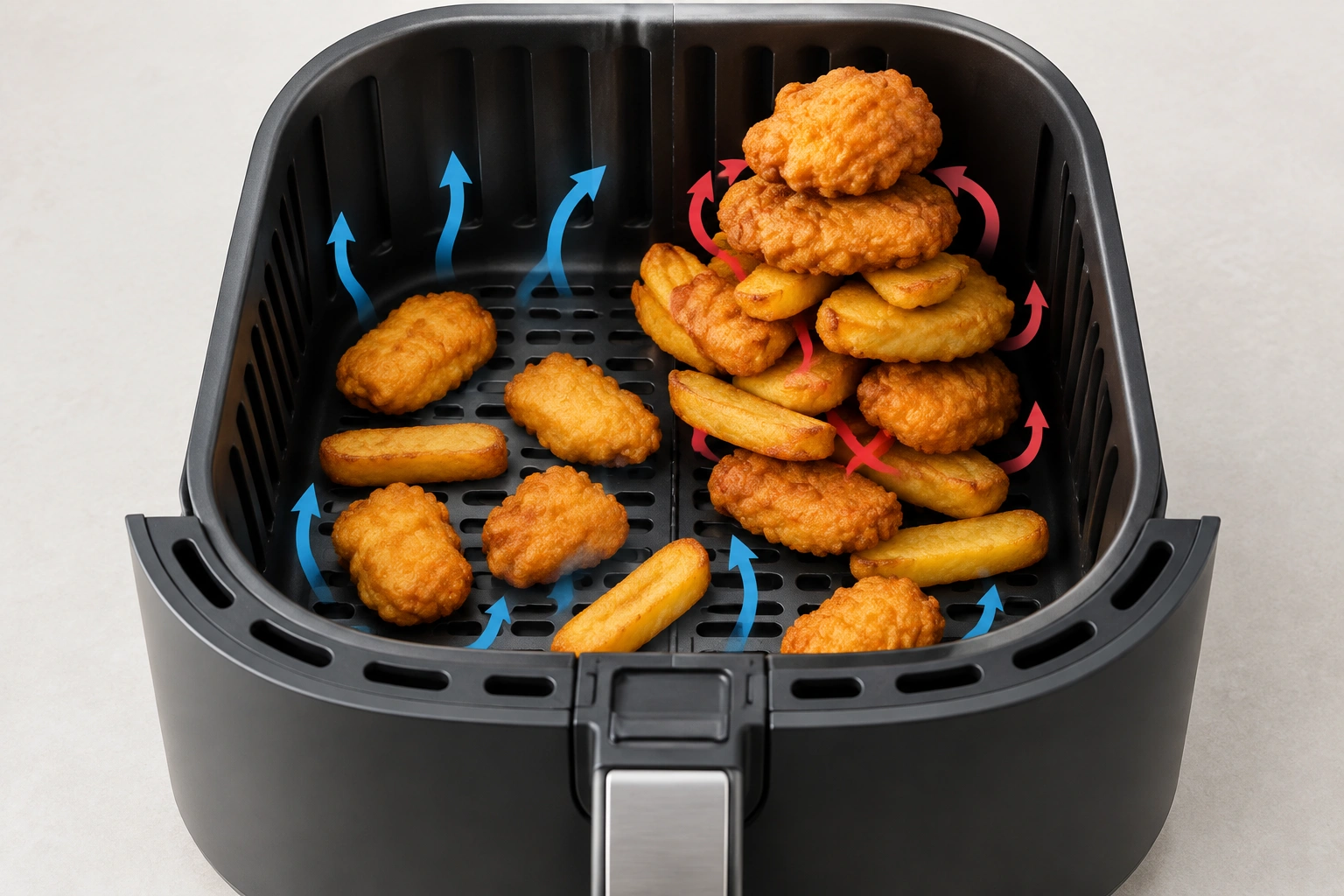
I cook with air fryers often, and the same pattern shows up again and again: a basket that’s too full, pieces that are different sizes, or food that never gets moved during cooking. Sometimes the appliance itself has a hot spot. Either way, you can usually narrow it down fast.
The quickest way to diagnose uneven air fryer cooking
Here’s the short version: if only some pieces are cooking properly, the issue is usually one of these:
- The basket or tray is crowded, so air can’t reach every side.
- The food pieces are not the same size or thickness.
- The food was not shaken, flipped, or rotated during cooking.
- The temperature is too high, so the outside browns before the inside finishes.
- The air fryer has a normal hot spot, especially in basket-style or oven-style models that cook differently from front to back or top to bottom.
A simple way to tell technique issues from appliance problems is to test the same food two ways. Cook a small, evenly cut batch with good spacing and move it halfway through. If the result improves, the main issue was likely overcrowding, size, or movement. If the same uneven pattern keeps showing up across different foods, even after cleaning and proper spacing, the appliance may need closer inspection.
If the problem happens with almost every food, not just one recipe, that points more toward technique or appliance airflow than the recipe itself. If it happens only with one type of food, the issue is often the cut size, moisture level, or load amount.
Why air fryers cook unevenly in the first place
Air fryers work by moving hot air around food. That sounds simple, but it means the food has to be arranged so the air can reach as much surface area as possible. When pieces touch, stack, or sit too close together, the air hits some areas strongly and barely reaches others.
That’s why one side can brown faster, the top can look done while the middle stays soft, or the bottom can stay pale while the edges overcook. A tray, rack, basket wall, or even the heating element’s position can also create predictable hot spots.
This is especially noticeable in two situations:
- Basket-style air fryers: food sits in a compact space, so overcrowding and shaking matter a lot.
- Oven-style air fryers: food is spread across racks, so tray rotation becomes more important.
If you want a broader look at which foods tend to perform best in this appliance, see what food is best cooked in an air fryer. It helps explain why some foods are naturally easier to cook evenly than others.
The fastest fixes to try first
When you want a better result on the very next batch, use this order.
1. Cut the batch size
If the basket is crowded, reduce the amount of food. This is the most common fix because it gives the hot air room to move.
A practical example: if frozen fries are piled into a mound, the top layer may crisp while the middle stays soft. Spread them out and cook in two batches instead.
2. Spread food in a single layer
Single-layer cooking usually gives the most consistent browning because each piece gets exposed to airflow. Stacking is convenient, but it’s a common reason for pale spots and soft patches.
This matters most for foods like chicken nuggets, vegetables, breaded fish, and fries. If the food overlaps, the touching areas usually cook more slowly.
3. Preheat when the food benefits from a hot start
Preheating can help food cook more evenly, especially thicker items or foods that need a crisp exterior. A cold basket can slow browning at first, which sometimes leads people to extend the cook time too long and dry the food out.
If your recipe assumes a preheated air fryer, skipping that step can throw off the timing. If your model heats very quickly, preheating may matter less for thin foods, but it still helps consistency for denser items.
4. Shake, flip, or rotate halfway through
This is the step many people skip. Moving the food mid-cook exposes the less-cooked side to the strongest airflow. In basket-style units, shaking works well for small pieces. In oven-style models, rotating the tray or rack is usually more effective.
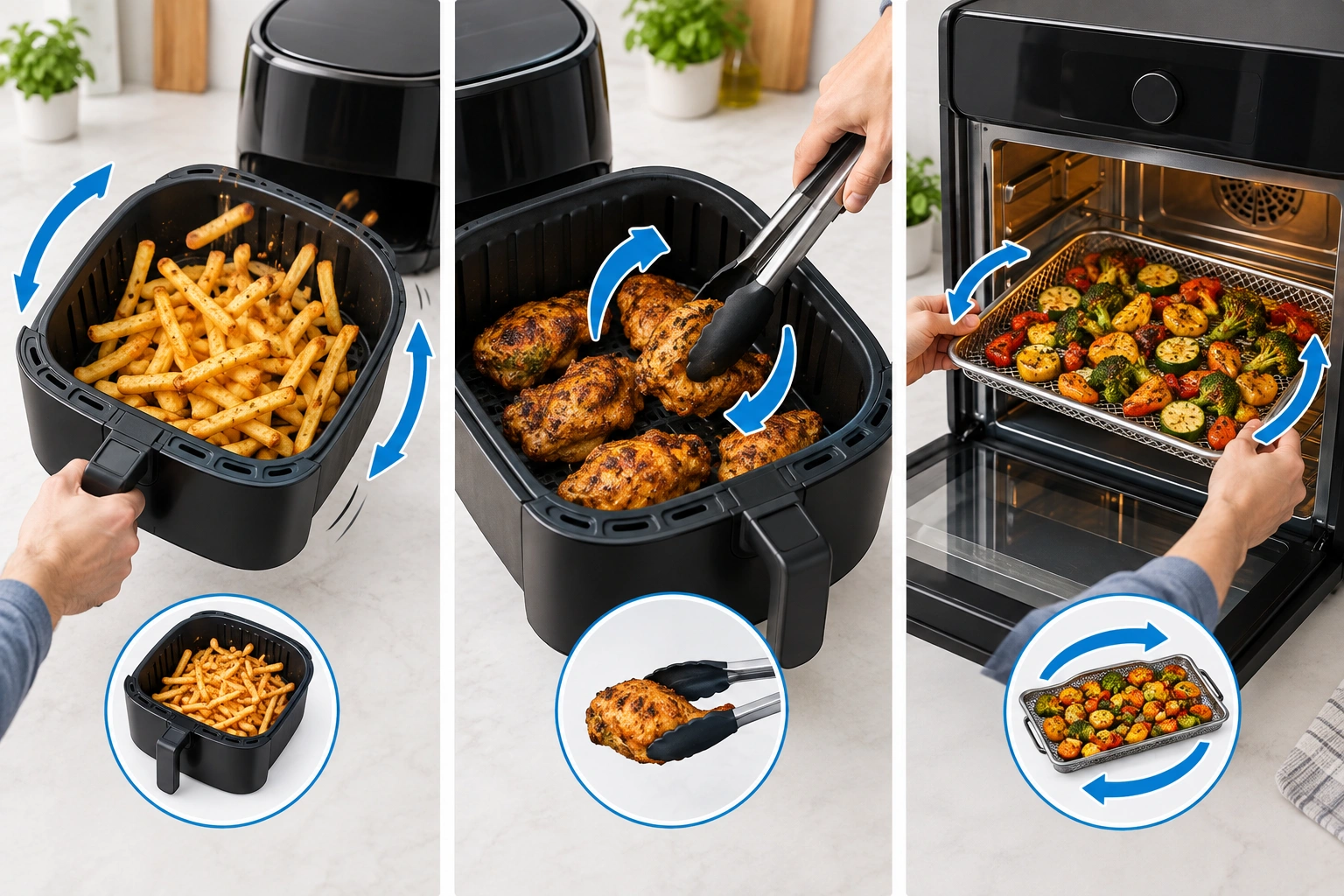
A general rule: if one side keeps browning faster, don’t just extend the cook time. Move the food.
Check your food size, spacing, and arrangement
Uneven cooking is often less about the air fryer and more about how the food is prepared before it goes in.
Mixed sizes cook at different speeds
A thick chicken thigh and a thin one should not be cooked exactly the same way in the same batch. The same is true for potato wedges, cauliflower florets, or sliced vegetables. Smaller pieces finish faster and can dry out while larger pieces are still catching up.
If a recipe calls for “even pieces,” that’s not just for looks. It helps the food finish at the same time.
Crowded trays create uneven browning
When food is packed tightly, the pieces in the middle usually get less airflow than the ones near the edge. That can leave the center soft while the outside browns too quickly.
A useful decision rule:
– If the food is touching in more than a few places, use a smaller batch.
– If pieces are stacked, spread them out.
– If you can’t spread them out, expect to shake or rotate more often.
Moist foods need more space
Foods with more moisture, such as vegetables or marinated chicken, release steam as they cook. If that steam has nowhere to go, it can soften the surface and make browning uneven. That’s another reason spacing matters.
Adjust temperature and cook time for more even results
Sometimes the issue is not that the food isn’t cooking enough. It’s that the outside is cooking too fast.
Lower heat can improve consistency
If the top browns before the inside is done, the temperature is probably too high for that food. Lowering the heat and extending the cook time often gives the inside a better chance to catch up.
This is useful for:
– thicker chicken pieces
– breaded foods that brown quickly
– denser vegetables like potato chunks
– frozen foods that need time to heat through
Higher heat can help crisping, but it can also create unevenness
A hotter setting may give you faster browning, but it can also make the outside look finished before the center is ready. That’s especially frustrating with chicken or larger vegetables, where the outside can dry out before the inside is cooked through.
For food safety, especially with poultry, follow official guidance and check that the center reaches a safe temperature rather than relying on appearance alone. The USDA’s food safety guidance for poultry is a reliable reference.
When to extend time instead of raising heat
If the food is browning nicely but still underdone inside, more time at a moderate temperature is usually better than a sharp increase in heat. That approach gives you a better chance of even cooking without burning the outside.
How to flip, shake, or rotate different foods
These three actions sound similar, but they solve slightly different problems.
Shake
Shaking works best for small, loose foods in a basket-style air fryer:
– fries
– tater tots
– sprouts
– small breaded bites
It redistributes the pieces so the ones on the bottom get a turn near the airflow.
Flip
Flipping is better for larger pieces that have a clear top and bottom:
– chicken breasts
– burgers
– fish fillets
– thick vegetable slices
Flipping exposes the underheated side directly to the hot air. It’s usually more effective than shaking for foods that sit flat.
Rotate
Rotation matters most in oven-style air fryers and in basket-style models with a known hot spot. If one side of the tray consistently cooks faster, rotate the basket or tray position halfway through.
That simple change can solve the “same side always overcooks” problem without changing the recipe.
Food-specific fixes for the most common problem foods
Fries
Fries are one of the easiest foods to overcrowd. If they’re piled up, the top layer may crisp while the lower layer stays soft. Use a smaller batch and shake once or twice during cooking. If the fries are very uneven in size, the thinner ones may need to come out earlier.
Chicken
Chicken often looks uneven because the outside browns before the inside finishes. That’s especially true with thicker pieces. Use a moderate temperature, flip halfway through, and check the thickest part instead of judging by color alone. For bone-in pieces, expect more variation and a longer cook time.
Vegetables
Vegetables cook unevenly when the pieces are cut at different sizes. Broccoli florets, carrot chunks, and zucchini slices all behave differently if some are much thicker than others. Cut them more uniformly and keep them in a single layer when possible.
Frozen foods
Frozen nuggets, mozzarella sticks, and similar foods often need rotation or flipping because the coating can brown faster on the side closest to the heating element. Oven-style models especially benefit from tray rotation. If the bottoms stay pale, check whether a liner or tray setup is blocking airflow.
Liners, foil, oil, and accessories: what helps and what blocks airflow
Accessories can make cleanup easier, but they can also interfere with the very thing the air fryer needs most: circulation.
Oil helps browning, but too much can work against you
A light coating of oil can improve color and crispness on vegetables and some breaded foods. But too much oil can make the surface greasy and reduce the dry, crisp finish people want from an air fryer.
Liners and foil need space around them
Parchment liners, foil, or bulky inserts can block airflow if they cover too much of the basket or tray. For example, a parchment liner cut to the full basket size and weighed down by food can seal off the holes and slow airflow underneath. Foil wrapped tightly across the base of the basket can do the same thing.
Safer placement looks more like a liner that sits under the food without covering vents or blocking the side openings, or a small piece of foil used only where the recipe specifically calls for it. The goal is to support the food, not create a solid barrier.
Also, avoid placing foil or parchment where it can interfere with the heating element or vents. That’s a safety issue as well as a cooking issue.
Accessories should support airflow, not replace it
A rack or accessory that lifts food can help if it improves circulation underneath. But if it creates a solid barrier, it may make uneven cooking worse.
Basket-style vs oven-style air fryers: why results differ
Basket-style and oven-style air fryers both use hot air, but they do not behave the same way in practice.
Basket-style air fryers
These usually need:
– smaller batches
– more shaking
– careful spacing
Because the food sits in a tighter chamber, the center of the load can cook differently from the edges.
Oven-style air fryers
These usually need:
– tray or rack rotation
– attention to upper and lower rack position
– more awareness of hot spots near the heating element
Foods on the top rack may brown faster, while lower trays may need extra time or a position change.
If you’re switching between styles, don’t assume the same timing or movement will work exactly the same way.
When uneven cooking points to a cleaning or appliance problem
If you’ve already reduced the batch size, spaced the food properly, and moved it during cooking, but the same uneven pattern keeps showing up, inspect the appliance itself.
Check for grease buildup or debris
A dirty basket, tray, or heating area can affect airflow and heat distribution. Built-up grease can also make the appliance perform less predictably over time.
Look for blocked vents or a fan issue
If air cannot move properly through the unit, the food will not cook evenly. A fan that sounds weak, inconsistent, or unusually noisy may be part of the problem.
Red flags that justify cleaning, service, or replacement
A few symptoms are more concerning than ordinary hot spots:
- the same side or corner stays undercooked even after proper spacing and rotation
- the unit takes noticeably longer than usual to cook familiar foods
- grease, crumbs, or residue are visibly blocking vents, the basket, or the heating area
- the appliance produces a burnt smell that doesn’t go away after cleaning
- the unit sparks, shuts off unexpectedly, or overheats
- the fan sound changes a lot from one cook to the next, or airflow seems weak compared with normal use
If the appliance keeps producing the same problem after cleaning, stop using it and inspect it carefully.
Simple troubleshooting checklist for the next cook
Use this order the next time your air fryer gives uneven results:
- Reduce the amount of food if the basket or tray is crowded.
- Spread it out so pieces are not stacked or tightly touching.
- Preheat if the food is thick, dense, or the recipe assumes it.
- Shake, flip, or rotate halfway through.
- Lower the temperature if the outside is browning too fast.
- Cut food into more even pieces next time.
- Remove liners, foil, or accessories that may be blocking airflow.
- Clean the basket, tray, and vents if the problem keeps happening.
- If uneven cooking happens across multiple foods, inspect the appliance for a fault.
That sequence solves most issues without trial and error for every meal.
When to Consult a Professional
If the air fryer repeatedly cooks unevenly after proper cleaning, correct spacing, and normal flipping or rotation, the problem may be mechanical. In that case, check the manufacturer’s support resources or have the appliance inspected. If the unit sparks, overheats, or smells burned, stop using it until it has been evaluated.
For most home cooks, though, the fix is simpler than it first seems. Uneven air fryer food usually comes down to airflow, batch size, or movement during cooking. Once you adjust those three things, the results become much more predictable.
FAQ
Why does my air fryer cook one side faster than the other?
That usually happens because of a hot spot, blocked airflow, or food that is too crowded in the basket or tray. Rotating the food or tray halfway through often helps.
Should I always shake air fryer food?
Not always. Shake small loose foods like fries or tots, but flip larger items like chicken breasts or fish fillets. Oven-style air fryers often need rotation more than shaking.
Do liners cause uneven cooking?
They can if they cover too much of the basket or block the holes that let air move through. A liner that fits the food without sealing off airflow is less likely to cause problems.
When should I suspect the air fryer itself?
If the same uneven result keeps happening across different foods after proper spacing, movement, and cleaning, the appliance may have a blockage, fan issue, or another fault that needs inspection.
Is a smaller batch always better?
Not always, but it often helps when food is stacked or packed tightly. If the batch is already fairly open, the better fix may be flipping, shaking, or rotating instead of reducing the amount further.

