
Why Is My Air Fryer Making a Loud Noise? A Practical Guide to the Most Common Causes
If your air fryer suddenly sounds louder than usual, the good news is that the noise is often something simple: a basket that is not seated properly, a bit of debris near the fan, or vibration from the countertop. Air fryers are not silent appliances, though. A steady fan hum is normal. What is not normal is a new rattling, grinding, whistling, or harsh buzzing that showed up out of nowhere.
This guide breaks down what different noises usually mean, what you can check safely in a few minutes, and when the sound points to a real mechanical problem. I’ll keep it practical and simple, the way I’d explain it in general terms to a friend in the kitchen.
What a Normal Air Fryer Sound Actually Sounds Like
An air fryer works by moving hot air quickly around the food, so some fan noise is built in. A normal unit usually makes a steady hum or whooshing sound while it runs. That sound may be louder on high settings or in larger models because the fan is working harder to move more air.
It is also worth noting that some air fryer models are naturally louder than others because of their size, wattage, and design. So the best comparison is not “How quiet is it compared with every other air fryer?” but “Did this unit suddenly get louder or start making a harsher sound?”
What usually counts as normal:
- A consistent fan hum
- A soft airflow sound
- A brief click when the unit starts or stops heating
- A little vibration from the basket or drawer
What is more likely abnormal:
- Rattling
- Grinding
- Scraping
- Whistling that suddenly got louder
- Buzzing that sounds rough or uneven
A useful rule: if the sound has always been there and it is steady, it may just be the appliance doing its job. If it changed suddenly, or it sounds harsh, that deserves a closer look.
Match the Noise to the Most Likely Cause
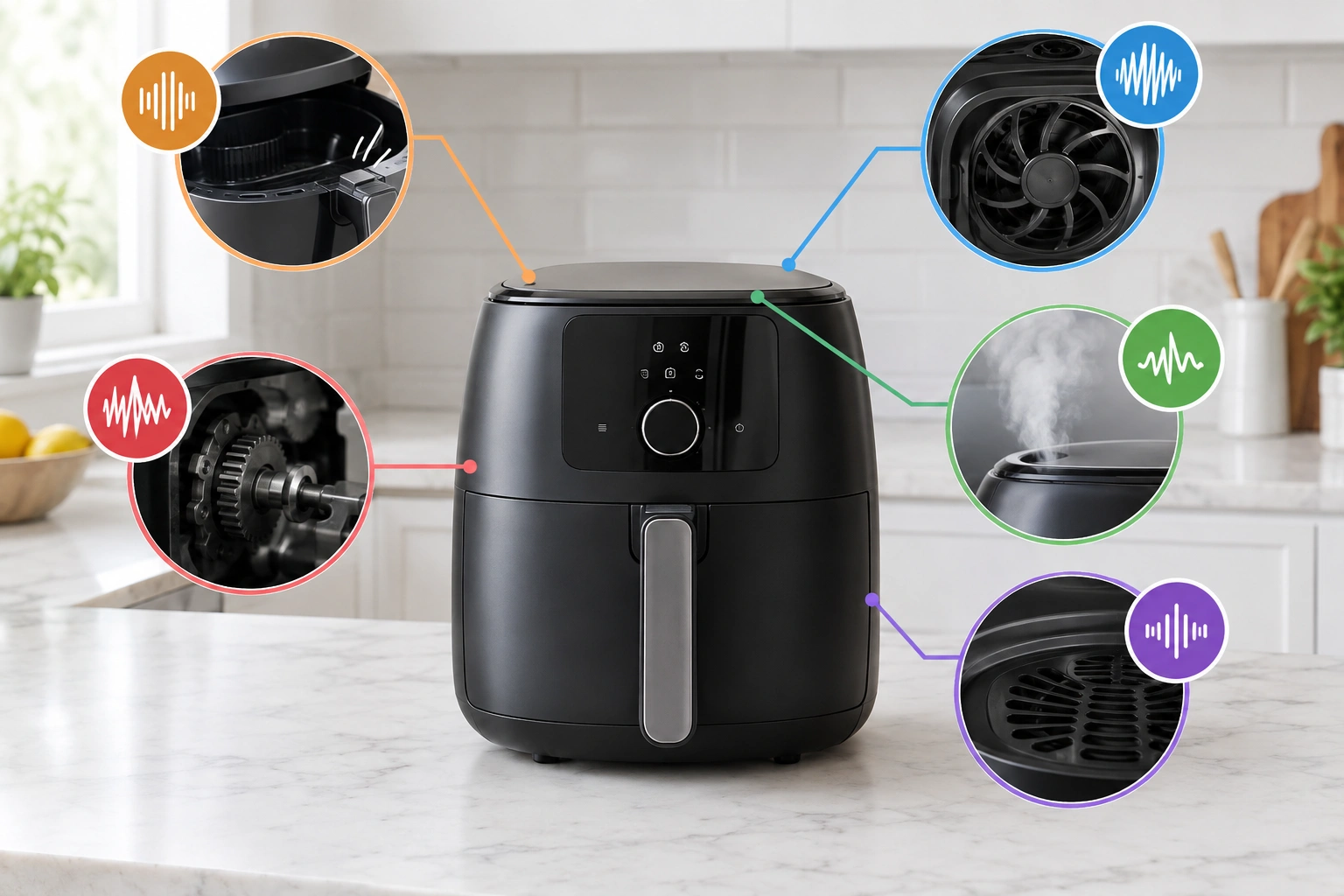
This quick comparison can help you narrow things down before you start cleaning or moving parts around.
| Sound | What it often means | Safety level | First thing to try |
|---|---|---|---|
| Steady hum or whoosh | Normal fan and airflow | Usually normal | No action unless it gets much louder |
| Rattling | Basket, tray, or loose part vibrating | Usually fixable | Reseat the basket and check placement |
| Buzzing | Vibration from the surface or a part not sitting right | Usually fixable | Move the unit to a flat, solid counter |
| Whistling | Restricted airflow or buildup around vents | Usually fixable | Clean vents and check for blockage |
| Grinding or scraping | Fan or internal part may be rubbing | Possible problem | Stop using it and inspect only if safe |
| Clicking that repeats | Part shifting, control issue, or heating cycle | Sometimes normal, sometimes not | See if it stops after reseating parts |
The biggest clue is whether the sound comes from the outside parts or seems to come from inside the machine. A loose basket can make a loud clatter, but a grinding sound usually deserves more caution.
Basket or Fan? A Quick Way to Tell Where the Noise Is Coming From
If you are not sure whether the sound is from the basket/drawer area or the fan/motor area, try this simple check:
- Noise seems to come from the front or lower section: more likely the basket, drawer, tray, or another removable part
- Noise seems to come from the top, back, or inside the unit: more likely the fan, motor, or airflow path
A useful clue is timing. If the sound changes when you push the drawer in, lift the basket slightly, or tap the outer shell, it is probably related to the basket area. If the sound stays the same no matter how the basket sits and seems to come from inside the housing, that is more concerning.
Quick Checks You Can Do in a Few Minutes
Before assuming the air fryer is broken, run through these simple checks.
1. Unplug it first
Do not inspect or clean it while it is plugged in. Let it cool if it was recently used.
2. Remove and reseat the basket or drawer
Take the basket or drawer out, then put it back in firmly. Make sure it slides in evenly and locks the way it should. A basket that is slightly crooked can rattle enough to sound like a much bigger problem.
3. Check the surface underneath
Set the air fryer on a flat, stable countertop. Thin cutting boards, uneven mats, wobbly tables, and hollow surfaces can make normal vibration sound much louder.
4. Look for anything loose outside the unit
Check the basket handle, tray, crisper plate, and any removable inserts. If one piece is not sitting flat, it can bounce during operation.
5. Listen again
After reseating the parts and moving the unit, run a short test cycle if the manual allows it. If the sound improves, you likely found the issue.
If the noise disappears after one of these checks, that is a strong sign the problem was placement or alignment rather than a failed motor.
Common Reasons an Air Fryer Gets Loud
A sudden increase in noise usually comes from one of a few everyday causes.
Loose basket, tray, or drawer
This is one of the most common and most fixable reasons. If the basket is not fully in place, it can shake against the frame. That often sounds like rattling or a plastic-on-plastic clack.
A simple example: if you hear the noise mostly when the drawer moves or when you tap the front of the unit, the problem may be fit and alignment, not the fan.
Grease or crumbs affecting airflow
A thin layer of grease, crumbs, or dust near vents can change how air moves through the machine. That can make the fan sound louder or create a whistle. In some cases, buildup also adds vibration because the fan is working against more resistance.
This is one reason a unit that used to sound fine can gradually become annoying over time.
Vibration from the countertop
Air fryers can sound much louder on certain surfaces. A hard, hollow, or slightly uneven counter can amplify the vibration. Even a machine that is working normally may seem harsh if it is sitting on a surface that resonates.
If the sound changes when you move the air fryer a few inches, the counter is probably part of the problem.
Noise that changes with temperature or preheating
If the sound only shows up during preheating or at certain temperatures, it may be normal fan cycling rather than a fault. Some units ramp the fan up or down as they heat, which can make the noise rise and fall during a cycle.
What matters most is whether the sound is predictable and steady for that model, or whether it is a sudden harsh new noise that was not there before.
Internal wear or damage
If the sound is more like grinding, scraping, or an uneven mechanical buzz, the fan or motor may be worn, damaged, or obstructed. A drop or hard bump can sometimes make that worse. This is the point where simple cleaning may not be enough.
A general observation: many “loud air fryer” complaints turn out to be loose parts or airflow issues, but a brand-new grinding sound is different. Treat that as a warning sign rather than something to ignore.
How to Clean and Inspect It Safely
You do not need to take the air fryer apart to do a useful inspection. In fact, for most home cooks, that is not the right move.
Clean the removable parts first
Wash the basket, tray, and crisper plate according to the manual. Dry everything fully before putting it back. A warped or sticky insert can shift around and make noise.
Wipe the vents and exterior
Use a soft cloth or brush to remove dust from the vents and around the outside of the unit. Pay attention to the areas where air enters and exits. If those openings are partly blocked, the fan may sound louder than usual.
Look for visible debris
With the unit unplugged and cool, check for crumbs or bits of food around the basket area and the outer openings. Do not poke inside the machine with sharp tools.
Check for signs of damage
If you see cracks, bent parts, scorch marks, or anything that looks out of place, stop there. That kind of damage is more than a cleaning issue.
If the noise started right after cleaning, make sure the basket, tray, and inserts were put back correctly. A part that is slightly misaligned after washing can rattle even if it looked fine at first.
When the Noise Points to a Mechanical Problem
Some sounds are not worth trying to “live with.”
Grinding or scraping
This is the sound that makes me pay attention first. It can suggest that something inside is rubbing where it should not. If you hear that, stop the unit and do not keep running it just to see if it settles down.
Loud buzzing that does not change
A rough, constant buzz that stays the same even after you move the air fryer and reseat the basket may point to a fan or motor issue.
Noise after a drop or impact
If the air fryer was knocked off the counter, bumped hard, or shipped with damage, a fan blade or internal part may be out of alignment. In that case, the sound may start immediately and stay loud every time you use it.
Noise plus poor performance
If the air fryer is louder and also cooking unevenly, heating slowly, or shutting off strangely, that combination is more concerning than noise alone.
A temporary buzz that appears only during startup or preheating can be harmless, especially if it settles into a normal hum. A true internal fault is more likely when the noise is persistent, harsh, and clearly coming from inside the unit.
At that point, the problem may be beyond normal maintenance.
Is It Safe to Keep Using a Loud Air Fryer?
Here is the simple decision rule I use:
- Usually okay to keep using: steady hum, mild vibration, or a rattling sound that stops after reseating the basket or moving the unit to a stable surface
- Pause and inspect first: new whistling, louder-than-usual buzzing, or vibration that improves after cleaning
- Stop using it: grinding, scraping, burning smell, smoke, sparking, visible damage, or a sound that keeps getting worse
A loud air fryer is not automatically dangerous. If it is merely loud but otherwise functioning normally, the immediate risk is often low. But a loud air fryer with a burning smell or visible damage is a different story. In that case, unplug it and leave it off until it has been checked.
For general food-safety guidance on safe handling and cooking temperatures, the USDA’s food safety resources are a solid place to start when you are using any countertop appliance for cooking.
What to Do If the Noise Started After Cleaning, Moving, or a Drop
The timing matters.
After cleaning
If the noise began right after washing the basket or tray, check that every removable part is seated correctly. A part that is slightly off can rattle against the frame.
After moving the air fryer
If you shifted it to a new counter and the sound changed, the new surface may be amplifying normal vibration. Try a sturdier, flatter spot.
After a drop or bump
Treat a sudden new grinding or loud buzz as a possible internal issue. Even if the appliance still turns on, that does not mean the fan or motor is fine.
A good comparison: a loose basket usually sounds like something shaking outside the machine. A damaged fan usually sounds like the noise is coming from inside the top or back of the unit.
When to Contact Support, Use Warranty, or Replace the Unit
If the air fryer is still under warranty, contact the manufacturer before trying anything more involved. If you open the unit yourself, it may complicate a warranty claim with some brands, so it is usually better to check the support terms first.
Reach out to customer support if:
- The noise is grinding, scraping, or very rough
- The sound started suddenly and does not improve after basic checks
- The unit was damaged in transit or dropped
- The air fryer smells burnt, smokes, or sparks
- The basket, tray, or drawer seems warped or broken
- The unit is getting louder over time
Replacement starts to make more sense when the appliance is older, the noise keeps returning, or the cost and hassle of repair outweigh the value of the unit. If you are already seeing multiple problems, a new air fryer may be the more practical choice.
If you are comparing a replacement, our air fryer toaster oven combo guide can help if you want a different style of appliance. And if you are looking at a specific model, our Apecoo 3a 5-liter air fryer review and ARINOO 8 Qt Air Fryer Pro review may be useful starting points.
A Simple Way to Diagnose the Noise Fast
If you want the shortest possible checklist, use this:

- Unplug the air fryer.
- Reseat the basket, tray, or drawer.
- Move it to a flat, solid surface.
- Clean the vents and check for crumbs or grease buildup.
- Test again.
- If the sound is still grinding, scraping, or getting worse, stop using it and contact support.
That sequence solves a lot of noise complaints without any guesswork.
When to Consult a Professional
If the air fryer still makes a harsh mechanical noise after cleaning, reseating the basket or drawer, and moving it to a stable surface, it is time to stop troubleshooting at home. A professional service center or the manufacturer’s support team can tell you whether the motor, fan, or another internal part needs repair or replacement.
A clear trigger is noise that persists after those basic checks and still seems to come from inside the unit. That is more than a simple placement issue.
That is especially true if the unit is under warranty. Opening it yourself can make the warranty harder to use with some manufacturers, so it is usually better to confirm the support process first.
Final Take
A loud air fryer is often fixable, especially when the cause is a loose basket, a shaky surface, or buildup around the vents. The key is to listen carefully to the type of sound. A steady hum is usually normal. Rattling, whistling, or buzzing often points to something simple. Grinding or scraping is the sound that should make you stop and check the unit before using it again.
If you handle the basic checks first, you can usually tell pretty quickly whether the problem is minor maintenance or a sign that the appliance needs support, repair, or replacement.
FAQ
Why is my air fryer making a loud noise all of a sudden?
A sudden loud noise is often caused by a loose basket, a drawer that is not seated correctly, debris near the vents, or vibration from the countertop. If the sound is harsh or clearly coming from inside the unit, it may be a mechanical issue.
Is a loud air fryer safe to use?
If it is only louder than usual but still heating normally and the sound is steady, it may be safe in the short term. If you hear grinding, scraping, burning, smoke, or sparking, stop using it right away.
Why does my air fryer only get loud during preheating?
Some models are naturally noisier during preheating because the fan cycles differently while the unit heats up. If the sound settles into a normal hum afterward, that can be normal. If it becomes a rough new noise, inspect the unit.
What if the noise is coming from the fan area?
A sound from the top, back, or inside the housing is more likely related to the fan or motor. If cleaning and reseating the basket do not help, contact support.
What if the noise is coming from the basket or drawer area?
That usually points to a loose basket, tray, handle, or insert. Remove the parts, check that they sit flat, and reinstall them firmly.
Should I open the air fryer to inspect the inside?
In most cases, no. Basic cleaning and reseating are safe home checks, but internal repair is better left to the manufacturer or a qualified service center.
Does every air fryer sound the same?
No. Some models are naturally louder because of their size, wattage, fan design, or housing. The main concern is a sudden change or a harsh new sound.
When should I replace my air fryer instead of repairing it?
Replacement may make more sense if the unit is older, the noise keeps returning, or there are multiple issues such as poor heating, damage, or repeated mechanical sounds.

