
Why Score Bread Before Baking: A Baker’s Guide to Better Loaves

If you’ve ever pulled a loaf from the oven and wondered why it split along one ugly seam instead of blooming where you wanted it to, you’ve already met the reason bread gets scored. Scoring is the baker’s way of giving dough a planned path for expansion. Done well, it helps the loaf rise in a controlled way, improves the shape, and creates that classic finished look many bakers chase.
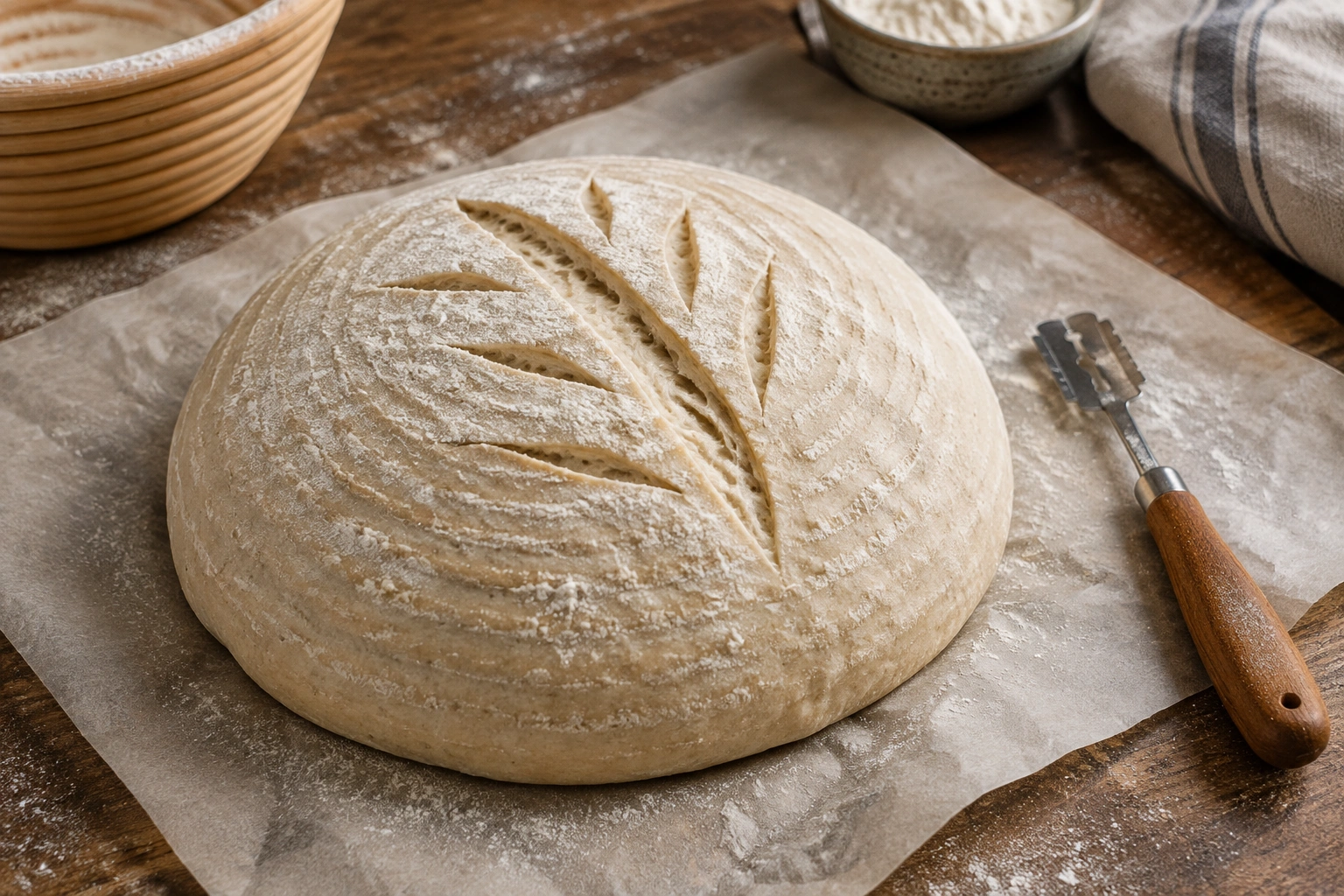
Scoring mainly affects expansion, shape, and crust appearance rather than flavor. It does not fundamentally change the taste of the bread, though it can influence how evenly the crust develops and how the loaf finishes in the oven.
But scoring is not just about looks. It affects how the loaf opens in the oven, where pressure escapes, and how the crust sets in those first crucial minutes of baking. In other words, the slash is doing structural work, not just decorative work.
As Ethan Baker, I like to think of scoring as the moment where shaping and baking shake hands. The dough has been developed, fermented, and proofed. Now it needs a clear invitation to expand.
What Bread Scoring Is and Why Bakers Do It
Scoring means making shallow cuts in the surface of shaped dough just before baking. Those cuts can be a single slash, a cross, diagonal lines, or a more decorative pattern, depending on the loaf.
The practical reasons are straightforward:
- It gives the dough a controlled place to expand.
- It helps reduce random tearing or side blowouts.
- It can improve the finished shape and visual appeal.
That last point matters, but it’s secondary to structure. In general, scoring helps guide the loaf’s expansion and gives the crust a more intentional finish.
Think of an unscored loaf like a balloon with no easy escape route. Pressure builds where the crust is weakest, and the bread may rupture on the side or bottom instead of opening where you hoped. Scoring creates a deliberate weak point so the loaf can bloom in a more predictable direction.
How Scoring Affects Oven Spring, Crust, and Crumb
The reason scoring works comes down to what happens in the oven during the first few minutes of baking.
As heat reaches the dough, gases inside expand and the yeast activity continues briefly before the loaf sets. At the same time, steam in the dough and oven environment helps keep the outer skin flexible for a short window. Once the crust firms up, the loaf can no longer expand as freely.
That timing is everything. A well-placed score gives the loaf a controlled opening before the crust locks in. Without it, the dough may split wherever pressure wins the race.
Here’s the simple version:
- Before the crust sets: the loaf can still expand.
- At the score: the dough opens where you intended.
- After the crust sets: expansion slows and shape becomes fixed.
This is why scoring can influence oven spring. The cut doesn’t create the spring by itself; it directs the spring you already have. A strong, well-fermented dough with good surface tension will still need a place to open. The score is that release valve.
Scoring can also affect the crust. A clean slash often produces a more attractive bloom and a more even crust pattern. In some loaves, it can even help avoid thick, torn edges where the dough burst unpredictably. The crumb is influenced indirectly: when the loaf expands more evenly, the internal structure is more likely to develop without being compressed by a random rupture.
When Bread Needs Scoring and When It Doesn’t
Not every loaf needs the same kind of scoring, and some doughs barely need it at all.
Lean doughs usually need intentional scoring
Lean doughs are breads made with little or no fat, sugar, or dairy. Think sourdough boules, bâtards, baguettes, and many hearth loaves. These doughs often have strong oven spring and a firm outer skin, so scoring is usually important for directing expansion.
Enriched doughs may need little or no scoring
Brioche, soft dinner rolls, and many sandwich-style enriched doughs behave differently because butter, milk, eggs, or sugar soften the dough structure. These loaves often expand in a gentler, more uniform way. Some are scored lightly; others are baked in pans and don’t need scoring at all.
High-hydration doughs need confident scoring
Sticky, wetter doughs can expand beautifully, but they also demand a very sharp blade and a quick hand. If the cut drags, it can deform the surface instead of opening cleanly.
Decision rule for home bakers
Ask yourself three questions:
- Is the loaf free-form or in a pan? Free-form loaves usually benefit more from scoring.
- Is the dough lean and elastic? Lean doughs usually need a planned opening.
- Do you want a controlled bloom or a soft, uniform top? A dramatic bloom calls for scoring; a tender enriched loaf may not.
A simple rule of thumb: artisan hearth loaves and baguettes usually need scoring; sandwich loaves in pans usually do not; enriched doughs are often optional or lightly scored at most.
If the loaf is shaped to hold itself, scoring is usually part of the plan. If the loaf is soft, rich, or already constrained by a pan, scoring may be minimal or unnecessary.
Tools for Scoring Bread: Lame, Razor, or Knife
The best tool is the one that gives you a clean cut with control. That said, the tools are not equal.
| Tool | Strengths | Trade-offs | Best for |
|---|---|---|---|
| Lame | Very sharp, precise, easy to angle | Requires a little practice and careful handling | Most artisan loaves, sourdough, baguettes |
| Razor blade | Extremely sharp, inexpensive, very clean cuts | Less comfortable to hold safely unless mounted | Confident bakers who want a crisp slash |
| Sharp knife | Easy to find in any kitchen | Often drags more than a blade made for scoring | Casual home baking, sandwich loaves |
| Bread knife | Already in the kitchen | Serrations tend to tear rather than slice | Usually not the first choice for scoring |
A lame is often the most reliable option because it’s designed for controlled scoring. A razor can work just as well if used carefully. A kitchen knife can do the job in a pinch, but if the blade is not truly sharp, it may tug at the dough and deflate the surface.
Safety matters here. These blades are sharper than they look, and a confident grip is better than a rushed one. Keep your hand out of the cutting path, and don’t force the blade through resistant dough.
How to Score Bread Step by Step
The best scoring happens after final proofing and just before the loaf goes into the oven. Have your blade ready before you un-mold or load the dough so you can score it immediately before baking. You want the dough relaxed enough to open, but not so overproofed that it collapses when touched.
1. Check the proof
A properly proofed loaf should feel airy and slightly springy, not dense and tight. If it’s underproofed, the cuts may close up or the loaf may burst later. If it’s overproofed, the dough may deflate easily and lose oven spring.
2. Prepare the blade
Use a very sharp lame or razor. A dull blade can leave ragged cuts. Ragged cuts often seal unevenly or drag the dough surface.
3. Support the loaf
Place the dough where you can score it without awkward reaching. A banneton, proofing basket, or parchment-lined tray can help you move smoothly from cut to oven.
4. Make a confident motion
Don’t saw through the dough. Use one clean motion. Hesitation usually creates drag, and drag can collapse the surface tension you worked to build.
5. Control the depth
For many hearth loaves, a shallow-to-moderate slash is enough to guide expansion. Too shallow, and the loaf may tear elsewhere. Too deep, and you can weaken the structure and reduce lift.
A useful mental picture: you are opening the skin, not carving into the body of the loaf.
6. Angle the blade when needed
For a classic bloom on a boule or bâtard, a slightly angled cut can help create a lifted “ear.” A more vertical cut tends to open more directly. The angle changes the way the crust peels back, so choose it based on the look and behavior you want.
Practical score-depth guide
These ranges are approximate, but they help home bakers choose a starting point:
- Baguettes: about 6–10 mm deep, with overlapping diagonal cuts.
- Boules and bâtards: about 6–12 mm deep, often with one main angled slash.
- Sandwich loaves baked free-form: about 3–6 mm deep, usually a single centered slash.
- Enriched doughs: about 3–5 mm deep if scoring is needed at all.
- Very delicate or fully proofed loaves: use the shallow end of the range and score quickly to avoid collapse.
As a general rule, shallow scoring gives a more restrained opening, while deeper scoring creates a more dramatic bloom but can weaken the loaf if overdone.
Best Scoring Patterns for Common Loaf Styles
Scoring patterns should match the loaf’s shape and how it wants to expand.
Boules
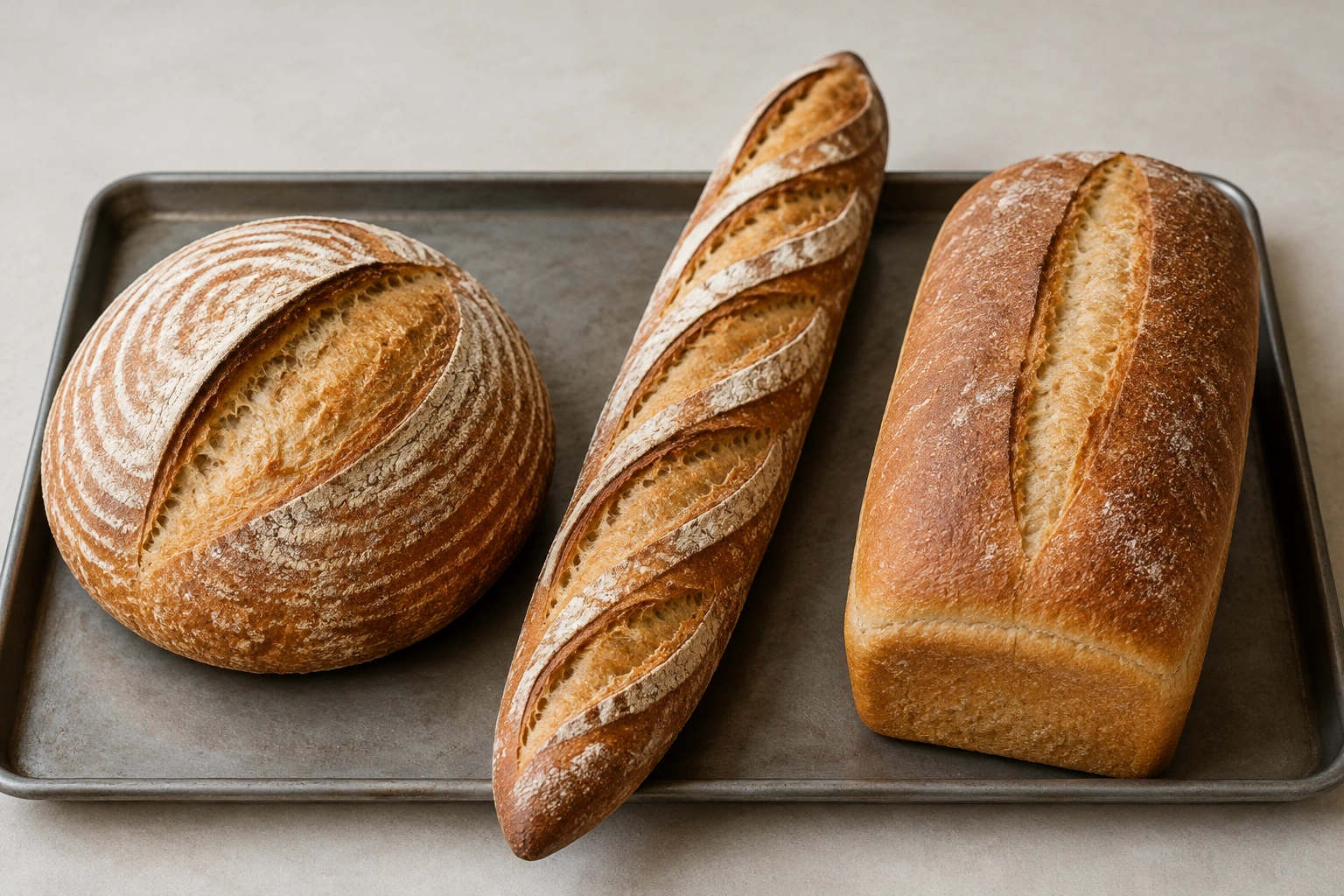
A round loaf often does well with one main slash or a small number of overlapping cuts. One deep-ish angled slash can encourage a dramatic bloom. This is a functional choice first and a decorative one second.
Baguettes
Baguettes usually need a series of overlapping diagonal cuts along the length of the loaf. Those cuts help the loaf expand in a controlled way without splitting unpredictably down the center.
Sandwich loaves
Free-form sandwich loaves often do well with a single centered slash. If the loaf is in a pan, scoring may be minimal or unnecessary. The pan itself already controls expansion.
Enriched doughs
Brioche and similar doughs often need little scoring, especially when baked in molds, pans, or as rolls. If you do score them, keep it light and purposeful. Too much cutting can interfere with the tender structure.
Decorative vs. functional scoring
Decorative scoring can make a loaf beautiful, but it should never fight the dough’s structure. If a pattern looks impressive but doesn’t give the loaf room to expand, it may work against the bake. Functional scoring is the real priority.
Shallow vs. Deep Scoring: What Changes?
| Scoring style | Typical depth | Best effect | Main risk |
|---|---|---|---|
| Shallow scoring | about 3–6 mm | More controlled opening, less structural disruption | May not open enough if the dough has strong oven spring |
| Deep scoring | about 6–12 mm | Bigger bloom and more dramatic ear | Can weaken the loaf or reduce lift if overdone |
| Single slash | Usually one main cut | Clean, simple expansion path | May be too limited for long or highly active loaves |
| Multiple slashes | Several overlapping cuts | Better for baguettes and elongated loaves | Can overcomplicate the pattern if the loaf only needs one opening |
If you want a restrained, tidy loaf, choose shallower cuts. If you want a more dramatic bloom, use a slightly deeper cut within the range that still preserves structure. For baguettes and other long loaves, multiple slashes usually work better than a single one. For boules and bâtards, one well-placed slash is often enough.
Common Scoring Mistakes and How to Avoid Them
Most scoring problems come from timing, blade quality, or overthinking the cut.
Scoring too late
If the dough goes into the oven before it’s scored, the crust may set unevenly and the loaf may rupture on its own. That often happens when the baker hesitates at the loading stage.
Fix: Have the blade ready before the dough leaves the proofing area.
Using a dull blade
A dull knife drags. Dragging can flatten the surface and leave jagged cuts.
Fix: Use a sharper tool than you think you need.
Cutting too shallow
A timid slash may look neat but fail to direct expansion.
Fix: Commit to a clean cut that actually opens the skin.
Cutting too deep
A slash that goes too far can weaken the loaf and reduce the structure needed for oven spring.
Fix: Aim to open the outer layer, not slice through the loaf.
Wrong angle for the loaf
A vertical cut and an angled cut do different jobs. If you want a lifted ear, a more angled slash usually works better than a straight-down cut.
Fix: Match the angle to the loaf style, not to habit.
Troubleshooting Poor Oven Spring, Blowouts, and Deflated Dough
If a loaf bursts on one side, the score was probably not giving the dough a clear enough path. That can happen for several reasons, and the cause is not always the same.
If the loaf was underproofed
An underproofed loaf still has a lot of spring left, but the dough may be too tight to open cleanly. It can burst at the weakest point or spring unevenly.
Clue: The loaf feels dense, tight, or resistant before baking.
If the loaf was overproofed
If the dough has already exhausted much of its strength, it may not respond well to scoring. The loaf can spread, deflate, or open weakly.
Clue: The dough feels fragile, overly slack, or collapses easily when touched.
If the shaping tension was weak
A loose shaped loaf may not hold a clean score because the outer skin is not tight enough to support the cut.
Clue: The loaf spreads sideways before baking or looks slack after proofing.
If the score was too shallow
A cut that is too shallow may not open enough during baking, so the pressure escapes elsewhere.
Clue: The loaf tears at the side or bottom instead of blooming at the slash.
If the score was too deep
A cut that is too deep can weaken the loaf and reduce the lift you want.
Clue: The loaf opens, but it spreads too much or loses height.
If the blade dragged
Sticky dough and a dull blade often make ragged scoring worse. The cut may smear rather than open.
Clue: The slash looks torn, uneven, or sealed back down.
A practical way to diagnose the issue is to ask: did the loaf expand where I planned, or did it escape somewhere else? If it escaped elsewhere, the score, the proof, the shaping, or the blade is likely the issue.
Practical Examples: How to Score Different Types of Bread
Sourdough boule
A sourdough boule often benefits from one main angled slash across the top. That cut gives the loaf a controlled opening and can produce a pronounced bloom. If the dough is very active and well proofed, the slash should be confident and quick.
Baguette
A baguette usually gets several diagonal cuts, each slightly overlapping the next. The goal is to guide expansion along the length of the loaf rather than letting it split randomly.
Sandwich loaf
A shaped sandwich loaf may only need one centered slash if it is baked free-form. If it’s baked in a pan, scoring may be unnecessary because the pan already controls the rise.
Brioche
Brioche often needs little to no scoring, especially in pans or as rolls. The rich dough tends to expand more softly, and a deep score can be more harmful than helpful.
High-hydration artisan loaf
For a wetter dough, use a very sharp lame and a confident motion. The cut should be decisive enough to avoid dragging. In these loaves, hesitation is often the real enemy.
A Simple Way to Decide Before You Bake
Before scoring, run through this quick check:
- Free-form loaf? Probably score it.
- Lean dough? Usually score it.
- Rich, soft dough in a pan? Maybe not.
- Want dramatic bloom? Use a purposeful angled slash.
- Want a softer, more uniform top? Keep scoring minimal.
That little checklist is often enough to prevent the most common mistakes.
When to Consult a Master Baker
If your loaves keep bursting in the same spot, collapsing after scoring, or opening poorly despite good proofing, it may be time for a second set of eyes. A master baker can help you evaluate shaping tension, dough maturity, and the timing of your score in relation to fermentation and oven loading. Sometimes the cut is not the real problem; it’s the loaf preparation leading up to it.
Final Thoughts
Scoring bread is one of those small techniques that reveals a lot about the baker’s understanding of dough. It directs expansion, reduces random tearing, and helps the loaf finish with better shape and a more intentional crust. Once you understand why bread is scored, the cut stops feeling mysterious and starts feeling like part of the loaf’s architecture.
The best scores are usually the ones made with confidence, at the right moment, with a blade sharp enough to do the work cleanly. That’s when the dough can do what it was built to do: rise beautifully.
For a deeper step-by-step walkthrough, see our guide on how to score bread for better oven spring and cleaner loaves.