
Why Yeast Needs Time to Ferment Bread Dough: A Practical Guide for Better Bread
When bread dough is mixed, yeast does not instantly create the structure, flavor, and rise you want in the finished loaf. It needs time to work through the dough, consume available sugars, and produce the gas and byproducts that transform a sticky mass into bread with volume, texture, and character.
If you have ever wondered why a recipe asks you to wait before shaping or baking, the answer is fermentation. That waiting period is not wasted time. It is when the dough develops the strength and aeration it needs to bake well.
For home bakers, this is one of the most useful bread lessons to understand. Once you know what fermentation is doing, you stop treating the clock as the only guide and start reading the dough itself.
What fermentation means in bread dough
Fermentation is the stage where yeast feeds on sugars in the dough and produces carbon dioxide, alcohol, and flavor compounds. In practical baking terms, that means the dough expands, becomes more aromatic, and changes from rough and tight to more elastic and lively.
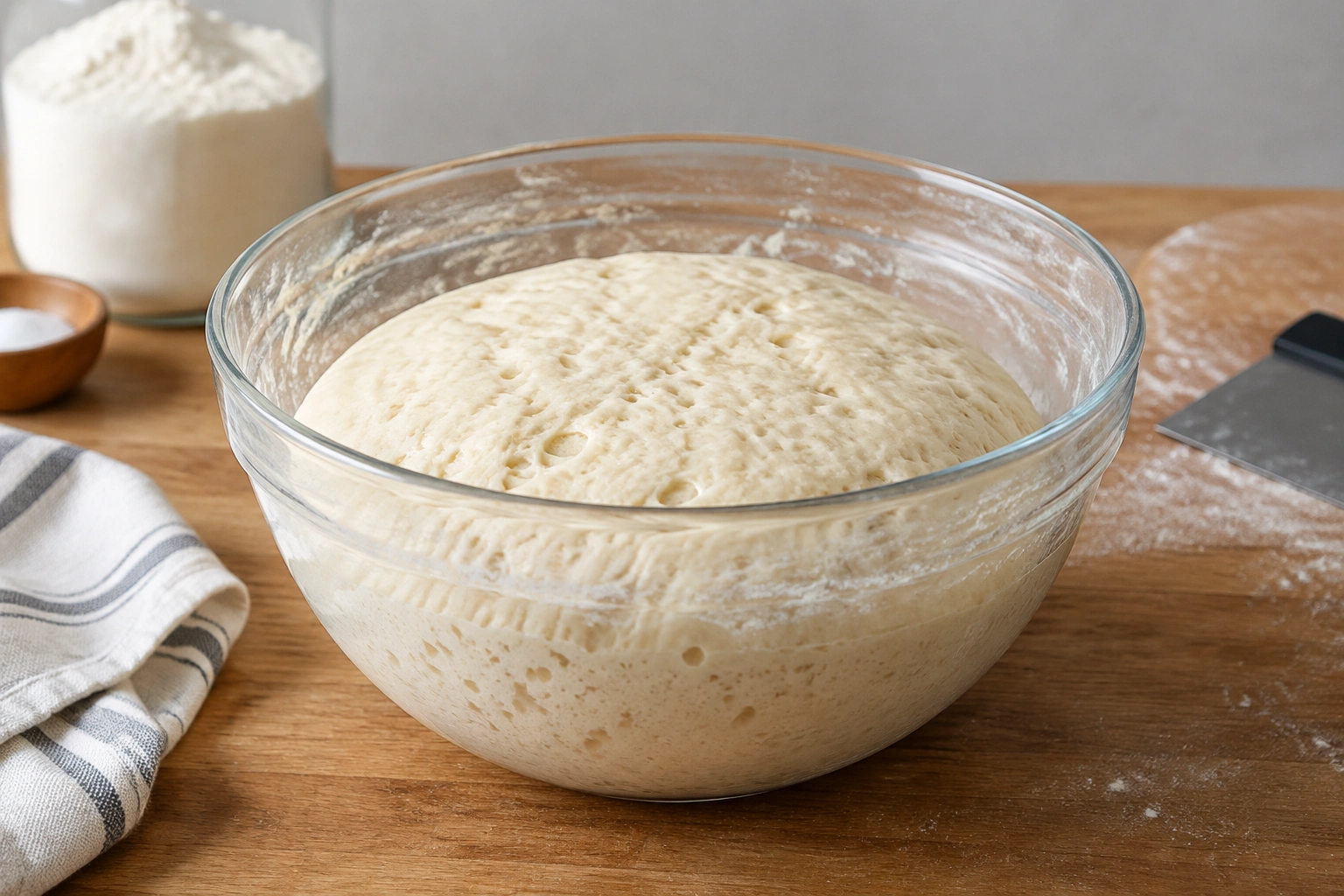
Yeast does not work in isolation. It is part of a larger dough system that includes flour, water, salt, and time. Flour provides starches that enzymes break down into simpler sugars. Yeast uses those sugars as fuel. As gas builds, the dough inflates. As time passes, the dough also becomes more extensible and easier to shape.
That is why fermentation is more than “letting dough rise.” Rise is one visible result. Flavor and structure are the less obvious results, and they matter just as much.
Fermentation vs. proofing: what’s the difference?
Fermentation is the broader process of yeast activity in dough, including both the first rise and the final rise. Proofing usually refers to the final rise after shaping, though some bakers use the terms loosely.
A simple way to separate them is this:
- Bulk fermentation happens before shaping and builds most of the dough’s gas and strength.
- Proofing happens after shaping and gives the loaf its final rise before baking.
So if you are asking, “Is proofing the same as fermentation?” the practical answer is no, but proofing is part of fermentation.
What yeast is doing during fermentation
Yeast is a living organism, so it needs time to metabolize the sugars it can access in dough. As it feeds, it releases carbon dioxide, which gets trapped in the dough’s gluten network and creates the rise you see. It also produces alcohol and other compounds that contribute to bread’s flavor and aroma.
This process does not happen all at once. At first, the dough may seem quiet. Then gas production becomes more noticeable, the dough expands, and the surface often looks smoother and more inflated. That gradual change is part of the point: fermentation gives the dough time to build enough gas and enough internal structure to hold it.
A useful way to think about it is this: yeast makes the gas, but the dough has to be ready to hold the gas. Time helps both sides of that equation.
Why waiting improves both structure and flavor
Bread improves during fermentation for two main reasons: the dough structure becomes more capable of holding gas, and the flavor becomes more developed.
Time helps gluten relax and strengthen
When flour and water first come together, the dough can feel tight. As fermentation continues, the gluten network becomes more organized and the dough becomes easier to stretch without tearing. At the same time, the gas produced by yeast gently inflates the dough and encourages a lighter crumb.
This is why a dough that has had enough fermentation often feels airier and more elastic than one baked too soon. The dough is not just bigger; it is better prepared to expand in the oven.
Time builds flavor
Freshly mixed dough often tastes less developed or less complex. Fermentation changes that. As yeast and enzymes work, the dough develops more complex aromas and a deeper bread flavor. This is especially noticeable in lean doughs, where there are fewer enriching ingredients to mask those flavors.
A quick rise can make bread technically baked, but it often tastes simpler. Longer, controlled fermentation usually gives a more complete flavor profile.
Bulk fermentation vs. final proof
These two stages are related, but they are not the same.
Bulk fermentation
Bulk fermentation is the first rise, after mixing and before shaping. This is when the dough develops most of its gas and strength as a mass. During bulk fermentation, you are looking for expansion, aeration, and a dough that feels more active than it did at mixing.
Final proof
Final proof happens after shaping. The dough has already been divided and formed into its final shape, and now it needs time to rise again before baking. This stage matters because shaping tightens the dough. The final proof gives it a chance to relax and expand enough to bake properly.
A common mistake is treating both stages as interchangeable. They are not. A dough can be ready to shape after bulk fermentation but still need more time after shaping before it is ready for the oven.
How to tell when dough has fermented enough
The clock can help, but it cannot tell you everything. Dough readiness is better judged by look, feel, and volume.
Here are practical signs to watch for:
- The dough has increased in volume, often by about 50% to 75% in bulk fermentation for many everyday doughs, though some formulas call for less or more.
- The surface looks smoother and less dense than when it was mixed.
- The dough feels lighter and slightly puffy when handled.
- When you gently shake the bowl or container, the dough looks softly jiggly and aerated rather than stiff and compact.
- When you gently press it, the dough springs back slowly rather than snapping back immediately.
- Bubbles may be visible along the sides or surface, especially in wetter doughs.
- If you pull a small edge of dough, it should feel extensible rather than rubbery and resistant.
For final proof, the signs are a little different:
- The shaped dough looks fuller and slightly domed, not tight or flat.
- A gentle fingertip press leaves an indentation that springs back slowly and partially, rather than bouncing back at once.
- The loaf feels airy and relaxed when you lift or move it, but it still has enough structure to hold its shape.
- In a banneton or proofing basket, the dough may rise close to the rim or show a visibly puffed surface, depending on the recipe.
If the dough still feels tight, heavy, and resistant, it likely needs more time. If it feels fragile, overly loose, and prone to collapsing, it may have gone too far.
The best habit is to use the recipe’s timing as a range, then let the dough tell you where it is within that range.
Underfermented, properly fermented, and overfermented dough
| Dough stage | What it looks and feels like | What happens in the bake | Practical takeaway |
|---|---|---|---|
| Underfermented | Dense, tight, limited expansion, little aeration | Smaller loaf, thicker crumb, less flavor development | Give it more time before shaping or baking |
| Properly fermented | Puffy, elastic, aerated, responsive to gentle touch | Better rise, better texture, fuller flavor | Shape or bake when readiness cues are present |
| Overfermented | Very slack, overly gassy, fragile, may deflate easily | Weaker structure, poor oven lift, flatter loaf | Move quickly if it still has strength, or adjust next time |
Underfermentation is usually easier to fix than overfermentation. If the dough is simply underexpanded, more time often helps. Once the dough has lost strength, the structure is harder to recover.
A practical fermentation-time guide by dough type
Fermentation time depends on formula, temperature, and handling, but these ranges can help you plan more realistically.
| Dough type | Room temperature fermentation | Refrigerator fermentation | What to watch for |
|---|---|---|---|
| Lean doughs | Often the fastest, sometimes a few hours for bulk plus proof depending on the recipe | Often overnight or longer, with slower movement and more scheduling flexibility | Look for visible expansion, bubbles, and a dough that feels lighter but still strong |
| Enriched doughs | Often slower than lean doughs, and usually needs more patience | Can take longer in the fridge because fat, sugar, and eggs may slow visible rise | Watch for gradual puffing and softness rather than dramatic expansion |
| Sourdough | Highly variable; some doughs move steadily, others need much longer depending on starter strength and temperature | Often used for extended cold fermentation, but timing varies widely by formula | Judge by dough volume, aeration, and feel rather than the clock alone |
These are practical ranges, not fixed rules. A strong starter, warm kitchen, high hydration, or very active dough can all shorten the timeline. A cooler room, weaker starter, or richer formula can extend it.
How temperature changes fermentation speed
Temperature has a major effect on how quickly yeast works. Warm dough ferments faster. Cooler dough ferments more slowly. That sounds simple, but the practical effect is important: two doughs made from the same recipe can behave very differently depending on the room temperature, water temperature, and whether the dough is kept at room temperature or refrigerated.
Warm fermentation can be convenient when you want bread on the same day. The trade-off is that the dough moves faster and becomes less forgiving if you miss the right moment.
Cold fermentation slows everything down. That gives you more scheduling flexibility and often a more developed flavor, but it requires planning ahead.
If your kitchen runs warm, expect fermentation to move quickly. If your kitchen is cool, the dough may need more time than the recipe suggests.
How flour type, hydration, and yeast amount affect timing
Fermentation time is not controlled by yeast alone. Several dough variables change how fast the process moves.
Flour strength
Stronger flours generally hold gas better and can often support longer fermentation, but flour strength is only one part of the picture. Protein quality, hydration, and dough handling also affect how well a dough tolerates fermentation. Softer flours may not behave the same way, and whole grain flours can also act differently because they contain more bran and germ, which affect absorption and dough behavior.
Hydration
Higher-hydration doughs tend to ferment differently from stiffer doughs. They often feel softer and may show bubbles and expansion more visibly. Lower-hydration doughs can ferment more slowly in appearance because they are firmer and less extensible, even when yeast is active.
If you want to dig deeper into how flour absorbs water and why that affects dough consistency, our guide on how to measure water absorption of bread flour is a useful companion.
Yeast amount
More yeast usually speeds up fermentation, while less yeast slows it down. That does not automatically make more yeast better. Faster dough can be harder to monitor and may develop less flavor. Lower yeast levels often give you more time and better flavor, but they demand patience.
The main point is this: fermentation time is a result of the whole formula, not just the yeast packet.
Warm fermentation vs. cold fermentation
Both methods can produce excellent bread, but they serve different goals.
Warm fermentation
Warm fermentation is useful when you want a faster schedule and are able to watch the dough closely. It can be efficient for same-day sandwich loaves or other breads where a shorter timeline makes sense.
The drawback is control. Dough can move from underfermented to overfermented quickly if the room is warm or the dough is especially active.
Cold fermentation
Cold fermentation is slower because refrigeration reduces yeast activity. That slower pace gives the dough more scheduling flexibility and often supports a deeper flavor.
This method is especially useful for doughs like pizza dough, where overnight refrigeration can make the dough easier to handle and more flavorful the next day. A practical example is a dough mixed in the evening, held in the refrigerator, then brought back to workable temperature before shaping and baking.
If you want a broader look at planning dough ahead, our article on how to make cookie dough ahead of time shows the same general idea of using time and temperature to improve results.
How fermentation differs in lean doughs, enriched doughs, and sourdough
Not every dough ferments at the same pace.
Lean doughs
Lean doughs contain little or no sugar, fat, or eggs. They often ferment more predictably and may show clear activity sooner, especially in formulas with strong flour and moderate hydration. Many artisan breads fall into this category.
Enriched doughs
Enriched doughs contain ingredients such as sugar, butter, milk, or eggs. These ingredients can slow fermentation or make it less straightforward to judge. Enriched doughs often need more patience because the added ingredients affect how yeast behaves and how the dough feels.
Sourdough
Sourdough fermentation is different because it relies on a starter containing wild yeast and lactic acid bacteria. In practice, it can be slower or faster depending on starter strength, temperature, and formula, so it usually needs careful observation rather than a fixed commercial yeast timeline.
If you are comparing dough styles, the key rule is simple: lean doughs often move faster, enriched doughs often need more time, and sourdough usually asks for the most attention to the dough itself.
Practical rules for deciding whether to shape, proof, or bake
When you are unsure what to do next, use the dough’s condition as your guide.
- If the dough is dense and tight after bulk fermentation: give it more time before shaping.
- If the dough has expanded, feels lighter, and shows bubbles: it is likely ready to shape.
- If the shaped dough looks puffy, slightly domed, and relaxed: it may be ready for the oven.
- If a fingertip press leaves a slow, partial spring-back: the final proof is likely close.
- If it feels fragile and deflates easily: it may have gone too far and should be handled gently.
One useful habit is to check the dough at intervals rather than waiting until the end of a fixed timer. That gives you a better sense of how your kitchen, flour, and recipe are behaving together.
For bakers who want to understand formulas more precisely, our guide on how to calculate baker’s percentages for bread helps you see how flour, water, yeast, and salt affect fermentation from the beginning.
A simple way to think about yeast timing
If you want one practical takeaway, make it this: yeast needs time because bread is not just a chemistry reaction. It is a living dough system that has to build gas, strength, and flavor at the same time.
Bake too early, and the dough often tastes less developed and bakes up dense. Wait until the dough shows real fermentation cues, and you give it the chance to become bread instead of just risen dough.
FAQ: Bread fermentation basics
Is proofing the same as fermentation?
Not exactly. Proofing is a stage of fermentation, usually referring to the final rise after shaping. Fermentation is the broader process that includes bulk fermentation and proofing.
Why can’t I bake bread right after mixing the dough?
Because the dough has not had time to produce enough gas, develop structure, or build flavor. Straight from mixing, it is usually too tight and underdeveloped to bake well.
How long should bulk fermentation take?
That depends on temperature, flour, hydration, yeast amount, and dough style. Use the recipe’s timing as a guide, but judge readiness by volume, feel, and aeration.
What should properly fermented dough feel like?
It should feel lighter, more elastic, and slightly airy rather than dense or rubbery. In bulk, it often looks expanded and jiggly; after shaping, it should hold its form but still feel relaxed.
What happens if dough ferments too long?
Overfermented dough can become weak, overly slack, and prone to deflating. It may bake up flatter and with less structure than a properly fermented dough.
Does cold fermentation improve flavor?
Often, yes. Slower fermentation usually gives the dough more time to develop flavor. It also makes scheduling easier, which is why many bakers use the refrigerator intentionally.
Why does enriched dough ferment more slowly?
Sugar, fat, and eggs change how yeast behaves and how the dough holds gas. Enriched doughs often need more time and closer observation than lean doughs.
When to Consult a Pastry Chef
If your dough repeatedly ferments unevenly, collapses before baking, or behaves very differently from the recipe’s expected range, a pastry chef or experienced bread instructor can help you diagnose the formula and technique. That is especially useful with enriched doughs, sourdough, or breads made in kitchens with frequent temperature swings.

