
How to Use the Windowpane Test to Judge Bread Dough Like a Pro

If you’ve ever wondered whether your dough is kneaded enough, the windowpane test is a practical way to find out. It’s a simple check for gluten development: stretch a small piece of dough gently until it becomes thin enough to let light through. If it stretches into a delicate membrane without tearing right away, the dough is usually developed enough for the next stage.
That said, this is not a rigid pass/fail exam. As King Arthur Baking notes, the windowpane test shows the stage of dough development, not just a yes-or-no answer. In practice, that makes it useful for home bakers and culinary students alike, because it helps you decide whether to keep kneading, let the dough rest, or move on to bulk fermentation. King Arthur Baking’s explanation is especially helpful on this point.
What the Windowpane Test Is and Why It Matters
Bread dough gets structure from gluten, the network formed when flour proteins hydrate and are worked together. Kneading aligns and strengthens that network. The windowpane test simply checks whether that structure is developed enough to hold gas, stretch during fermentation, and support a good loaf shape.
Here’s the practical value: dough that tears immediately is usually still weak or underdeveloped. Dough that stretches thin and translucent is generally stronger and more elastic. That doesn’t mean “perfect” in every case, but it does mean the dough has likely reached a useful stage for bread making.
A useful mental model is this:
- Weak dough breaks quickly and feels rough or ragged.
- Developing dough stretches farther but still tears at the edges.
- Well-developed dough forms a thin, light-catching membrane before breaking.
For a lean white bread dough, that membrane can become surprisingly sheer. For enriched or whole wheat dough, the result may look less dramatic, and that’s normal.
When to Use the Windowpane Test
The best time to test is after the dough has had enough mixing or kneading to start developing strength, not at the very beginning. If you test too early, the result can be misleading because the gluten network simply hasn’t had time to form.
The test is especially useful after initial mixing and kneading, after autolyse if your dough uses one, and before bulk fermentation. That’s when it can tell you whether the dough has enough structure to move forward.
A good rhythm is:
- Mix until the dough comes together.
- Knead for a while.
- If the recipe includes autolyse, let that rest happen first, then continue mixing or kneading.
- Pause and test a small piece.
- If needed, rest the dough briefly and test again.
Dough that feels tight from recent kneading may tear sooner than the same dough after a short rest. Resting gives the gluten time to relax, which often makes the next stretch more informative.
A practical example: a dough that tears after six minutes in a stand mixer may not be “bad.” It may just need a short rest before you test again. In many cases, the dough becomes easier to stretch after a short rest, though the exact timing depends on the formula and handling.
What You Need Before You Test
You don’t need special equipment. You do need the dough to be in a state where the test can tell you something meaningful.
Before you test, make sure you have:
- Clean hands
- A small piece of dough to test
- Enough kneading or resting time already completed
- A calm, gentle touch
If the dough is very cold, it may feel stiff and resist stretching. If it’s extremely sticky, that alone does not mean it is under-kneaded. Stickiness and gluten development are related, but they are not the same thing.
For sticky doughs, lightly oiling your fingers can help. I’d avoid adding much extra flour during the test, because that can change the feel of the dough and make the result harder to read.
How to Perform the Windowpane Test Step by Step
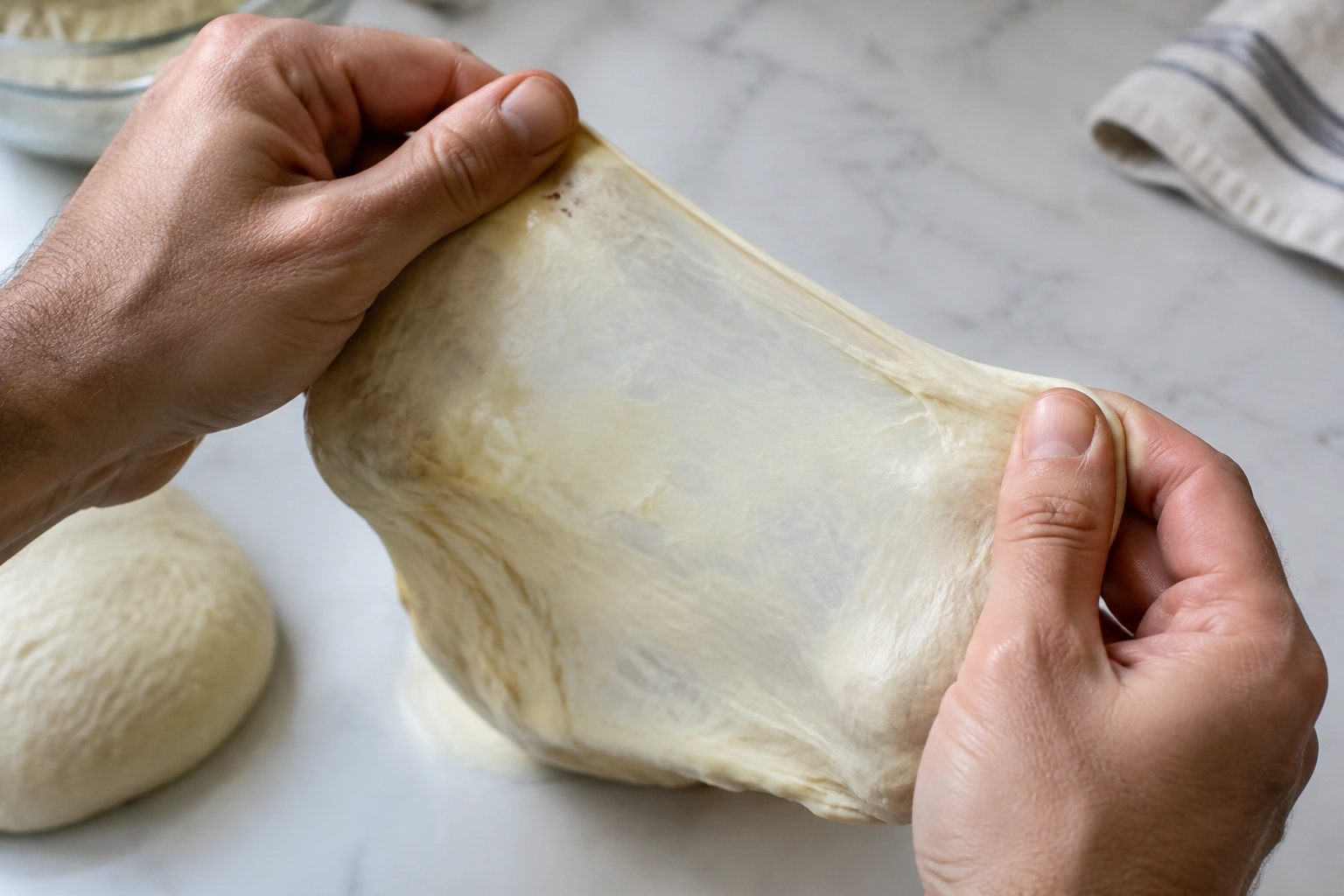
The traditional approach is to test a small piece of dough, not the whole mass. That small sample stretches more predictably and avoids the weight of the full dough interfering with the result.
1) Tear off a small piece
Take a piece about the size of a golf ball or slightly smaller. It doesn’t need to be exact, but it should be large enough to hold between both hands comfortably.
2) Hold it gently
Use both hands and support the dough from underneath with your fingers. Try not to pinch or squeeze the center too hard.
3) Stretch slowly
Pull the dough outward from the edges, rotating it slightly as you go so the center thins evenly. The goal is not to rip it open, but to stretch it into a thin sheet.
4) Watch the center
A properly developed dough will thin out in the middle and begin to look translucent. If you can almost see light through it, you’re close.
5) Stop before it tears violently
A good windowpane stretches thin before it breaks. If it tears immediately, the dough likely needs more development or rest.
A gentle touch matters more than force. If you yank the dough, even a well-developed dough can tear simply because you overstressed it.
How to Read the Result
The windowpane test is most useful when you treat it like a diagnostic chart rather than a simple pass/fail stamp.
| Result | What It Looks Like | What It Usually Means | Next Move |
|---|---|---|---|
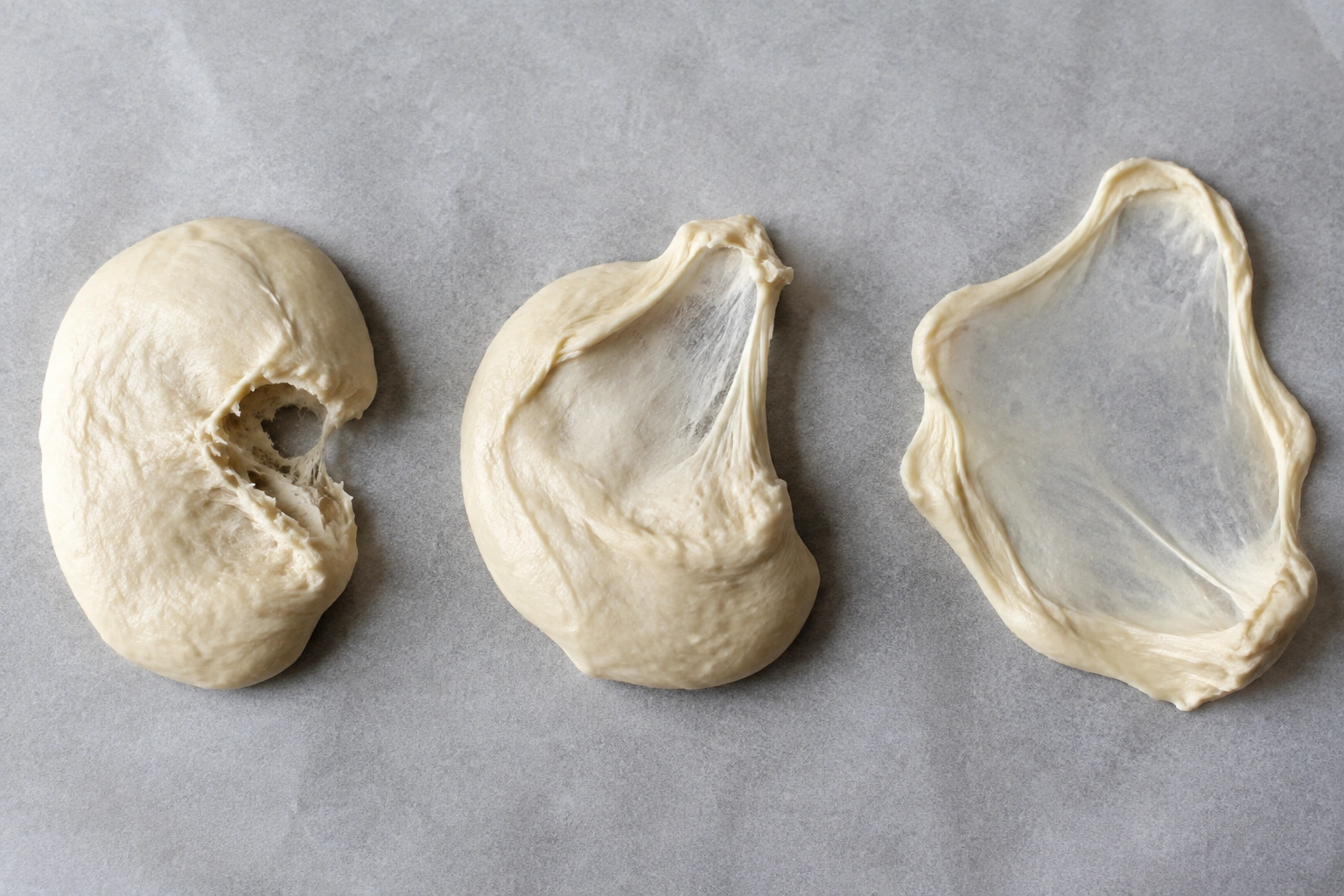
| Clear windowpane | Thin, translucent membrane stretches without tearing quickly | Gluten is well developed for that dough type | Move on to fermentation or shaping |
| Partial windowpane | Dough stretches, but the edges fray or tear before becoming very thin | Dough is developing, but not quite there yet | Knead a bit more, then retest |
| Failed test | Dough tears almost immediately or feels rough and short | Gluten is still weak, underdeveloped, or too tight from lack of rest | Knead more or rest, then retest |
A “good” result does not always mean a perfectly see-through sheet. That standard makes sense for some lean doughs, but it can be unrealistic for doughs with whole grain, butter, sugar, or other enriching ingredients.
What to Do If the Dough Tears Too Soon
If the dough tears before it forms a thin membrane, don’t assume it’s doomed. There are three common reasons:
The dough needs more kneading
This is the most straightforward explanation. The gluten network may simply not be strong enough yet. A few more minutes of kneading can make a real difference, especially in lean dough.
The dough needs a rest
Sometimes the dough is actually close, but it is too tight to stretch well. A short rest can relax the gluten and improve extensibility. This is especially useful after machine kneading.
The dough type changes the expectation
Whole wheat, enriched, and very high-hydration doughs often behave differently from standard white sandwich dough. A dough can fail a dramatic windowpane and still be ready for the next stage.
A useful decision rule: if the dough tears but feels smoother and more elastic than it did a few minutes ago, rest it and retest. If it still feels rough, weak, or shaggy, keep kneading before you test again.
How the Test Differs for Different Dough Types
This is where many bakers get tripped up. The windowpane test is helpful, but the standard changes with the dough.
Lean dough
Lean doughs, such as basic white bread or pizza dough, usually give the clearest result. They tend to stretch into a thin, translucent membrane when properly developed. This is the easiest dough type for learning the test.
Enriched dough
Brioche, milk bread, and other enriched doughs contain butter, sugar, eggs, or milk. Those ingredients can slow gluten development or make the dough feel softer and more delicate. You may still get a windowpane, but it may not look as starkly translucent as lean dough.
A practical stopping point: stop kneading when the dough is smooth, elastic, and can stretch into a thin sheet without tearing immediately, even if it stays a little opaque or soft-looking.
Whole wheat dough
Whole wheat dough often shows a less dramatic windowpane because bran can interfere with the gluten network. The dough may still be ready even if the membrane is speckled or less transparent. Expect a more modest stretch and judge the dough by both feel and structure.
A practical stopping point: stop when the dough stretches fairly well, feels cohesive and springy, and forms at least a partial windowpane before tearing.
High-hydration or sourdough dough
Very wet doughs can be tricky because they may stretch beautifully at one moment and slacken at another. Sourdough formulas also vary widely. In these cases, the test is useful, but it should be read alongside fermentation stage and overall dough strength.
For a balanced comparison, think of the test like this: lean dough often gives you a cleaner yes; enriched and whole grain doughs often give you a “yes, but with context.”
Common Mistakes That Make the Test Misleading
Some failed tests are really testing mistakes.
Pulling too hard
If you stretch aggressively, you can tear even well-developed dough. The test should be slow and controlled.
Testing too early
A dough that has just come together may still be far from ready. Early testing often produces a false negative.
Ignoring the rest period
A dough that looked disappointing right after kneading may improve after a short rest. Retesting too soon can make you think nothing has changed.
Expecting one standard for every dough
This is probably the biggest mistake. A whole wheat dough and a brioche dough should not be judged by exactly the same visual standard.
Chasing a perfect membrane
More kneading is not always better. If the dough already stretches well and feels smooth, pushing for an ultra-thin windowpane can make the dough overly warm, tight, or overworked.
What to Do After the Test
Once you’ve tested, the next step depends on what you saw.
- If the dough passes clearly: move on to bulk fermentation or shaping, depending on your recipe.
- If it is close but not quite there: knead a little more, then retest.
- If it tears because it is tight rather than weak: rest it briefly, then test again.
- If it never really develops: reassess the formula, hydration, mixing method, or the flour you’re using.
A dough that passes the test may still need fermentation time to rise and build flavor. The test tells you about structure, not final proof.
Practical Examples of Windowpane Test Results
Here are a few realistic scenarios.
Lean white bread dough
After kneading, the dough stretches into a thin sheet that lets light through before tearing. That usually means you’re in a good place to continue with fermentation.
Brioche dough
The dough stretches well and feels silky, but the membrane never becomes fully transparent because butter and sugar soften the structure. That can still be acceptable if the dough is smooth, elastic, and cohesive.
Whole wheat sandwich dough
The dough stretches fairly well, but tiny bran flecks interrupt the membrane. That partial windowpane may still be enough to proceed, especially if the dough feels strong and springy.
Stand mixer dough that looks smooth too early
A dough may look polished after a few minutes in the mixer but still tear at the first stretch. That usually means the surface has smoothed out before the gluten network is fully developed. Give it more time or a rest, then test again.
A Simple Decision Framework You Can Trust
When you’re unsure, use this three-part check:
- Does it stretch?
- Does it thin without immediate tearing?
- Does the result make sense for this dough type?
If the answer to all three is yes, the dough is probably ready for the next stage. If the dough stretches but tears too quickly, decide whether it needs more kneading or just a rest. If the dough type is enriched or whole grain, lower your expectation for a perfect translucent sheet.
When to Consult a Master Baker
If you’re working with a formula that repeatedly fails the test even after proper kneading and resting, or if a dough behaves unpredictably across batches, it may help to compare notes with a more experienced baker or instructor. That’s especially true in culinary training, where hydration, flour strength, and mixing technique can all change the outcome.
For a related kitchen skill that also depends on accuracy and calibration, you may find this guide useful: why your meat thermometer isn’t working. It’s a different tool, but the troubleshooting mindset is similar.
Final Takeaway
The windowpane test is a practical way to judge gluten development, but it works best when you read it in context. A thin, stretchy membrane usually means the dough is developed enough; a tear can mean more kneading, more rest, or simply a different expectation for that dough style.
Once you learn to combine the visual result with the dough’s feel, the test becomes less of a quiz and more of a conversation with the dough itself. That’s when bread making starts to feel much more reliable.
FAQ
What does a proper windowpane look like?
It usually looks like a thin, translucent sheet of dough that stretches before tearing. In lean doughs, light may pass through the center quite clearly.
Can dough pass the windowpane test and still need more time?
Yes. Passing the test means the dough is developed enough structurally, but it may still need fermentation time before shaping or baking.
Why does my dough tear even after kneading?
It may need more kneading, a short rest, or a different expectation based on the dough type. Whole wheat and enriched doughs often behave differently from lean dough.
Should I test the whole dough or a small piece?
A small piece is better. It gives you a cleaner read and avoids the weight of the full dough affecting the stretch.
Does the windowpane test work for sourdough?
Yes, but sourdough doughs can vary widely. Use the test along with the dough’s feel and fermentation stage rather than relying on it alone.
Can over-kneading affect the result?
It can. If you keep kneading long after the dough is already developed, it may become overly warm, tight, or harder to handle.
How long should I knead before testing?
There isn’t one universal number. Test after the dough has begun to smooth out and gain elasticity, then adjust based on what you see and feel.
Is a partial windowpane ever okay?
Absolutely. For whole wheat or enriched doughs, a partial result may be enough if the dough is strong, cohesive, and appropriate for the recipe.