
Are Air Fryer Liners Safe to Use? A Practical Guide for Home Cooks
Air fryer liners can be safe, but only when the material, temperature rating, fit, and airflow all line up with your machine and the food you’re cooking. That’s the short answer.
If you want the safest quick rule: use a liner that is made for air fryer temperatures, keep it fully inside the basket, and never let it sit loose where it can fly up into the heating element. With that in place, liners can make cleanup easier without creating unnecessary risk.
The catch is that not every liner is the same. Parchment paper, silicone, and aluminum foil each behave differently in the basket. Some are better for easy cleanup, some are better for reusability, and some need more caution because they can interfere with airflow or touch hot components.
What Air Fryer Liners Are and Why People Use Them
Air fryer liners are inserts placed in the basket or tray to catch drips, reduce sticking, and make cleanup easier. Most home cooks use them for one of three reasons:
- To keep sticky foods from clinging to the basket
- To reduce scrubbing after greasy or saucy meals
- To protect a nonstick basket from repeated wear
The main types are:
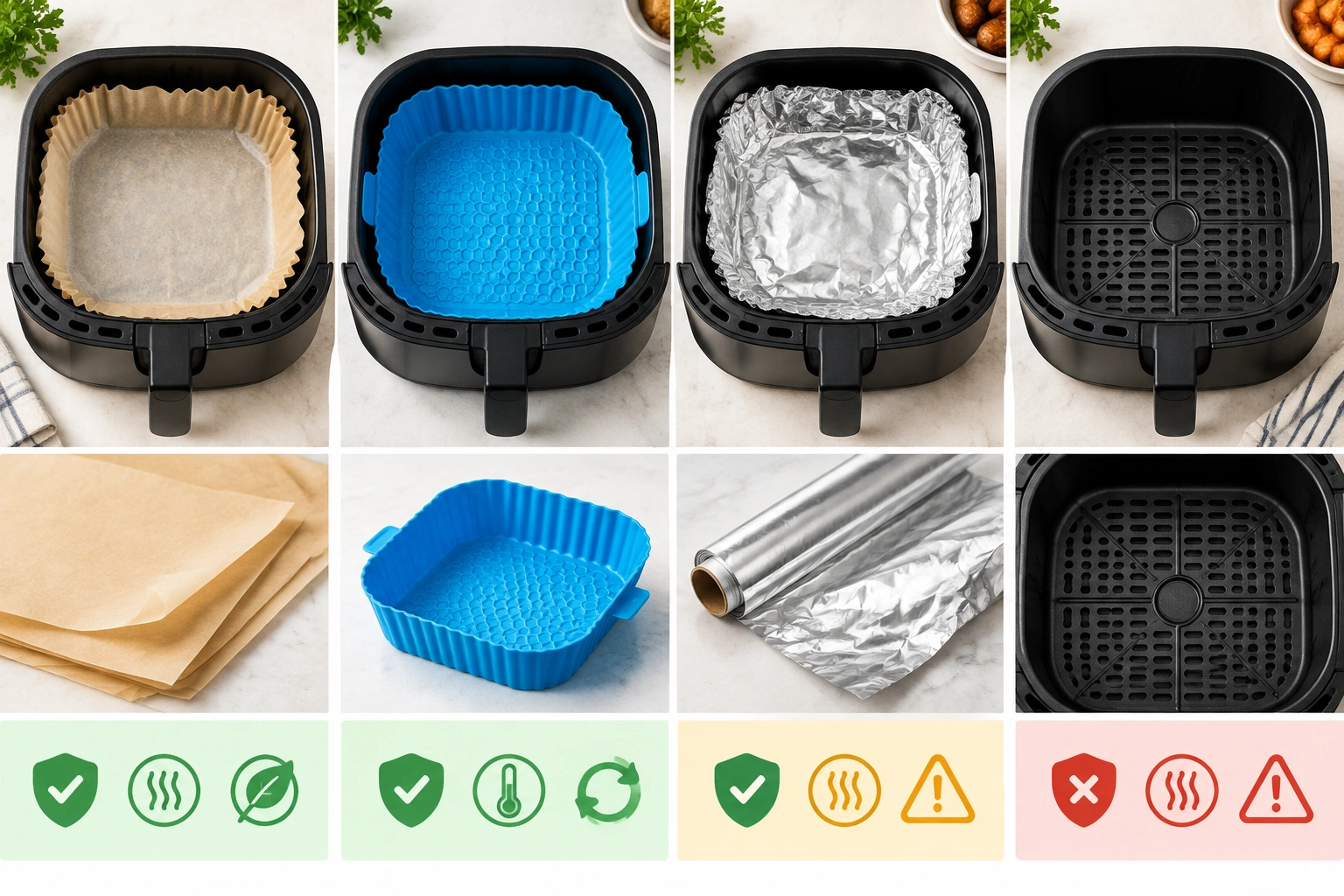
- Parchment paper liners: disposable, often perforated, and commonly sold in basket shapes
- Silicone liners: reusable, flexible inserts that sit in the basket
- Aluminum foil: not a true liner product, but sometimes used in small sections for cleanup or moisture control
A liner is not automatically safer than cooking directly in the basket. In some cases, no liner is the cleaner choice from a cooking and airflow standpoint. But if you’re making something messy, sticky, or drippy, a properly used liner can be useful.
What Makes a Liner Safe or Unsafe in an Air Fryer
Safety comes down to four practical checks.
1) Heat rating
A liner should be rated for the temperature you plan to use. That matters more than the material name on the package. Some parchment liners are described as safe up to 425°F, while Reynolds says its parchment air fryer liners are heat-safe up to 400°F on the air fryer setting when used as directed. If your air fryer runs hotter than the liner’s rating, skip it.
2) Proper fit
The liner should sit flat in the basket without curling up the sides in a way that blocks airflow or reaches the heating element. Oversized liners are a common mistake.
3) Airflow
Air fryers work by moving hot air around food. A liner that covers too much of the basket can reduce browning and crisping, especially if it is solid rather than perforated.
4) Weight and placement
A loose liner can lift and move. The safest setup is one where the food holds the liner down before the machine starts circulating air. This matters in both basket-style and toaster oven-style air fryers, though toaster oven-style models can have different liner limits because of their larger chamber and more exposed heating elements.
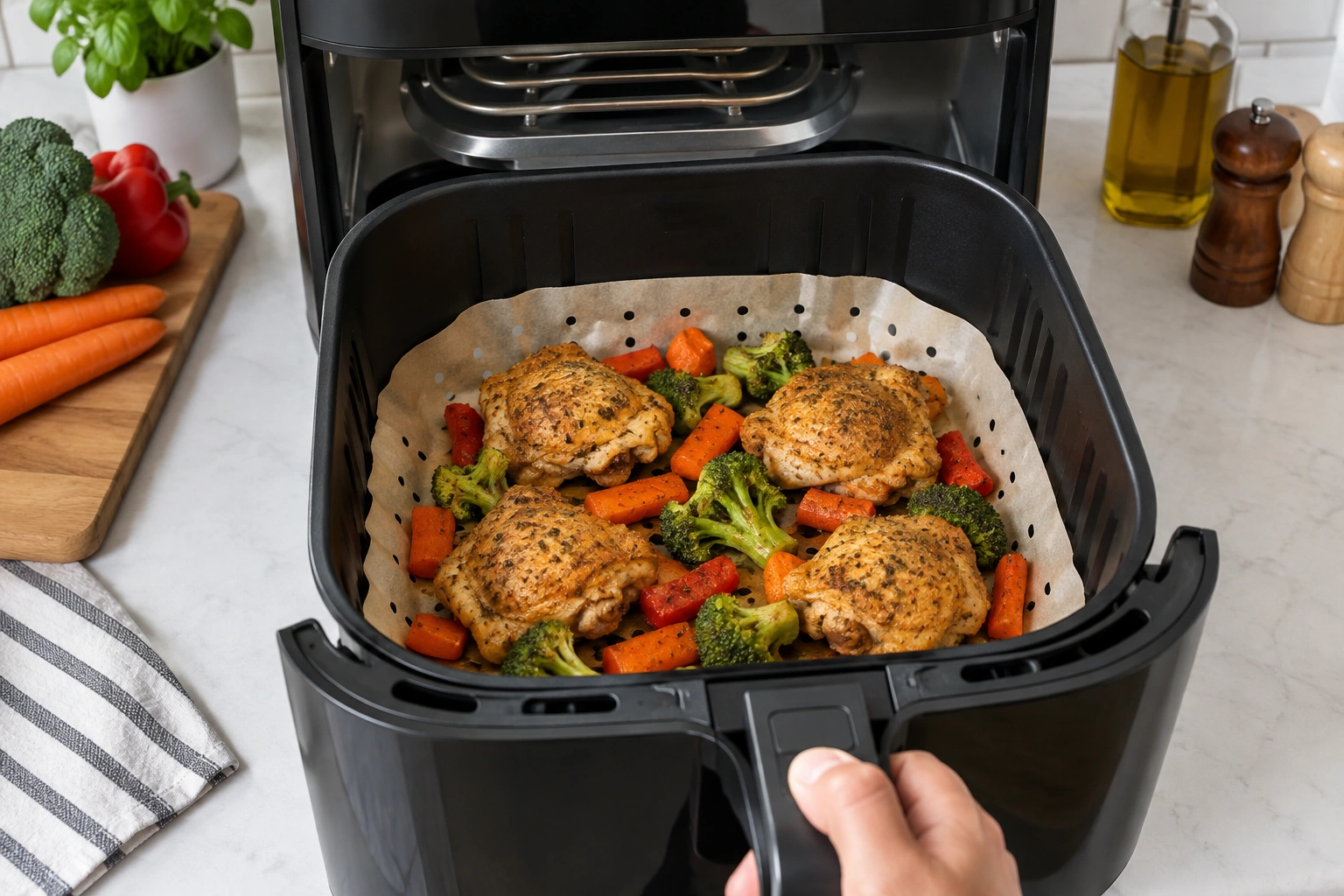
If you want a simple rule: if the liner is loose, oversized, or not covered by food, treat it as a problem.
Parchment Paper Liners: Safe When Used Correctly
Parchment paper is the most common disposable liner for air fryers, and it can be a good choice when used the right way. Reynolds says its parchment paper air fryer liners are designed for safe use in air fryers when used as directed, are heat-safe up to 400°F on the air fryer setting, and are not recommended for rectangular or toaster oven-style air fryers. Reynolds also says a liner should never directly contact a heating element.
That last point matters. A parchment liner is fine when it stays in the basket under food. It becomes risky when it is loose, too large, or used during preheating without anything weighing it down.
When parchment liners make sense
Parchment liners are useful for:
- Chicken wings with sticky seasoning
- Breaded foods that leave crumbs and residue
- Fish fillets that might stick
- Small batches where cleanup matters more than maximum browning
Perforated parchment is usually the better choice because the holes help airflow. A solid sheet can still work, but it may reduce crisping more noticeably.
When parchment becomes a problem
Avoid parchment if:
- The liner is not rated for your cooking temperature
- The basket is empty or nearly empty
- The paper can rise toward the heating element
- The air fryer model is a toaster oven style and the manufacturer does not recommend it
If you’ve ever seen parchment curl or flutter in a hot basket, that is your warning sign. Stop and adjust before continuing.
For a deeper look at paper liners specifically, see Is Parchment Paper Safe in an Air Fryer?
Silicone Liners: Reusable and Stable, but Not Always the Crispiest Option
Silicone liners are generally safe to use when you follow the manufacturer’s guidelines. WAFE says silicone air fryer liners are generally safe when used according to the maker’s instructions, and silicone itself is typically chosen because it is heat-resistant and reusable.
That makes silicone a practical option if you want less waste and a liner that stays put better than lightweight paper.
Where silicone does well
Silicone liners are a solid pick for:
- Sticky marinades
- Saucy vegetables
- Foods that leave baked-on residue
- People who want a reusable option
Because silicone is heavier than parchment, it is less likely to lift into the heating element. That stability is one of its biggest advantages.
The trade-off
Silicone can slightly reduce crisping if it covers too much of the basket or traps moisture underneath the food. That does not make it unsafe, but it can change results. If your main goal is maximum crunch on fries, wings, or breaded items, silicone may not be the best performer.
Think of silicone as the cleanup-first choice. It is useful, durable, and convenient, but not always the best if crispiness is your top priority.
Aluminum Foil in an Air Fryer: When It’s Okay and When to Avoid It
Aluminum foil can be safe in an air fryer, but it needs more careful handling than parchment or silicone. I cover the details more fully in Is Aluminum Foil Safe in an Air Fryer?, but the short version is this: foil is best used sparingly and only when it will not block airflow or touch the heating element.
Good uses for foil
Foil can work for:
- Small sections under very messy foods
- Wrapping delicate items that need moisture
- Catching drips from especially oily ingredients
When foil is a bad idea
Avoid foil when:
- It covers too much of the basket
- It blocks the path of hot air
- It could blow upward into the heating element
- It is left loose or with unsecured edges
- Your air fryer manual says not to use it
Foil is less forgiving than parchment because it can crease, shift, and create airflow problems. It is useful, but it should be treated as a targeted tool, not a default liner. Do not line the entire basket with foil, and keep any foil edges weighted down and away from the heating element.
How Liners Affect Airflow, Browning, and Cooking Performance
This is the part many people notice after the first use: a liner can change how food cooks.
Air fryers depend on circulation. If you cover the basket with a solid liner, you may get:
- Less browning on the bottom
- Softer crusts
- Slightly uneven cooking
- More moisture trapped under the food
That does not mean liners are bad. It means you should match the liner to the food.
Best matches by food type
- Fries and breaded foods: use perforated parchment or no liner for the best crisping
- Sticky vegetables or marinated items: silicone or parchment can be worth it
- Fatty foods with drips: parchment or a small amount of foil may help cleanup
- Large batches needing airflow: skip the liner if possible
If you care most about texture, choose the liner that interferes the least. If you care most about cleanup, a liner may be worth the small trade-off.
How to Keep Liners from Flying Up or Burning
Most liner problems happen because the liner is too loose, too light, or too large. Here is the safest practical approach.
A simple safety routine
-
Check the basket size
Make sure the liner sits flat and does not reach into the side walls in a way that blocks vents. -
Use a liner made for the temperature
Don’t assume all parchment or silicone products are equal. -
Place food on top immediately
The food should hold the liner down before the air starts moving. -
Avoid empty preheating with loose paper
A bare parchment liner can lift and drift toward the heater. -
Watch the first minute
If you see the edges curling or fluttering, stop and adjust. -
Use perforated liners or trim paper to basket size
Perforations help airflow, and trimming reduces the chance of loose edges catching air.
The best liner is the one that stays below the food line and never has a chance to move upward.
Which Liner Is Best for Your Air Fryer and the Food You’re Cooking
Here’s the practical way to choose.
Choose parchment paper if:
- You want disposable cleanup
- You are cooking at or below the liner’s temperature rating
- Your basket shape matches the liner
- You want a simple option for sticky or messy foods
Choose silicone if:
- You cook often and want a reusable liner
- You want something more stable in the basket
- You do not mind a possible trade-off in crispness
Choose foil if:
- You need a small amount for a specific food
- Your manual allows it
- You can keep it flat and away from the heating element
Choose no liner if:
- Crisping is your top priority
- You are cooking foods that do not stick much
- Your air fryer basket is easy to clean
- Your model has restrictions on liners or foil
A good practical example: if I’m cooking wings, I usually lean toward perforated parchment or no liner. If I’m cooking marinated vegetables, silicone can be worth it. If I’m dealing with a very messy drip situation, I might use a small piece of foil only where needed.
When You Should Skip Liners Entirely
Sometimes the safest and best-performing choice is no liner at all.
Skip liners when:
- You want the strongest airflow and browning
- The food is light enough to move around
- The basket is already nonstick and easy to clean
- The manufacturer does not clearly allow the liner you want to use
- The liner would cover too much of the basket floor
This is especially true for foods where texture matters. Fries, breaded cutlets, and other crisp foods often do better directly in the basket.
Common Mistakes That Make Air Fryer Liners Unsafe
These are the mistakes that cause most problems:
- Using a liner above its temperature rating
- Choosing a liner that is too large for the basket
- Running the air fryer with an empty liner
- Blocking too much airflow
- Ignoring the owner’s manual
- Letting parchment or foil touch the heating element
- Using a liner just because it’s convenient, not because it fits the job
If a liner starts to smoke, scorch, or curl sharply, stop the cycle and remove it once the unit is safe to handle.
Air Fryer Manufacturer Instructions and Model-Specific Limits
The owner’s manual should override general advice. Some basket-style air fryers are fine with parchment liners, while some toaster oven-style models have different airflow patterns or heating-element exposure that make certain liners a poor fit.
That is why a liner that works in one air fryer may be a bad idea in another. Even if a product says “air fryer safe,” your specific model may have its own limits.
When in doubt, check:
- Whether your model allows parchment, foil, or silicone
- Whether the basket shape fits the liner
- Whether the heating element is exposed
- Whether the liner can stay flat during cooking
If the manual does not clearly support the liner, I would treat that as a warning sign rather than guessing.
Quick Bottom Line
So, are air fryer liners safe? Yes, they can be — but only when the liner type, temperature rating, fit, and airflow all line up with your air fryer and your food.
For most home cooks:
- Parchment liners are the easiest disposable option when rated for the temperature and used under food
- Silicone liners are stable and reusable, but may reduce crisping a bit
- Foil can work in limited situations, but needs the most caution
- No liner is still the best choice when airflow and texture matter most
If you keep the liner inside the basket, covered by food, and away from the heating element, you remove most of the avoidable risk.
FAQ
Can parchment paper catch fire in an air fryer?
It can if it is used incorrectly, especially if it is loose, oversized, or too close to the heating element. Use parchment only within its temperature rating and keep it covered by food.
Are silicone air fryer liners better than paper liners?
They are better for reusability and stability, but not always better for crisping. Paper often gives a drier, crisper result, while silicone is easier to reuse and less likely to shift.
Is aluminum foil safe in an air fryer basket?
It can be, if your model allows it and the foil does not block airflow or touch the heating element. Use it sparingly and only where it makes sense.
Do liners damage nonstick baskets?
A properly used liner should not damage the basket. In fact, it may reduce scraping and wear. The bigger risk is using a liner that causes poor airflow or contacts hot components.
Can I preheat my air fryer with a liner inside?
Not with a loose paper liner. That is one of the easiest ways for the liner to lift and move. If you preheat, add the liner with food in place unless the manufacturer says otherwise.
What’s the safest liner overall?
There is no single safest liner for every situation. The safest choice is the one that matches your air fryer model, temperature, and food without blocking airflow or reaching the heating element.
Do I need a liner at all?
No. Many foods cook better without one, especially when crisping matters. Liners are a convenience, not a requirement.
Are air fryer liners safe at high temperatures?
Only if the product is rated for that temperature. Always check the package or manufacturer instructions before using it at the top end of your air fryer’s range.

