
How to Freeze Buttercream for Later Use Without Ruining the Texture
Buttercream is one of the easiest cake components to make ahead, and in many cases, freezing is a practical way to save time and reduce waste. If you have extra frosting after a cake project, or you like to prep in batches for future orders and celebrations, freezing can be a reliable option.
The key is to freeze it in a way that protects the emulsion, limits air exposure, and makes thawing predictable. Done well, frozen buttercream can still be smooth enough for frosting cakes, filling cupcakes, and even piping borders or simple decorations. Done poorly, it can turn greasy, grainy, or oddly soft after thawing.
Can You Freeze Buttercream?
Yes, buttercream can often be frozen for later use, but the result depends on the style of buttercream and how it is stored.
American buttercream is usually the most forgiving. It is built on butter, sugar, and sometimes shortening or milk, so it tends to handle freezing and thawing fairly well. Meringue-based buttercreams, such as Swiss meringue and Italian meringue, can also be frozen, but they are a little more sensitive and may need rewhipping or gentle re-emulsifying after thawing. French buttercream can be frozen too, though its richer egg-yolk base may make texture recovery more delicate.
Freezing is especially useful when you have:
– leftover frosting after decorating
– a large batch made for future orders
– a flavor you want to prep in advance, such as vanilla, chocolate, or lemon buttercream
Which Buttercream Types Freeze Best?
Not all buttercreams behave the same way in the freezer. The ingredients that make each style stable when fresh also affect how it thaws.
| Buttercream type | Freezer suitability | What to expect after thawing | Best use after thawing |
|---|---|---|---|
| American buttercream | Usually freezes well | May soften quickly; often needs a brief rewhip | Frosting, filling, borders, simple piping |
| Swiss meringue buttercream | Freezes reasonably well | Can look loose or slightly separated before mixing back together | Smooth cake frosting, filling, lighter piping |
| Italian meringue buttercream | Freezes reasonably well | May need careful re-emulsifying to regain silkiness | Elegant frosting, detailed but not overly warm-weather piping |
| French buttercream | Can freeze, but texture may be more delicate | Rich, soft, and sometimes less stable after thawing | Filling or softer frosting applications |
If you are deciding whether a recipe is freezer-friendly, look at the base. Butter-heavy, sugar-heavy frostings are usually easier to freeze than very airy or very delicate ones. A stable buttercream that already holds its shape well is more likely to thaw into something usable.
For readers who often store frosting in the refrigerator before freezing, this guide on how to store buttercream frosting in the fridge pairs well with the method below.
Best Way to Freeze Buttercream for Later Use
The best freezing method is the one that keeps air out and makes thawing easy. You do not need special equipment, but you do need a tight seal.
1. Cool the buttercream before packing it
Buttercream should be fully mixed and no longer warm before freezing. If it has just been made, let it settle first so excess heat does not create condensation in the container. Moisture inside the package can lead to ice crystals and a weaker texture later.
2. Portion it for how you actually use it
Smaller portions are usually more practical than freezing one large mass. For example:
– 1-cup portions work well for cupcakes or a small cake
– larger portions make sense for batch decorating or orders
– piping-bag portions are convenient if you know you will use the frosting directly for borders or details
Portioning matters because thawed buttercream should be used once it is brought back to the right consistency. If you freeze too much at once, you may end up thawing more than you need.
3. Pack it tightly
Use an airtight container or freezer bag. Press the buttercream down to remove trapped air pockets. If using a freezer bag, flatten the frosting into a thick, even layer so it freezes and thaws more evenly.
A thin layer wrapped tightly is usually better than a loose mound in a bowl. Less exposed surface area means less chance of freezer burn or odor pickup.
4. Seal it well
If you use a container, choose one that closes firmly. If you use a bag, press out as much air as possible before sealing. For extra protection, you can place wrapped portions inside a second container or bag.
5. Label it clearly
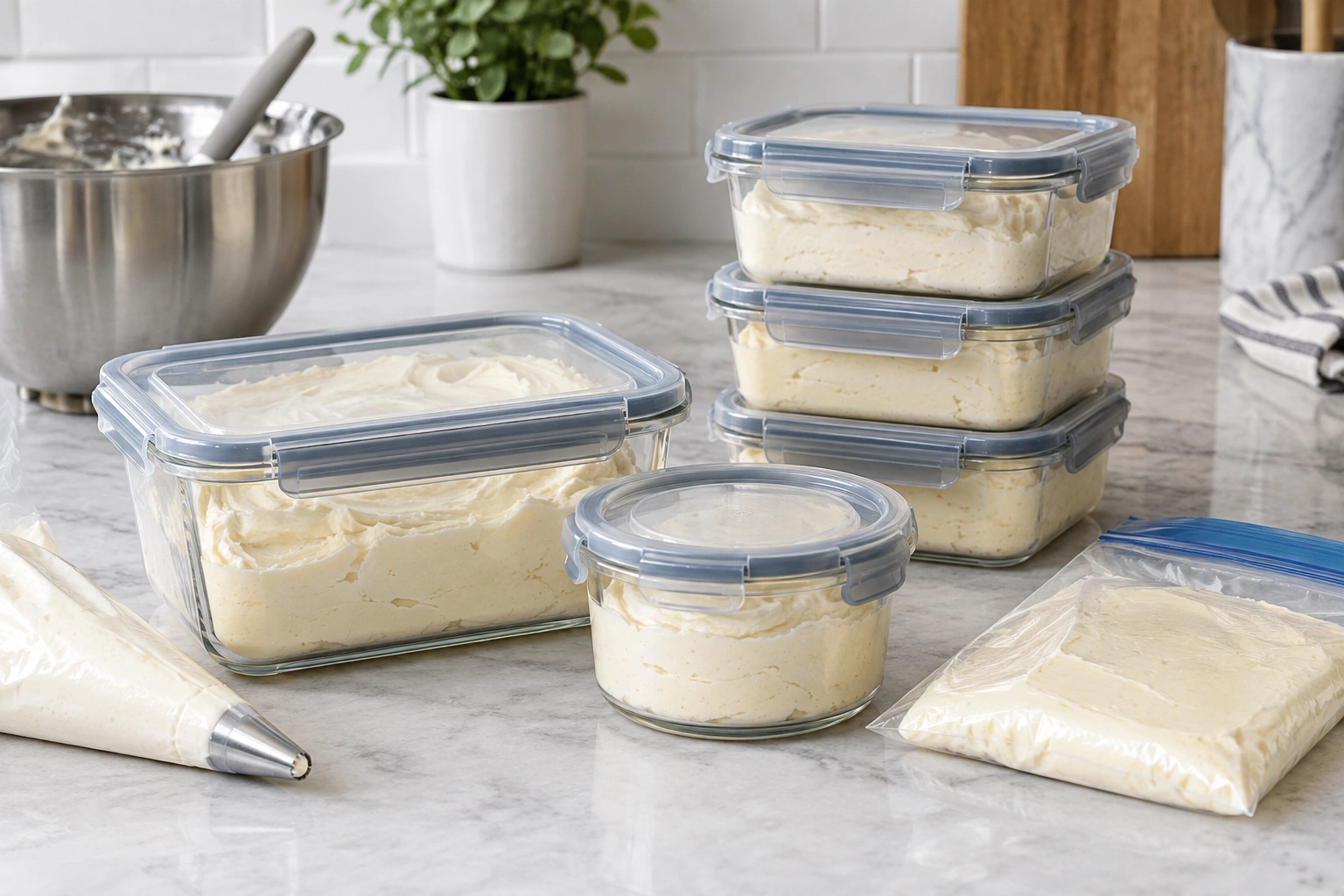
Write the buttercream type, flavor, and date on the package. This matters more than it sounds. A batch of vanilla American buttercream and a batch of lemon Swiss meringue buttercream can look similar once frozen.
A simple label like “chocolate American buttercream, 1 cup, October” is enough to help you use the oldest batch first.
Should You Freeze Buttercream in a Bowl, Container, or Piping Bag?
Each storage method has a different advantage.
Bowl
A bowl is the least ideal choice unless it is covered very tightly. It often leaves more air around the frosting, which increases the risk of freezer burn and stale freezer odors. If you only have a bowl, press plastic wrap directly against the buttercream surface before covering it.
Airtight container
This is usually the most reliable option for most home bakers. It protects shape, limits air exposure, and stacks neatly in the freezer. It is especially useful if you plan to thaw the buttercream and then rewhip it in a mixer.
Piping bag
A piping bag is convenient when you want to thaw and use the buttercream for decorating without moving it into another container. It can work well for small-batch bakers, but only if the bag is sealed carefully and stored where it will not get crushed.
Use a piping bag when convenience matters most. Use a container when protection and stability matter most.
How Long Buttercream Lasts in the Freezer
Frozen buttercream is best used within about 2 to 3 months for top quality. It may still be usable longer if it stays consistently frozen and well sealed, but texture and flavor are more likely to decline after that.
A simple rule:
– Use first: buttercream frozen within the last 2 to 3 months
– Discard: buttercream that shows freezer burn, off odors, discoloration, or a texture that will not come back together after thawing and rewhipping
For the best results, rotate older batches to the front and label each container with the date. If you are freezing buttercream for a specific project, keep the storage window as short as practical.
How to Thaw Buttercream Properly
Thawing matters almost as much as freezing. Fast thawing can create uneven softness on the outside while the center stays firm, which makes the buttercream harder to bring back together.
Refrigerator thawing
This is usually the most controlled method. Move the buttercream from the freezer to the refrigerator and let it thaw gradually. For small portions, this often takes overnight; larger portions may need longer.
A good cue to move it out of the refrigerator is when the buttercream is thawed through but still cool and slightly firm in the center, not icy or hard. At that point, let it sit at room temperature until it is pliable enough to mix.
This method is especially useful for meringue-based buttercreams, which often respond better to slow thawing than to sudden warmth.
Room-temperature thawing
This can work for smaller portions, especially in cool kitchens, but it needs more attention. If the outside of the buttercream gets too soft before the center thaws, the texture may become uneven.
For a small container or piping bag, room-temperature thawing usually works best only after the frosting has already spent time in the refrigerator. If it feels cold and dense in the middle, give it a little more time before rewhipping.
What to look for before rewhipping
Buttercream is ready to rewhip when:
– it is no longer icy
– it bends or scoops easily
– it feels cool, not hard
– there are no frozen lumps in the center
What to avoid
Do not microwave buttercream to thaw it. That usually melts the fat unevenly and can break the emulsion. Quick heat is the fastest way to turn a usable batch into a greasy one.
How to Fix Buttercream After Thawing
Thawed buttercream often looks worse before it looks better. That does not automatically mean it is ruined.
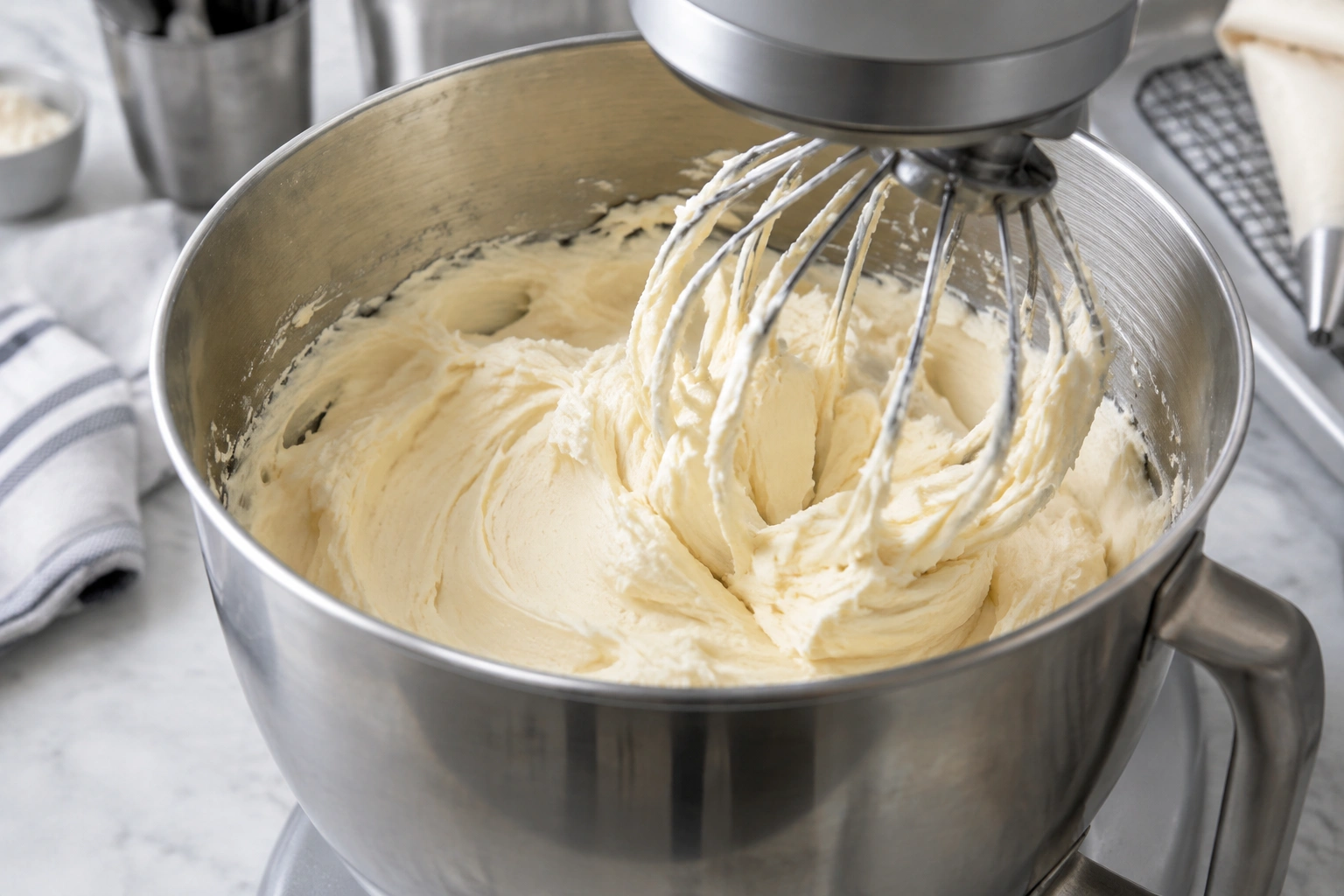
If it looks grainy
Give it a good rewhip. Graininess often happens when the fat and sugar need to be redistributed after freezing. A stand mixer or hand mixer can usually smooth it out.
For American buttercream, start on low speed for 10 to 15 seconds, then move to medium speed until the texture loosens and looks creamy again. If it still feels sandy, let it warm for a few minutes and mix again briefly rather than beating it hard for a long time.
If it looks separated
Let it sit until it is close to workable room temperature, then mix again. Buttercream is an emulsion, so it may need a little time and agitation to come back together. If it still looks broken, a small amount of gentle warming on the outside of the bowl can help, followed by more mixing.
For Swiss or Italian meringue buttercream, use a gentle re-emulsifying approach: mix on low to medium speed, pause to scrape the bowl, then mix again until it turns smooth and satiny. If it looks soupy, it may simply be too warm; chill it briefly before trying again.
If it is too stiff
Let it warm slightly at room temperature, then mix. Cold buttercream can feel dense and hard even when it is otherwise fine.
If it is too soft
Chill it briefly, then rewhip. Soft buttercream is often just too warm to hold structure. Cooling it before mixing again usually helps.
By buttercream type
- American buttercream: usually needs the most straightforward rewhip. Mix until fluffy and smooth, but stop once it is spreadable; overmixing can make it too loose.
- Swiss meringue and Italian meringue buttercream: often need a slower re-emulsifying step. If they look curdled, keep mixing on low to medium speed and give them a minute or two to come together before deciding they need chilling or warming.
- French buttercream: treat it gently and avoid aggressive beating. A short mix is often better than a long one because the richer base can soften quickly.
The goal is not to force the frosting into shape immediately. It is to bring the temperature and texture back into balance.
Can You Freeze Buttercream Under Fondant or Already Decorated Buttercream?
Yes, but with limits.
Buttercream under fondant can usually be frozen if the cake is fully assembled, well wrapped, and protected from air. The main risk is condensation during thawing, which can make fondant sticky or damp. Thaw the cake slowly in the refrigerator first, still wrapped, so moisture forms on the wrapping instead of on the cake surface.
Already decorated buttercream cakes can also be frozen, but only if the decoration is sturdy. Simple borders, smooth finishes, and durable piping generally hold up better than delicate flowers, very sharp edges, or fragile sugar decorations. Freeze the cake uncovered just long enough to firm the surface if needed, then wrap it carefully to protect the design.
In both cases, avoid freezing decorations that are known to soften, bleed, or crack easily. If the finish is highly detailed or meant for display, freezing may not be the best option.
Can Thawed Buttercream Be Used for Frosting and Piping?
Yes, thawed buttercream can often be used for both frosting and piping, but the final texture should decide the job.
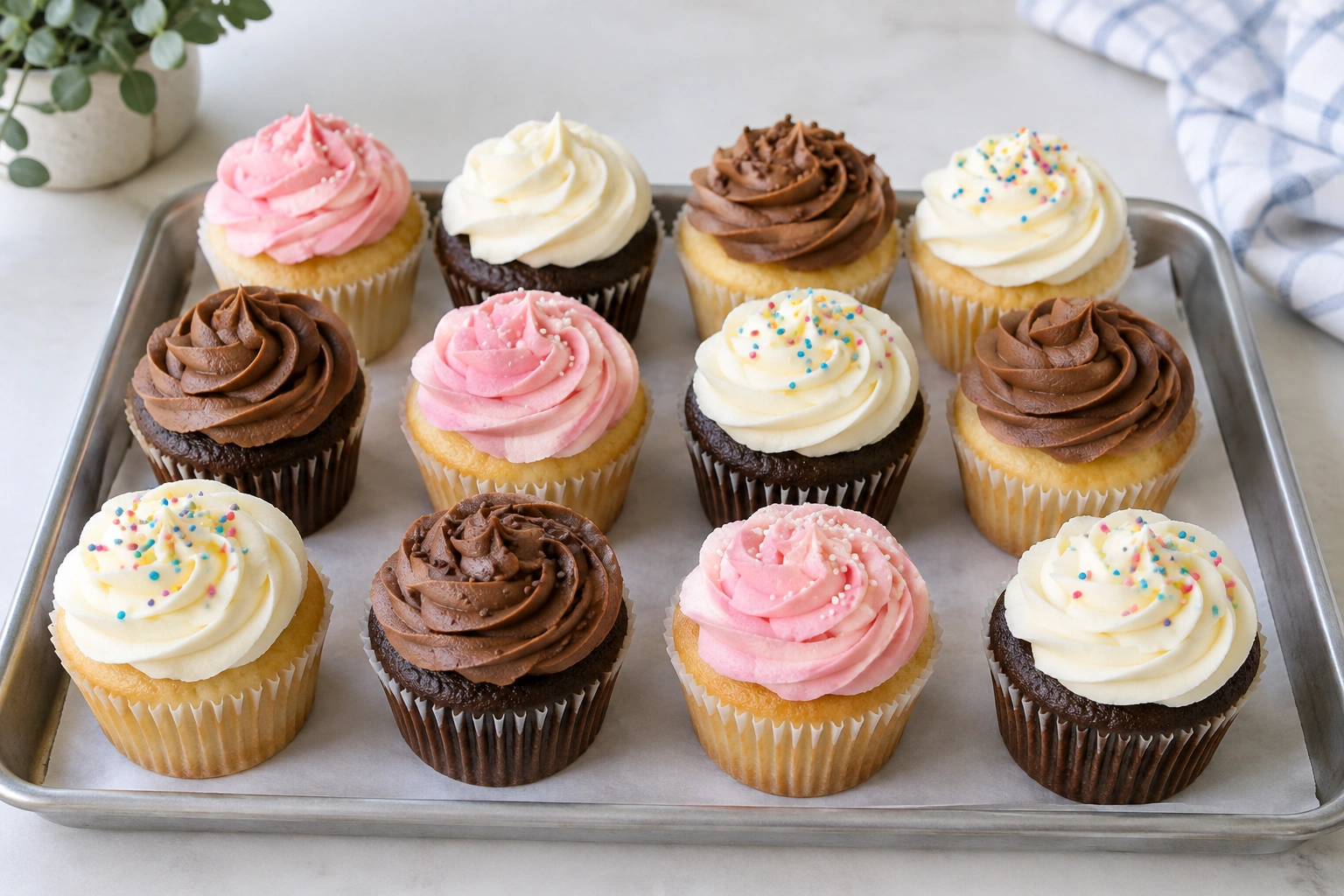
Use it for:
– crumb coating
– frosting cupcakes
– filling layer cakes
– simple borders
– swirls and rosettes if the texture is firm enough
Be more cautious with:
– intricate piping
– sharp-edged decorations
– warm-weather projects
– very smooth finish work on tall cakes
A practical test is to lift a spoonful and see whether it holds a clean shape without looking oily or slack. If it slumps immediately, it may still be too warm or too soft for detailed decorating.
Common Mistakes When Freezing Buttercream
Most problems come from storage, not from freezing itself.
Freezing warm buttercream
Warm frosting traps condensation. That extra moisture can make the thawed buttercream looser and less stable.
Leaving too much air in the package
Air speeds up freezer burn and makes the buttercream more likely to pick up odors from nearby foods.
Thawing too fast
Rapid thawing often creates a soft outer layer and a cold center, which makes mixing harder.
Skipping the rewhip
Many bakers assume thawed buttercream should look perfect right away. In reality, it often needs a few minutes in the mixer to regain its texture.
Freezing without labeling
Unlabeled buttercream is easy to forget. Once it has been in the freezer a while, you may not remember the flavor or date.
How to Tell If Thawed Buttercream Is Still Usable
Use sight, smell, and texture together.
Buttercream is usually still worth using if:
– it smells normal and buttery
– the color looks like the original batch
– it becomes smooth after mixing
– it holds shape when tested with a spatula
It is safer to discard it if:
– it smells sour, rancid, or otherwise off
– it has unusual discoloration
– it stays broken or watery after rewhipping
– you see signs that it picked up freezer odors or contamination
Texture problems alone do not always mean the buttercream is bad. Spoilage signs are different from ordinary thawing issues.
Can You Refreeze Buttercream?
Refreezing is only acceptable if the buttercream stayed cold, was thawed in the refrigerator, and has not been left out long enough to become soft or contaminated. In that case, you can refreeze it, but expect some loss of texture.
Do not refreeze buttercream if it has been fully thawed, rewhipped, and then sat at room temperature for decorating or serving. Once it has warmed up and been handled, the chance of texture breakdown and quality loss goes up, and repeated freezing is more likely to make it greasy, grainy, or unstable.
The reason is simple: every freeze-thaw cycle can break the emulsion a little more and introduce more moisture changes. If you need to save leftovers, portion carefully before the first freeze so you can thaw only what you need.
A Practical Workflow for Small-Batch Bakers
If you make buttercream in advance for cakes or cupcakes, this is the simplest routine to follow:
- Mix the buttercream fully and let it cool.
- Portion it into the amount you usually need.
- Pack it tightly in an airtight container or sealed bag.
- Label the flavor and date.
- Freeze it flat or in compact portions.
- Thaw it slowly in the refrigerator.
- Bring it closer to room temperature.
- Rewhip until smooth before decorating.
That sequence keeps the process repeatable, which is what matters most when you are baking on a schedule.
When to Consult a Pastry Chef
If your buttercream contains unusual ingredients, such as cream cheese, fruit purées, custards, or other highly perishable additions, freezing behavior can change. The same is true if you need the frosting for high-end finish work, warm-weather display, or large production batches.
In those cases, a pastry chef can help you decide whether freezing is the best option or whether a different make-ahead plan would give you better results.
For bakers who also prep cakes ahead of time, this guide on how to freeze cake layers before frosting is a useful next step.
FAQ
Can all buttercream be frozen?
Most buttercream styles can be frozen, but some thaw more smoothly than others. American buttercream is usually the easiest to manage, while meringue-based styles may need more mixing after thawing.
Do I need to rewhip buttercream after thawing?
Often, yes. Even when the buttercream looks fine at first, a short rewhip usually improves the texture and makes it easier to spread or pipe.
Can I freeze buttercream in a piping bag?
Yes, if the bag is sealed well and stored carefully. This is convenient for direct decorating use, but an airtight container is usually safer for long storage.
Is thawed buttercream good for piping?
Often it is, as long as it returns to a smooth, stable consistency. If it is too soft, too warm, or slightly broken, it may be better for frosting than for detailed piping.
What if my buttercream looks separated after thawing?
Do not throw it out immediately. Let it warm slightly, then rewhip or re-emulsify it. Many separated batches come back together with a little patience.
Freezing buttercream is less about perfection and more about control. Once you know how to portion it, seal it, thaw it, and bring it back to the right texture, it becomes a dependable part of your baking routine.

