
Steam Oven Bread: How to Bake Loaves with Better Rise, Crust, and Color

A steam oven can be a genuine advantage for bread baking, especially if you want stronger oven spring, a more even rise, and a crust that finishes crisp instead of leathery. The reason is simple: steam keeps the dough’s surface flexible long enough for the loaf to expand before the crust sets. That early expansion window is where good bread often wins or loses its shape.
If you’ve ever baked a loaf that looked promising in the first ten minutes, then came out pale, flat, or oddly thick-crusted, steam may be the missing piece. Used well, it can help a loaf bloom more fully, support a thinner crust, and give you more reliable results than a dry oven alone. Used poorly, though, it can delay browning and leave you with a soft exterior that never quite firms up.
This guide walks through the method, the trade-offs, and the small decisions that matter most in real kitchens.
What Steam Oven Bread Is and Why Steam Helps
A steam oven is simply an oven that can introduce moisture into the baking chamber during cooking. In bread baking, that moisture matters most at the beginning of the bake.
Here’s the key idea: bread rises most dramatically early on, while the dough is still soft and the gases inside it are still expanding. Steam keeps the outer skin from drying too soon, so the loaf has time to stretch upward before the crust locks in. That helps the loaf reach fuller volume.
That has three practical effects:
- Better oven spring: the loaf can expand more before the crust hardens.
- Improved crust development: once the steam is vented and the surface dries, the crust can set and crisp properly.
- More even color and sheen: steam often supports a thinner, shinier crust than dry heat alone.
That said, steam is not magic. It helps most when the dough is well mixed, properly proofed, and scored cleanly. A weak dough won’t suddenly become a great loaf just because the oven is steamy.
For a broader refresher on dough structure before you bake, see our guide to what bread dough is made of and how to make bread dough from scratch.
What You Need Before You Start
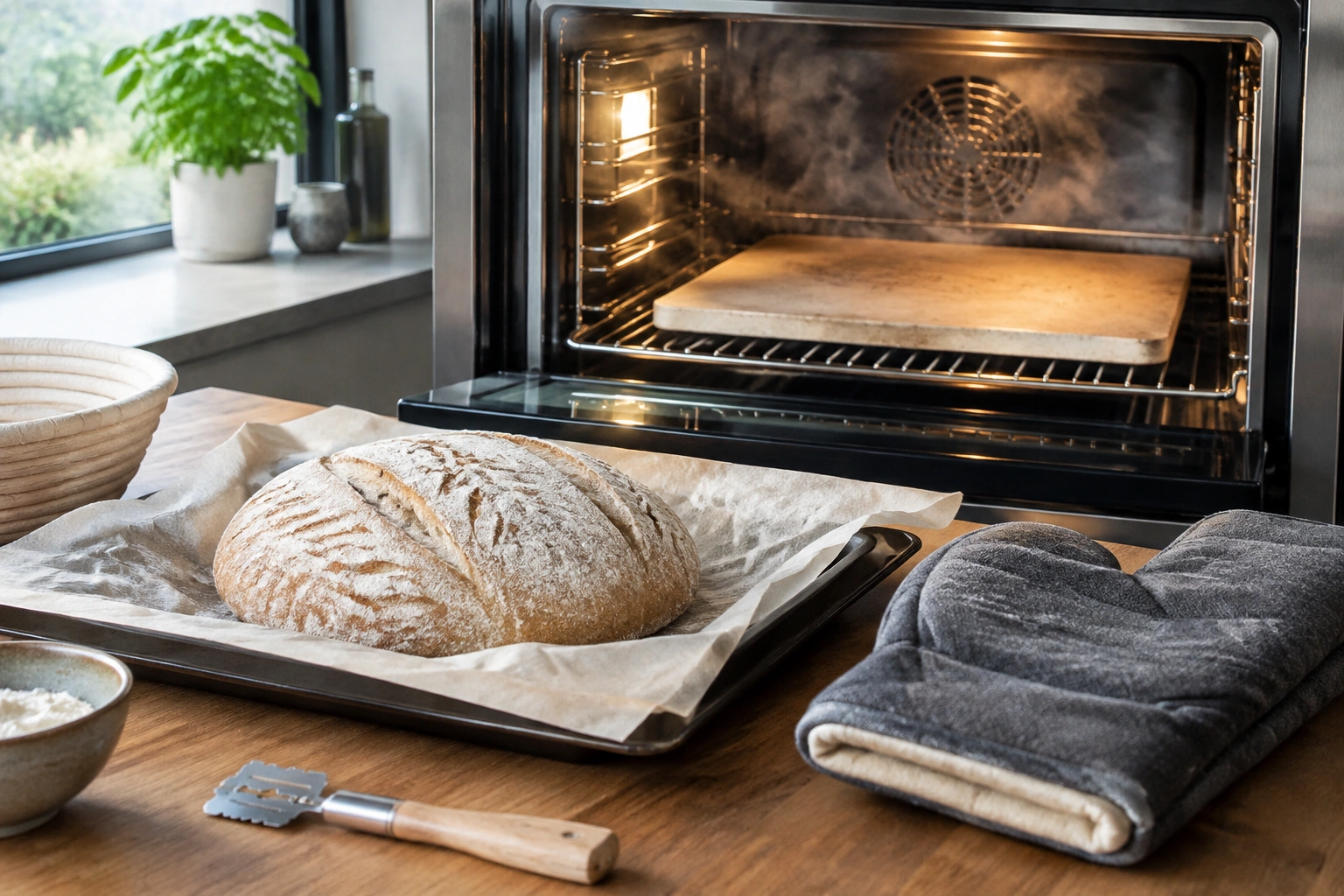
You do not need a complicated setup to bake good bread in a steam oven, but a few basics make the process much more reliable.
Essential tools and setup
- A steam oven with a bread, steam assist, or convection-plus-steam mode
- A preheated baking surface such as a stone or steel if your oven supports it
- A peel or flat tray for loading shaped loaves
- A sharp lame, razor, or very sharp knife for scoring
- An instant-read thermometer for checking doneness
- Oven mitts and steam-safe caution when opening the door or venting steam
In practical terms, many steam ovens create moisture by heating water inside the appliance and releasing it into the oven cavity. The exact mechanism varies by brand and model, so it is best to follow your oven’s manual for the correct steam setting or program.
Dough basics that matter
A steam oven works best when the dough is already set up for success:
- Proper fermentation so the loaf has enough gas and strength
- Good shaping so the loaf can rise upward rather than spread sideways
- Adequate proofing so it is expanded but not overproofed
- Clean scoring so the loaf opens where you want it to
Safety note
Steam and hot metal can burn quickly. When opening the door or venting steam, keep your face and hands back, and use mitts that actually cover your wrists.
Choose the Right Bread for a Steam Oven
Steam helps some breads more than others. The biggest gains usually show up in loaves that benefit from a long early expansion phase.
Best candidates for steam
Lean artisan loaves
Country loaves, bâtards, boules, and similar breads with little or no fat or sugar usually benefit the most. These doughs need oven spring and a crisp crust, so steam is a strong fit.
High-hydration doughs
Wetter doughs often gain more from steam because they already have a softer structure and need help staying extensible during the first part of the bake.
Dinner rolls and smaller hearth breads
A short steam burst can improve rise and surface shine without over-softening the crust.
Breads that need less steam
Sandwich loaves
These often bake better with reduced steam or a shorter steam phase. You usually want a softer crust here, not an aggressively crisp shell.
Enriched doughs
Brioche, challah, milk bread, and other doughs with butter, eggs, milk, or sugar brown more quickly and can become too dark before the center finishes if steam is too heavy or too long. They may need little steam or none at all.
Quick decision rule
If your goal is maximum oven spring and a crackly crust, use steam early.
If your goal is softer crust and gentler browning, reduce steam or skip it.
Best Steam Oven Settings, Temperature, and Bake Surface
There is no single setting that fits every oven brand, but there are useful decision rules.
Steam level: full, partial, or brief
- Full steam at the start works well for lean artisan loaves when you want the most expansion.
- Intermittent or lighter steam can be better for softer loaves, rolls, and enriched doughs.
- No steam is sometimes the right choice for breads that should brown quickly or stay tender.
The trade-off is straightforward: more steam can improve early rise, but too much steam for too long can delay crust setting and slow browning.
Starting temperature by bread type
Use these as practical starting points, then adjust for your oven:
- Lean loaves: start hot, around 450°F to 475°F (232°C to 246°C).
- Enriched loaves: start a little lower, around 350°F to 400°F (177°C to 204°C).
- Rolls: often do well around 375°F to 425°F (191°C to 218°C) depending on size and sweetness.
- Sandwich breads: usually bake well around 350°F to 375°F (177°C to 191°C) for a softer crust and even color.
Steam-and-temperature cheat sheet
| Bread type | Start temp | Steam | Typical steam time | Finish |
|---|---|---|---|---|
| Lean loaves | 450°F to 475°F | Full steam | 10 to 15 minutes | Turn steam off and bake dry until deeply browned |
| Enriched loaves | 350°F to 400°F | Light steam or none | 0 to 8 minutes | Finish dry; watch browning closely |
| Rolls | 375°F to 425°F | Brief steam | 5 to 10 minutes | Vent early so they color without drying out |
| Sandwich breads | 350°F to 375°F | Little steam or none | 0 to 5 minutes | Bake to a soft, even crust |
Stone, steel, tray, or pan?
- Stone or steel: best when you want stronger bottom heat and a firmer base crust.
- Tray or sheet pan: simpler and often fine for softer loaves or loaf-pan breads.
- Pan below the loaf: useful in some ovens if you need a dedicated steam source or a catch pan, but not always necessary in a true steam oven.
Practical rule of thumb
If your loaf tends to pale on the bottom or feel slightly underfinished there, a preheated stone or steel can help. If you are baking a softer sandwich loaf, a tray may be perfectly adequate.
How to Bake Bread in a Steam Oven: Step-by-Step
1) Preheat fully
Give the oven enough time to reach stable heat before loading. A half-preheated oven often leads to weaker spring and a denser base.
2) Prepare the loaf
Shape the dough with enough surface tension to hold its form. Then score it cleanly so the loaf knows where to expand. Weak scoring often causes random tearing instead of a neat bloom.
3) Load quickly and safely
Slide the loaf into the oven with minimal heat loss. If your oven uses a steam mode that activates at the start, engage it as directed by the appliance settings.
4) Use steam during the early bake
This is the phase that protects the surface from setting too early. For many lean loaves, the first part of the bake is where steam matters most.
5) Switch to dry heat
Once the loaf has expanded and the crust begins to color, turn off steam or vent it away. This is the part many bakers miss. Steam is useful early; dry heat is what finishes the crust.
6) Finish until the crust is fully set
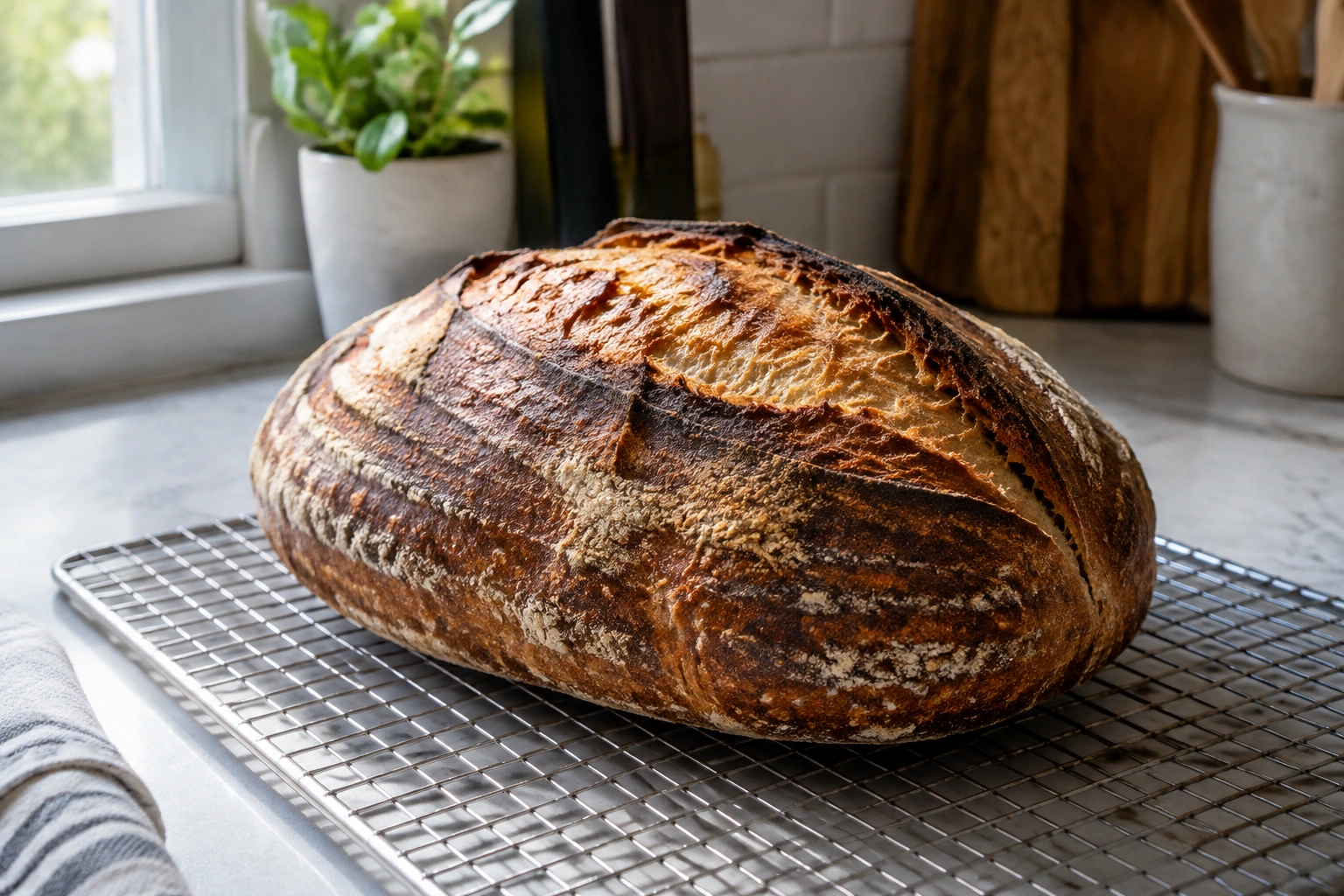
Continue baking until the loaf is deeply colored and sounds hollow or nearly hollow when tapped. If you want certainty, check internal temperature.
7) Cool before slicing
Let the bread cool on a rack. Cutting too soon can make the crumb seem gummy even when the loaf is technically baked through.
How Long to Use Steam and When to Turn It Off
This is the part that most often separates a decent loaf from a really good one.
The early steam phase should last long enough to support oven spring, but not so long that the crust stays soft and pale. A practical rule is to keep steam on only through the loaf’s main expansion period, then vent it once the crust begins to set and color. For trapped steam methods like a Dutch oven or cloche, that usually means removing the cover around 20 minutes in. In a steam oven, the same logic applies: steam early, dry finish later.
Rule of thumb by loaf type
- Lean loaves: steam for 10 to 15 minutes, then switch to dry heat.
- Rolls: steam for 5 to 10 minutes, then vent early so the crust can brown.
- Enriched doughs: use 0 to 8 minutes of steam, or skip steam entirely if the loaf is already browning quickly.
- Sandwich breads: use little steam or none, especially if you want a softer crust.
Use a shorter steam phase when:
- the dough is enriched
- the loaf is small
- the crust is browning slowly but the shape is already set
- you want a softer sandwich-style crust
Use a longer steam phase when:
- the loaf is lean and rustic
- the dough is high hydration
- you want maximum bloom and a crisper shell
When steam starts to hurt the bake
If steam stays on too long, the crust may stay pale, soft, or thick rather than crisp. In other words, steam is a helper at the beginning, not a finish line.
How to Tell When Steam Oven Bread Is Done
Color alone is not enough. A loaf can look beautifully browned and still be underbaked inside.
Better doneness cues
- Internal temperature: a useful general target is around 190°F to 205°F (88°C to 96°C) in the center, depending on loaf type.
- Crust texture: the crust should feel firm, not rubbery.
- Sound: a properly baked loaf often sounds hollow or close to hollow when tapped on the bottom.
- Cooling behavior: the loaf should hold its shape as it cools instead of sinking or collapsing.
If the crumb seems gummy after slicing, the bread may simply need more time in the oven or more time cooling. That is especially common with loaves that were removed because the crust looked dark enough.
How to Adapt a Standard Bread Recipe for a Steam Oven
When converting a conventional recipe, do not just press the steam button and hope for the best. Think in terms of three adjustments: steam, temperature, and finish time.
1) Keep the dough formula mostly the same at first
For a first test, do not change everything at once. Bake the original dough in the steam oven, then adjust from there.
2) Match steam to the bread style
If the recipe is a lean country loaf, use a fuller steam phase at the start. If it is enriched, begin with lighter steam or no steam.
3) Expect to reduce the initial temperature for enriched breads
A standard loaf recipe that bakes at 375°F in a conventional oven may need the same or slightly lower temperature in a steam oven if it contains milk, butter, eggs, or sugar. For a lean loaf, you can often keep the temperature high and simply use steam early.
4) Adjust bake time in two parts
A simple conversion approach is:
– keep the early steam phase to about 10 to 15 minutes for lean loaves, or 5 to 10 minutes for rolls
– then add a dry finish until the loaf is fully browned and baked through
If a conventional recipe says “bake 35 minutes,” a steam-oven version may still land close to that total time, but the bake is often split into an early steamed phase and a longer dry phase.
5) Watch the crust, not just the clock
If the loaf is coloring too slowly, the steam phase may be too long. If it is coloring too fast, the oven may be too hot or the loaf may be too close to the top element.
6) Be ready to extend the dry finish
A steam oven can make the early bake feel fast, but the loaf may still need a longer dry finish to fully set the crust and crumb.
7) Adjust hydration only if needed
If a dough that normally works well in a conventional oven becomes slack or spreads too much, the issue may be proofing or shaping rather than hydration. Change hydration only after you have checked the basics.
Two simple recipe-adaptation examples
- Example 1: Standard lean boule recipe. If the recipe was written for a dry oven at 450°F, keep the temperature at 450°F, use full steam for about 12 minutes, then turn steam off and finish until the loaf is deeply browned.
- Example 2: Standard sandwich loaf recipe. If the recipe was written for 375°F in a conventional oven, keep the temperature around 350°F to 375°F in the steam oven, use little or no steam, and bake until the loaf is evenly colored and the center is done.
What to Do If Your Oven Has Only One Steam Mode
Some ovens do not let you fine-tune steam level. Others offer an automatic steam program that controls moisture for you. In either case, use the setting as a starting point, not a rule you cannot adjust.
If the oven has only one steam mode
- Use the steam mode for the first part of the bake only.
- Turn it off manually if the oven allows that.
- If it cannot be turned off, shorten the overall bake time only if the loaf is browning too slowly, and watch for a soft crust.
If the oven has an automatic steam program
- Choose the program that matches your bread type as closely as possible.
- Use it first for lean loaves, where steam is usually most helpful.
- For enriched breads, switch to a lower-steam or no-steam setting if available, or shorten the bake if the crust darkens too fast.
If you cannot control steam very precisely
Treat the oven like a conventional oven with a built-in moisture boost. Check the loaf earlier than usual, and be ready to finish with dry heat if the crust needs more color.
Practical Examples for Common Bread Types
Lean artisan loaf
Use a strong initial steam phase, then switch to dry heat once the loaf has expanded and begun to color. This is the bread style that usually benefits the most from steam.
Sandwich loaf
Use lighter steam or a shorter steam phase. The goal is usually a tender, even crumb with a crust that is not too thick or too crackly.
Dinner rolls
A brief burst of steam can improve lift and surface shine. Because rolls are smaller, they usually need less steam time than a large loaf.
No-knead loaf
These loaves often start with good potential but can underbake if the crust is judged too early. Use steam early, then finish dry until the loaf is deeply colored and fully set.
Common Mistakes to Avoid
Leaving steam on for the whole bake
This is the most common mistake. You may get good expansion, but the crust can remain soft and dull instead of crisp.
Underpreheating
A loaf loaded into a weakly heated oven can spread before it springs. That often leads to a flatter shape and a less open crumb.
Scoring too timidly
If the score is shallow or uneven, the loaf may burst in the wrong place.
Using too much steam on enriched doughs
These breads already brown more quickly. Extra steam can delay browning without improving the result.
Trusting color alone
A dark crust is not proof of doneness. Internal temperature and crumb structure matter just as much as color.
Troubleshooting Steam Oven Bread Problems
| Problem | Likely cause | What to try next time |
|---|---|---|
| Pale crust | Steam lasted too long or oven temperature was too low | Turn off steam earlier and finish longer in dry heat |
| Weak rise | Underproofed dough, weak scoring, or insufficient early heat | Proof more carefully, score more decisively, preheat longer |
| Thick or leathery crust | Too much steam or no dry finish | Vent steam earlier and let the loaf dry out at the end |
| Gummy crumb | Bread was underbaked or sliced too soon | Bake longer and cool fully before cutting |
| Soggy bottom | Weak bottom heat or excess moisture | Use a stone or steel, and avoid over-steaming |
| Over-dark top before center is done | Oven too hot or loaf too close to top heat | Lower the temperature slightly or move the rack down |
A useful troubleshooting habit
Change only one variable at a time. If you alter steam, temperature, and bake time all at once, it becomes hard to learn what actually fixed the loaf.
Steam Oven vs Dutch Oven vs Conventional Oven
A steam oven can replace a Dutch oven for many breads, but not in every kitchen or for every baker.
Steam oven
Best for: convenience, repeatability, and breads that benefit from controlled steam
Trade-off: settings vary by appliance, so you may need a few test bakes to learn your oven
Dutch oven
Best for: trapping steam around a loaf in a conventional oven
Trade-off: it is less flexible and usually limits loaf size, but it works very well for many home bakers
Conventional oven without steam
Best for: simplicity and everyday baking
Trade-off: you may need workarounds to get the same early moisture, and the crust may set sooner than you want
If your steam oven offers reliable moisture control, it can be a cleaner and more consistent solution than improvised steam methods. If not, a Dutch oven still has real value.
FAQs
Do I still need a Dutch oven if I have a steam oven?
Usually not for lean hearth loaves, because the steam oven can provide the early moisture that a Dutch oven is used for. That said, a Dutch oven can still be useful if your steam function is limited or inconsistent.
Should I bake bread on a stone or a tray?
Use a stone or steel if you want stronger bottom heat and a firmer crust. Use a tray if the loaf is softer, enriched, or baked in a pan and you want a simpler setup.
Can too much steam hurt bread?
Yes. Too much steam, or steam for too long, can slow browning and leave the crust soft instead of crisp.
What temperature is best for steam oven bread?
A hotter start is often helpful for lean loaves, while enriched breads usually do better at a lower starting temperature. If the top browns too quickly, lower the temperature slightly on the next bake.
How do I know the loaf is fully baked?
Use a combination of cues: deep crust color, firm crust texture, hollow sound, and internal temperature. A general doneness range is about 190°F to 205°F (88°C to 96°C) in the center, depending on loaf type.
Which breads benefit most from steam?
Lean artisan loaves usually benefit the most, followed by many high-hydration doughs and some rolls. Enriched doughs often need less steam or none at all.
Final Thoughts
Steam oven bread is less about adding a fancy feature and more about controlling the loaf’s first few minutes in the oven. That early phase decides a lot: how high the bread rises, how the crust forms, and whether the finished loaf feels crisp or dull.
If you remember only one principle, make it this: steam helps early, dry heat finishes the job. Once you start thinking in those two phases, your steam oven becomes a much more precise bread-baking tool.