
What Bread Dough Is Made Of: The 4 Essential Ingredients Every Baker Should Know

If you strip bread down to its essentials, bread dough is made of four ingredients: flour, water, yeast, and salt. That’s the simple answer. The better answer is that each ingredient has a job, and the quality of your loaf depends on how well those jobs work together.
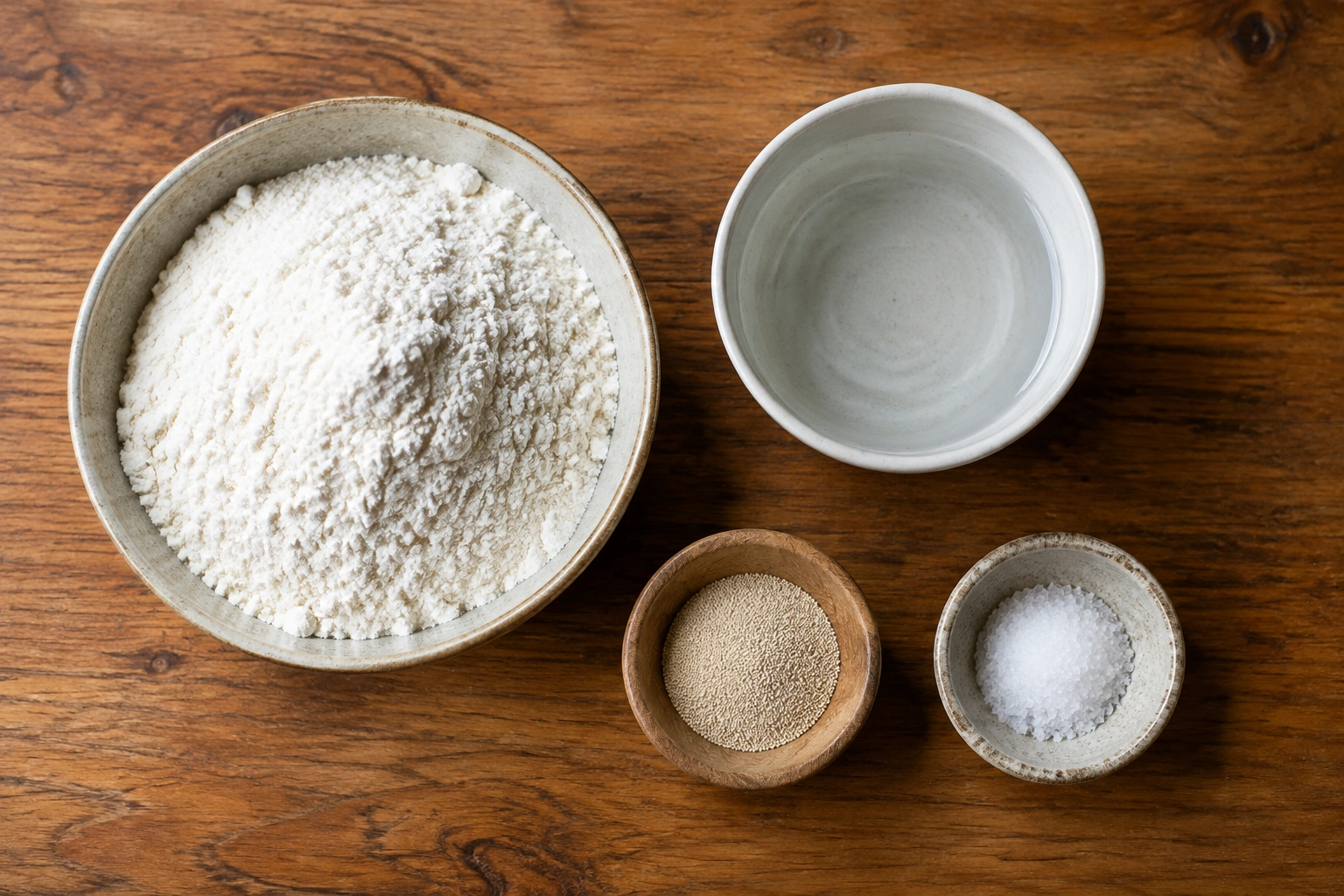
Once you understand what each ingredient does, bread stops feeling mysterious. A dough that’s too sticky, too tight, too bland, or too slow to rise usually isn’t “bad luck.” It’s often a sign that one ingredient is out of balance.
The 4 Essential Ingredients in Bread Dough
Here’s the core formula in plain language:
| Ingredient | What it does | If you use too little | If you use too much |
|---|---|---|---|
| Flour | Gives the dough structure and the proteins needed for gluten; stronger flour usually absorbs more water and gives more dough strength | Dough may be weak, slack, or unable to hold shape | Dough can feel dry, dense, or stiff |
| Water | Hydrates the flour, lets gluten form, and controls dough feel; higher hydration usually means a softer, stickier dough | Flour stays dry; dough feels crumbly or hard to mix | Dough becomes sticky, loose, and harder to handle |
| Yeast | Ferments the dough and produces gas for rise; the amount and handling depend on the fermentation schedule | Dough rises slowly or not enough | Dough can overproof, lose strength, or taste overly yeasty |
| Salt | Adds flavor, strengthens dough, and helps control fermentation; standard bread dough needs it for balance | Bread tastes flat and dough may ferment too quickly | Fermentation slows too much and dough can tighten |
1) Flour: the foundation of bread
Flour is the backbone of bread dough. In most breads, wheat flour is the key ingredient because its proteins can form gluten, the network that traps gas and gives bread structure.
Think of flour as the ingredient that makes bread possible in the first place. Without enough structure, the dough can’t hold the gases created during fermentation, and the loaf won’t rise well.
Bread flour vs all-purpose flour
The two most common choices are bread flour and all-purpose flour.
- Bread flour usually gives stronger gluten and a chewier, more structured loaf.
- All-purpose flour is more flexible and often produces a slightly softer, less chewy crumb.
If you want a taller sandwich loaf or a more robust crusty bread, bread flour is usually the better fit. If you want a more everyday dough that’s easier to handle, all-purpose flour can work very well.
The trade-off is simple: stronger flour gives you more structure, but it can also make the dough feel firmer. Softer flour is easier to work with, but it may not hold as much rise or chew.
2) Water: the ingredient that brings dough to life
Water does more than “wet” the flour. It hydrates the proteins and starches, which allows gluten to develop and the dough to come together. It also helps disperse the other ingredients evenly through the dough.
The amount of water matters because it changes the feel and behavior of the dough.
- Around 60% hydration: the dough is usually firmer, easier to shape, and less sticky.
- Around 65–70% hydration: the dough is softer, more extensible, and often a little stickier.
- Above 70% hydration: the dough can feel very loose and sticky, but it may produce a more open crumb in the finished loaf.
That’s why bakers talk about hydration. In practical terms, hydration is the amount of water relative to flour. A beginner-friendly bread dough often lands somewhere around 60–70% hydration by baker’s percentage as a general starting point, though the exact number depends on the flour and the style of bread.
Flour strength also matters here. Stronger bread flour usually absorbs more water than weaker flour, while lower-protein or softer flour may need less water to reach the same dough feel. Even the same recipe can need a small adjustment depending on the flour brand and how it was milled.
If your dough feels dry and tears easily during kneading, it may need a little more water. If it feels soupy or clings to everything, it may have too much.
3) Yeast: the engine behind rise
Yeast is the living ingredient that ferments the dough. As it ferments available sugars in the dough, it produces gas and flavor compounds. The gas inflates the dough, while fermentation contributes the deeper bread flavor that plain flour and water cannot create on their own.
Yeast is why bread dough rises at all.
For home baking, you’ll usually see one of two common yeast types:
- Instant yeast: mixes directly into the dry ingredients and is convenient for most home recipes.
- Active dry yeast: is often dissolved in warm water first, depending on the recipe method.
If a recipe is written for one type, it’s best to follow that method closely. Instant yeast is commonly added with the dry ingredients, while active dry yeast is often bloomed or dissolved first when the recipe calls for that step. Some formulas handle yeast differently, so there is not one universal mixing order.
Yeast needs time and warmth to ferment properly. If the dough is too cold, fermentation slows. If the dough is over-salted or otherwise imbalanced, yeast activity can be held back too much.
4) Salt: the small ingredient that makes a big difference
Salt does a lot more than season the dough. It gives bread flavor, helps strengthen gluten, and helps fermentation proceed in a more controlled way.
Salt is used in very small amounts in most bread formulas, but it plays an outsized role in how the dough behaves. In standard bread dough, it should not be omitted.
If you leave salt out:
- the bread can taste flat,
- the dough may ferment too quickly,
- and the structure can feel weaker.
If you add too much salt, fermentation may slow too much, and the dough can become tight or sluggish.
For most basic breads, salt usually sits around 1.8–2.2% of the flour weight in baker’s percentage. A practical home-baking range is about 18–22 g per 1,000 g flour. That’s a useful starting point, not a universal law, but it gives you a reliable benchmark.
How the Ingredients Work Together
Bread dough works because each ingredient supports the others.
- Flour provides the structure.
- Water activates and hydrates that structure.
- Yeast inflates the structure with gas.
- Salt keeps the process controlled and the flavor balanced.
If one ingredient is off, the whole dough feels off.
For example, if you add too much flour while kneading, you can end up with a dry dough that resists expansion. If you add too much water, the dough may feel loose and weak, even if the flavor is fine. If you forget salt, the fermentation may move too fast and the finished bread may taste one-dimensional.
A balanced dough is not just about ingredients being present. It’s about them being present in the right relationship.
Tools and Prerequisites for Mixing Bread Dough
You don’t need a lot of equipment, but accuracy matters.
Helpful tools
- Digital scale
- Mixing bowl
- Bench scraper
- Spoon or dough whisk
- Clean work surface
- Kitchen thermometer, if you want more control over water temperature
Weighing ingredients is generally more reliable than using cups, especially for flour and water. A cup of flour can vary a lot depending on how it’s scooped or packed. That inconsistency is one of the most common reasons bread feels unpredictable.
If you want a deeper walkthrough on this, see our guide on how to measure baking ingredients accurately for better results every time.
Ingredient prep
Before mixing, make sure:
- flour is measured accurately,
- water is ready at the temperature your recipe calls for,
- yeast is fresh,
- and salt is measured separately rather than guessed.
A well-prepared setup makes the mixing stage much easier to read.
Basic Bread Dough Ratio for Beginners
A practical beginner formula, using baker’s percentages, looks like this:
- Flour: 100%
- Water: 60–70%
- Salt: about 2%
- Yeast: a small amount, often around 1% or less, depending on fermentation time, dough temperature, and whether the recipe is same-day or overnight
Here’s what that looks like in simple terms for 1,000 g of flour:
- 1,000 g flour
- 600–700 g water
- 20 g salt
- 5–10 g yeast, depending on the recipe and rise time
That range gives you a realistic starting point rather than a rigid formula. A dough at 60% hydration will usually feel firmer and easier to shape. A dough closer to 70% hydration will feel softer and stickier, but can produce a more open texture.
Step-by-Step: How to Make Basic Bread Dough
Here’s a straightforward workflow for a basic dough.
-
Combine the dry ingredients.
If you’re using instant yeast, it can usually go in with the flour and salt. If you’re using active dry yeast, follow the recipe method, which may call for dissolving it in water first. Some recipes add yeast with the dry ingredients, while others bloom it separately. -
Add the water.
Pour it in gradually so you can see how the dough comes together. -
Mix until shaggy, then cohesive.
At first, the dough may look rough and uneven. That’s normal. Keep mixing until the flour is mostly hydrated. -
Knead or fold until the dough develops strength.
The goal is not just smoothness. You want the dough to become elastic and able to stretch without tearing immediately. -
Check the dough feel.
It should be soft, slightly tacky, and manageable. If it’s dry and stiff, it may need a little more water. If it’s unmanageably sticky, it may need more time or, in some cases, a small adjustment in flour. -
Let fermentation do its work.
Once mixed, the dough needs time to rise and develop flavor.
If you’re working the dough by hand and it keeps sticking to your rolling pin or bench, this guide on how to keep dough from sticking to a rolling pin without ruining the texture may help.
Bread Flour vs All-Purpose Flour
This is one of the most useful decisions a baker makes.
Choose bread flour when you want:
- more strength,
- better shape retention,
- a chewier crumb,
- and a loaf that stands up well to longer fermentation.
Choose all-purpose flour when you want:
- a softer texture,
- easier handling,
- and a more flexible dough for everyday baking.
A good rule of thumb: if you’re making a rustic loaf, sandwich bread, or anything where structure matters, bread flour is often the safer choice. If you’re experimenting or want a softer loaf, all-purpose flour can still produce very good bread.
Instant Yeast vs Active Dry Yeast
Both types can make excellent bread. The difference is mostly in how they’re used.
Instant yeast
- Mixes directly into the dry ingredients
- Convenient for quick, straightforward doughs
- Often favored for simplicity
Active dry yeast
- Often dissolved in water first, depending on the recipe
- May need a little more attention to method
- Still very reliable when used as directed
If you swap one for the other without adjusting the method, the dough may behave differently. That doesn’t mean the bread will fail, but it can change timing and rise.
Optional Ingredients That Change the Dough
Once you understand the core four, it’s easier to see why many recipes add other ingredients.
Sugar
Sugar can add sweetness, support browning, and change the flavor profile. It’s common in softer sandwich breads and enriched doughs.
Fat: oil or butter
Fat helps make bread softer and richer. It can also make the crumb feel more tender. The trade-off is that fat can reduce the “lean” bread character and make the dough feel less crusty.
Milk
Milk adds richness and softness compared with water. It also contributes flavor and can create a more tender crumb. Compared with water, milk usually gives a softer, richer loaf and a slightly less crisp crust.
Eggs
Eggs enrich the dough further, adding color, flavor, and tenderness.
These ingredients are not part of the core formula, but they can be useful when you want a softer, richer loaf instead of a classic lean bread.
Lean Dough vs Enriched Dough
This is a helpful way to think about bread styles.
Lean dough
A lean dough is made with the basic bread ingredients and little or no added fat, sugar, milk, or eggs. It tends to produce bread with a more pronounced crust and a cleaner, more direct bread flavor.
Enriched dough
An enriched dough includes extras like sugar, fat, milk, or eggs. It usually bakes into a softer, richer loaf with a more tender crumb.
The choice comes down to style and purpose:
- Want a crusty artisan-style loaf? Lean dough makes sense.
- Want soft dinner rolls or sandwich bread? Enriched dough is often the better fit.
If you’re working with dough portions and shaping multiple pieces, a bench scraper can make the job cleaner and more even. Our guide on how to use a bench scraper to cut dough cleanly and evenly is a useful companion.
Common Mistakes When Making Bread Dough
Most dough problems trace back to ingredient balance or measuring.
Too much flour
This is one of the most common mistakes. The dough becomes dry, dense, and harder to knead. It may also bake into a tighter loaf. If the dough is only slightly dry, add water a teaspoon or tablespoon at a time and mix fully before adding more. If the dough is already tight but not dry, give it a short rest first so the flour can absorb moisture before you change the formula.
Too much water
The dough can become sticky and weak. It may spread instead of holding shape. If it’s just a little loose, let it rest and develop strength before adding more flour. If it’s clearly overhydrated for the flour you’re using, stop adding flour in big amounts and consider adjusting the next batch instead.
Missing salt
The bread may taste flat, and the fermentation can move too quickly.
Inconsistent measuring
Using cups instead of weight can create different doughs from one batch to the next, even when the recipe looks identical on paper.
Troubleshooting Dough Problems
Here’s a practical way to read the dough.
If the dough is dry
It likely has too much flour or too little water. Add water a little at a time and work it in fully before deciding whether to add more.
If the dough is sticky
It may simply need more mixing time, especially early on. If it’s extremely loose, the hydration may be too high for the flour you’re using.
If the dough is dense
Check for under-mixing, too much flour, or not enough fermentation time.
If the dough rises slowly
Salt may be too high, the yeast may be weak, or the dough may be too cold.
If the dough feels weak and slack
That often points to excess water, underdeveloped gluten, or flour that doesn’t have enough strength for the style of bread you’re making.
FAQ: Can Bread Dough Be Made Without Yeast, Salt, or Water?
Can bread dough be made without yeast?
Not if you mean standard bread dough. Yeast is the usual leavening in classic bread dough. Bread can be made without yeast by using another leavening method, but that becomes a different style of bread or a quick bread, not standard yeast bread dough.
Can bread dough be made without salt?
You can physically mix it, but standard bread dough should not omit salt. Salt improves flavor and helps the dough ferment and handle properly.
Can bread dough be made without water?
No. Water is essential because it hydrates the flour and allows the dough to form. Without water, you don’t really have bread dough.
Does standard bread dough depend on all four essentials?
Yes. Standard bread dough depends on flour, water, yeast, and salt. If one is missing, the dough changes significantly and is no longer a basic standard bread formula.
Practical Examples of Bread Dough Formulas
Here are two simple examples to show how ingredient choices change the result.
Example 1: Basic 4-ingredient bread dough
- Flour
- Water
- Yeast
- Salt
This gives you a classic lean dough. Expect a straightforward bread flavor, a chewy or moderately chewy crumb, and a crust that can be pleasantly crisp.
Example 2: Simple enriched dough
- Flour
- Water or milk
- Yeast
- Salt
- Sugar
- Butter or oil
- Sometimes eggs
This version usually bakes into a softer loaf with a more tender crumb and richer flavor.
The difference isn’t just “more ingredients.” It’s a different dough character entirely.
Key Takeaways
Bread dough is built from four essentials: flour, water, yeast, and salt.
- Flour provides structure.
- Water hydrates the flour and helps gluten develop.
- Yeast creates fermentation and rise.
- Salt strengthens the dough and improves flavor.
Once you understand those roles, you can make smarter decisions about flour type, hydration, yeast choice, and whether to keep the dough lean or enrich it. That’s the real foundation of better bread: not memorizing a recipe, but understanding what the ingredients are doing.