
Can an Air Fryer Fan Be Repaired? How to Tell, What to Try, and When to Replace It
If your air fryer is rattling, cooking unevenly, or sounding like the fan is struggling, the short answer is: sometimes, yes — but not always. A fan issue may be fixable if the problem is something simple like debris, grease buildup, a loose connection, or a seized bushing. If the fan motor is worn out, the blades are damaged, or the housing is sealed in a way that makes service impractical, replacement is usually the smarter move.
In other words, an air fryer fan is often repairable in theory, but whether it is worth repairing depends on the exact failure, the model, and how comfortable you are opening an electrical appliance.
How the Air Fryer Fan Actually Works
An air fryer depends on moving hot air quickly around the food. The fan pulls air across the heating element, then pushes that hot air through the cooking chamber and around the basket. That circulation is what creates the crisp edges people expect from an air fryer.
The main parts involved are simple enough:
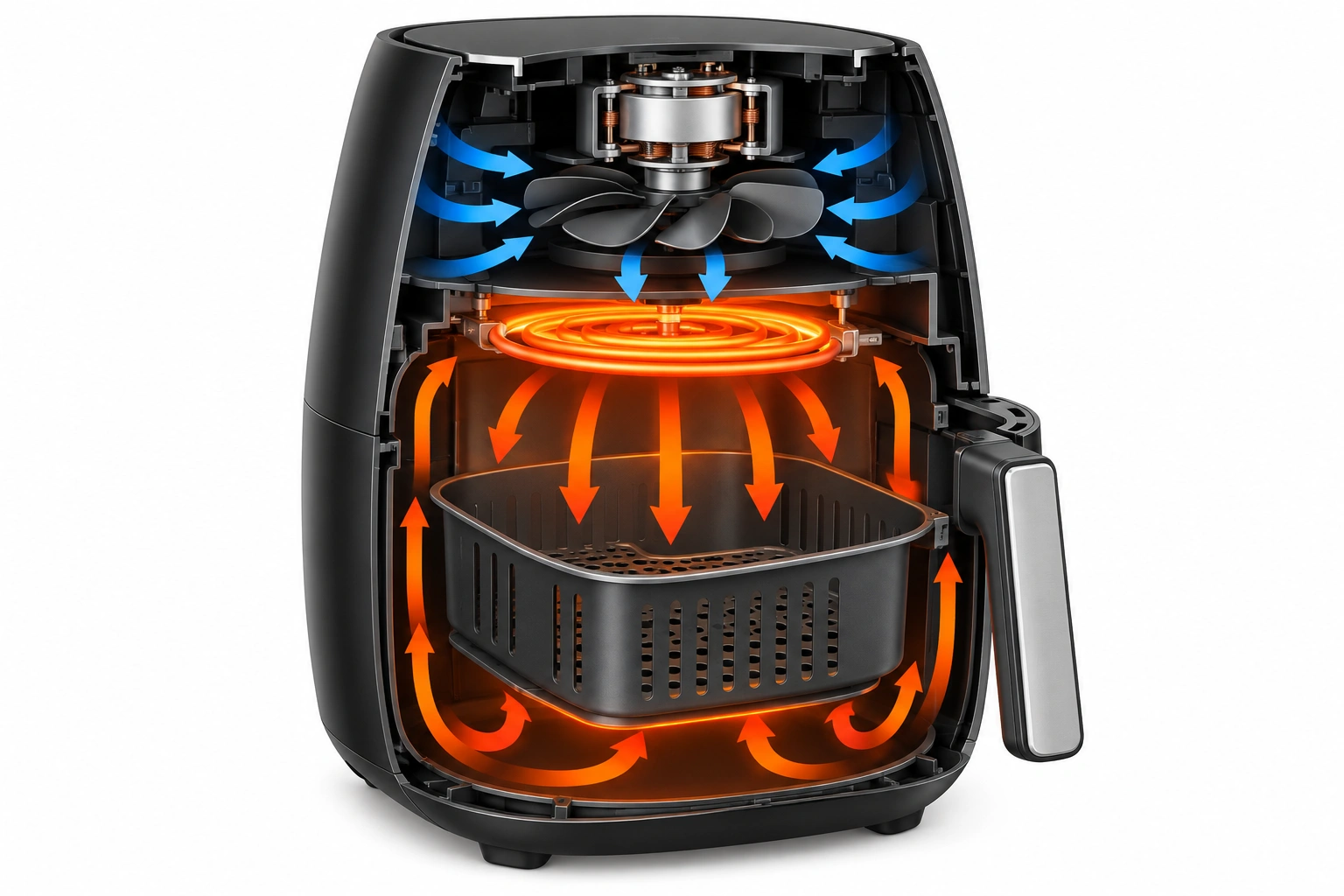
- Fan blades move the air.
- Fan motor spins the blades.
- Heating element warms the air.
- Control board tells the unit when to heat and run the fan.
- Thermal fuse may shut the unit down if it overheats.
If the fan slows down, sticks, or stops, the appliance may still power on, but the airflow drops. That often shows up as weak crisping, hot spots, longer cook times, or overheating inside the unit.
A useful comparison: if the heating element is the “oven,” the fan is the “delivery system.” Without airflow, the machine may still get hot, but it will not cook the way it should.
Signs the Fan Is Failing
Not every odd sound means the fan is broken. Some air fryers are naturally louder than others. But certain symptoms point more clearly to a fan problem.
Common warning signs
- Rattling or scraping sounds: often means a loose blade, debris, or a part rubbing inside the housing.
- Grinding or squealing: can point to worn bearings or a dry/seized bushing.
- Weak airflow: food cooks, but not evenly or not as crisp as usual.
- Intermittent spinning: the fan starts, stops, or works only sometimes.
- Overheating or hot exterior panels: can happen if airflow is restricted.
- Burning smell: a red flag for electrical trouble or overheated components.
A simple example: if fries come out pale on one side and darker on the other, the fan may be moving air unevenly. If the basket is still heating but the top of the food is not browning well, airflow may be reduced even though the unit still “works.”
A noisy fan can also be a clue. A brief hum at startup is normal on many models, but metal-on-metal scraping, repeated clicking, or a sound that gets worse over time usually deserves attention.
What Usually Causes Fan Problems
Most fan failures fall into a few categories. Knowing the likely cause helps you decide whether cleaning, repair, or replacement makes sense.
1. Food debris or crumbs
Tiny crumbs can get pulled into the fan area or settle near the blade path. That can cause rattling, scraping, or temporary sticking.
2. Grease and dust buildup
Over time, grease can harden around moving parts. Some repair guides describe seized bushings or bearings caused by heat-baked grease, which can make the fan hard to start or noisy once it does.
3. Loose wiring or connections
If the fan works only intermittently, a loose internal wire or connector may be the issue. That kind of fault is harder to spot without opening the unit.
4. Damaged fan blades
A bent or cracked blade can throw off balance and create vibration, noise, or poor airflow.
5. Worn fan motor
If the motor is aging, the fan may spin slowly, stall, or fail completely. In that case, replacement is often the only practical fix.
6. Thermal fuse or related safety component
If the unit overheats, a thermal fuse may interrupt operation. That does not always mean the fan itself is broken, but it often points to a deeper airflow problem.
Safe Checks to Do Before Opening the Appliance
Before you even think about screws or replacement parts, do the low-risk checks first. This saves time and keeps you away from unnecessary electrical risk.
A simple inspection sequence
- Unplug the air fryer.
- Let it cool completely.
- Remove the basket and tray.
- Look inside the cooking chamber for crumbs, foil, packaging, or loose food.
- Check whether anything is touching the fan area or blocking airflow vents.
- Inspect the power cord for damage.
- Smell for burning or melted plastic.
What to do next based on what you find
- If you find crumbs, grease, or loose debris: clean what you can safely reach, then test again.
- If you find a loose object or something visibly rubbing: remove the obstruction if it is accessible without opening the housing.
- If the fan still makes noise after cleaning: the issue is more likely mechanical, such as a bent blade or worn bearing.
- If the fan does not spin, starts only sometimes, or needs a tap to run: the problem may be motor-related or a loose internal connection.
- If you see melted wiring, scorch marks, or smell burning plastic: stop there and do not keep testing the appliance.
If your model has a clearly accessible fan area, you may be able to remove visible debris without opening the electrical housing. But if the obstruction is deeper inside, that usually means disassembly.
For food-safety and heating safety basics, it’s also worth following official guidance on safe handling and appliance use from sources such as FoodSafety.gov.
Can You Clean or Clear the Fan Instead of Replacing It?
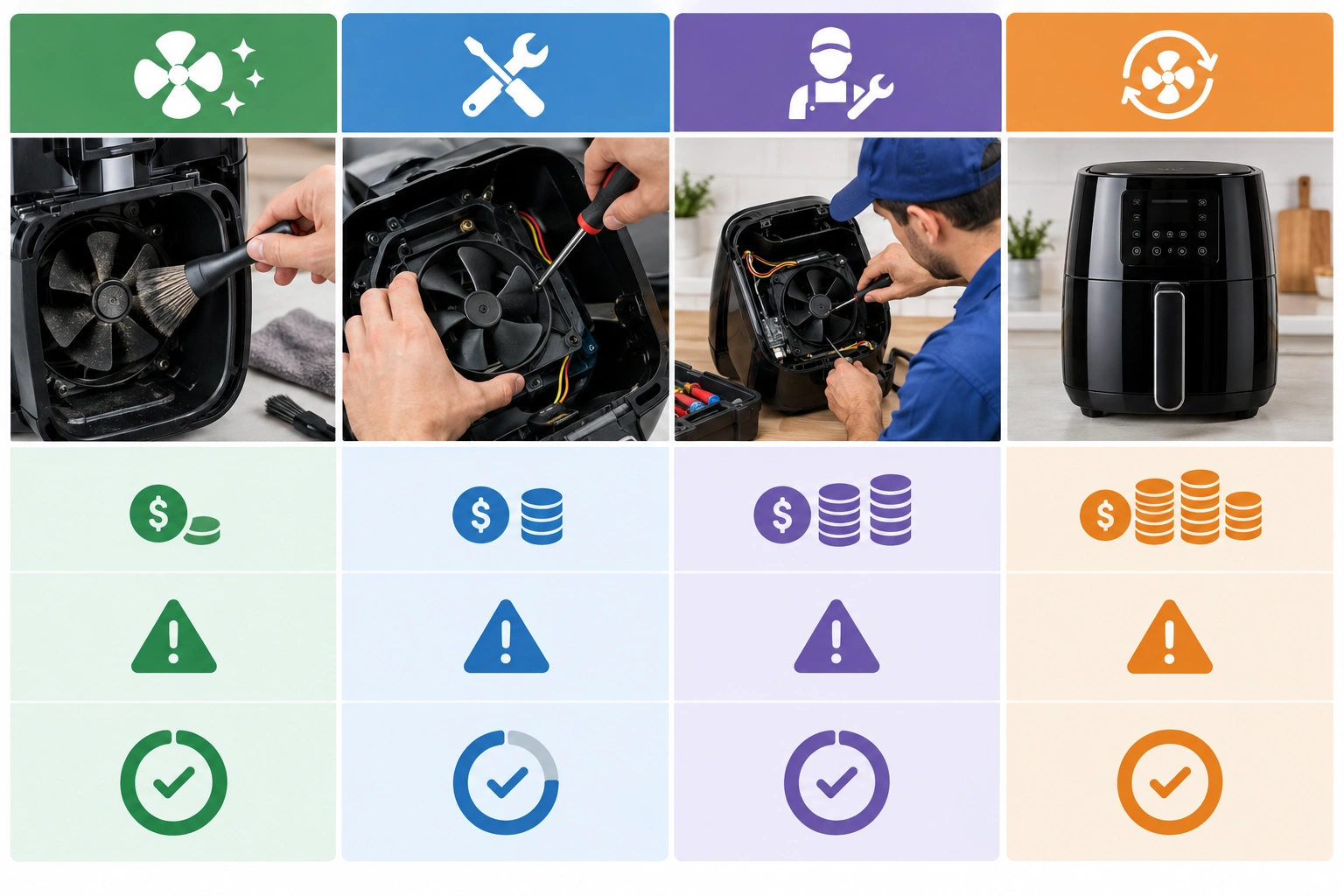
Sometimes cleaning is enough. In fact, it is usually the first repair worth trying because it is the least risky and least expensive.
Cleaning may help when:
- the fan is making a light rattling sound
- the unit seems weak but not dead
- the problem started after a messy cook
- airflow improved briefly after shaking or moving the unit
- there is visible buildup near vents or around the chamber
Cleaning is unlikely to help when:
- the fan motor does not spin at all
- the sound is a grinding noise from inside the housing
- the unit overheats even after thorough cleaning
- the fan starts only when tapped or tilted
- there is visible damage to the blade or motor shaft
A practical example: if a crumb or dried grease is rubbing against the blade, cleaning may completely solve the issue. If the fan spins freely by hand but still does not run under power, the problem is more likely electrical or motor-related.
Some repairers also talk about lubricating a seized bushing. That can work on certain models, but it is highly model-dependent and not a universal fix. If you are considering that route, check whether your exact model has a serviceable fan assembly first.
When a DIY Repair Is Realistic—and When It Is Not
A DIY repair makes the most sense when the problem is simple, visible, and low-risk.
DIY is more realistic if:
- the issue appears to be debris or grease buildup
- the fan blades are accessible and not damaged
- replacement parts are sold for your exact model
- the housing is serviceable and not fully sealed
- you are comfortable using basic hand tools carefully
DIY is usually not worth it if:
- the unit is still under warranty
- the fan motor is dead and parts are hard to source
- the appliance shows signs of heat damage
- the wiring looks brittle, melted, or charred
- the repair would require deep electrical troubleshooting
- the design uses a sealed or integrated fan assembly that is not realistically serviceable
A good rule: if the fix involves only cleaning, a loose connector, or a clearly replaceable fan assembly, DIY may be reasonable. If the repair moves into motor diagnosis, board testing, or hidden wiring work, the risk climbs quickly.
For readers who want a deeper troubleshooting walkthrough, this related guide on why your air fryer fan isn’t working covers symptoms and checks in more detail.
Tools, Parts, and Skills You May Need
You do not need a full repair shop, but you do need the right basics.
Common tools
- screwdriver set
- flashlight
- tweezers or small pliers
- soft brush or compressed air
- multimeter for basic electrical checks
- replacement screws if the originals strip
Common replacement parts
- fan motor
- fan blade
- thermal fuse
- wiring connector or harness
- replacement fasteners
A multimeter can help confirm whether a circuit has continuity or whether a fuse is blown, but it will not magically identify every fault. A motor can still fail mechanically even if it tests fine in a simple check.
Skills that help
- careful disassembly and reassembly
- reading a model number and parts diagram
- handling small connectors without forcing them
- knowing when to stop if the wiring looks unsafe
If you have never opened an appliance before, the biggest challenge is often not the repair itself but putting everything back together correctly.
Safety Risks and Warranty Considerations
This is the part that matters most. Air fryers combine heat, electricity, and compact internal parts. That means repair carries real risk.
Main risks
- shock risk if the unit is opened incorrectly
- burn risk if the appliance is not fully cooled
- fire risk if damaged wiring or overheating is ignored
- cut risk from sharp internal edges or fan blades
Also, opening the appliance may void the warranty. If the unit is still covered, contact the manufacturer first. That is usually the safest and cheapest path.
If you see repeated overheating, melted insulation, or a burning smell, do not keep testing the appliance “one more time.” That is the point to stop using it.
Repair vs. Replace: Which Makes More Sense?
This is where most people make the final decision. The question is not just “can it be fixed?” It is “should it be fixed?”
Repair makes more sense when:
- the air fryer is otherwise in good condition
- the fault is minor or clearly isolated to the fan
- parts are available at a reasonable cost
- the model is newer or a favorite to use
- the repair is simple enough to do safely
Replacement makes more sense when:
- the motor is failing and parts are expensive
- the unit has multiple problems, not just the fan
- the housing is sealed or difficult to service
- the appliance is old and replacement parts are scarce
- the total cost of parts and labor gets close to the price of a comparable new unit
A practical rule of thumb: repair only when the parts cost plus any labor stays well below the cost of a comparable new air fryer. If the repair starts approaching roughly half or more of a replacement unit’s price, replacement is usually the better value.
For many home cooks, the deciding factor is convenience. If the fryer is a basic model and replacement is straightforward, buying a new unit can be less frustrating than spending hours on a repair that may not last.
How to Find Compatible Replacement Parts
If you do decide to repair, compatibility matters more than price.
Check these details first
- Exact model number: look on the rating label, usually on the bottom, back, or side of the appliance.
- Serial number if needed: some manufacturers use it to confirm revisions or production runs.
- Mounting style: compare screw locations, bracket shape, shaft length, and blade clearance.
- Voltage: match the original motor or component rating exactly.
- Connector type: check the plug shape, pin count, and wire colors or positions.
- Blade size and shape: even small differences can affect fit and airflow.
Where to look
- the manufacturer’s parts store
- authorized appliance parts sellers
- reputable appliance parts marketplaces
- model-specific parts diagrams from the brand or parts distributor
OEM parts are the safest starting point, but they are not the only option. Aftermarket parts can work if the seller clearly lists your exact model and revision, and if the photos and measurements match your original part.
Before you buy
- compare the part number, not just the product title
- check the mounting holes and connector layout against your old part
- read the seller’s compatibility notes carefully
- confirm whether the part is for the same voltage and motor direction, if listed
- avoid parts that only say “fits many models” without naming yours
If a listing does not identify your exact model, treat it as a risk rather than a bargain.
When to Consult a Professional
A professional repair service is the better option when the problem goes beyond basic cleaning or part swapping.
Get help if you have:
- burning smell or visible heat damage
- melted wiring or connectors
- a dead fan plus other electrical issues
- repeated failures after a previous repair
- no confidence testing components safely
Professional service also makes sense if the appliance is expensive enough to justify the labor, or if the manufacturer offers a repair path that preserves warranty coverage.
The Bottom Line
Yes, an air fryer fan can sometimes be repaired, but the real answer depends on the failure. If the problem is debris, grease buildup, or a loose part, a careful cleaning or basic repair may solve it. If the motor is worn out, the blades are damaged, or the unit shows electrical or heat damage, replacement is usually the better call.
My practical rule is simple: clean first, inspect second, and repair only when the problem is clearly mechanical and the parts are easy to match. That approach keeps you from turning a small issue into a bigger one.
Frequently Asked Questions
Can an air fryer fan be repaired at home?
Sometimes. Cleaning, clearing debris, or replacing an accessible fan part may be possible at home. If the motor or wiring is involved, the repair becomes much more technical.
What causes an air fryer fan to stop working?
Common causes include crumbs or grease buildup, a damaged blade, a loose wire, a worn motor, or a thermal fuse issue.
How do I know if the fan motor is bad?
If the fan does not spin, starts only intermittently, makes grinding noises, or still fails after cleaning, the motor may be the problem. A multimeter can help with basic checks, but it will not catch every failure.
Can I lubricate the fan instead of replacing it?
On some models, a seized bushing may respond to lubrication, but that is not a universal fix. It depends heavily on the design of the fan assembly.
Is it safe to open an air fryer myself?
Only if you unplug it, let it cool fully, and the unit shows no signs of burning, melted wiring, or electrical damage. If anything looks unsafe, stop and contact the manufacturer or a technician.
Is it better to repair or replace an air fryer fan?
Repair is worth considering when the issue is simple and parts are available. Replacement usually makes more sense when the motor is failing, the unit is old, or the repair cost is close to a new air fryer.
Will opening the unit void the warranty?
It can. Check your warranty terms before disassembling the appliance.
Where can I get the right replacement part?
Use your exact model number and look for OEM parts or a manufacturer-approved parts source first. Generic parts are riskier unless the seller clearly lists your model as compatible and the mounting, voltage, and connector type match.
How long does a fan repair last?
That depends on the cause of the failure and the quality of the repair. A cleaned blockage may last a long time, while a worn motor replacement will only be as good as the part and installation.
What if my air fryer only makes noise but still cooks?
Noise can be the first warning sign of a fan problem. If the sound is new, gets worse, or comes with weak airflow or overheating, inspect it sooner rather than later.
Do all air fryers have replaceable fan assemblies?
No. Some models use sealed or integrated designs that are not realistically serviceable, which can make repair impractical even if the symptom seems minor.
What is the best first step if I suspect a fan problem?
Unplug the unit, let it cool, and inspect for crumbs, loose debris, or anything blocking airflow before opening the appliance.

