
Can Organizers for Pantry: How to Choose, Measure, and Set Up the Right System

A crowded pantry can make even simple cooking feel harder than it should. Cans get buried behind other cans, duplicates get bought by accident, and older food is easy to forget. A well-chosen can organizer solves the practical part of that problem: it puts canned goods where you can see them, reach them, and rotate them in a sensible order.
Used well, these organizers do more than tidy a shelf. They help you keep similar items together, make meal prep faster, and reduce the chance that a can gets lost at the back until it is no longer useful. The key is matching the organizer to your pantry space and the way your household actually cooks.
What a Can Organizer for Pantry Is and Why It Helps
A can organizer is any rack, tray, dispenser, or shelf insert designed to store canned food in a more orderly way than loose stacking. Some are simple tiered risers. Others use gravity so the next can rolls forward when one is removed. Some are pull-out systems that make deep shelves easier to use.
The real benefit is access. When labels face outward and cans stay grouped by type, you can see what you have before you open the pantry door a second time. That matters for weeknight cooking, but it also matters for waste reduction. If older cans are easier to spot, they are more likely to be used first.
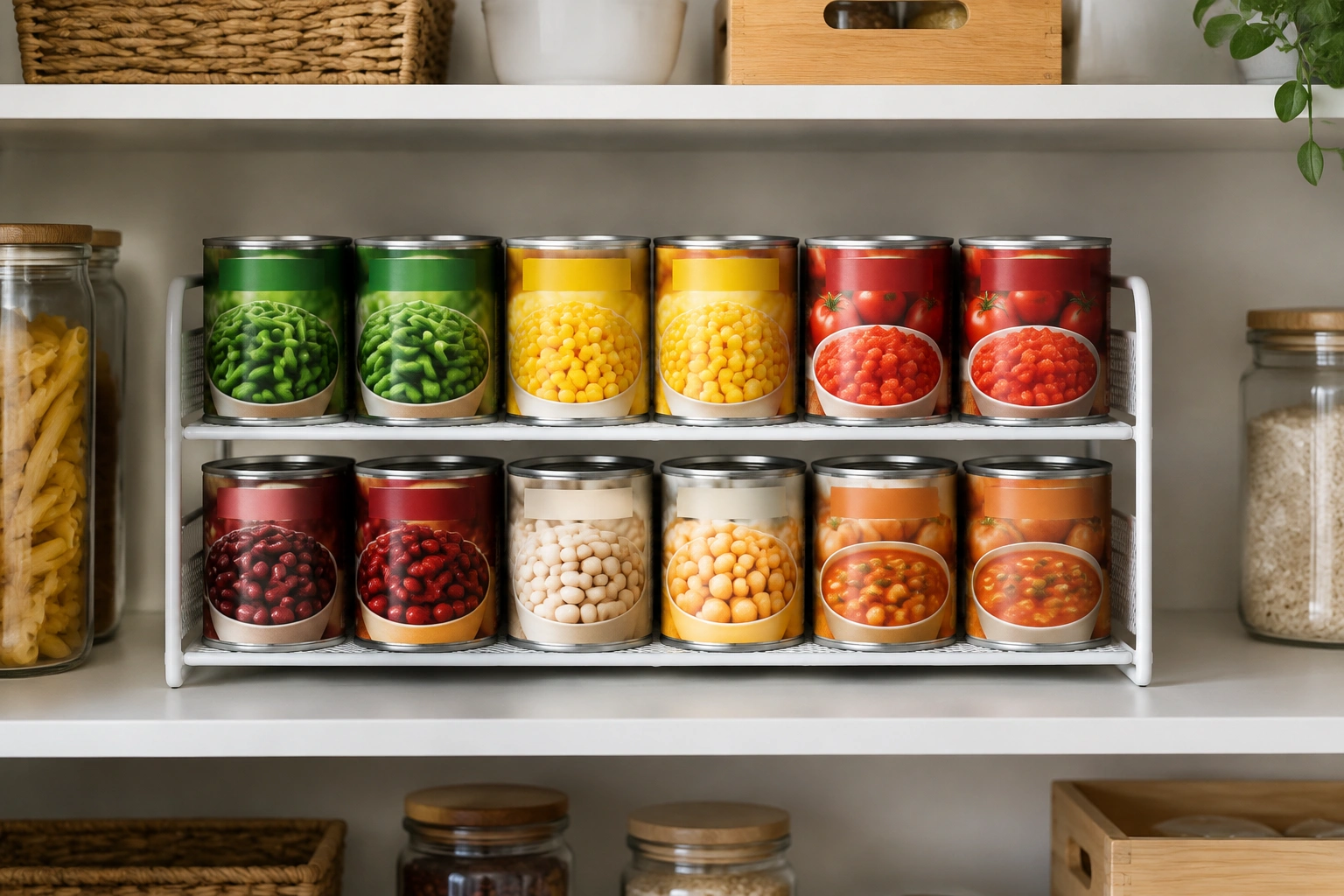
A practical setup should support FIFO rotation, short for “first in, first out.” In plain terms, the cans you bought earlier should be the ones you reach for first. That is easier when the organizer naturally brings the oldest stock forward or when you load new cans behind older ones on purpose.
There is one more reason these systems help: they reduce the “temporary pile” effect. Without a defined place, canned goods tend to spread across shelves, get double-stacked, and become harder to count. A can organizer gives those items a home, which makes inventory checks quicker before grocery shopping.
Choose the Right Can Organizer Type for Your Pantry
Different organizers solve different problems. The best choice depends on shelf depth, pantry size, budget, and how mixed your can inventory is.
Stackable can racks
Stackable racks are useful when you want to build upward without committing to a fixed installation. They work well in smaller pantries or on shelves with limited width. The trade-off is access: once you stack too high, the lower cans can become awkward to retrieve.
These are often best for households that store a moderate number of standard cans and want a simple, low-commitment solution. They are also easy to move if you reorganize the pantry later.
Gravity-fed organizers
Gravity-fed organizers are designed so cans slide or roll forward as you remove the front can. That makes them especially helpful for FIFO rotation because the next can is automatically pushed into the most visible spot.
They are a strong choice for busy families who want less manual reshuffling. The downside is that they usually need more specific can sizing and a more careful setup. If your pantry holds a mix of can heights or diameters, check compatibility before buying.
Tiered shelf organizers
Tiered shelf organizers are the simplest to understand. They lift the back row so you can see what is behind the front row. They are often the easiest budget option for people who mainly want better visibility without a more mechanical system.
Tiered shelves are a strong fit for small to medium pantries with a mixed but not extreme can assortment. They do not rotate cans for you, but they make labels easier to see, which is often enough for everyday pantry use.
Pull-out organizers
Pull-out systems are useful for deep shelves where cans at the back are otherwise hard to reach. Instead of reaching around the front row, you slide the organizer out and access everything more easily.
These tend to be the most convenient for deep pantry shelving, but they can cost more and may require more clearance. If your shelves are shallow, a pull-out unit may waste space rather than save it.
Quick decision guide
- Very small shelves or a tight budget: choose a tiered shelf organizer or a simple stackable rack
- Deep shelves with enough clearance: choose a pull-out organizer
- Frequent use, standard-size cans, and a need for easy FIFO rotation: choose a gravity-fed organizer
- Mixed can sizes or a flexible setup: choose a tiered shelf organizer or separate organizers by can type
Quick comparison
| Organizer type | Best for | FIFO help | Shelf fit | Can compatibility | Installation | Cost tendency |
|---|---|---|---|---|---|---|
| Stackable rack | Small spaces, flexible storage | Moderate | Good for narrow shelves | Best with standard cans | Usually none | Lower |
| Gravity-fed organizer | Frequent use, rotation | Strong | Needs careful fit | Often size-sensitive | Usually none or minimal | Moderate |
| Tiered shelf organizer | Visibility, simple setup | Moderate | Works on many shelves | Usually flexible | None | Lower |
| Pull-out organizer | Deep shelves, easier reach | Strong | Needs depth and clearance | Depends on design | Sometimes more involved | Moderate to higher |
Measure Your Pantry Shelf Before You Buy
Measuring first prevents most buyer’s remorse. A can organizer that is too deep will block the shelf behind it. One that is too tall may hit the shelf above. One that is too wide may leave unusable gaps or simply not fit.
Measure three things:
- Width: the usable space from side to side
- Depth: the usable space from front edge to back wall
- Height clearance: the space from shelf surface to the shelf above
Then compare those numbers with the organizer’s outer dimensions, not just its advertised capacity. Capacity tells you how many cans it can hold, but not whether it will fit your shelf with enough room to use it comfortably.
A useful rule: leave a little breathing room if you can. If a rack fits only when it is jammed tightly between shelf supports or the back wall, loading and unloading may become annoying fast. In real kitchens, convenience matters as much as fit.
If your pantry shelves are adjustable, measure again after you decide which shelf will hold the cans. A few inches of clearance can determine whether a pull-out unit works or whether a simpler tiered shelf is the safer choice.
Check Can Size Compatibility and Storage Capacity
Not every organizer handles every can well. Standard soup and vegetable cans are usually easier to store than tall specialty cans, but mixed can sizes are common in real pantries.
The most reliable approach is to sort your cans into groups before buying:
- standard cans
- taller cans
- wider cans
- specialty or odd-shaped cans
If your pantry mostly stores one can size, choose an organizer that is built for that size range. If you keep a mixed inventory, a flexible tiered shelf or a separate organizer for each can category may work better than a single rigid dispenser.
Capacity claims should be treated carefully. For example, one expandable bamboo can rack product page says it holds up to 24 standard canned drinks or foods, but that number applies to that specific design, not to every organizer. Always check whether the stated capacity refers to standard-size cans only, because taller or wider cans can reduce the real-world count.
A few practical capacity examples can make shopping easier:
- Tiered shelf organizers: often work well for a small to medium set of cans, roughly a single category or two on one shelf
- Stackable racks: often suit a modest pantry load and may hold a few rows of standard cans, depending on shelf width and height
- Gravity-fed organizers: commonly work best when filled with one can size and a limited range of shapes, rather than a mixed pantry
- Pull-out organizers: often make the most sense for a deeper shelf where you want to store a larger active inventory without losing access
A deeper truth here: capacity and usability are not the same thing. A rack that holds more cans may also make the back row harder to see or reach. If your household uses canned goods often, a slightly smaller organizer that keeps labels visible may be more useful than a larger one that turns into a storage cave.
Tools, Materials, and Setup Checklist
Many pantry can organizers need no tools at all. Others require basic assembly. DIY systems may need plywood, screws, a saw, and measuring tools.
Before you begin, gather:
- the organizer and all included parts
- a tape measure
- a level if the shelf is uneven
- labels or masking tape for grouping cans
- a soft cloth for cleaning the shelf
- a screwdriver if assembly is required
If you are building or modifying a unit, check the weight support of the shelf itself. Full cans add up quickly, and the shelf must support both the organizer and the load. If a shelf already flexes under stored goods, a heavier organizer may not be the best choice.
How to Set Up a Pantry Can Organizer Step by Step
- Empty the shelf completely. You need a clear view of the space and a chance to clean crumbs or sticky spots.
- Measure the space again. Confirm width, depth, and height before placing anything.
- Assemble the organizer on the floor or counter. It is easier to fix a problem before the unit is packed with cans.
- Test the fit empty. Slide or place it on the shelf and make sure doors, trim, or shelf lips do not interfere.
- Load cans by category. Put like with like: soup with soup, beans with beans, tomatoes with tomatoes.
- Place older stock first. Put earlier purchases where they will be most visible or easiest to reach.
- Check stability. Give the unit a gentle push and make sure it does not wobble, tilt, or jam.
- Label if needed. If cans are hard to read from the front, add simple shelf labels or category tags.
If the organizer uses gravity, load it according to the manufacturer’s direction so the feed mechanism works correctly. If it is a tiered shelf, place taller cans where they do not block the labels behind them.
How to Arrange Cans for Visibility and FIFO Rotation
The simplest rotation system is also the most reliable: new cans go behind older cans, or into the back of a gravity-fed unit, while older cans stay in the front. That keeps your pantry aligned with FIFO without requiring a separate inventory notebook.
Group cans by meal use, not just by product type. For example, you might keep:
- beans together
- tomatoes together
- tuna and other proteins together
- soups together
- vegetables together
That makes meal planning faster because you can scan one category at a time instead of searching the whole shelf.
If you buy in bulk, consider using one organizer for everyday cans and a second one for less-used items. A simple rotating tray can also work well for occasional ingredients that you want visible without dedicating a full rack to them.
For mixed can sizes, do not force everything into one rack if the fit is awkward. Separate organizers are often easier to use than one overloaded system that makes every can harder to reach.
Best Placement Tips for Small Pantries and Deep Shelves
Small pantries benefit from systems that use vertical space without blocking access. A stackable rack or tiered shelf can work well on a narrow shelf where a pull-out unit would be too bulky. Keep heavier cans on lower shelves when possible so the pantry stays stable and easier to load.
Deep shelves usually need a different strategy. If the back row disappears from view, a pull-out organizer can be worth the extra cost because it turns hidden cans into reachable cans. If you do not want to spend that much, place a tiered shelf toward the front and reserve the back section for backup stock.
For very tight spaces, one useful trick is to dedicate a single shelf to canned goods and avoid mixing cans with unrelated pantry items. That prevents the shelf from becoming a catch-all zone where rotation breaks down.
Common Mistakes to Avoid
The biggest mistake is buying before measuring. The second is assuming all cans are the same size. A rack that works for standard cans may be frustrating for taller ones.
Other common problems include:
- overloading the organizer beyond what it was designed to hold
- placing labels against the wall where you cannot read them
- mixing too many can sizes in one unit
- choosing a system that is hard to reach, so you stop using it
- ignoring shelf strength when the organizer and cans are heavy
A pantry organizer only helps if it stays easy to use. If you have to move three items to get one can, the system is too complicated for daily life.
Troubleshooting: When Your Can Organizer Does Not Work Well
If the unit wobbles, check whether the shelf is level and whether the organizer is sitting flat. If it still shifts, the problem may be the shelf itself, not the rack.
If cans jam in a gravity-fed system, look for mixed can sizes or overfilling. These organizers often work best when loaded with the can size they were designed for.
If you cannot see what is inside, raise the organizer slightly or switch to a tiered design that exposes more labels. If you keep reaching for the wrong can, add category labels to the shelf edge.
If the organizer feels too hard to use, simplify it. A less elaborate system that gets used every day is better than a more impressive one that becomes a nuisance.
Can Organizer Material and Design Trade-Offs
Plastic organizers are usually lighter and often less expensive. That makes them a good fit if you want a budget-friendly option or expect to move shelves around. The trade-off is that lighter materials may feel less rigid under a heavy load, especially on a deep shelf with many cans.
Metal organizers tend to feel sturdier and may handle heavier loads more confidently, but they can also weigh more and cost more. They are often a better choice for households that buy in bulk or want a system that feels more permanent.
Bamboo or wood-look organizers can be attractive and sturdy enough for everyday pantry use, but they may sit in the middle on price and weight depending on the build. They are often chosen as much for appearance as for function.
Freestanding organizers are easier to install because they usually do not require mounting. Mounted or built-in designs can save space more effectively, but they are less flexible if your pantry layout changes.
Countertop units are convenient for items used daily, but they consume valuable prep space. Pantry-shelf units usually make better use of storage space, especially in smaller kitchens.
Are Can Organizers Worth It?
They are worth it when one of three things is true: your cans are getting lost, your shelves are too deep to use comfortably, or you are buying duplicates because you cannot see what you already have.
A simple decision framework helps:
- If you need better visibility, choose tiered shelving or a lazy Susan.
- If you need rotation help, choose gravity-fed.
- If you need easier reach in deep shelves, choose pull-out.
- If you need low cost and flexibility, choose stackable.
For a small pantry, a basic tiered shelf or stackable rack is often enough to make a noticeable difference without much spending. For a bulk buyer or meal prep household, a more structured system can be worth the money because it keeps high-turnover cans visible and easier to rotate. If you only keep a few cans on hand, the simplest organizer that fits your shelf is usually the best value.
For a busy household, the value is not just neatness. A usable pantry can make meal prep more efficient and grocery shopping more streamlined, which is exactly what matters when time and budget are both limited.
Practical Pantry Examples
A small apartment pantry with mostly soup and vegetable cans might do best with a compact stackable rack or a tiered shelf organizer. That keeps the cans visible without taking over the whole shelf.
A family pantry that buys beans, tomatoes, and broth in larger quantities may prefer a gravity-fed unit for the most-used items and a separate shelf for overflow stock. That keeps the active inventory easy to reach.
A deep pantry shelf with mixed cans often works best with a pull-out organizer for everyday items and a rotating tray for odd cans or occasional ingredients. This split approach is often more practical than forcing one system to do everything.
When to Ask a Food Safety Expert
If you are unsure whether a can is damaged, bulging, leaking, or otherwise unsafe, do not rely on storage organization to solve the problem. When in doubt, follow current food safety guidance from FoodSafety.gov or your local extension service, especially if you are sorting older pantry stock.
Final Takeaway
The best can organizer for your pantry is the one that fits your shelf, matches your can sizes, and stays easy enough to use every day. Measure first, choose the simplest design that solves your actual storage problem, and set it up so older cans stay visible and reachable. That is the combination that saves space without creating a new chore.
